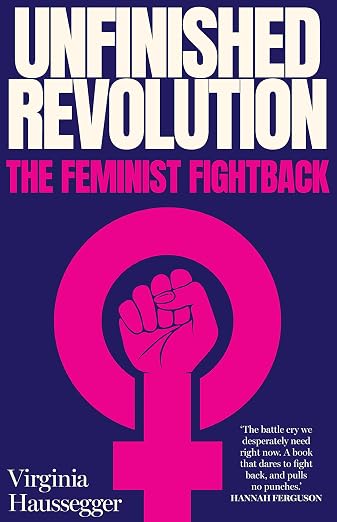
This is my second reading group book review in a row, which shows just how behind I still am. Vincenzo Latronico’s Perfection (my review) was our August meeting book. That meeting was the night before we left for Europe and I didn’t get to write it up until our return. Haussegger’s Unfinished revolution was our end-of-September book. I was in France, and completely engrossed in travel, so I didn’t read it then. However, I try to read all our reading group books, if I can. It took me a while to get to it after our return, due to immediate busy-ness and a bout of Influenza A, but I did it!
Virginina Haussegger may not be known to many of you – perhaps even not to all Australians. She lives in Canberra, and Wikipedia describes her as an “Australian journalist, academic advocate for gender equity, media commentator and television presenter”. She presented Canberra’s local ABC News from 2001 to 2016. Unfinished revolution is her second book. I read her first, Wonder Woman: The myth of having it all, but that was before blogging, and I admit to not loving it, because I didn’t agree with her underlying premise. I understand that Unfinished revolution engendered a rather lively discussion in my reading group, but I wasn’t there, so I can’t report on that unfortunately.
I’m going to start, instead, with a little background and reflection. I was coming into adulthood during the Feminist Second Wave, or what we called the Women’s Liberation Movement back then. On 8 May 1970, Kate Jennings delivered a powerful fighting-words speech on the lawns of Sydney University, during a Vietnam moratorium rally. It is generally seen as marking the beginning of the movement in Australia. Women were fed-up with being treated as second-class citizens by their male activist colleagues. I am around a decade younger than most of the leaders of that movement, but I was following closely. I read Germaine Greer’s The female eunuch at this time, and through the 80s I subscribed to Ms Magazine. As family life and career got busy, I read less, but my concern remained.
So, here’s my reflection. As we moved into the 1990s and early 2000s, I became increasingly troubled that younger women were dropping the ball, that they were feeling it was all done, and could live off the benefits. Older women were still active, often unseen, but it felt like younger women didn’t see much point. And then the 21st Century really hit. By the 2010s, it was clear all was not hunky-dory. In 2012, we had Prime Minister Julia Gillard’s Misogyny Speech, which ricocheted around the world, and later in the decade the MeToo movement happened. “Domestic Violence” (whatever we call it) moved out of the of the home and into the courts, meaning it was recognised as a crime not “just a domestic”. Coercive control started to be talked about. Women were waking up.
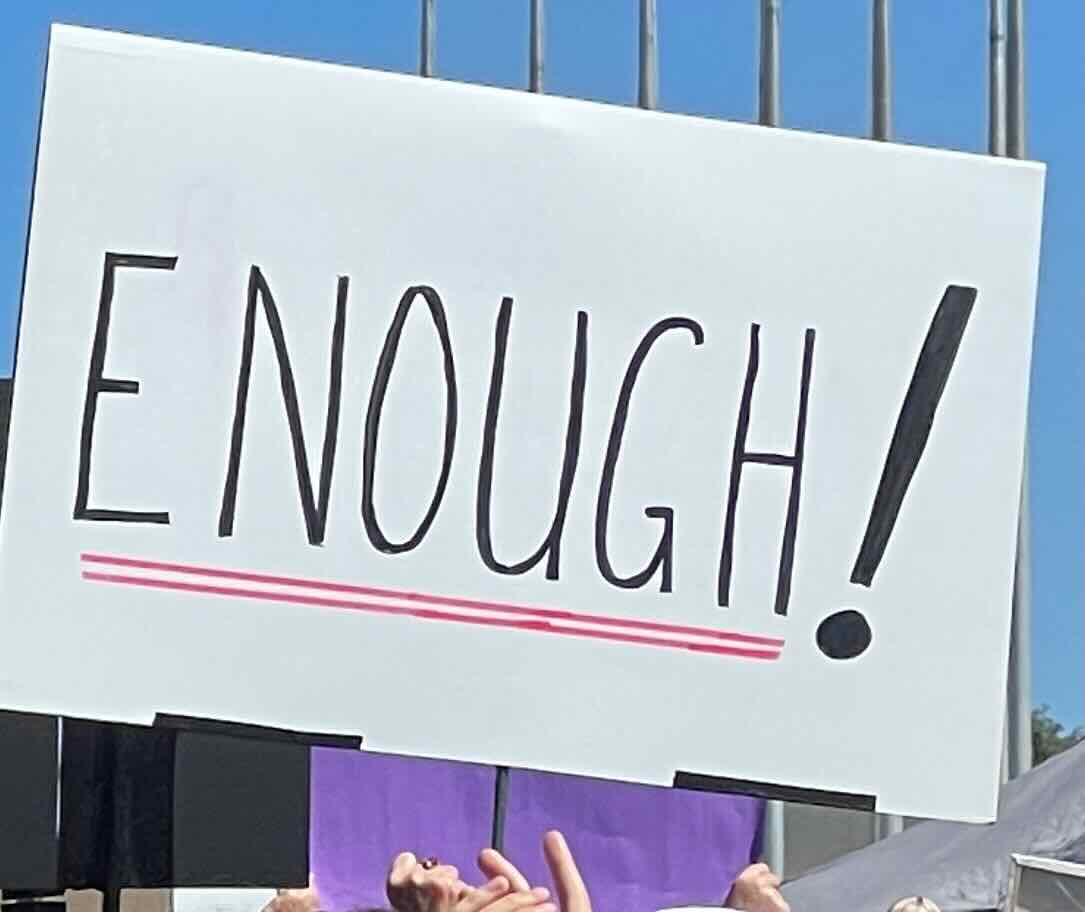
This is where Haussegger’s Unfinished revolution comes in. She takes as her starting point the March 4 Justice protest which happened on 15 March 2021. It comprised a series of protests at 55 locations across Australia – I attended the Canberra one – and involved around 150,000 people. Yet, writes Haussegger, not one arrest was made. (Just think about that.)
Haussegger does something that feels counter-intuitive in this book. She works backwards from this 2021 protest, and “Our New Now” of the mid-2020s, to the 1970s and those Second Wave feminists. It felt right, she said, and then she found something British feminist theorist, Juliet Mitchell, had said at a women’s conference in Canberra in 1975. Mitchell believed women needed to unpack “why they were oppressed”, and argued that such investigation should “start with the present and work backwards” rather than vice versa (p. 388). Does this work? We’ll see. I certainly enjoyed reading this one.
In her Preface, “A fightback: Why Now?”, Haussegger explains what she is doing and why. What she is doing is exploring an over-riding question, with the why embodied in that question:
how do we regroup collectively in the face of the biggest, ugliest, vilest and most vicious backlash against women sweeping the globe right now? (p. 14)
But there’s another “what”, too, as in, what sort of work she was writing. She also answers this:
the conclusions I draw are those of a subjective journalist. I make no claim to objectivity here. Nor is this a book of history. I am not an historian. My feminist anger and angst, along with my willingness for a fight, are all personal responses. Writing about feminism is always fraught. (p. 19)
“Revolution is our only option”
Unfinished revolution, then, is not, technically, a history, and it is not objective, but this doesn’t make it an ill-informed rant. Haussegger might be a “subjective” journalist, but she is still a journalist and she undertook significant research – in libraries and archives (printed and audiovisual), and through interviews and conversations with participants from the last 50 plus years of feminist action. Whether you agree with her conclusions or not, this is a thorough piece of work focused on women’s experience. It is not “balanced” journalism or detached academic writing. It is a call to action, inspired specifically by the idea that, as the UN Secretary-General, António Guterres, put it in 2025, “Power is not usually given. Power must be taken”. (p. 33)
For this reason, Haussegger’s prime focus is not the reformers, though they get some due, but the revolutionaries, that is, the rebels and radicals. These are the women who see the big picture, not just that we haven’t achieved equal pay yet, for example, or that to engage in the workforce women needed childcare as was a major goal in the 1970s, but that what women are fighting is something more systemic. Gaining rights – as we have seen (Roe vs Wade, anyone?) – is shaky if the beliefs and values, and the structures supporting these, have not changed. One thing Haussegger’s working backwards does show is that some fundamental things have not changed. Here is where I should bring in Elizabeth Reid.
For those who haven’t heard of her, in 1973 at the age of 28, Elizabeth Reid became the world’s first adviser on women’s affairs to a head of government. Haussegger’s focus on her – not only her achievements but the quality of her thinking, her grasp of the critical issues, and her political nous – is one of the triumphs of the book. Reid’s resignation in 1975 was a tragedy for the movement. She saw that
We can no longer delude ourselves with the hope that formal equality, once achieved, will eradicate sexist oppression … there is a real danger, a very real danger, that satisfaction with the achievement of formal equality will encourage the belief that all problems are thereby solved (p. 234).
In recognising this, she was, says Haussegger, “ahead of her time”, because current debates centre on this very thing, on “the direct danger of using equality as the key measure”. Essentially, the argument is that equality measures “do nothing about changing fundamental attitudes and beliefs. They have little or no impact on the deep-seated sexism that fuels belief in male superiority and continues to empower patriarchy”. (p. 234) In other words, “the core problem remains: the dominant presence of sexism that is deeply embedded in our social and cultural norms, directing our behaviours and responses.” (p. 235)
Reid knew how women fit themselves into smaller, enfeebling spaces, and that this could not be captured “in gender analysis, or through pro-diversity or pro-equality initiatives”. She saw that focusing on access and opportunities does not “reach anywhere near the social and psychological condition that marks the lives of women more profoundly than those of men.” She recognised that transformation of society – that is “changing how women and men thought about gender and sex-role stereotypes, while identifying how sexism entraps and oppresses – was pivotal to Australia’s agenda.” (p. 279)
Working back to this history and these insights reveals some profound truths, which is that what Reid recognised 50 years ago is still true today. We have “achieved” more rights, we have more women in politics, more women in senior positions throughout the workforce, and so on, but the backlash we are experiencing now shows that we have barely begun to transform the way society thinks, and therefore works.
Several threads weave through Haussegger’s book. One, of course, is the idea of power – and women’s lack of it. It absolutely underpins women’s struggle to be heard and taken notice of. Another is the role of media – and don’t we know it. The book is worth reading just for Haussegger’s analysis of the media. A third thread is the idea of the sisterhood, which encompasses many ideas including non-hierarchical organisation, and the willingness to work collectively across individual political, cultural, religious, etc, differences for a greater cause.
In 2017, the still-working, still-provocative Elizabeth Reid gave the keynote address at a symposium at the Australian National University. She said:
Why does such a movement seem so anachronistic today? Have we moved away from the radical feminist discourse of ‘liberation’ and ‘revolution’ to a more ‘acceptable’ language of ‘diversity’ and ‘equality’? What happened to this social movement? Don’t women need liberating anymore? (from “How the Personal Became Political: Re-assessing Australia’s Revolutions in Gender and Sexuality in the 1970s”)
We know that patriarchy is feeling threatened, that “Team Backlash has been emboldened”, but March4Justice, MeToo, and the appearance of fearless women like Grace Tame, Brittany Higgins, and Chanel Kontos, are evidence that “we can do this”. Haussegger concludes:
In a world in which power is not given but taken, revolution is our only option. It starts with courage and is fired by collectivism.
It’s time.
Unfinished revolution is an unabashedly polemical book – but well worth reading, particularly if you are sitting on the fence.
Virginia Haussegger
Unfinished revolution: The feminist fightback
Sydney: NewSouth, 2025
425pp (incl. extensive footnotes, and index)
ISBN: 9781761179327 (eBook)

