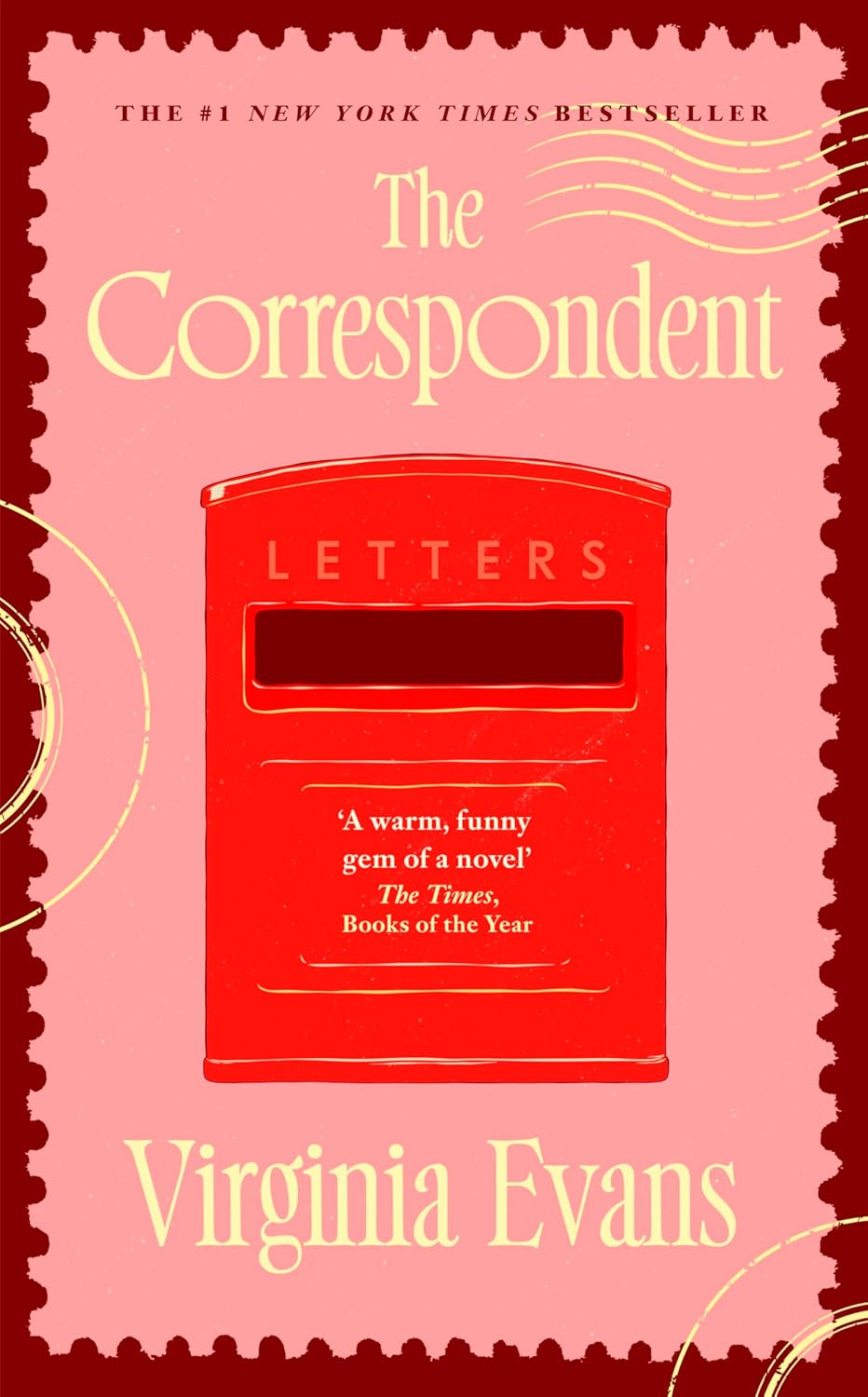
After two books in a row which incited rather lively debate, my reading group’s October read, Virginia Evans’ 2026 Women’s Prize winner, The correspondent, was liked by us all. This doesn’t mean, however, that our ideas aligned perfectly on all points. Indeed, we found much to discuss besides just sharing what we liked!
I know I’m late to the blogosphere with this book. I wanted to read it, but I was hoping my reading group would schedule it because it seemed just right for us, given we are all in the vicinity of protagonist Sybil Van Antwerp’s age. As most of you know, The correspondent is an epistolary novel. It spans ten years, from 2012 to 2022, and includes letters, emails, and various other documents, shared between Sybil and not one, but various correspondents, who range in age from 11-year-old Harry (at the beginning) to people in her own age-group. These include family, friends, ex-colleagues and neighbours, but she also writes to authors, like Joan Didion, Ann Patchett and Larry McMurtry.
“The clerkship was my job; the letters amount to who I am”
So, who is Sybil? By the time we meet her she is 73, and has been retired for some time. She has settled down to her quiet, somewhat self-contained life, living in the house in Annapolis, Maryland, that she has lived in for years. She has an adult daughter (living in London) and son (living nearish-by). A third child, another son, died in a diving accident when he was 8. She got on with her life, but the pervading grief has had an ongoing impact on her life. Nonetheless, she had a long, successful career as a lawyer and judge’s clerk, but now she does what she has loved doing since she was a child, writing letters, which she does four mornings a week. Early in the novel, however, she starts receiving some disturbing letters from an angry someone from her past. This and some other events force her to confront some truths about herself that she has been suppressing.
I found the novel an absorbing read. Evans’ decision to use multiple correspondents means that we get to understand Sybil’s character because we see her through many different eyes – and not only the eyes of others but her own different eyes! In other words, Sybil, like most of us, can present herself a little differently depending on the recipient. Evans captures well the way we can tweak our story for different people, perhaps telling the real truth to those we trust or who know us, and a different version to others. Sybil is warm, intelligent and kind, but can also be acerbic, impatient and rather inflexible. So, which is the real Sybil? Perhaps it’s the Sybil who is writing the “still unsent” letter that she has been writing for years, a letter in which she often admits things that she can’t – or doesn’t always – tell others.
Consequently, The correspondent kept me on my toes as I tried to unravel just who Sybil was. As the letters progress, more is revealed about her life, character and relationships. We learn that she and her brother were adopted, that she had a good marriage until that tragic death of her son, that she had chosen to be a judge’s clerk rather than continue with what had been her own successful legal career, and that she loves gardening and reading. She has a close, warm relationship with brother Felix, friend Rosalie, and young Harry, but her relationship with her daughter is fraught and prickly, as it is with the secretary of her garden club. She is not particularly welcoming to her kind neighbour, Theo, who leaves little messages and gifts for her. She is quick to reject opportunities – from potential suitors to finding out about her origins – than to open herself to change. Why? Well, there’s that disturbing letter … it provides the impetus for Sybil to reassess her life, to confront an error she’d made – and, importantly, why she made it.
The novel explores many of the issues you might expect in a long life – grief, guilt and remorse, motherhood, aging, loneliness – and health! At the beginning of the novel, Sybil tells us that she is going blind, something that is subtly metaphorical of her personal blindnesses. The irony, though, is that she is going blind just as enlightenment seems possible.
Another irony relates to her correspondence. Sybil prefers to write to people, than deal with them in person. She is her letters, they are the “mainstay” of her life. But, while letters can and do play a role in unearthing truths and repairing relationships, they can also do the opposite. For example, an ongoing battle with an academic, who refuses to let her continue auditing a literature class, is resolved when they meet face-to-face. Sybil sees what this woman is dealing with, and warms to her humanity. More significantly, when it comes to sharing a critical truth with her dying ex-husband, who asks her to write to him, she cannot write that letter. So, while this novel is, in one sense, a love letter to letter-writing, it also recognises its limits.
My reading group agreed on most of this. For all but one of us, Sybil’s crotchetiness was reminiscent of Olive in Olive Kitteridge (my review). The outlier was the one who did not like Olive! We felt Evans got Sybil’s feelings down well, despite making Sybil seem older than ourselves and other septuagenarians we know. Still, we could all relate to
“That amazement one feels at this stage of life – a sort of astonishment that is also confusion, which leads to a sort of worry, or a sort of fear, I guess. How did we get here? How can it be?” (p. 7, to Ann Patchett)
Nonetheless, there were points of difference. Some questioned whether the attraction to Mick was realistic, while others saw it differently. Some found it a bit hard to keep track of the characters, while others liked how the epistolary style made it easy to keep track of time, but the main bone of contention concerned …
the ending.
Although we all liked the book, some did think it was just too neatly wrapped up. I don’t want to spoil the book so won’t go into details, but will just say that several of the issues that were bothering Sybil or holding her back were resolved. However, others of us felt that while there was some wrapping up, it wasn’t all that neat or complete. I see Sybil as an everyoldwoman. She has lived a full life, and had some great achievements, but she also made mistakes, some with devastating consequences. As her life draws near its final chapters, she is forced to confront some of them. Those she can repair she does, but there are things that aren’t – and, in fact, can’t be – resolved. That to me is a realistic ending, not a neat, tied-up one.
Late in the novel, Sybil writes to the author Larry McMurtry about his famous novel Lonesome dove. She tells him how on her first read she felt it was a book about a “disappointment … wretched bitter disappointment”, when she was looking for “assurances that there was still reason for hope”. However, on her later reading she saw something different, that the ending
was courageous because it was unbearable but it was true, and YET, Mr McMurtry. AND YET. Here was something I had not taken pains to see, but for which I was now looking, indeed hoping to find (as I am hoping to find in my own life): this GREAT VITALITY. Augustus and Call, full to overflowing with the meaning of life they had made.
This is the Sybil we see at the end, someone who can never, really make amends for some big mistakes she made but someone who kept on trying. This is a book about life, warm-hearted but real. And, it is also about reading, deep reading. Recommended.
Many other bloggers have read this book before me, including Brona (This Reading Life), Cathy (746 Books), and Rach (Yarra Book Club)
Virginia Evans
The correspondent
London: Penguin, 2026 (Orig. Pub. 2025)
271pp.
ISBN: 9780241721278 (eBook)

