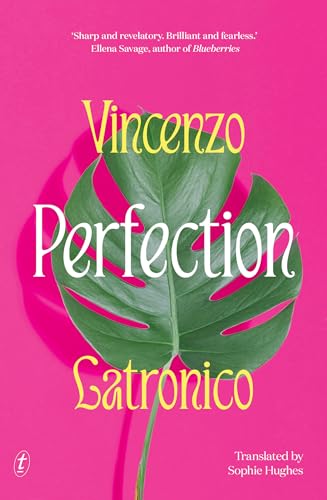
Italian author Vicenzo Latronico’s Perfection, which was shortlisted for the 2025 International Man Booker Prize, was my reading group’s August book. It was my suggestion, for three reasons: I like for us to read at least one translated book a year (which we don’t always achieve); I’d seen a few bloggers in my circles review it; and its protagonists are millennials which is our children’s generation. Additional factors in its favour were that it’s a novella – call me shallow, if you like – and it is published in English by Australia’s Text Publishing.
The sad thing is that I planned to write this review before we went to Europe at the end of August, and schedule it to post while we were away, but, as with Jessie Fauset’s short story, “Mary Elizabeth” (my review), that didn’t happen. It’s now two months since I read the book, and I fear I may have lost all my engaged thoughts, but I’ll give it a shot.
Perfection concerns a young expat millennial couple, Anna and Tom, who, says the book’s promo, “are living the dream in Berlin, in a bright, plant-filled apartment”. It is the 2010s, and they see themselves as “cool digital creatives” who “enjoy slow cooking, Danish furniture, progressive politics, sexual experimentation and the city’s twenty-four-hour party scene”. Gradually, however, this perfectly curated life starts to pall. It all becomes somewhat performative, and without meaning. Friends move away, have children, grow up, which, perhaps, they never quite do. Whatever the reason – and Anna and Tom don’t seem to always know, which says something about the quality of these “friendships”- it forces them to make some changes.
Before I continue, I should say a little about the overall style. For a start, with only a couple of exceptions, Anna and Tom are never differentiated, they are just Anna-and-Tom. There could be a few reasons for this, but practically it means we focus on their journey rather than on them personally. They operate, in other words, more as types (archetypes) of their generation, which leads me to talk about tone …
I’ve read a few blog commentaries, and found some very different readings of the tone, ranging from those calling it bitter satire to those not thinking it’s satirical at all. I’m in the middle – are you surprised? In my “first impressions” statement to my reading group I described it as a curious, quietly or lightly satirical book that read like a modern fable or cautionary tale. I was completely engrossed by its tone which I found dispassionate, knowing, sometimes wryly humorous, sometimes satirical. I found it more kind than bitter. Latronico is of this generation, and I don’t think his aim was to skewer them as to look at the gap between what they hoped for and the reality that panned out.
So, how did it go in my reading group? Well, there were strong differences of opinion. Three or four really didn’t like it because they couldn’t buy the characters who, they argued, had no character development, whereas – as you will have guessed by now – I proposed that these aren’t characters you “buy”. They read more like representatives of a lifestyle. Other members were more mixed, and then there were the few of us who loved the novel for its commentary and completely different tone. We differed about our reading of its ending, too. Overall it was one of those lively meetings, in which we all tried to explain feelings and reasons to others who felt the exact opposite.
“taming reality to make it fit the images”
Interestingly Latronico has Anna-and-Tom choose an expat life, which amplifies the generational story he is telling. Back home, where their old school sets weren’t changing, they “weren’t free to be themselves, or rather, they weren’t free to reinvent themselves”, so they moved to hip Berlin. But, in the first “chapter”, we already sense an undirected approach to life. The decision to move is “made on a whim in a bar at time when work was getting them down and but their savings were high”.
Even their job (and yes, they do it together), they fell into:
Did they like the job? Yes, but they would reformulate the question. They did for money now what they used to do out of passion. This was a fact. From this fact they concluded that they had turned their passion into a job. This was a deduction.
I love this sort of writing. The quiet satire – “This was a fact … This was a deduction” – tells us much about them, and we are still in the first chapter. From here, Anna-and-Tom drift somewhat unthinkingly through life, jumping on the bandwagons of their generation without thinking them through, or even testing their own ideas against each other’s. Their friends are other expats, not local Germans, and they do things as a group, but “it would not have occurred to them to call on those friends in times of need”.
They go, for example, to the “in” art show openings:
… but Anna and Tom were aware they didn’t actually ‘get it’. They couldn’t even say how it had come to be such a big presence in their lives. Before moving to Berlin, they had never had any interest in art …
They are living in the middle of the ructions caused by history but, “it never occurred to them, for example, that the distinction between Alt- and Neu- buildings in property listings had been drawn by the Allied bombings”.
So, what is the point of telling this story? Here is where I should share that the novel is, essentially, a rewrite of, or a tribute to, a 1960s novel by Georges Perec titled Things: A story of the sixties. Both novels have an undifferentiated couple as their protagonists, though Perec’s live in Paris. Perec’s two are market researchers, while Latronico’s are digital creatives. Perec’s pair seek material perfection – perfect possessions – while Latronico’s seek the perfect lifestyle, a lifestyle which is presented to them constantly online and which they themselves are part of creating. There is an underlying tension between “images” and “reality”; their work involves devoting hours “to taming reality to make it fit the images they had sold”.
But it slowly overtakes them:
They could name every single update—the introduction of likes and notifications, video sharing, picture posting, tagging. But any attempt to draw a connection between those minutiae and the way in which social media had spread through every aspect of their lives was so reductive as to miss the point entirely, like wondering whether it is at the first twig or the third tree that a forest can be said to be on fire.
Perfection takes place over a decade, starting in the early 2010s, when our couple is in their mid-twenties. As life in Berlin starts to stagnate they seek the next new place, which turns out to be Lisbon, “the city that many were saying was becoming the new Berlin—only with Mediterranean food, mild winters and the sea”. Of course … but no, but I will leave the plot there.
Perfection is also about time, about how time overtakes us all (so our millennials find themselves replaced by newcomers to Berlin). The book is structured by grammatical tenses – Present, the perfectly named Imperfect which contains the bulk of the story, Remote, and Future. Remote is not a tense used in English, but it is commonly used in Italian for storytelling, for describing the sort of past – myths, historical events – that is disconnected or distant from the present. In Anna-and-Tom’s story it encompasses their less-than-stellar Lisbon interlude, before we move into the final section, Future. This is – of course – written in future tense, describing what they “will” do:
They will be tempted to search elsewhere for what they found all those years ago in Berlin and then tried and failed to find again that winter. But it will prove impossible because that abundance was the result of a specific overlap between the city’s history and theirs.
They do make changes, they do move again, but this future tense makes their lives feel fixed. For me there was no sense of possibility in the use “will”, as in something you say you “will” do but actually may not. Rather, there’s a force to it, as in this is what will happen and there will be no choice!
I loved reading Perfection. Latronico’s observations of his generation’s zeitgeist, of lives lived online, are spot on. Social media underpins whatever they do, from engagement with foodie culture to heartfelt but misguided attempts at activism. He presents a generation lost in too much choice, too much opportunity. A word that recurs throughout the novel is “abundance” – abundance of time, of freedom, of potential – but abundance is not always a positive thing. This is not so much a book about characters, but about a way of life that seemed to be drifting rather than purposeful, one caught up in unformed aspirations, driven by an online aesthetic over which they have little control. Is it a cautionary tale? A satire? Simply a reflection? All of this, I’d say.
In an interview with Latronico and translator Sophie Hughes, Latronico says that “I wanted to write a book about how our inner life has been changed by digital technologies, and Perec’s is about how our inner life has been changed by consumerism”. At the end of the novel, our pair, now disillusioned with the superficiality of their digital nomad lifestyle seek something more authentic and real, but …
As with most of my reading group’s discussion of the book, we also disagreed about the ending. Unfortunately, I cannot share that with you, without giving away the ending, but let’s just say that for me it is clever and deeply ironic, and a bit sad rather than unkind.
Vincenzo Latronico
Perfection (Le Perfezioni)
Translated from the Italian by Sophia Hughes
Melbourne: Text Publishing, 2025 (orig. Italian ed. 2022)
150pp.
ISBN: 9781922791924 (eBook)

