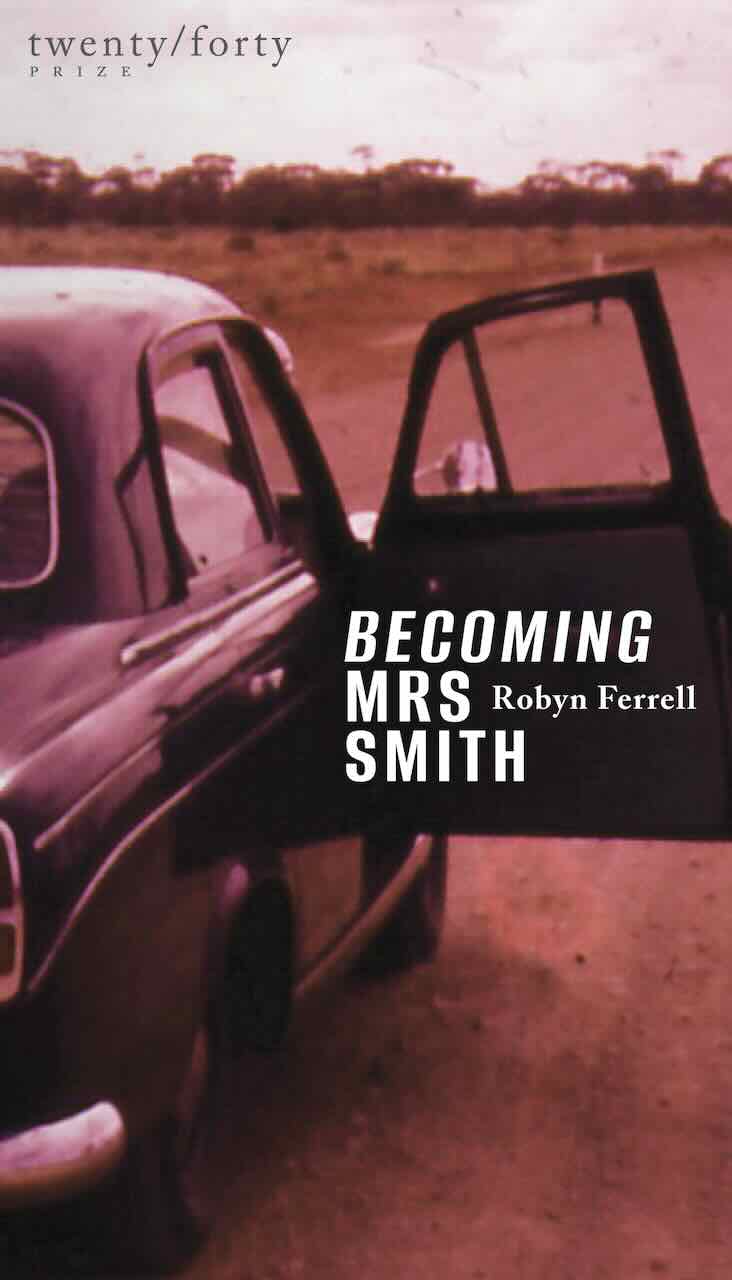
In a strange coincidence, the two 2026 winners of Finlay Lloyd’s 20/40 Prize both feature imaginary friends, albeit, I understand, in rather different ways. I’ll confirm this, however, when I have read the second one. Meanwhile, this post will focus on Robyn Ferrell’s Becoming Mrs Smith, with its engaging protagonist, the titular Mrs Smith.
Finlay Lloyd’s judges said of their choice:
Why this book is different: In a university psychology seminar, the narrator of Becoming Mrs Smith, is reminded, with some surprise, of an imaginary friend from her childhood—a stout and intrusive middle-aged woman. And so, the reader is off on an intriguing and amusing escapade about the shifting nature of identity.
Why we liked it: Writing where imagination intersects with notions of reality, biography and intellectual endeavour can be riskily ambitious, so we were delighted to meet this wonderfully playful, comedic, inventive and insightful book. It reaches far more widely and deeply than the compact number of its pages.
The book starts in the middle of a family trip across the Nullarbor, during which our four-year-old narrator spends much of her time either communicating with her imaginary friend, the “staid and sensible” Mrs Smith, or “relaying her [Mrs Smith’s] pearls of wisdom” to her parents, such as “Mrs Smith says when are we going to get there?” and “Mrs Smith says she’d like a toffee”.
Immediately, of course, this suggests that Mrs Smith is rather close to our narrator, but, as is the way of imaginary friends, “as we got older we lost touch”. Then, years later, our narrator has “another sighting of Mrs Smith”. It happens during a philosophy seminar when a paper on Winnicott mentions his view that imaginary friends were “alter egos … that could presage the development of psychological problems in later life and even the seeds of psychosis”. Our narrator is shocked that her “homely” and rather “comic” friend could be so “maligned” by a famous psychoanalyst, but, oh well, she was in the past.
Except, 50 years later, Mrs Smith pops up again, “a lumpish, frumpish, unglamorous woman and frankly fat. It was then I realised with incredulous certainty that I was becoming Mrs Smith”. And we are off on a delightful life-journey with Mrs Smith, and her side-kicks, Roy the dog and Myrtle the cat, her imaginary friends, who could be read as a sort of Greek Chorus – or Duet, as it were. As she tells her life-journey – with occasional interjections from the practical stalwart Roy and the confident worldly Myrtle – Mrs Smith also engages with the narrator about her life.
That’s the setup or plot, but what is it about? There is a clue to the book’s meaning in its epigraph, which comes from Friedrich Nietzsche, “And so I tell myself my life”. Hmmm … here is where I need to say that I am not a philosopher, and have never studied philosophy, so I may not engage as deeply as perhaps I should with the book’s more complex philosophical content. This lack, however, did not lessen the value of this book for me – and certainly did not lessen my delight in it – because Becoming Mrs Smith is a perfect example of the idea that a writer starts a book and the reader finishes it. That is, it’s a book you can read and enjoy on different levels depending on your own knowledge and interests.
“how one becomes what one is”
I’ll start with the title. The first word is “becoming” so the book is about “becoming”, in this case Mrs Smith, or, as we are told a little into the book, becoming who you are, which for our narrator seems to be Mrs Smith, though Mrs Smith, herself, vehemently denies being “a version” of the narrator. She has her “own take on things”. Be that as it may, part of the point is Nietzsche’s focus on the idea of becoming rather than of simply being.
Throughout the book, as Mrs Smith takes us on her journey of becoming, she mentions or alludes to many philosophers, discarding the ideas of some and taking on at least bits of others. And as the story progresses, the interplay between the narrator* and her imaginary friend Mrs Smith becomes more complex, so that we start to wonder where the self and the imaginary self merge and where they separate.
And this is where I should introduce a complication in this journey of “becoming”, which is the idea of story or narrative. As I said above, Mrs Smith asserts that she is not the narrator, and in her Acknowedgements at the end, the author tells us that “this is not a memoir, and accounts of events shouldn’t be relied upon”, all of which adds another layer to what Becoming Mrs Smith is about. One layer introduces us to various philosophical ideas about life and being, while another interrogates the idea of story (with a side-eye on its relationship to life). I see both a philosophical aspect to this and a literary theory one. You might tell the story of your life but, says Mrs Smith, life is not a story. In this novel, there is much in Mrs Smith’s life that seems to match the author’s biography, but this does not make it a memoir, and neither, apparently, does it make it a story:
Mrs Smith said life is not a story despite appearances, because it doesn’t conform to the eight-point arc. Of course people tell their life-story all the time but it’s always arranged so that the life fits the story and not the other way around. It is arranged in a three-act structure, however it really happened, that always resolves in the pattern of setup-crisis-resolution.
Actually, said Mrs Smith, life interrupts story. Life is not a story because it does not have the logical principle of a plot. (losing the plot, p. 112)
Life, for example, might start looking like you are “in a romantic comedy” but then suddenly turn into “more of a ‘real-life drama’. Maybe even a tragedy”. In other words, in life, things change. “You start to lose things … your job … your partner to cancer … your partner to a younger woman” and so on. “Each of these plot points have the effect of changing the genre”. The exploration of the relationship between life and story, and between how philosophers might frame it versus, say, a novelist or, different again, a memoirist, is both tricksy and playful. I found myself chuckling – a lot – while also at times nodding my head in agreement, or other times shaking it in bemusement.
Framing Mrs Smith’s telling of her life, which includes fantastical relationships with various philosophers like Sartre and Adorno, to name just two, is another trip across the Nullarbor. The book has six parts, with every part ending on a section called “mile peg”. These sections anchor the flights of fantasy in the main story, although they too contain their own bits of whimsy and metaphysical pondering woven through the reality. After all, how seriously can you take a car, occupied by our narrator, her imaginary friend Mrs Smith, and two imaginary pets, bowling across the Nullabor, which itself is described as
a majestic construct that continually dissolved and reformed. Something about this space aids in the suspension of disbelief. (mile peg, p. 73)
Throughout it all we return to the two main questions, “the great philosophical mystery” of becoming and an exploration of the nexus between life and story. I will conclude on a delightful interaction between Roy and Myrtle, which occurs near the book’s end after a discussion of Mrs Smith’s stint as a cruise ship guest speaker (!):
‘I don’t know where she’s going with this cruise business,’ said Roy. ‘It doesn’t seem to fit with the rest of the story.’
‘But that’s the nature of biography,’ Myrtle told him. ‘It’s just a thing that happened next. One thing after another. Life is full of contingencies–that’s the whole point she’s trying to make.’
‘Are you sure?’ Roy said, doubtfully.
‘It’s picaresque! She’s asking: what is story and is life one?’
‘Don’t you think the reader will struggle?‘
‘Have a little faith!’ said Myrtle. ‘People can join the dots’. (going to sea, p. 126-7)
And, much as I am a dog person, I think Myrtle is right. We can join the dots – or at least some of them – though whether we join them in the same way is another question. That, however, is the joy of this book’s journey. Becoming Mrs Smith is for anyone who loves writing that takes an idea and tackles its many angles with intelligence and wit. Recommended.
* Occasional paragraphs in italics seem to be a third – overlapping personage – the author, which just adds to the overall enquiry!
Robyn Ferrell
Becoming Mrs Smith
Braidwood: Finlay Lloyd, 2026
138pp.
ISBN: 9780645927061


It does sound intriguing. I love it when an author has the confidence to let his or her readers join the dots.
It really is kimbofo – and yes, you’ve said that well. It’s something Beejay Silcox said recently too (at CWF).