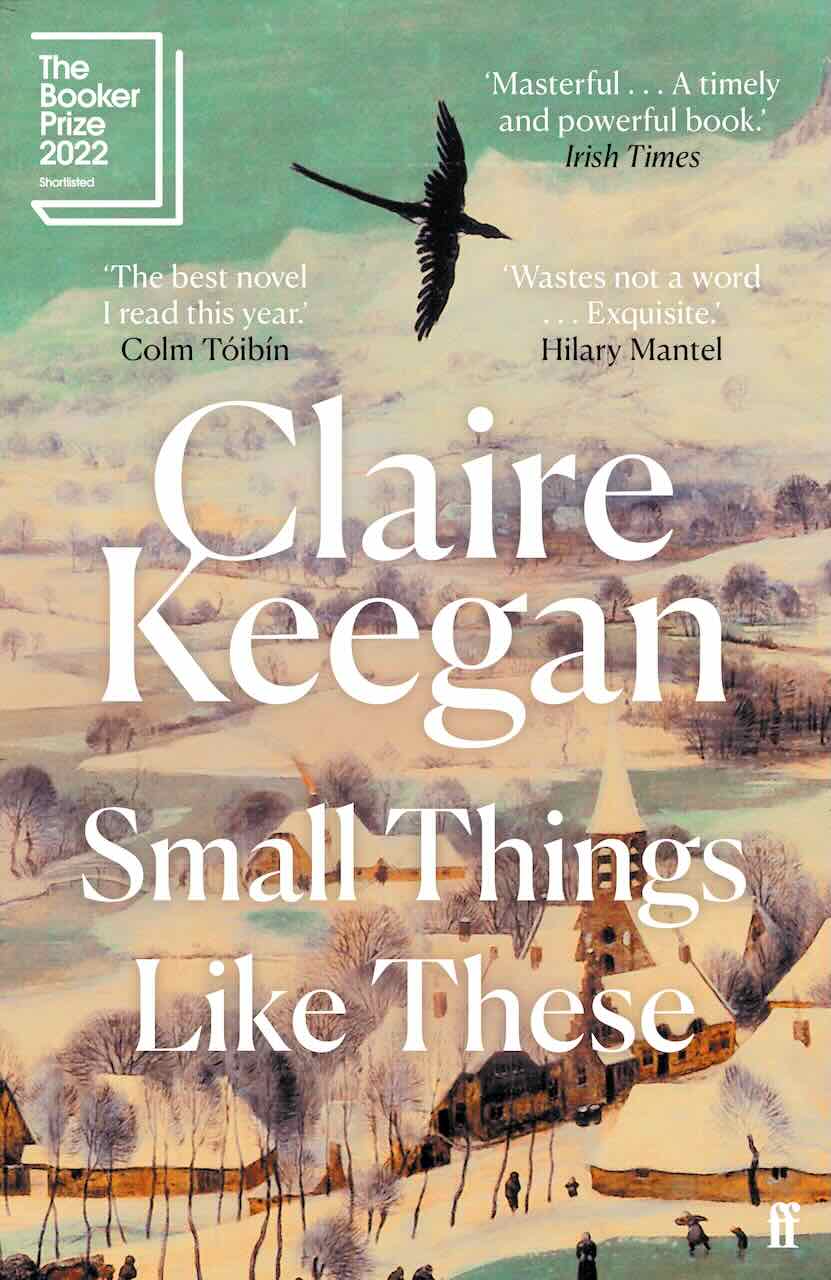
Very occasionally my reading group makes a book-scheduling boo-boo, and it happened this year when we chose Irish writer Claire Keegan’s So late in the day: Stories of women and men for our May read. This book, which comprises three of Keegan’s short stories, “So late in the day”, “The long and and painful death”, and “Antarctica”, looked like a great introduction to Keegan, but locating it proved a challenge. There is no e-version, and the printed version seemed not to be in stock at Australian booksellers. So, given the titular story (which I’ve reviewed) was available, we decided to read that, and let those interested choose their own value-adds.
I chose to read “Antarctica”, from the eponymous short story collection already on my TBR, and the historical fiction novella, Small things like these. I will post on the short story collection later, so this post is devoted to the novella, which most of you have already read. I had seen the movie, which was excellent, but wanted to read the original.
Small things like these is set in the small Irish town of New Ross in 1985, over the weeks leading up to Christmas. The place is important. It is a real, historic port town which, significantly, housed one of Ireland’s notorious Magdalene laundries. And the date is important because, socioeconomically, 1980s Ireland was a bleak time. Redundancies were increasing – “the dole queues were getting longer” – and people struggled to pay their bills. It’s the sort of time, in other words, when pragmatism and morality are most likely to come into conflict. It’s telling that, besides being shortlisted for awards like the Booker Prize, this book won the Orwell Prize for Political Fiction.
“things you have to ignore”
The novel’s protagonist, Bill Furlong, is a “coal and timber merchant” and the father of five daughters. A little over halfway through the novel, while delivering coal to the local convent, he discovers a young girl locked in the coalshed. What happens next forces him to confront who he is.
Here is Keegan’s description of Furlong at the end of chapter 2:
The times were raw but Furlong felt all the more determined to carry on, to keep his head down to stay on the right side of people, and to keep providing for his girls and see them getting and completing their education at St Margaret’s, the only good school for girls in the town.
What I particularly love about Keegan’s writing is the slow way she releases information, which challenges us to read between the lines and not jump to simplistic responses (or, to reconsider those responses as we read a little further). She uses simple straight-forward sounding sentences and plain words that carry huge weight. So, in this sentence we learn that Furlong knows times are tough, that he wants to give “his girls” the best start he can, but that to do this he needs to “keep his head down to stay on the right side of people”. Now what does that mean? By chapter 5, in which he discovers the young girl, we are getting an inkling.
In the preceding four chapters, Keegan has gradually built a picture of who Furlong is. In chapter 2, we learn his origins. He was born in 1946 to a teen mother, who was a domestic servant at the time. Her family rejected her, but her widowed Protestant employer, Mrs Wilson, not only kept her on, but provided a nurturing environment for the boy. Furlong, in other words, was one of the lucky ones. In his turn, he passes on little kindnesses when he can. This doesn’t thrill his wife, Eileen. She’s a good mother, but she inclines more to the charity-begins-at-home philosophy, and questions helping those who “bring the hardship on themselves”. By chapter 3, Furlong, who is about to turn 40, is questioning what it’s all for, “the work and the constant worry … he had begun to wonder what mattered”.
So, the scene is set. We have a decent man, whose life could very well have gone a very different way but for the kindness of an unrelated woman. Instead, he’s an established family man with his own business. He’s not wealthy, and he understands life’s precarity – “it would be the easiest thing in the world to lose everything” – but right now, with hard work and care, he can provide for his family. However, he’s a sensitive man and questions keep popping up.
Chapter 4 opens with an image of crows “gathering in black batches … perching, impudently … scavenging for what was dead … before roosting at night in the huge old trees around the convent”. The next paragraph describes the convent, “a powerful-looking place … with black, wide-open gates”. They might be invitingly wide-open, and the convent might “look like a Christmas card” but the opening image of the crows, the wide-open gates being black, and the rumours that circulate about the “training school” run by the Good Shepherd nuns, suggest darker possibilities. Furlong doesn’t like to believe the rumours but on a pre-Christmas visit to the convent he accidentally comes across some young “trainees” whose desperate appearance and manner deeply unsettle him. From here on, he finds it hard to forget what he knows to be true, though his wife urges him to do so:
“If you want to get on in life, there’s things you have to ignore, so you can keep on”.
A little later, pub-owner Mrs Kehoe is more explicit, warning him that “these nuns have a finger in every pie”, and crossing them could have serious consequences for his family and livelihood. But, for Furlong, the questions won’t go away:
… was there any point in being alive without helping one another. Was it possible to carry on along through all the years, the decades, through an entire life, without once being brave enough to go against what was there and yet call yourself a Christian, and face yourself in the mirror?
It would be a spoiler to tell you what he does, but Small things like these is a quietly powerful story about a man confronting himself – who he is, and who he wants to be – in the face of what he knows is cruelty and injustice, while living in a community that is complicitly silent about what it knows. That this is Christmas and takes place in a Christian community adds to the novel’s power and import, as does the epigraph from “The Proclamation of the Irish Republic” which declares, among other things, that it will cherish “all of the children of the nation equally”.
Small things like these has what I love best in my reading – a story which grabs my heart and speaks to my mind, a generosity towards its characters, and tight evocative writing. It’s a deeply moral book about how we choose to live, about being brave when you know what the right thing to do is but there’s a good chance you’ll pay for it. You could say that this is a book for now, but in fact it is a book for all time.
Claire Keegan
Small things like these
London: Faber & Faber, 2022 (Orig. ed. 2021)
116pp.
ISBN: 9780571368709


Eeeee, this book has my head reeling. That line about charity beginning at home reminds me of a kinder version of what’s happening in the US. We don’t believe in charity at home; we believe in taking care of ourselves and “F-U” to everyone else. It’s a very fight-y response to what’s happening economically, politically, and is born out of fear. However, I know just how awful the 1980s in Ireland were, and I’m worried we’re going to end up there. Maybe there is more to it and we are already in a terrible state. I’m thinking of books by Roddy Doyle and Irvine Welsh that are set in the 80s and show the significance of the unemployed male and what he gets up to, ESPECIALLY the younger men. In the US we get what are called “incels,” typically younger men who feel like the whole world has crapped on them, especially women, who “refuse” to date them, and that they are owed for being “good” guys. Their thinking changes such that women in particular are at fault for all their issues. It’s pretty scary. This is the kind of person we most commonly see behind mass shootings. Anyway, thanks for reading my brain gush.
Always happy to read your brain gush Melanie because it always adds something … I particularly like your “gush” about the impact of tough times on men. Fortunately this book shows, as we know, that not all men react negatively or aggressively.
Indeed! I’m my latest read, The Woman Who Walked Into Doors by Roddy Doyle, he makes it abundantly clear that the man abusing his wife did not start after he lost his job due to economic hardship. He was always an abuser, and job status doesn’t make abusers. That’s just an excuse.
That book has been on my radar for the longest time. I must get back to more Irish reading. I have always loved it. I would say it’s my second favourite after Australian, but I’ve not kept up. I think Doyle is right. Circumstances might exacerbate what’s there but I don’t imagine they cause it.
It’s actually a trilogy now! I can’t wait to see what happens next… I’ve read the first one several times but have never read the sequels.
Yes I knew there was at least one other involving those characters, so I’m not surprised to hear there’s a trilogy. My next Irish book, however, will be by another male Irish author – but that’s at the end of June. (Currently I’m reading Cannon!!)
A wonderful novella, so atmospheric and thought-provoking.
Antarctica I found disturbing at times – particularly that opening story
Agree with you about Antarctica
Thanks Angela. I hope to write a post on it next week. Wonderful stories.
Thanks Karen – and yes, that opening story in Antarctica is a shocker (in impact, not writing).
Exactly!
Coincidentally my book group is discussing this novella this month!
I read it last year and it is now one of my fave books of all time. Simple, profound, thought provoking.
The movie version is also one of the best book to film adaptations I’ve seen.
I’m sure you’ll have a great discussion Denise. And I agree with you about the adaptation. I saw the film a couple of years ago and as I read the book nothing seemed out of step with what I had taken from the movie. The visuals and the acting captured his feelings and the meaning so well.
I love Claire Keegan’s work. Her novellas are 100 pages of text and 1000 pages of subtext. I agree that the film of Small Things Like These is an excellent adaptation, as is the film based on her novella Foster, called The Quiet Girl. Highly recommended.
Thanks Angela … I’m sorry I’ve taken a while to respond but this (and a duplicate response which was your wondering why it didn’t post, I guess!) went into spam, and I don’t check spam every day. 100 pages of text with 1000 pages of subtext is a perfect description of her writing.
Yes, I have see The quiet girl too, and plan to read Foster. Another powerful story that, from my discussions with others, sounds like the film is a good adaptation of the book.
I really enjoyed this book. The film was also good. Keegan just keeps writing beautiful stories.
Thanks Pam … she sure does.
I just LOVE this book! Thanks.
Thanks Davida … I understand why.
So glad you enjoyed this, it such a good novella.
It sure is, Cathy, and I should have read it long ago. I gave it as a gift when it came out but didn’t read it myself!
The last 50 years has proved that the Catholic Church is the last organisation to which you would entrust your children. I was going to ask why Keegan wrote this story about the convent laundries from 40 years ago, but perhaps it was precisely because children are still being entrusted to the Church.
That’s a good question Bill, particularly because the laundry in the town she set her novel in had closed in the 1960s (though others went through to the 1990s). I think your overall reason is right. Children are not safe. I think too she wanted Furlong to have that background of “there but for the grace of god” which makes the plight of the girls more real to him and which complicates his wife’s reaction.
So glad you finally got to read this Sue, I knew it would be one that you would get a lot out of. For me the key line is, He found himself asking was there any point in being alive without helping one another? It’s something I come back to often.
Mr Books’ bookgroup also just read this for their June meeting last week. It’s was universally admired and a couple of the older men who had been raised Catholic added quite a bit to their historical understanding of the church in Ireland. And you will pleased to know it is still a book that sells a number of copies every week at week.
Thanks Brona…that is a great line, I agree. I’m sorry I didn’t link to any reviews this time because pretty much every blogger I know has reviewed it by now.
I’m not surprised to hear it still sells well. I’ve noticed that every book shop I check has more that one copy of more than one of her books!
I plan to comment on your blog post today. Im in Melbourne and it has been full one with family, grandchildren, galleries but we have a quiet day until the Australian Ballet tonight.
Gorgeous review Sue, I had to go back and read mine and I didn’t express my thoughts anywhere near as eloquently as you have here. I totally echo your comments: ‘a story which grabs my heart and speaks to my mind, a generosity towards its characters, and tight evocative writing. It’s a deeply moral book about how we choose to live, about being brave when you know what the right thing to do is but there’s a good chance you’ll pay for it. ‘
It sums up this book so beautifully. Enjoy the ballet tonight! I am enjoying a night in and finally being up to date on my ‘paid’ work so that I can start to catch up on blogs, bike racing and reading 😀
Thanks very much Rach … the ballet was great but we had a lovely quiet day beforehand catching up! Life is busy, even when retirement!
A beautiful write-up of a truly excellent book. I think you’ve nit the nail on the head with your closing comments:
“It’s a deeply moral book about how we choose to live, about being brave when you know what the right thing to do is but there’s a good chance you’ll pay for it.”
That’s spot on. It’s about having to choose between making a stand against systemic cruelty, even though it will put your own family’s future at risk, or saying nothing and living with the guilt…a terrible dilemma for Bill.
Thanks Jacqui … and I’m really glad you like my closing paragraph. She’s a great writer isn’t she?
I had trouble with this short novel because it seemed overly simple, but when I saw you had reviewed it I knew you would probably make me see it in more depth and like it a little better and indeed! I was right. Thanks.
That’s a really special thing for you to say Jeanne. Thankyou. And I’m glad.
An excellent review. I loved this so much, I pressed it into my husband’s hands the minute he got back from a work trip to the US! I did allow him to sleep before he had to read it in the end – and he did agree with me at least. I suspect she wrote it because these things are still being found out – just the other week there was a mass grave of babies found, so it’s sadly still relevant.
Haha Liz … I love that you pressed it on your husband, and that he appreciated it. I think you could be right about why she wrote it now. The abuse of children hasn’t stopped yet.
I also loved the closing paragraph of your review. Perfect!
Thanks so much Carolyn. Finishing a review is often hard so it means a lot when people say they like it.
We’re not reading the same collection (as it seemed it might have been) after all, but I’m on the hold list for this one, and hopefully it won’t take too long. Although I skip-read your review, I’ve seen enough to be even more excited about my Claires project this summer now.
I completely understand about skip-reading my review, Marcie. But I’m glad you saw enough to encourage you in your summer project! And I look forward to reading the your posts on it.
I love this, Sue, especially: ‘the slow way she releases information, which challenges us to read between the lines and not jump to simplistic responses (or, to reconsider those responses as we read a little further)’. Spot on!
Oh thanks very much Jonathan … it’s the sort of writing I enjoy.