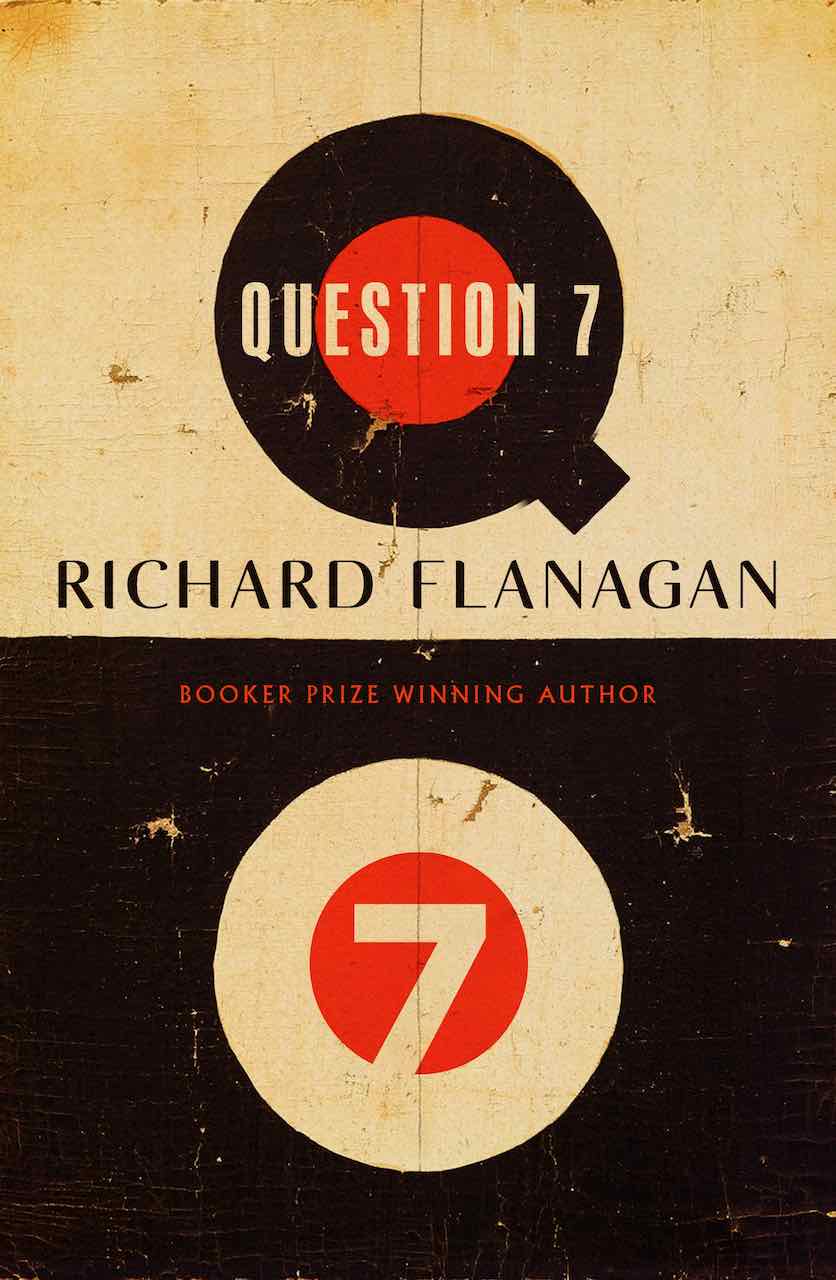
Question 7 is the fifth book by Richard Flanagan that my reading group has done, making him our most read author. That surprised me a little, but he has produced an impressive body of work that is hard to ignore – and, clearly, we haven’t.
We always start our meetings with sharing our first impressions. For this book they ranged from those who were somewhat bemused because of its disjointed nature to those who loved it, one calling it “extraordinary”. My first impression was that it’s a book full of paradoxes, and that these started with my experience of reading it. By this I meant that it was both easy and hard to read, easy because it was so engrossing and moving I was compelled on, but hard because the paradoxical nature of the ideas being explored kept pulling me up to ponder what he meant. What I didn’t add, because I feared overstaying my “first impressions” time, was that Question 7 felt like a humane book, a book about who we are and how we are, about what we do to each other and why.
“The words of a book are never the book, the soul of it is everything”
I can see how Question 7 can feel a bit disjointed – an effect of its stream of consciousness style – but there is a clear structure underpinning it, one provided by three interwoven threads. The first comprises the Hiroshima story, the role of Wells’ novel The world set free, in which he imagined “a new weapon of hitherto unimaginable power”, and the scientist Szilard. Flanagan uses novelistic techniques to link Wells, his lovers, Rebecca West and Little e (aka Elizabeth von Arnim), and Szilard, whose reading of Wells’ novel set him thinking about an atom bomb, and conceiving the idea of a “nuclear chain reaction”. The idea of a chain reaction becomes one of the novel’s connecting motifs or metaphors. One things leads to another, and, as Szilard was to find out to his horror, once started chain reactions are very hard to stop.
The second concerns the colonisation of Tasmania and, bringing in Wells again, his statement that his novel, The war of the worlds, was inspired by the cataclysmic effect of European colonisation on Aboriginal Tasmanians. Wells’ invading Martians become the novel’s second metaphor, Flanagan equating them with the colonising British. In a neat additional link, we learn that Szilard and some of his Hungarian Jewish scientist peers called themselves the Martians.
The third thread encompasses the story of Flanagan’s Tasmanian-based family, particularly his father’s life and his own. The way these threads, and their linking metaphors, coalesce to explore and expose life’s unanswerable questions makes for involving reading, as Brona and Lisa also found.
And yet, there’s more… There is another less visible connecting thread which provides the novel’s backbone and guide to meaning. It comes from Flanagan’s understanding of an essay by a young Yolnju woman, Siena Stubs, in which she discusses “a fourth tense” in Yolnju thinking. As I understand it, this encompasses the idea – in my words – that all time can coexist. For the Yolnju, for example, this means the ancestors were here, are here, will be here. Flanagan uses this concept as a refrain throughout his book, but in different contexts so that we can see its relevance. Thinking about his near-death experience on the Franklin, for example, he writes that “though it happened then it’s still happening now and won’t ever stop happening”. Or, to universalise it, “life is always happening and has happened and will happen” (p. 99).
A little later on, reflecting on the Hiroshima atrocity, he says:
what if vengeance and atonement both are simply the lie that time can be reversed, and thereby some equality, some equilibrium, some justice had? Is it simply truer to say Hiroshima happened, Hiroshima is still happening, and Hiroshima will always happen? (p. 140)
Further on again, he delves into the horrors of Tasmania’s colonial past and uses the refrain, “we were, we are, we will” to encompass not only the continuation of First Nations culture but the fallout from “the System” that the Martians had created. He concludes this section with another of his paradoxes:
And thereafter it was we who bore the inescapable, ineradicable shame that was not ours and which would always be ours. (p. 230)
Question 7, then, explores some of the toughest imponderables of our existence. It reminds us that once something happens, it doesn’t go away, but is part of the past, present and future, is part of the fabric of our being.
And so, we get to a related idea of memory, which also recurs throughout the novel. Writing about his childhood in Rosebery, Flanagan eschews checking some facts, saying,
This is an account of memory, not fact, and facts are not how we know ourselves, while memory – its tricks, its invasions, its silences, its inventions, its inevitable questions – is who we become as we shuffle around in a circle …. (p. 151)
There’s that circle – or non-linear time – again, because, in Flanagan’s mind “only fools have answers”. It is far better to keep questioning. This might be the appropriate place to share Flanagan’s two perfect epigraphs, as they provide a guide to how to read this book:
The author has not given his effort here the benefit of knowing whether it is history, autobiography, gazetteer, tragedy, romance, almanac, melodrama, or fantasy. It maybe myriad, it may not. The question is put, but where is the answer?
– Hobart Town Mercury reviewing Moby Dick 1851
and
No, this is not piano. This is dreaming.
– Duke Ellington.
It might also be the time to share book’s framing question, which comes from a short story by Chekhov, “Question posed by a mad mathematician”, in which he parodies a school test problem:
Wednesday, June 17, 1881, a train had to leave station A at 3am in order to reach station B at 11pm; just as the train was about to depart, however, an order came that the train had to reach station B by 7pm. Who loves longer, a man or a woman?
Ha! This unanswerable non-sequitur of a question, “who loves longer, a man or a woman”, is another of the novel’s framing motifs, alongside the (almost) throwaway line he uses at the end of particularly tragic or egregious situations, “that’s life”.
So, where does this all leave us, the reader? With a challenge, I think, to reckon with our personal histories and the wider histories we are part of – and to do so with a sceptical attitude to logic and rationality, because “the world from which we presume to derive meaning and purpose is not the true world. It is a surface world … beneath which an entirely different world surges.”
Near the end of the book, Flanagan shares some of the rather bizarre responses he received to his first novel, Death of a river guide, and writes,
After that I knew that the truth wasn’t the truth even when it was.
Here, then, another paradox, one that quietly snuck up on me but that embodies the book. Truths, of one sort or another, come thick and fast as you read, but always there are questions. We cannot, in other words, measure Hiroshima or the impact of colonialism. We cannot pretend
… there is some moral calculus to death. There is no equation of horrors … Who do we remember and who do we forget?
Ultimately, as Flanagan wrote part way through his book, the words are not the book, its soul is everything. In Question 7, we see into Flanagan’s soul and, inevitably, have a light shone on our own. Where to from here?
Richard Flanagan
Question 7
Knopf, 2023
280pp
ISBN: 9781761343452


Excellent review. I received my copy as soon as it was released/published and was struck in the earliest part of the book by the fact that RF’s father had been a PoW in the very town where I taught for 14 years – many times drove past the place (Big Beach/Ōhama) beneath which – under the sea – his Dad dug coal – and I knew absolutely nothing about it as a former PoW site! No plaques or Memorials. And I had travelled to many corners of Japan to visit sites where Australians had been slave labourers/PoWs. And there was one right on my doorstep – . One of my favourite coffee shops not two km from the site – overlooking the Seto Inland Sea towards Shimonoseki in the visible distance. And that the non sequitur question challenges us to see beyond logic and rational understanding – that there is a randomness to life and experiences. Even though as human beings we always want to establish the reason, the cause-and-effect.
How interesting Jim that you knew nothing, but not surprising.
It’s a wonderful and provocative book isn’t it – with many moments of enlightenment.
And in those early pages – the International Affairs fellow mentioned was an acquaintance from my earliest years in the region – met one night while admiring fireflies. Question 7.
Thanks Jim… I wouldn’t be surprised if many recognised people in these pages!
Your reviews are always so good when you’ve teased things out with your book group!
I get too emotional reading Flanagan…
Thanks Lisa… We had a good discussion and teased out a lot of things. Memory was a big one we talked about, and his mother.
I’m too lazy for this kind of intellectual reading, ST; or perhaps I could be less hard on myself and say instead that it’s my loss of ability to focus that makes it a book I wouldn’t undertake to listen to. (And I believe firmly that authors should NOT read their own books - they’re far too deeply invested.)
But people like me have the good fortune of being able to read your reviews and this make decisions like this one; so I thank you for preventing me from buying it on Audible and having to ask them to take it back.
Well I’ll take that as a backhanded compliment MR. I’ve not listened to many audiobooks but I must say that I loved Roald Dahl reading Charlie and the Chocolate Factory. And I think Alan Bennett reading his The lady and the van. They know what they mean amd if they read well they can convey it. In my little experience!
It’s not that they CAN’T read ’em <i>OK</i>; it’s that professionals do it far, far better. 🙂
Fair enough – and I think you are absolutely right that in most cases professionals do.
MR I once found a recording of Ray Bradbury reading Farenheit 451 which was a really moving experience, to hear him say the words they way he thought they should be said.
On the other hand, my absolute gold standard reading is Reece Witherspoon and Harper Lee’s Go set a Watchman.
Interesting Bill to hear these experiences.
It was Mark Billingham’s decision to do away with his EXCELLENT narrator and do it himself that first set my teeth on edge, Bill. I think from then on I was always going to be against it. I am a woman of limited nuance. 🙂
Oh dear MR, exceptions don’t make the rule, do they? In either direction, I suppose!
I loved every minute of it. A wonderful book.
Thanks Sara … I did too… I loved all the ways he provoked me to think and how cleverly he kept bringing ideas together – by an idea, a phrase, an anecdote.
Thank you for this terrific review, Sue! I haven’t read Question 7 yet, but I’ve listed it for my U3A Australian Literature class this year. Unlike other book groups, I select the books for the year’s reading, and I also provide background notes and questions for discussion ahead of each class. Writing the questions is always the hardest part for me, and you’ve given me some great pointers here!
Thanks Teresa. Very glad you like it, as it took me a few days to get right (and I’d probably still like to tweak it!) I’m glad I’ve given you some good pointers re questions. One we discussed in our reading group that I don’t explore in my post was “Does it matter that we don’t know – or that it doesn’t have – a clear form?” (What the reading group discusses and my own tangents can vary quite a bit, though with this book I think they coalesced more than often happens.)
This is our reading group book for April so will be starting it soon.
Great, Pam, I look forward to hearing how your Group likes it, but I’m sure they will are all from (in) Tasmania.
I am unfamiliar with this author – it looks like he is published in the US but by a smaller publisher, so maybe that is why – but this books sounds both fascinating and difficult. I just finished a very nonlinear book and found it hard to describe but you did a great job with this one. I don’t think my book group would have stayed the course, alas. There is sometimes that dreadful moment when I’ll hear that, “Who suggested this book?” and it is usually not meant as a compliment!
Constance
Thanks so much Constance. It is fascinating.
Flanagan’s oeuvre varies with some works being, hmm, innovative or different, and others being more, hmm, regular in terms of narrative approach.
I remember the non-complimentary “who suggested this book ?” question. That pretty well stopped when we changed our method of choosing – over two decades ago. Now, we do get that question occasionally but it’s almost always positive as in “thanks so much”. We had it with this book in fact. But we choose all our books by concensus, twice a year, so we often can’t remember! often, it’s “I remember I wanted to read this, but I can’t remember whether I suggested it!”
Oh this sounds so good! It’s not out in the US yet, but I’ve added it to my wishlist so I don’t forget about it 🙂
It sounds like nonfiction, but it’s actually fiction which makes me even more intrigued.
No, it’s nonfiction Stefanie! Not sure where you got the idea that it’s fiction? And, I think you would really enjoy his thinking.
Heh, well I thought it was nonfiction, and then you said something about a novel, and then I got confused. It was early Monday morning yet 🙂
Oh, did I say never somewhere? I’ll check because I did find myself writing the world “novel” sometimes when I was writing my post.
When I first saw this discussed, I thought it was part of a book group and (I think it might have been Bron) they were answering a question that had been put to the circle of readers! I’ve only read one Flanagan but I loved it (was it in different inks? there was something remarkable about it!) and always meant to read more.
Yes, Marcie – that was about his third novel, Gould’s book of fish. (And the first I read). Many of his novels have an historical setting or, theme, in the sense of the pervading presence of the past and the wrongs done. Gould is definitely one of those and is the one the truly got him on the map I think.
Brona has discussed the novel – in four posts – but I’m not sure whether it was a bookgroup discussion. It might have been. I think you’d enjoy the provocative thinking in this one.
I have read and disliked so many Flanagans that, as interesting as you make this sound, I’m not going to read it.
I’m glad that at least I made it sound interesting, Bill, that’s an achievement it seems!
Thanks to reading this in January and then packing Death of a River Guide for our trip to Tasmania, I felt like I was walking in Flanagan and his characters footsteps for a large part of the trip. I made sure we detoured through Zeehan and Rosebury where RF spent his childhood. His many questions and provocations played in my mind as I walked his streets and as I tried to explain Question 7 to Mr Books. It’s a book that will have a long afterlife I feel.
That Queenstown-Zeehan-Rosebery part of Tasmania is fascinating isn’t it Brona. There are so many different nooks packed into Tasmania.
Anyhow, Question 7 is a book that was great to read, but hard to explain, so good on you for giving it a go with Mr Books.
I would have so much trouble holding back when asked my initial impressions if I read the whole book. Biscuit and I have a book club for which we meet two times per week, discussing about 75 pages worth of story. In that instance, I can give my initial impression because I’ve only read the initial part of the book.
Haha Melanie, it can be a challenge. We didn’t used to do it this way, but in those days we often didn’t hear from the quieter members because the more excitable of us – pas moi, of course, haha! – would take over. The good thing about this approach is that we hear from everyone, and sometimes we hear/make little points that we can then pick up for discussion, like with this book, “I thought the writing was great, but what was all the Wells stuff about?” Or, “this book covers so many things, and I have a few I’d like to discuss later”. Others will give a more straight impression, like “I really enjoyed this book because x and Y”, or “I found it hard to get into the book because x, but by 30% through I was was engrossed and really liked y and z”. But still, as you clearly understand, it can be a challenge to keep it to a couple of sentences!
thanks Sue. A great write-up.
loved it hugely
Marie… then, now and in the future
mmmm mmmm and other consonants and vowels piled up Jenga-style!
Well done, Marie then, now and in the future! Love it – and I did enjoy reading this book immensely.
Question 7 is a formidable and mysterious book. Richard F. confronts with courage and clarity the awful history of Australia, and he has a lot to tell us about the great emptiness at the heart of our spiritual life. His quote from Moby Dick relates to the ineffable mystery at the heart of this book. The Ouroboros, which now resides outside the National Gallery of Australia, is another powerful and shocking symbol. Both are warnings.
Thanks Angela, great to have your thoughts on this book. It picks up so many issues and ideas doesn’t it? Formidable and mysterious are good descriptions. Coincidentally I was thinking last night about my reading group reads to date this year and this is one of them.
BTW The Ouroboros is there but it’s not uncovered yet I think?
I think it is! But I haven’t had a to chance to go and see it yet!
I drove by a week or so ago and it looked covered. My understanding was that it’s to be unveiled in October for the Gallery’s 40th birthday? But maybe it’s unofficially visible now?
Hi, Sue – thanks for this excellent review. My U3A class, Landmarks in Australian Literature, will be discussing Question 7 next month, and I’m looking forward to our discussion. Your comments will be a great help!
Like you, I used to start by going around the group asking everyone for their first impressions of the book, but lately I’ve come up with a variation on that technique.
There are a couple of tricky people in the group who take a very negative approach to some books, and who will say things like, ‘I hated it,’ or ‘It bored me stiff,’ without being able to articulate much more than that. And a few other people tend to launch into a long dissertation about the book, rather than just giving a quick comment about their initial impression.
So recently I’ve taken to going around the group and asking everyone to say one thing – and one thing only – that they especially liked or appreciated about the book. This has been quite a challenge to the naysayers – I’ve had to press them quite hard sometimes! But I think they’re getting the idea. It also seems to make them a bit more willing to hear other people’s positive views.
Thanks Teresa … I like your idea for mixing it up a bit. I’ve been thinking of a similar idea but haven’t suggested it which is the share one quote from the book that interests you and say why. Naysayers can choose a cliche or stereotype if they like!
Hope your discussion goes well. It’s a rich book for discussion.
“Martians” was a conceit of George Gamow’s. Gamow suggested that these men were actually Martians, who had adopted the guise of Hungarians, knowing that nobody but Hungarians knew the Hungarian language and could check up on them. John von Neumann was one and I suppose that Edward Teller was another.
(Gamow was Russian born and raised, for what that’s worth.)
Thanks George – I understood that the term had come from someone, but I hadn’t known the story. I’ve never heard of George Gamow.