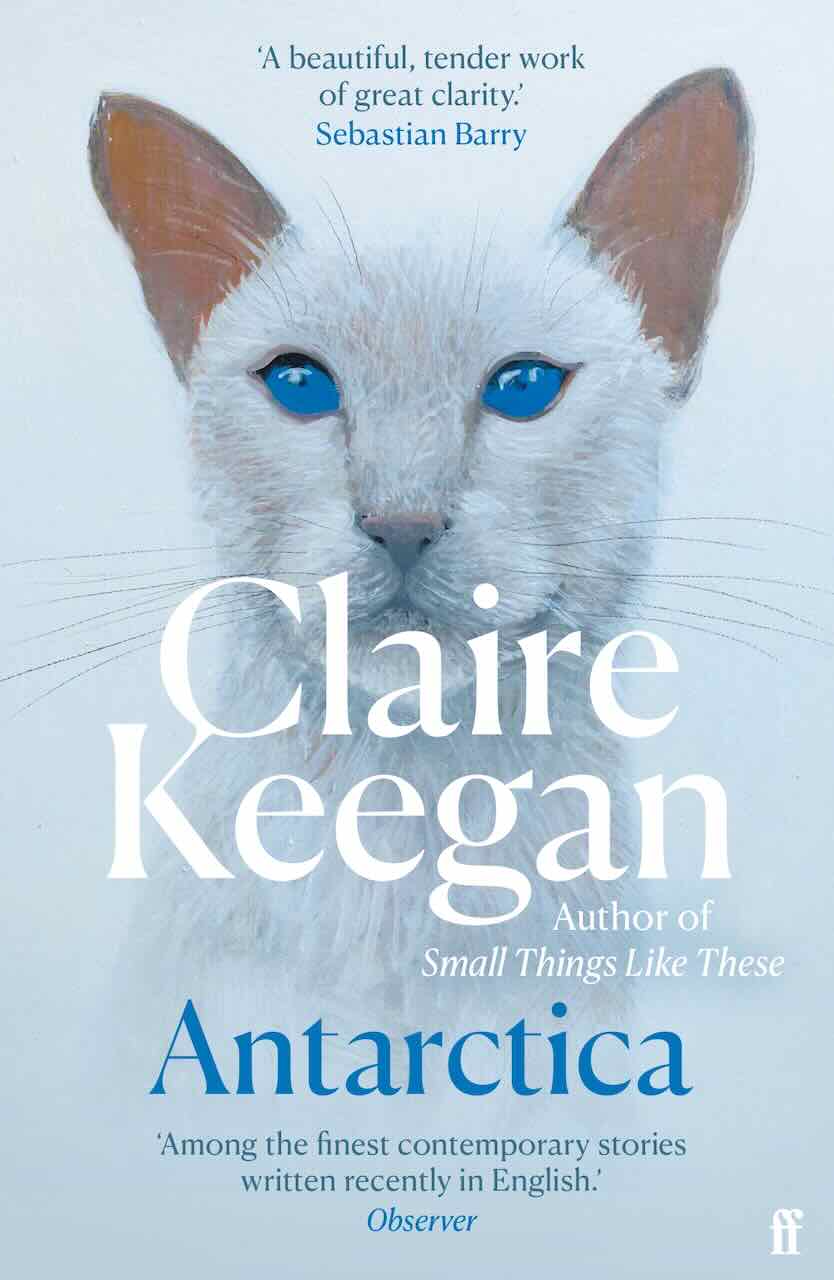
I promised in my post on Claire Keegan’s novella Small things like these, that a review of Antarctica would be coming soon, and I like to keep my promises, so here it is.
First, though, I must say I’m thrilled to have had this unexpected opportunity to spend time with Keegan whose So late in the day (my review) I loved when I read it in 2023. Having now also read Small things like these and Antarctica, and having seen The quiet girl, the film adaptation of her story Foster, I have some overall thoughts about her writing. These are that, essentially, Keegan writes stories about ordinary humans living lives that we understand, not necessarily from our own experience, but certainly from our knowledge of the world. This makes them relatable. And the way she writes, the way she observes and describes rather than explains and judges, make her stories perfect for discussion.
Take “Antarctica” for example. It opens the collection and is a confronting story about a “happily married woman” who decides she’d like to experience sex with a different man. Although only a couple of us had read the story, it’s easy to summarise and it generated a good discussion. It invites questions like why would a “happily married woman” have such a wish, and then why, given this decision, did she take the risks she did in the way she did? After briefly discussing our various reactions to her decision, we talked about how easy it was to judge her – why did she go to his place, why did she follow him through the woods, why did she drink so much, and so on – and how little attention, by comparison, we gave to the man. (Is this because his behaviour in a still misogynistic world didn’t surprise us?) It’s a story about a woman taking her needs and desires, or maybe just a curiosity, into her own hands. The setup invites judgement from the first paragraph – on moral or practical grounds or both – but then makes you think. Why are you judging, who are you judging, not to mention what are you judging and why. What is most interesting, and most impressive, is that, despite how the story plays out, it does not feel like Keegan herself is judging. Rather, it feels like she is presenting a human being to us, and saying, what do you make of this?
“nothing will ever be the same”
It is this sense – this idea of telling stories about humans without judgement – that underpins Keegan’s writing for me. The stories in Antarctica are mostly set in Ireland or the USA, with a couple set in England, but setting feels less important than the fact that the stories are about humans. The specific place certainly adds a layer, such as in the Southern US-set “A scent of winter” where racism provides the background, but ultimately, the stories are human, not political, not particularly national even. The most important thing about place is the evocative ways Keegan uses it to create tone or to build tension. Most of the stories are set in small rural settings, often farms, or places that feel isolated in some other way, which focuses attention on the ways in which her characters, humans, are vulnerable. “Antarctica”, for example, is set in London but the action mostly takes place in confined settings – a bar, or a room. The city in fact provides an anonymity which increases our awareness of the woman’s isolation when it all comes to a head.
Many of the stories feature women – wives, sisters, young girls, adulterous lovers – but there are also male and child protagonists. The stories are not particularly feminist. They are not not-feminist either, because patriarchal values do pervade many of the stories. Essentially, though, the stories are about women as humans, coping within the society they find themselves in. There are women who are put upon by others (a sister in “Sisters”, a husband in “Men and women”); women who seek some happiness for themselves (as in “Love in the tall grass” and “Ride if you dare”); and mothers who are grieving (as in “Passport soup”, told through the eyes of the father). Then, there’s the young woman in “The Ginger Rogers sermon” who seduces a farmworker with shocking (though not what you are assuming) consequences.
The stories are serious, and sometimes bleak, but there is warmth and nurturing too. In “The singing cashier” a sister does what she can to care for and protect her younger sister, only to discover there can be dangers you don’t even consider. In “Burning palms”, despite a tragedy, the love between a grandmother and her grandson is palpable. People realise their limitations but live to tell the tale, like the narrator in “You can’t be too careful” who goes out in a boat with a violent murderer.
It’s hard to pick favourites, but of course I do have some. The titular story, “Antarctica”, is a shocker and one I won’t forget quickly. The next story, “Love in the tall grass”, is gentler but, in Claire Keegan style, somewhat like “So late in the day”, it is told drip-by-drip until finally you understand what is going on. It starts with a woman preparing for something – “when this day is over, nothing will ever be the same” – but we are not told what it is. There are unsettling words in the opening paragraph, like “the trembling hedge” and “this water is colder than a broken dream”. In paragraph two, there are “withered leaves” but also,
The clock on the mantle ticks happily. Not long now it seems to say. Not long now.
In this story, as in all, the detail is crucial. By the end, we know what the day is about, but what the end result will be, well, who knows? It’s a beautiful, precisely unfolded story about love, and the costs of hope. In “Men and women” and “Sisters”, a wife and a sister take a stand, if not exactly to take revenge, certainly to say, I am here and you can’t keep walking over me. Of course there were stories I liked less, or that worked less well for me, but every story offered something about humanity worth thinking about.
By the end of each story, “nothing will ever be the same”, but we don’t always know in what way. Keegan has the ability to tell an arresting story in language that is controlled but not cold, and through plotting that builds tension which is less about suspense than about unfolding a situation, a choice, a conundrum. How could I have been so late to this party?
Claire Keegan
Antarctica
London: Faber & Faber, 2023 (Orig. ed. 1999)
209pp.
ISBN: 9780571382217


I have read almost all of Claire Keegan’s work and I love her work, but I have to say that the stories in Antarctica were my least favourite. I think I found them so grindingly depressing, especially the titular story. I don’t mind a confronting read, and I like stories that challenge, but this one in particular seemed so tough I felt overwhelmingly debilitated and drained by it. It’s the only one of her books I have added to my Lifeline box as I will never read it again. That said, Small Things Like These, So Late in the Day and Foster as some of my all time favourite reads. So there you go.
I understand that Karen, though I didn’t find them all grindingly depressing. Some were. That first one though is a shocker, isn’t it? But, it’s so cleverly written. Quite a few though had some lift at the end.
When I review a book that’s about everyday lives and is fantastic, I have such a hard time reviewing that book and not making it sound mundane. I really like how you explain that this is a book in which people may not have experienced with the characters are experiencing, but the reader will be familiar with those experiences through others. I think that’s something that can make an everyday lives kind of book special. For instance, in my recent review of a Roddy Doyle novel, I don’t have experience living with an alcoholic, but there are several in my life and I know what that may look like through my interactions with others.
Thanks Melanie … I’m glad that point made sense. It’s partly what reading does for us, isn’t it, but also just about moving through our lives with other people.
I think that first story should have been placed further on in the book. Our book group read this and the first story frightened a few and they thought the whole book might be quite ominous. I enjoyed these stories. She just does such a wonderful job. I didn’t realise Foster has a film so I’ll look for it.
That’s an interesting idea Pam. I thought a little about the order. If I were a serious critic, I would spend more time looking at that aspect of the collection. It does start toughly – frighteningly as some of your book group felt – while the last story, though it contains a tragedy, ends on a warm scene between grandma and grandson. Meanwhile, story two, the one after Antarctica, is also about a woman who takes a risk for her own happiness, but its ending is more equivocal.
I’m with you, I liked these stories. Most aren’t black and white are they. There are angles to consider, even when something wrong happens, there are things to think about.
It is a book I could read again as I usually don’t do rereads. The stories are so interesting but that first one was really creepy.
I think you hit the nail on the head when you say her writing is ‘controlled not cold’ as that is how I feel too.
Thanks Cathy. I’d like to read her other published collection but I might have to wait until I get a few more books read first!
My (old) bookgroup read this collection earlier this year and the first story put them off. Many refused to read further, so Pam’s comment about the order of the stories interests me too. Their comments (I am still part of the whatsapp group so I can join in the book chats when I have read the book and still keep up to date with their social happenings) did put me off I must admit, so I was glad to read your thoughtful discussion of their merits.
I find this really interesting Brona … it is a very powerful story, and confronting, but it made me want to read more … though the next day! Quite a few bloggers have read this collection and most if not all name that story as one of the standouts. We might all use words like chilling and shocking but most were not put off. So, of course I’d be interested in your thoughts but I also know you have a lot to read!
I think your comment:
Is completely spot on and why I enjoy her works so much, though I haven’t read this one.
Question for you – is Antarctica actually set in Antarctica? Or any of these stories? I have to read for my book club a book set in the Arctic or Antarctica and this would be a perfect choice if it meets the requirement 😀
Thanks Rach, I’m glad you agree.
But, I’m sorry no, the story titled Antarctica is set in London. The Antarctica reference is metaphorical. None of the other stories are either, I’m afraid. Some say Nikki Gemmell’s book Shiver is good. It’s set in Antarctica I believe, but I’ve not read it so don’t quote me! Andrea Barrett’s Voyage of the Narwhal is set in the Arctic, and has a slight Australian relevance because it is about a search for Franklin’s expedition. As I recollect, Lady Jane Franklin features because I think – if I remember correctly – she is back in England wanting to clear her husband’s name. (I might be misremembering though). I’m sure there are more recent books set in either of these places though. Just throwing these in because I know of one and have read the other!
Thank you so much. I haven’t heard of either of these books, so I have just looked them up and both look great. I have put both of them on my list as potentials… I will make a decision when I clear some of my TBR, I have been a bit ‘request’ happy on NetGalley recently… lol
A pleasure Rachel… I don’t go near Net Galley. I think they are going to disenfranchise me but I just don’t need to be tempted by more books right now!
It’s interesting to read your impressions of this story collection, Sue, particularly the discussion you had around the temptation to judge the central character’s motives and actions in the titular story. I try not to do this (easier said than done sometimes!), especially where relationships are concerned as it can be hard for someone to make rational decisions when their emotions come into play.
I’m glad the collection gave rise to some fascinating discissions in your group!
Thanks Jacqui, it’s a collection that invites discussion isn’t it.
/eyeroll Sometimes it’s so annoying when a writer is this good. I’m still reading. And listening. In this summer of Claires (winter).
Haha Marcie … it is.