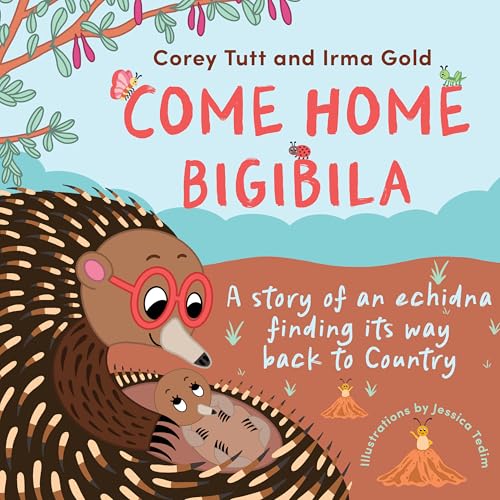
The recently published children’s picture book, Come home Bigibila, is a gorgeous book for several reasons, but the most important of these is that it’s a good read. If it weren’t that, the other reasons would fade away! So, let’s start there.
Come home Bigibila tells the story of Bigibila, a baby echidna who is cared for by her loving mother. Bigibila grows until one day, her mother believes Bigibila is old enough to be left for a short time while she finds some food for them. Of course, in a recognisable children’s story trope, the curious Bigibila thinks she’s old enough to explore on her own, only to find herself far from home with no obvious way of return. Fortunately, she’s resourceful and, using her digging skills and good nose, she finds a way, so – of course – it all works out in the end.
That’s the bare outline of the story. However, there’s much more to it than this, because Come home Bigibila is set in Kamilaroi Country, and is a collaboration between Kamilaroi scientist and writer Corey Tutt, writer and nature lover Irma Gold, and illustrator Jessica Tedim, a Gamilaroi/Ularoi artist. This, then, is a story about a particular type of home – Country. Bigibila, we are told, was born when Gawarrgay, the Dark Emu, was high in the sky, and when “the air tasted of native lime and was full of the sound of animal songs”. Bigibila knows from the start that this was her Country, her Place.
Through these three collaborators, Bigibila’s story is told with a beautiful simplicity and clarity that enables all readers to relate to the importance of home, but that also conveys just what home – Country and Place – means to First Nations people. I have read it to Granddaughter Gums, who has asked for it to be read to her again. This is a sure sign of a successful picture book, because in my experience pre-schoolers (well, all children) do not ask for a boring or uninteresting book to be read again!
The book design is beautiful, with clear, effective text appearance and layout. And the illustrations, with their soft but earthy colours are truly gorgeous, providing just enough details for children to explore without distracting busy-ness. Enough Kamilaroi words are used – Bigibila (echidna), Maliyan (wedge-tailed eagle), Gawarrgay (Dark Emu in the Sky) and Jinarr (Kamilaroi woman) – to provide an introduction to other Australian languages, but not too much to overwhelm and undermine the story. At the end, there’s some value-adding to help parents and teachers use this book. This includes a glossary, information about echidnas (including their life cycle), and the importance of keeping them wild.
Collaborations like these seem to be increasing, and we are all the winners. For participants there is knowledge-sharing and truth-telling, which are important parts of our journey to reconciliation. I can’t speak for First Nations readers of course, but I expect books like this help reinforce identity and culture in young people, even perhaps when it’s not their own particular culture, while for the rest of us, it speaks to the importance of home that we all feel while also teaching something about the specific meanings of home (Country and Place) for First Nations Australians. In other words, the knowledge-sharing and truth-telling that starts with the collaborators reaches out to all of us.
Come home Bigibila deserves a big audience because it is a gorgeous book. That it has these additional benefits for contemporary Australian life and culture is just the icing on the cake.
Corey Tutt and Irma Gold, with Jessica Tedim (illus.)
Come home Bigibila
Crows Nest: Allen & Unwin, 2026
36 pp.
ISBN: 9781761181863
Review copy courtesy Allen & Unwin.


I love that they include info on the importance of echidna in the back so it is included but doesn’t overwhelm the story itself. Did you have any troubles reading the words in Kamilaroi? I feel like I would just be making up pronunciations 😬 In my hometown, on the reservation, all signs are in English and Ojibwe, but I have no clue how to say any of them.
I know what you mean Melanie. These words didn’t feel too bad, but the book I expect to post on next has many words I have no idea how to say. I have found some on YouTube in the part and can approximate the sound but really the intonations can be so different and I don’t have a great ear. I have a fair one but not great!!
I have to come up with five books for pre-schoolers between now and the end of the year, so I guess this will be one. I don’t get to read to the grandchildren (and great grandchild) so much these days, but Milly often does.
Thanks Bill. It would be great if you made this one of them. My Miss Four enjoyed it.