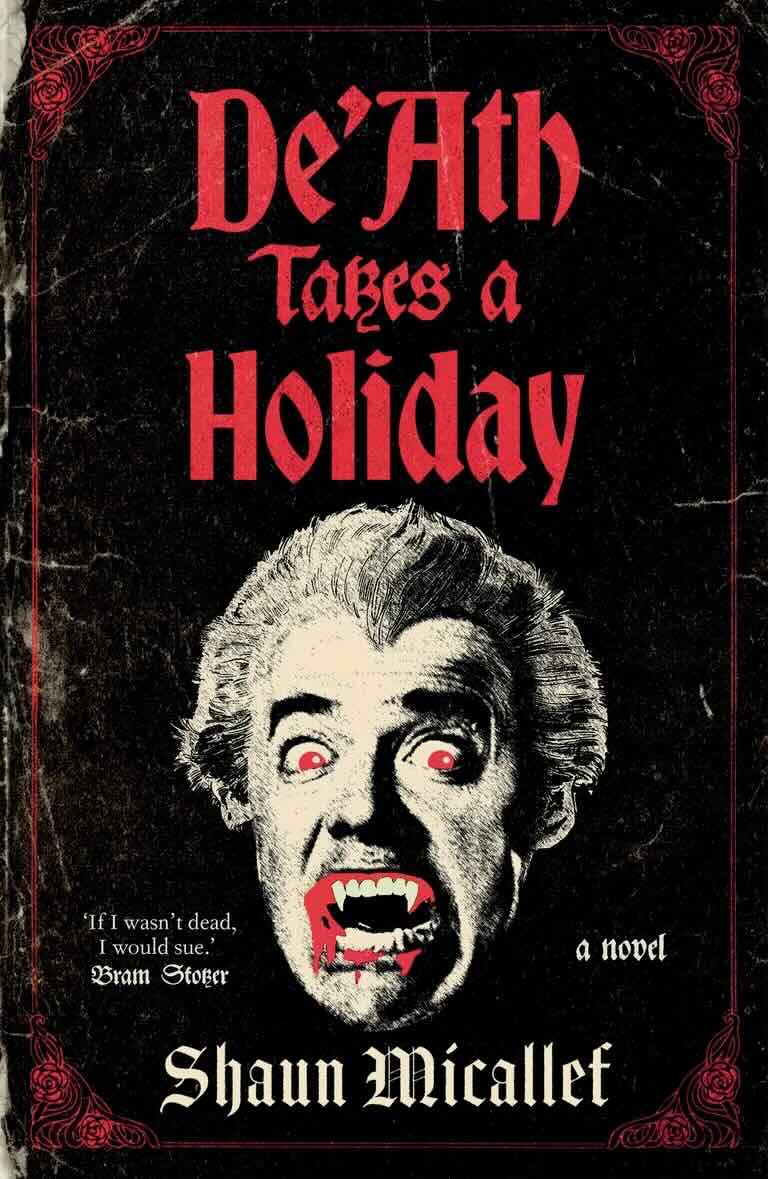
This book is bonkers, but that’s mainly its point of course. It has other points too, and I’ll get to those, but first I’ll introduce it more formally. De’Ath takes a holiday is billed by its author, Australian comedian and satirist Shaun Micallef, as “the origin story of the first real vampyre (not Dracula)”, which means that it takes the form, roughly speaking, of a Gothic romance. However, from the front cover, with its blurb quote by none other than Dracula’s creator Bram Stoker to its last page with its upside down author biography, this book is clearly not meant to be read “straight”.
Instead, De’Ath takes a holiday is part satire, part spoof, part parody, though which parts are which aren’t necessarily easy to tease out and it probably doesn’t matter. So, perhaps a better way to explain this book is to share the description on the back cover:
The trouble with immortality is that eventually you get sick to death of it, and so to soothe his sickened soul, the Comte De’Ath decides to take a trip. From psychoanalysis in Vienna to blood transfusions in London, the Comte learns that a holiday is as good as a change. On the way, he meets the Queen, brings her husband back to life, helps win the Second Matabele War, matches wits with the Elephant Man, inspires Henry Ford to pursue the American Dream, almost solves the crisis in the Middle East and even falls in love. Will he become mortal again in time for his funeral in Carfax Abbey? Ah – but what a fine book this would be if we gave away the end of the story in the blurb.
Some of you may remember that a couple of months ago I attended a meet-the-author event in which Shaun Micallef was in conversation with journalist Adam Shirley. My report intrigued Melanie (of Grab the Lapels) who is not averse to vampires and horror, but who also knows that this is not a genre I gravitate to. She suggested we do a buddy read, ending with us asking each other some questions which we answer on our blogs. In a case of nothing ventured, nothing gained, I agreed, so today I am bringing you my answers to Melanie’s questions.
Melanie’s questions
Most people skip over the reviews at the beginning of a novel. Did you read the blurbs at the beginning of the book?
Haha, good question, but of course, I do! I’m one of those people who doesn’t want to miss out on anything, because you never know what delight might be tucked away in some unexpected corner. I always read the epigraphs for example. The only exception – or, more a variation, really – is that if there’s an introduction, I will read it at the end. However, this book is by Shaun Micallef, and the aforementioned Bram Stoker blurb on the cover – “If I wasn’t dead I would sue” – told me that I would be reading this from the beginning to end, without deviation. What I found was that the tone established by Bram Stoker on the front cover took off on the first page with the blurbs about which Melanie asks.
Those blurbs, which occupy the first two pages and are titled “Praise for De’Ath Takes a holiday“, comprise “praise” from the likes of Anne Rice, HP Lovecraft, Peter Straub, Robert Bloch, Daphne Du Maurier, and end with a conversation between the Brontë sisters. They told me that this book was going to be a romp, if nothing else, but they also hinted at an author who knows his literature, and who will include literature in his satirical sights.
Some readers feel that Micallef wrote not so much a novel but multiple scenes or set pieces. What are your thoughts?
Early on, I decided that the book belonged – at least a little – to the picaresque tradition, and those books do read like a sequence of set pieces, but that doesn’t stop them being a novel. It just means to me that they are a certain type of novel. Wikipedia has a page on the picaresque, which lists a number of features of this form. Micallef’s novel doesn’t adhere slavishly to this list, but then I wouldn’t expect him to. However it definitely meets some of them, including that “there are often elements of comedy and satire”. It could be that one of the things Micallef is satirising is the picaresque!
As Micallef continues to introduce new characters, it can be hard to keep track of who’s who. Did you struggle with this?
A little, but it was not so much the keeping track of them – as most were well individualised which helped with this – but trying to work out who each new character was, whether I recognised them from history, and if so why Micallef had included them. Why did he choose, for example, Cecil Rhodes or John Merrick or Nicholas II? My brief answer is that each serves his satirical purpose – including satirising nineteenth to early twentieth century society and values, and, most significantly, the politics of capitalism and colonialism.
Did Micallef introducing historical figures into the same novel affect your reading experience? Was it a fun attribute, or did you long for made-up characters?
I’ve partly answered this question above. Of course, it affected my reading experience as does anything an author decides to do, particularly things that are unexpected. I didn’t long for made-up characters, because I rarely long for something different to what an author has done. My reading approach is to focus on “what is this author doing” more than “I wish the author would”, if that makes sense.
Comte De’Ath explains that he turned Africans that were on a slave ship headed for Haiti into zombies after the ship crashed and they all drowned. He does this so they can pick cotton forever; they have no need of sleep or food, so it’s great for him. Do you think Micallef means for this to be funny, or are we supposed to condemn our main character as vile?
Micallef is a comedian, and very often his comedy takes the form of satire, so, as I’ve already said, I read this novel as satirical. In this situation, I see the Comte as representing both colonialism and capitalism in the way these “isms” exploit human beings. I thought it was clever, and it made me laugh, but ruefully, because it’s obviously ridiculous, but it makes a point about what business owners and their ilk (like political masters) would really like. So, yes, we are not supposed to approve this behaviour. But yes, on the other hand, given his world, we can also see that this is a funny representation of what capitalism would see as an ideal solution to the labour problem. They are the perfect slaves.
Thinking about Comte De’Ath’s cotton-picking zombie slaves, does it then matter that he wants to become human, to live as a normal person with the fear of death hanging over him?
Hmm, interesting question. I’m not sure that I see these two things as related, though perhaps I should. As I said above, I see the zombie slaves as mainly reflecting thoughts about colonialism and capitalism, and the exploitation that these systems involve. And I wonder whether the Comte’s desire to become human – or mortal – is part of a wider philosophical question about the nature of life and death, and the idea that life has meaning because it will end. Even though Freud, early in the novel, cynically suggests that immortality is an ideal state allowing the Comte to continue his exploitative, wealth-building ways forever without regard for those around him, the Comte is tired of “the insufferable tedium of being awake”, of having “seen and done everything I could possibly want to see or do in my life – and quite a few things that I never want to see or do again”.
In conclusion…
These answers to Melanie’s questions don’t cover all I’d like to say about this novel, but I’ve written more than enough right now, so will end here. Perhaps I’ll return when Melanie has posted her answers. Meanwhile, I will say that if, like me, you are not into vampires or horror, don’t let it that put you off because this is something different. Further, despite Micallef’s suggestion at the meet-the-author event, that I would miss the jokes because I hadn’t read the classics in the genre, I found enough “jokes” in here from history and literature to not notice what I was missing!
Shaun Micallef
De’Ath takes a holiday
Ultimo: Ultimo Press, 2026
230pp.
ISBN: 9781761154812


I’ve read (the original) Dracula, though a very long time ago. I won’t read this, not out of respect for the original but because I generally find the comedy in novels like this forced. I would much rather it be implied as it is in Jane Austen for instance.
As for ‘blurbs’ I can see that the ones that you quoted are part of the comedy, but I won’t read back covers ever, except the bare minimum if I can’t guess what the book is about.
I don’t read back covers as a rule, Bill, and I only read this one because I wanted a quick summary of the book for the post. It’s the only part of the book that’s not satirical.
This book also satirises “books”. It has, at the end: Postscript, Further reading, Additional further reading, More additional further reading, Even more additional further reading, and Erratum. Yes, pretty silly, but most had something to offer. I particularly liked the Additional further reading chapter which contains an essay on the legal concept of the “Reasonable man”. It’s a wonderful discussion of the complexity (illogicality or unreasonableness, even!) of the idea.
BTW, re your response on Melanie’s blog, I thought about you as I wrote this, and thought you would like the capitalism and colonialism satire (though recognising that you might not like this form of satire!)
Melanie quite often picks up an angle which hadn’t occurred to me, and I never know whether it’s because she’s American, a woman, or more perceptive. Probably all three. I get myself into insensitive territory because one string of words suggests another and suddenly I’m in a quagmire; so I wonder if Micallef took a joke too far, or if he was trying to make a point about slavery which Melanie (and I) missed.
She does, I agree. She’s a different to us in generation and culture – and for you in gender too. These are some of the reasons I think for why we enjoy reading her blog, besides the fact that she’s so warmhearted, sincere and is funny.
But maybe the generational and cultural difference – including Micallef’s brand of humour which, as Melanie suggested, is more British – means that she didn’t read his humour in the way he intended. For me there’s no doubt. The description of the zombies by the narrator, includes “their movements were slow and mechanical but steady and without pause. I could see how such efforts, twenty-four hours a day, seven days a week, fifty-two weeks a year, forever, would be good for business and continued economic growth”. Earlier we are told of the low overheads – they are “living dead’ who don’t need food or to sleep. And then there’s Freud’s suggestion that continued immortality would enable to Comte to continue to accumulate wealth ad infinitum. Freud tells the Comte “in many ways you are like today’s public and private corporations whose registered offices can be found in the capital cities of our more advanced European nations. You are the human equivalent of say the British East India company.” I can’t see that Micallef is doing anything else but making a point about slavery and capitalism’s exploitation of labour.
From this side of the globe, the author would be raked over the coals for trying to use silly humor to make a point about capitalism that uses human misery to make money. The history is too close. We’re actually a country deeply divided over whether Juneteenth (the day the last slaves in the US were informed that slavery had been abolished after it happened) should be celebrated or is just some liberal nonsense. I mean, even if people don’t want to celebrate, we get off government holidays. Being mad about Juneteenth just spites the haters, too. That’s how divided we are on slavery to this day, hence the lack of humor I find in Micallef’s zombies.
I can’t read this as I don’t care for old Shaun at all. His program annoys me. It’s too in my face. I find that with a lot of comedy on the ABC especially. I’m hard to please- haha
Comedy is the hardest form I think Pam. Most people get tragedy, but comedy is far more individual. So I understand. I love bits of his programs but other bits don’t reach me.
I agree about comedy. The timing has to be right and I don’t like loud comedy or lots of slapstick stuff, unless it’s the Marx brothers.
You sound like Mr Gums, but then he’ll say that he likes Monty Python. I always pull that out when we have these discussions. (Though I’m not a huge fan of loud comedy or slapstick either, but am probably a bit more open than he is.)
Oh, this is so interesting ! I love Melanie’s questions and your responses. I think Sean’s humour, certainly what he does on TV, is quite cerebral and very language-driven (ie. puns, riffs on literature etc) and also quintessentially Australian, so intrigued how an American like Melanie got on with it.
Thanks kimbofo … I’m glad it worked for you. Melanie has posted her responses to my questions on her blog, which I’ve linked above. She found it a bit “British silly”, which of course is largely the tradition Micallef works in. That Monty Python absurdity with clever wordplay, slapstick, parody. Parts of it are over-the-top for me – in his live comedy and here, but other parts just make me laugh with the way he can skewer right to the heart of things. With the Zombie slaves he both shows the extreme of exploitation on the workers and how this is exactly what would make capitalists happy. Workers who can get the job done but need absolutely no care. My opening question to Melanie does refer to the fact that if you know Micallef, you know what sort of voice to expect, so I wondered too how it would translate.
Thanks for reading with me, Sue! I read through everyone’s comments here and was amazed by the different responses and feelings about the author’s work, showing me just how different we are in our two countries, though I forget and think we’re just the same. I’m really grateful I had this experience. ☺️
And thanks so much for suggesting we do this Melanie. I really enjoyed it when I actually sat down and did it, and who knows when I would have read it otherwise. As it turns out, the experience was more interesting than we expected!
You are right about how different our two countries are. I have realised it for some time of course – because I’ve lived in the US twice! If I’d not, I suspect my understanding would be far less nuanced than it is. I think our national senses of humour are very different. Ours is a sort of combination of English silliness, Irish dark humour and Australian self-deprecating-ness, I would say. Anyhow, when you overlay that difference onto your point above about division within the US about slavery (the Civil War etc) then a book like this probably wouldn’t travel well to the US. (My Californian friend has told me a bit bout Juneteenth tensions in recent years.)
We have literal white supremacists patrolling the streets, so yeah, things aren’t great here.
No, we hear some of these stories and they don’t sound good at all. Scary, in fact.
This was very fun reading both your posts! What I really liked is that you asked each other different questions and didn’t have a set of questions you both answered. That way I got a feel for how you each read the book as well as different aspects of the book.
Yes, exactly Stefanie. That’s a good observation. One or two our questions related to a similar idea but came from such different angles. It was fun to do.
I love what you and Melanie have done here (and on her blog). I too can only take Micallef’s humour in very short doses. I usually find him frustrating to watch as he is clearly very intelligent, but his skits are so silly. So it has been very informative and even entertaining to read all your thoughts and everyone’s comments about this book I was never going to read.
I’m glad you enjoyed the approach we took, Brona. I really thank Melanie for the idea, and for the encouragement to read a book that I ended up enjoying more than she did. Yes, there is much silliness and I admit that I don’t love all that, but I do like his wit, and appreciated his targets. I have enjoyed the discussion here, so thanks for being part of it.