A few years ago, I wrote several Monday Musings posts about Australian literature from the 1920s to the 1940s, including one titled A view from 1930. It looked at the ideas of two critics of the time, HM Green and Nettie Palmer. Today, I am sharing some ideas presented in one article written in 1946 in the Sydney Morning Herald, that is, 80 years ago.
Unfortunately, the article has no by-line, so we don’t know whose ideas are being presented, but I think it is still worth sharing as someone’s state-of-the-art. The article is titled “Growth in our literature” and attempts to show how Australian literature is developing a culture of its own. It’s a positive piece, but from the perspective of 2026, there are some gaps.
The article starts by saying that “it is a literary paradox that this country produced a national literature even before it produced a nation”. What the writer means is that Henry Lawson’s prose sketches are evidence that “there was an Australian literature before there was a united Australia”. However, the writer believed that nothing in terms of “a body of indigenous* writing” emerged until the 1890s. This “indigenous” writing was the “bush ballad and short story”. S/he (probably a “he” but I’ll use “s/he”, not “they”) argued that “earlier literary work was colonial, not national, restricted to either the nostalgic creations of exiles like [Manning] Clarke and [Adam Lindsay] Gordon or the imitation of English forms by such native-born poets as [Charles] Harpur and [Henry] Kendall. S/he is proud, nonetheless, that “compared with the centuries over which the old world literatures slowly produced their masterpieces, our period of literary growth is strikingly short”.
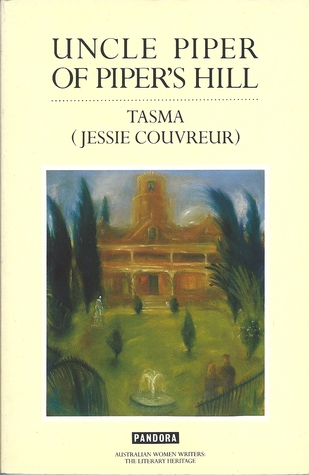
My point here is that s/he does not mention, for example, some of the nineteenth century’s women writers who produced novels. Catherine Helen Spence (with Clara Morison, 1854), Ada Cambridge (with The three Miss Kings, 1883), Rosa Praed (with The bond of wedlock, 1887) and Tasma (with Uncle Piper of Piper’s Hill, 1889)** are just some of the women writing in colonial Australia, and these are only some of their novels, . novels that were not “nostalgic creations of exiles” or “imitations of English forms”.
Uncle Piper, for example, could be seen as a forerunner of the migrant stories that have become a strand in Australian literature. Its plot overlays a New World made-good story over the more traditional romance narrative, resulting in a novel which explores some new ideas – including women’s right to autonomy – within a familiar format. In another example, Bill, reviewing Clara Morrison, said that Spence “paints vivid pictures of an Adelaide peopled almost entirely by women, and via letters and conversation, of Melbourne with its wide avenues and dirty, unregulated back lanes; of the goldfields; of daily life when the mail is nearly always lost, when ships can’t sail because they’ve lost their crews; of the SA Police having to provide an escort for gold back to Adelaide to prevent the complete collapse of the South Australian economy”. These books might have used some of the traditional novel forms of their time, but their subject matter reflect life in and the values being tested in “the colonies”.
Now, having made my point that Australian literature did not start with the likes of Henry Lawson and bush ballads, I’ll move on …
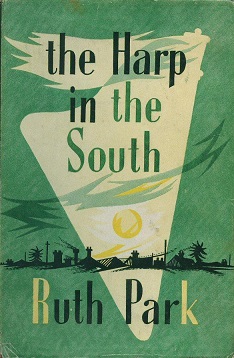
Our writer then talks about contemporary (1940s) literature, referencing the announcement that day of the winner of the Herald‘s novel prize. S/he doesn’t name the winner, but it was Ruth Park’s The harp in the south. S/he refers to the success of this competition, and says:
The mere size of this output in fiction, whatever its merit, shows amply how the itch for writing has grown, swelling the volume of attempts to make Australia articulate. Even more significant, of course, is the genuine quality arising out of this quantity, since the judges have expressed their satisfaction with the degree and range of talent displayed.
S/he continues that it’s encouraging that “the best of the competition novels can hold their own with current oversea fiction”, arguing that, despite patriotic ideals, “our writing … must, of course, ultimately be judged by international standards”. I’m not sure about the “must” but it adds gravitas to a nation’s literature when it can travel beyond its own borders.
However, there was still a way to go, s/he argues because Australia had “not yet produced a writer enjoying the world-wide fame of a Melba in music”, no Yeats or Shaw, Steinbeck or O’Neill. But, Australia had had achievements “creditable enough to arouse legitimate pride”, writers who’d won “warm recognition abroad”, like Henry Handel Richardson’s “monumental trilogy, The Fortunes of Richard Mahony“, Christina Stead, Katharine Prichard, Vance Palmer, and M. Barnard Eldershaw. S/he also identifies Such is life (Joseph Furphy), Capricornia (Xavier Herbert) and The timeless land (Eleanor Dark) as offering “vital renditions of Australia”. Further, Seven little Australians (Ethel Turner), had been read throughout Europe via translation, and Man-shy (Frank Dalby Davison) “hailed abroad as a classic”.
The article then mentions something Bill and I have discussed frequently over recent years, which is “the literary renaissance of the thirties” and its role in the growth and development of Australian fiction. S/he suggests that it is “significant” that “two of the three Herald awards have gone to novels which deal naturally and forcefully with life in Surry Hills and Paddington”. In other words, Australian literature was “moving from the outback”, and filling “the blanks in contemporary Australian literature”, as identified by a visiting American critic, Dr. Canby, who said “there should be crystallisations from the still dumb life of great cities.” I’m not sure about that “still dumb life”, but our writer was pleased to see the novel advancing
from the leisurely bush chronicle to the quickened tempo of drama in the slums; we see a progress in sophistication. Even when the setting is station life, as in the third prize-winner, the interest lies in processes of character, reflecting a transition from pioneering to psychology.
Further, contemporary novelists were eschewing historical romances, and catching up with contemporary world trends, meaning they were seeing “the present in terms of social realism”. And, they were moving from “the adolescent stage of aggressive self-consciousness” to a “maturity” which included “using a national idiom with confidence”. The article concludes that this all this should
break down the traditional timidity of those lagging Australian readers who, in the caustic phrase of Mr. Hartley Grattan, “feel safer with a third-rate English or American book than with a first-rate Australian book.”
By 1946, Patrick White was on the scene. Happy Valley (my post) and The living and the dead had been published, but the first of his great novels, The aunt’s story, was still two years away. While writers like Henry Handel Richardson and Christina Stead put Australia on the world map, it was probably Patrick White who sealed the deal.
Thoughts?
* Meaning, Australian not English.
** Links are to blog posts by Bill or me.


I’m perplexed by the phrase “attempts to make Australia articulate,” but I’m not sure what to say about it. Just this suggestion that Australia was so wild and needed words or something. I’m not sure.
Good question Melanie. Bill might have his own view on that but my reading is that it means attempts to show Australia as it is, not, as so much literature (and the other arts) had done which was to see Australia through other – often colonial – eyes. And, perhaps also, in the case of the masculine bush tradition, to show contemporary Australia not one focused on some sort of romantic/heroic/pioneering settler past.
Interesting, especially the colonial part. I thought maybe it referenced the stereotype of sending criminals to Australia.
And that’s a fair thought Melanie. It’s not how I read it. Let’s see if Bill agrees. “Articulate” is an odd word in the context.
Super interesting post. I wonder if the point being made was that the writing of these women (and I do not know their work, so I am simply speculating) was not Aussie enough, in that it doesn’t ponder over the landscapes, flora and fauna enough? I don’t know but it is fascinating to read these historic views with their biases. I wonder what people will make of the articles of today in 100 years. Probably that everything is political and news is simply a way to sell things..
Thanks Rach, and I’m sorry I somehow missed replying to you and Melanie above. I have no idea how that happened.
I don’t think the article was suggesting that the writing needs to ponder over landscapes, flora and fauna more. I think it was saying that Australian literature was coming into its own and starting to reflect the “real” Australia – rather than its old focus on the romantic/masculine bush. I have two points. One is the one I made in my post which was that there was another tradition already existing that wasn’t this “bush” as exemplified by Lawson et al. My other point is that the “literary renaissance of the thirties” (really from the 20s to 40s) was largely the work of the women writers. (They are well worth reading if you have the time and are interested in our literary heritage.)
Sorry, I must have misread your post.. I am interested in reading these writers and more Australian writers of the current times as well … I will look more into them.
No worries Rach … I need to try harder to make these Trove article posts easier. Their language is quite different to ours.
I’m glad you quoted me, especially about Spence who was definitely our first world class author. But all the women you named wrote of Australian life, some of domestic scenes and some, of the realities of bush life – Baynton and Praed in particular.
I’ve been away almost continuously since last Friday, but I’ll reread your post and consider it more fully when I get home next week.
Thanks Bill … I thought of mentioning Bayton too but I just decided to give a few examples rather than write a long post. I’d love though for you to add more when you have time.
I have read your post again. Whether I can add anything sensible is another matter. It annoys me that the starting point for so many (all) critics before Dale Spender is that Australian literature begins with short story (and doggerel) writer Henry Lawson, and then only consider writers who write like Lawson, about ‘the Bush’.
‘World-wide fame’ was probably never going to come about while Australian universities taught us to ignore and/or deride our own literature.
I’m glad your critic acknowledges the renaissance of the 1930s was real. Despite Vance Palmer and Miles Franklin, it involved a repudiation of Lawson, and the embrace of both Modernism and Social Realism (which of course we have discussed at length) – even as Bush stories linger on.
Maybe this last para is for Rach, above:
Australia has a rich history of excellent urban writing, but of course it’s nearly all written by women. In 1946 the early women had been out of print for up to 50 years so maybe there’s some excuse, but what about Stead, Seven Poor Men of Sydney (1934) or For Love Alone (1945); Cusack, Jungfrau (1936); Dark, Waterway (1938); Tenant, Ride on Stranger (1943)
Thanks for all this Bill … I can’t disagree with anything you say here. I liked, overall, the tone of this article.
Do you think it’s worth mentioning Ada Cambridge who around the turn of the century set some of her novels in Melbourne? Though I realise that “my” critic did of course mention her, and you are focusing on that 30s to 40s time.
You included Ada Cambridge, who I would read just for her accounts of visiting the Melbourne Exhibition Building in the 1880s; and I would also add Catherine Martin whose The Australian Girl I have always rated very highly
I have still to read Catherine Martin. One day.
I wonder if the underlying instinct was to find an element that distinguished writing by Australian writers rather than simply that they wrote books, which led to the idea of highlighting stories about the bush. Defoe might have taken readers to a deserted island, Stevenson might have put pirates on islands for more bloodthirsty plots, but only an Australian writer could tell bush stories? It reminds me of Atwood’s early thesis Survival, about how often Canadian writers (in the context of a national literature) prioritised survival stories, with and without blood in the snow, but always life-threatening weather and always in the wilds (her first chapter aims to remind readers that these weren’t wild lands, but homelands, whose storytellers have been overlooked/ ignored/ denied).
Thanks Marcie. I should read that essay by Atwood. Maybe I can find it for this year‘s MARM. I think the issue was that the bush stories tended to be fairly narrowly focused. Also, Australia always was, really, quite an urban country so writing about the bush felt driven by some romantic or “pioneering” – as you say survival – idea of Australia rather than the real Australia, meaning Australia in all its messy variety.
Ohhh, I wasn’t saying that it was a good instinct, or a truthful or representative one… heheh… just that it might have been part of the… /cynicaltone “marketing plan”? (It’s a skinny book, called Survival. She also wrote one called The Malevolent North… similar ideas.)