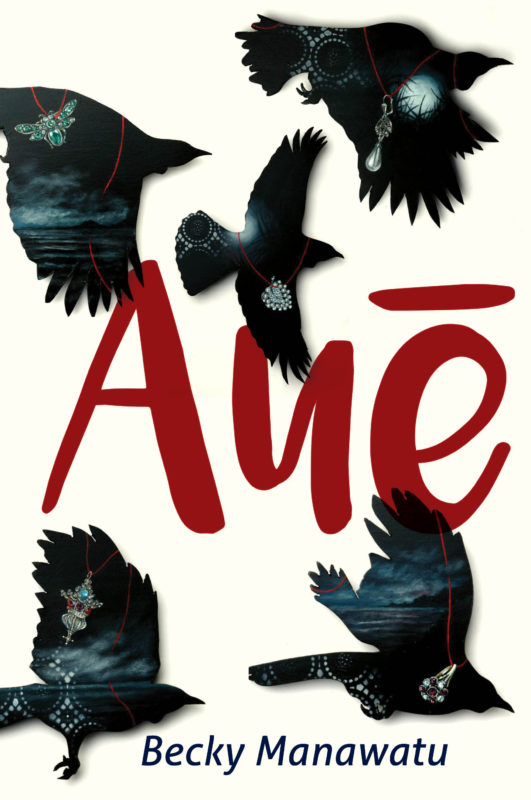
Becky Manawatu’s debut novel Auē won two Ockham New Zealand Book Awards and Best Crime Novel at the Ngaio Marsh Awards. She is of Māori and Pākehā* background, as are Keri Hulme and Alan Duff with whose novels, The bone people and Once were warriors, Auē has been compared. These books address the intergenerational trauma and violence, within Māori and Pākehā communities, that are the legacy of colonisation and marginalisation.
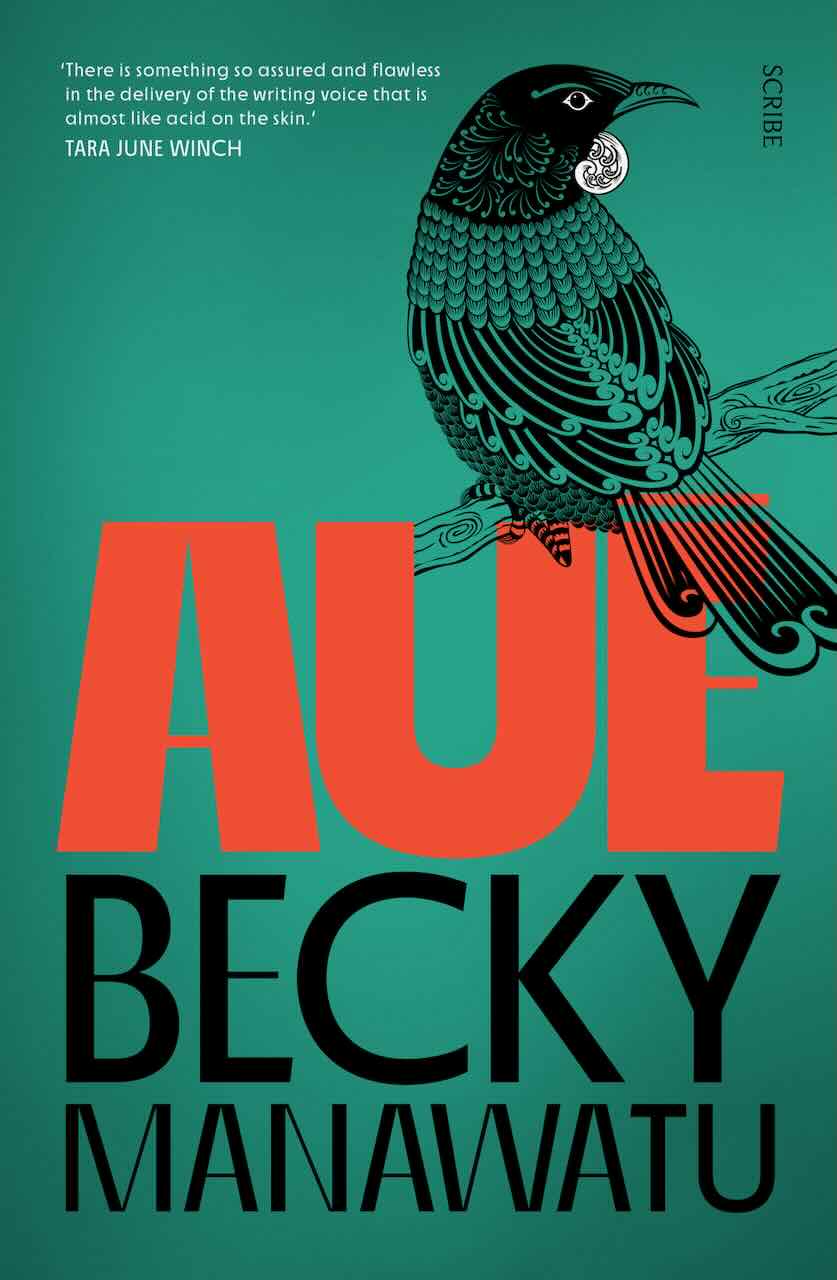
Now, when I first saw the title – and the covers don’t help here – I assumed it referred to a local New Zealand/Aotearoa bird. But no, as the back cover of my Scribe edition explains, auē is a verb meaning “to cry, howl, groan, wail, bawl” and an interjection expressing “astonishment or distress”. Now you know it, you can hear it, can’t you – and it’s perfect for this book.
However, Auē is not all grim. There is warmth and some humour, but I’m jumping ahead. First, the story. Centred around two brothers, 17-year-old Taukiri (Tauk) and 8-year-old Ārama (Ari), Auē looks back to why Tauk deposits Ari with their aunt Kat and husband Stu at the novel’s opening, and forward to what happens after that. These two timelines, are told in three main strands, two in the brothers’ first person voices, and the other, third person, focusing on Tauk’s mother Jade and her husband Toko. The italicised voice of Ari’s mother, Aroha, appears partway through the novel. Now dead, she offers a knowing, wiser perspective on what we are seeing:
We roar, we shake at the world, we weep, but most of the time roaring and shaking and weeping only makes everything much worse. (p. 174)
Auē is not an easy read, and not just because of the subject matter. It has many characters and several locations, so it takes some concentration to keep track of where we are and, more significantly, who is related to whom.
“the bottomlessness to my life was dizzying” (Tauk)
But, it is well worth persevering because things do fall into place, and because, for all the auē we feel throughout Auē, this is a story about human beings, the messes they get into and, significantly, why. Some are of their own making while some are out of their control, but even those of their own making – aimlessness, drug taking, and some of the violence – can be seen to have origins in dysfunction, in poverty, in lack of opportunity. There are awful scenes of violence, the worst being those where you can see people are trapped in something they can’t easily escape, such as Aunty Kat in her marriage to the violent Stu, and Jade and her cousin living in the violence-ridden, drug-fuelled “House” before she meets the gentle Toko.
Jade’s story is complex, starting with parents who loved her but who had their own demons meaning hers was an erratic, risky and sometimes violent upbringing, only to be followed by a possessive violent lover (one of many men who had owned her over time). As a result, when she meets the decent Toko, his mother, Colleen, is concerned. She likes Jade but fears what she brings with her, and the risk it means for her son.
Meanwhile, troubled Tauk, who had abandoned Ari to Kat, believing it’s the right thing because Ari “didn’t know I was trouble and that bad things happened to the people I loved”, heads to the North Island. He wants to get a job, but eventually falls in with a group of young people, where a caring young woman struggles to keep him away from the drug culture – the old cycle – he is being pulled into.
Set against these scenes focusing on adults are those involving Ari and his friend and neighbour, Beth, the daughter of widower, Tom Aiken. Beth is a confident, no-nonsense young girl who has also suffered loss but who, under her father’s care, has developed a decent moral compass (albeit, due to his inattention, she has also developed a toughness that might be her undoing. After all, who lets an 8-year-old watch Quentin Tarantino’s Django unchained). Ari and Beth’s friendship offers a lovely antidote to the other relationships in the novel. They observe and talk about what they see, and role-play different ways of being.
Tom is the adult-breath-of-fresh-air in the novel. He quietly offers Ari safety and security, food and nurture when violence erupts next-door, and he slowly works on getting Kat to leave Stu, though as we know leaving domestic violence is far easier said than done. The novel builds to a shocking climax.
As readers we follow these characters with hope in our hearts but knots in our stomachs. Manawatu beautifully captures the precarity of lives lived on the edge – economically, physically, emotionally.
So, the characters, in all their messiness, engage our attention, but it’s the writing that keeps us interested. Manawatu does what Walton did much later in I am Nannertgarrook (my review) which is to pepper her story with Māori language (explained in a glossary at the back). We learn about whakamā, the sense of shame many characters feel, and the beautiful whenua, a word for land but also, pointedly, placenta. We experience more than one tangi (funeral), and so on. As in Walton’s novel, these are mostly clear from the context.
Besides the language, many motifs – positive (such as a guitar, birds and the sea) and ominous (Bones Bay, paradoxically, also the sea) – thread through the novel, connecting the various chronologies and characters. Ultimately, Auē is both deeply tragic and quietly hopeful. Like the best novels, Manawatu does not judge her characters but lets us see them in all their reality, encouraging us to think about what made them, why they are where they are, and what might be needed for them to escape the destructive cycles they find themselves in.
Last year Becky Manawatu published a sequel to this novel, Kataraina, which takes up Aunty Kat’s story. The idea of stories and storytelling crops up frequently in Auē, with suggestions that stories, even broken ones, can comfort or heal or redeem. I would love to see where she goes in her sequel – and thank Brother Gums for giving me this book.
* Local term for European New Zealander.
Becky Manawatu
Auē
Melbourne: Scribe, 2022 (Orig. ed. 2019)
326pp.
ISBN: 9781922585295


For all the Indigenous writing I read, I haven’t read any from NZ. The closest I’ve got is to see Once Were Warriors, and that was a long time ago (you diverted me into looking up NZ films. I’m sure I saw a comedy at school about some guys getting around NZ in an old Vanguard. No luck. But I did find one about mutant killer sheep).
Two of my grandchildren, now teenagers, are Maori so I should make a bigger effort.
Oh yes, Bill, in that case you should! And I’d like to read more. I didn’t read or see Once were warriors. I think I was put off by what sounded like a lot of macho-ness but I think it’s far more nuanced than that. BTW Keri Hulme’s The bone people is the only book my reading group has done twice, but the second time was in the 90s so still a long time ago!
I have The Bone People on my TBR, near those Tim Winton novels I’ve competently avoided for a couple decades. This new novel from the same region sounds very good too. (And we should start a new list of Films to Watch before you’re 8YO.)
I’m so glad you have books you acquired a couple of decades ago too, Marcie, though I suppose it’s not unusual among readers?
Films to Watch! I don’t need more pressure!!!
Well, you’re a little past the age of 8, so I think you can let my particular imagined project be (as can we all, here). heheh But Bill did recently share with me a juicy list of Australian Films, which tidily exposed in just a few minutes, how few of them I’ve seen (the ones I’ve seen were good, mind you).
Just a little past … !
Now, I’m interested to know what ones you’ve seen, and what Bill had in his list.
WG, the list was the Age top 50 (as selected by experts). I’m sure you saw it. I added some extras.
Ah yes, I did see it – as an SMH list as we Canberrans are more likely to see. It was the subject of some angst amongst the film archivists because there were no films released before 1970. Would you care to share your extras? I’d love to know.
I have The Bone People on my TBR, near those Tim Winton novels I’ve competently avoided for a couple decades. This new novel from the same region sounds very good too. (And we should start a new list of Films to Watch before you’re 8YO.)
The bird represented on both covers is a tūī. I am going to guess that the tūī fits Auē‘s premise because the bird can represent Māori identity, voice, and resilience. I was a bit of a birder in my younger days and always took a bird book with me when I even went on skiing holidays to NZ. I have The Bone People unread.
Ah thanks John. I have heard of the tūī. That makes good sense. The bone people is worth reading.
I’m wondering if cycles of drug addiction and alcoholism will reduce in the future because we know a few things: only in recent decades are we diagnosing people with neurodivergent conditions as children, many people incarcerated show signs of being neurodivergent, and neurodivergence is genetic. Typically, someone without support (medication, behavioral support, channeling interests into healthy directions, etc.), folks get bored and into trouble, or they self-sooth with drugs and alcohol. I remember when Nick was first diagnosed and we were reading books about ADHD, we were surprised by how many people end up with addiction issues or in prison due to undiagnosed ADHD.
Also, we’ve been friends so long, in wondering if I sound like a broken record. Just a little tickle that asks, “Have I said this before??”
I’m not sure you have, Melanie, or not quite in the same way from the same angle.
I’d like to think your reasoning is right and the cycles will reduce, but I probably wouldn’t bet on it. I feel it’s probably poverty and inequality we need to fix to reduce these health problems?
Absolutely, and at least in the US, poverty includes lack of access to medical care because it’s not socialized here. You cannot afford medication or doctor’s visits. Many poor people end up going to get medical treatment when it’s too late. The idea of having an ongoing medication you need to pay for is unthinkable for many Americans.
I read Once were warriors all those years ago – it was beyond sad and so bleak and unhopeful. And I guess if Manawatu is still writing about it 30 yrs later, things have not improved anywhere near enough.