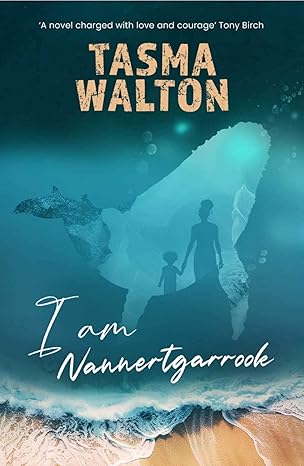
As we got ready for our recent Melbourne trip, I was thinking about the then upcoming announcement of the Stella Prize shortlist, so I packed the two longlisted books I already had. But then, en route, we listened to the Secrets of the Green Room interview with Tasma Walton about her longlisted novel, I am Nannertgarrook. I was intrigued, so I bought it, and, lo and behold, it was shortlisted. My next read was decided.
I am Nannertgarrook, which co-won last year’s ARA Historical Novel Prize, joins the increasing number of historical fiction novels written by First Nations authors, like Kim Scott’s That dead man dance (my review) and Melissa Lucashenko’s Edenglassie (my review). These novels make critical contributions to the truthtelling process. For far too long, Australians have been fed historical novels telling Australian history from the white settler perspective. It’s well past time that we heard other perspectives, particularly those of First Nations peoples.
So, I am Nannertgarrook is an early settlement story. It starts in 1833 in Nerrm (Port Phillip Bay), in Boonwurrung Nation, and moves slowly west to Bald Island, in Noongar Nation in south-western Western Australia, ending around 30 years later. It is based on the story, documented in colonial records, of Tasma Walton’s ancestor, Nannertgarrook (or Eliza ‘No-one’ Nowen/Gamble) who was snatched from her home and sold on the slave market to a sealer.
“in a horror story made real”
The novel opens, idyllically, with some of the traditional features of historical romance fiction, including Nannertgarrook’s romantic descriptions of her “strong” perfect husband: “His kiss stirs a yearning in my belly”, “He is mine … and I am his”. I recollected that publisher Anita Heiss’s goals for the Bundyi imprint is to publish “Commercial fiction: romance / chick lit, historical fiction, contemporary fiction” (see my post), and started to think this was going to be a bit too formulaic for me. But, it soon took a turn, and I realised that, although it had a compelling story-line, I am Nannertgarrook was not going to be a plot-driven book. Instead, it is a considered novel about grief, abuse, and rapaciousness, about true savagery, and about community and resilience in the face of a world ending.
I am Nannertgarrook is told first person through Nannertgarrook’s eyes. It follows her life as “her” sealer keeps moving them west, further and further away from all she knows. We feel her despair when, each time they board his boat, he turns towards the setting sun, and she knows she is not going home. The novel is driven, in fact, by a rich meaning of “home”, because here is the story of a young mother plucked, not only from her family and people but from partway along her journey to full knowledge of her culture. An ongoing grief through the novel is what she doesn’t know and now may never learn:
How different is my world now … the certainty of millennia-long knowledge and experience lost to me on the other side of the horizon. And for the first time a maternal fear creeps up my spine and wraps an icy hand around my heart. Will my baby be safe? Can I do this alone, without my Elders, my aunties, my countrywomen by my side?
This visceral grief – for her beloved Sea Country, and for the knowledge she will never have – combined with her attempts to understand, and then live lightly and fairly on unfamiliar Countries thread through the novel. Walton conveys, by showing, what living on Country is and means (just as Dank did in her nonfiction work, We come with this place). She does not play down to her readers. Indeed, she uses around 150 words from Nannertgarrook’s Boonwurrung language in her telling. There is a glossary at the back, to which I referred occasionally, but in most cases the words were understandable in context or quickly became familiar. These words, like bubup (child/baby), liwurruk (sister), and murrup (spirit/soul) breathe life into the telling. They are not italicised or differentiated in any way. It is up to the reader to go with the flow, and it works, because it gives the story its own flow and authenticity.
Nannertgarrook’s despair over her loss of home and family is pervasive, but I can’t ignore the elephant in the room, the physical horrors to which she and her companions were subjected. Walton handles this – the abuse, the rape, the brutalisation of women and children from very young ages – with skill. She does not build up suspense, nor does she describe it in great detail. These would sensationalise, and effectively downplay, the ongoing nature of the brutality. There is enough distressing description for us to know it, and to remember that it – and the fear of it – is constant. Like Nannertgarrook, we breathe a sigh of relief when the sealers leave the women on land while they go off on their killing sprees.
Related to the physical abuse is the issue of naming. Walton said in the interview that she did not grace the sealers with names, because they did not deserve such recognition. These men, of course, did name “their” women, so Nannertgarrook became Eliza, or, when her sealer felt like belittling her further, “No-one”. Walton, naturally, uses Boonwurrung names for her characters. These aren’t easy for our settler ears, but tough, eh? We won’t learn if we don’t hear.
“insatiable white ghosts”
Two main themes underpin this novel. One is Nannertgarrook’s abduction. A personal story, it also exemplifies the destruction of communities, country and, thus, culture by the early settlers, and it foreshadows the legacy of trauma. The other theme is the rapacious behaviour of the sealers, whalers and others, who killed everything in their path, paying no heed to preserving species into the future. This behaviour typifies the rapaciousness of settler culture in general. The destruction of trees, the indiscriminate killing of kangaroos and joeys, are documented in the novel. Nannertgarrook sees it all, and feels the “shocked hush of irreparable decimation” in the land.
Ultimately, I am Nannertgarrook interrogates one word, warragul, the Boonwurrung word for savage. The novel is divided into three main parts, with the central part titled “Warragul”. It becomes quickly clear just who the savage is, and it’s not the people who “come with this place”. Nannertgarrook knows it, and we know it, but it’s a point worth making in a world where language, sometimes all too subtly, infiltrates the way we understand each other.
So, after some early reservations, I found I am Nannertgarrook an impressive read – moving and informative.
Near the end of the novel, Nannertgarrook hears herself identified as Eliza:
Fierce, righteous anger propels the words from my mouth. Not Eliza. Not No-one. My words are clear and strong. I am Nannertgarrook.
Walton’s novel returns her ancestor Nannertgarrook to her rightful place as a human being deserving of respect. It also constitutes a powerful assertion of identity, much like, dare I say it, Helen Reddy’s “I am woman, hear me roar”. Nannertgarrook, quietly but strongly, roars in this novel.
Tasma Walton
I am Nannertgarrook
Sydney: Bundyi, 2025
263pp.
ISBN: 9781761426698


What an excellent review. I feel churlish for abandoning this novel. I just couldn’t get past the first few pages… the writing was too formulaic and there was too much exposition for me… but maybe I should have persevered because it sounds like your initial misgivings about this book were proved wrong and it got better.
I learnt something new from your review, too. I grew up not that far away from a place called Warragul and had no idea that it meant savage!
I don’t think you should feel churlish at all, kimbofo, because I understand your misgivings. I think the beginning was intended to set up a contrast, a picture of the life she lost and, I think, for white readers especially, of a life that was working very well, but it was a bit cloying.
It is probably a bit wordy, a bit longer than it needed be – perhaps. But I could also justify this. I thought the whole exploration of country/home/place, and of colonialism at a personal level was good.
Oops, and I love that you learnt the meaning of a word that was local to you.
I had the same reaction to the beginning of this novel. Maybe I will skim this chapter & try again…
I think a few did, Brona, and yet it was shortlisted so I guess the judges saw it as offering something new. It is probably one of the more “accessible” of the shortlisted books, but they still have to be able to defend it as shortlist worthy and I believe I can see why.
I really wanted to read this book but when I read more about it I knew it is just too upsetting so I decided not to. This history is just so appalling. I liked your review though.
Thanks Pam … appalling is a good word. I’m glad you enjoyed my review.
I had an interesting conversation with Bill recently about how a lot of these stories of oppressed people all start to feel the same, and I just can’t read that anymore. When you first started the book, you were worried it was going to be formulaic, but isn’t the story of being brutalized by oppressors also formulaic (UNFORTUNATELY), too? Whether I read about Black Americans as slaves, the native people of the US, the indigenous folks in Canada, the indigenous peoples of Australia, the colonized people in other countries, etc. the story is so old and makes me so…weary.
Good question Melanie … I think there’s a difference between formulaic and, what’s the best word, universal. As you say there’s a universality to oppression that means we understand what it is and how it plays out.
But I am talking about formulaic in how something is written. What I came to see was good in this book was the non-formulaic way Walton found to tell the story. She made us feel the oppression through showing how it impacted Nannertgarrook in her feelings and responses to her situation. She showed her grief and her resilience by showing how she thought and acted rather than describing the pain and horror in detail. That was not formulaic.
I think we could argue that all of human experience is formulaic in the sense you use – humans around the world experience romance, fear, grief, oppression, and so on. What I look for in writing in something that can engage my heart and brain by bringing new words, new structures, new situations to the telling.
I think some Indigenous stories deserve to be published whether they are ‘well-written’ or not. In my African reading it is clear that a large number of people who speak ‘English’ use something other than Queen’s English (or King’s English) and that the writing often – validly – reflects that. Still, I’m glad this one got going for you.
Yes, I think that’s a fair point Bill. It does need to be well enough written that people will want to read it, though, doesn’t it. I think this is where Heiss is coming from. Good accessible stories well told.
And that’s what this ended up being. It certainly wasn’t “dumbed down” for white readers – in its consistent use of Nannertgarrook’s vocabulary and its being a more reflective book than page-turning action.
I recently read a new novel by a Métis writer that also included many words that were comprehensible via context but also defined in a glossary in the back, and I was reminded again just how powerful it is to see words from other languages simply included in the story, not offset with a footnote or something. (There is a Métis Nation and Métis people, it’s a complicated intersection of identities, exacerbating contentious relationships between/with them and settlers too,, but in the novel the community/family was Métis Nation and “mixed” Indigenous and French so language use included Cree and French and Michif.)
Thanks for these thoughts Marcie. Language, as we know, is so powerful and has been such a way of colonising and disempowering people that this use of words in their stories feels like an act of defiance (in the I’m-not-dumbing-down-sense, and of reasserting identity. I don’t see it as being aggressive, however, but simply saying, “this is my culture and I’m asking you to walk with me in it…”
/nods Yes, agreeing to tell their story in another language but asserting their right to speak their own and to share enough of it with readers to remind us all that languages carry culture.
Later yesterday I read a great interview with Jake Skeets about the importance of Diné language in his writing. (It might be available to read here at Poets&Writers online, they do make content available online with their free login, not just for subscribers.) He talks about the word for turquoise, dootlizh, and how there is an angled line through the ‘L’, and how the word means “the color blue or green” but that ‘L’ character “connotes something more”, a “deep space that has the capacity to possess an entity within it, like time.” He talks about unearthing and sediment, erosion and landscape: so powerful. [Sorry for not properly replicating the character and clumsily describing it: my ASCII skills are hit-and-miss.]
This is fascinating Marcie. I’m particularly interested in the fact that that is a visual representation of meaning that wouldn’t come through in the spoken version of the word? At least I don’t see how it could? Is this connotation part of the language or his thinking about it as a writer?
Hmmm, good question! In the interview, there are instances where it seems clear that he’s talking about his response to language as a writer and musing on details but, in that part, it feels like he’s commenting on the language itself, like he’s simply stating facts not musing. (Perhaps that character in the written language is recognisable in spoken language because of a shift in articulation or pronounciation, the way that other diacritical marks subtly shift? But I have little experience to draw on there.)
Thanks Marcie … yes I was wondering about whether there’s something about the articulation/pronunciation.
Is this what you’d meant, btw – ł and Ł. Not showing off my ASCII skills, just my Apple keyboard!!
Enjoyed your review of what sounds like an excellent book. And how fortuitous that is also made the shortlist!
Thanks Stefanie … it is fortuitous! It’s one of those books I enjoyed thinking about as I read it.