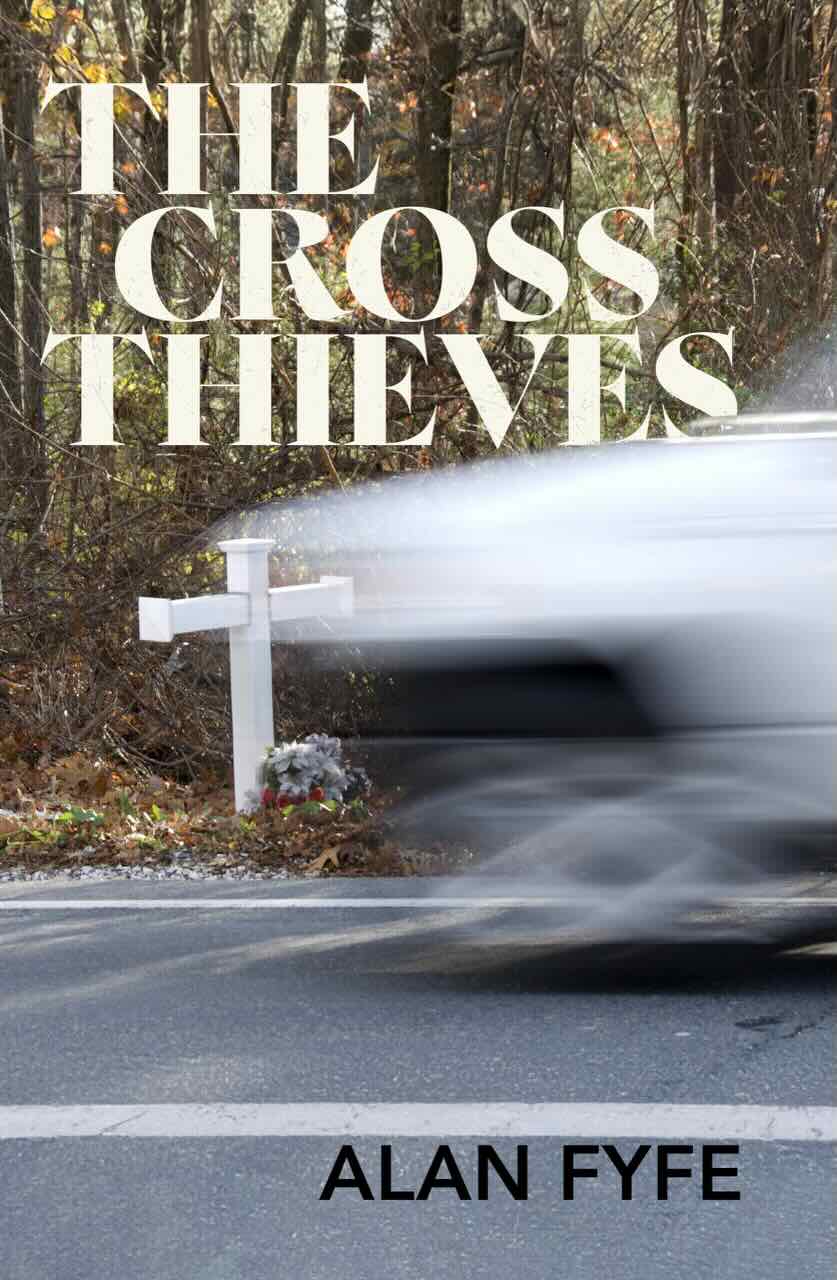
Publisher Transit Lounge introduces Alan Fyfe as “a maker of stories and poems who lives on unceded Noongar country”. His first novel, T, was listed for the West Australian Premier’s Award for an Emerging Writer, and his first poetry collection, G-d, sleep, and chaos, won The West Australian Premier’s Award for Poetry and the overall West Australian Book of the Year. In other words, although his name was only vaguely familiar to me, he has some runs on the board!
Transit Lounge also says that The cross thieves is the second part of a trilogy, which began with the aforementioned T and will conclude with The nine angles. The novels are centred around the Peel region of Western Australia, which is located just south of Perth, and includes the city of Mandurah. As far as I can gather, what makes these books a trilogy is not continuing characters but a continuing focus on social injustice – including homelessness and food insecurity – as it plays out in this particular region. Fyfe’s intention, in other words, is unashamedly political.
The story concerns the brothers Gark and Pell, “two skinny hungry boys living in a squat by a slow river”. Their warm, loyal relationship is one of the joys of this wild read. They are also the titular cross thieves. Intent on avenging the death of a friend who had been brutalised by local thug Cyrus Stanley, they reach his house only to discover he’s already dead, from a car accident. So, what do they do? They steal the roadside memorial cross, making them “cross thieves”, but, in a delightful bit of titular word play, they are also thieves who are cross. This is the setup, but where to now with this big, awkward cross? I’ll return to this in a mo …
First, the book’s origins. Fyfe explains in his Acknowledgements that it was a PhD Project, which is interesting enough, but more interesting is that he wrote it in “a little known (and very old) structure called ring composition”. He says it’s not important that we know what that is, “just that it’s bloody hard to do”. He may be right about our not needing to know, but it does explain the strange chapter “numbering” – A, B, C, D, E, F, X, F, E, D, C, B, A – between which are interspersed old letters between the boys’ now-dead mother Ellie and her sister Moll.
Of course, I wanted to know what “this ring composition” was, and Wikipedia came to my aid. The Ring or Chiastic structure is a symmetrical , or mirroring, structure that is more common in ancient literature – including the Odyssey, and some biblical stories. In The cross thieves, our brothers leave their squat on their mission, steal the cross, and end up on the run from an angry, criminal family, which runs a ‘statewide methamphetamine trade”. At the novel’s turning point, Chapter X, Gark and Pell decide to return the cross – and also have a good meal! The story then reverses their steps while simultaneously continuing the narrative until they … well, I won’t spoil the end but if you have understood the ring composition you’ll have some sense of where it ends. Just not how, or what it all means! As to why use this form, I’m not sure, but it does structurally mirror Fyfe’s interest in the cyclical nature of poverty and the difficulty of escape.
“you get to pick what you believe and what you value”
Now, before you start thinking this sounds contrived, let me say that if it weren’t for the chapter numbering, I’m not sure I would have noticed. What I did notice were two things – the warm, loyal and supportive relationship between the two brothers, and their destitution. Their hunger is visceral, and we are not allowed to forget it.
The novel is told by an unnamed narrator, who opens “A” by describing the brothers and their living conditions, and offers to tell us their story if we’ve “got the right heart to hear it”. Immediately, then, we know this book has serious intent. The narrator returns frequently during the story, such as in Chapter X:
You and I are together inside a comfortable room the height, width, and depth of a page. I can try to manipulate you into having the heart I want you to have by telling you that kind of heart is the right kind. But you get to pick what you believe and what you value. You’re alone with that choice as much as I’m alone when I decide what to tell you about the skinny boys.
Why the brothers are in their current predicament gradually becomes apparent but it is less the point than what happens to people once they are in this situation. Bureaucracy fails them, and starvation impacts the body and mind (although “limits are never exactly where you think they are”). Gark and Pell have stolen and lied – to survive – but they “do not have the souls of thieves”. Gark channels their mother, when, wanting to avenge Lilly, he tells Pell,
“Everyone has a duty to fix things where they can, and everyone’s a person, not a thing to be used. Mum taught us that.”
And so, their mission begins. As we follow them through Mandurah’s streets, we learn about their mother’s involvement in an ultimately destructive evangelical church, the Noble Shepherd Ministry, and in an additional storyline we follow a current pastor from that ministry on his odious mission. We meet buskers, we attend a house-destruction party, we experience the chase – and we are always hungry. The novel has an almost surreal tone as it sometimes hurtles, sometimes drags us through a turbulent, seemingly lawless world, and yet the situation and our narrator’s reflections feel grounded and real. This is because we are fully invested in Gark and Pell. They are ordinary people who just needed the right support at the right time. Fyfe captures their humanity perfectly, and we care deeply about their plight.
The cross thieves reads like a modern social realist novel. Its prose is more poetic and spare, and its plot more wild, but it has the same heart and intention. A memorable read, that should make us all cross.
Kimbofo also liked this novel and the first in the trilogy.
Alan Fyfe
The cross thieves
Melbourne: Transit Lounge, 2026
201pp.
ISBN: 9781923023567
Review copy courtesy Transit Lounge (via Scott Eathorne of Quikmark Media)


Nick and his friend Chris stole a coffee shop sign back in the 90s. Nick kept it for ages before mysteriously returning it one night. After that, the sign was chained down to ward off future shenanigans. Fortunately, no meth was involved. I told him now that we have Google, he should review the coffee shop and include the picture of the sign when it was in his room, lol.
Thanks for linking to my reviews, Sue.
I think Alan’s work is hugely important. He has lived experience re: poverty and drugs and so his stories have a real ring of authenticity about them.
A pleasure Kimbofo. I agree with you about his writing, having read this. It’s great to see someone tackling these issues, and in a fresh way. As I write it has the heart and drive of those social realist novels but is so modern and creative in its style.
Although I tend to most enjoy trilogies (or bodies of work) with the links feeling a little more tug than just the theme (Strout, in our shared experience, for instance, katherena vermette’s stories about Métis life in the city currently called Winnipeg in the context of Indigenous Canadian fiction), I do like thematically linked, or companion novels, like these too. The form of this one intrigues me, and in the right mood I would find it fascinating, and in the wrong mood, I’d be annoyed by how clever he is (which says more about me than it says about him heh).
Yes, well said Marcie. I probably prefer thematically linked/companion novels. I’m not sure you would be annoyed because it doesn’t feel as clever as it is, which I guess is clever in itself! Hmm …
Hah, that’s true! It’s such fun when you land in that kind of story when you are in the right mood to receive it (and not simply feel inferior and dumb /snorts).