It was unfortunate that this Meet-the-Author event coincided with school and university holidays, not to mention a cold Canberra evening, resulting in a small turnout, because the conversation spoke particularly to the career and life challenges facing millennials and Gen Z. This is not to say that it didn’t also speak to older generations, because not only are young people’s concerns our concerns but the bigger picture issues that were discussed are relevant to us all.
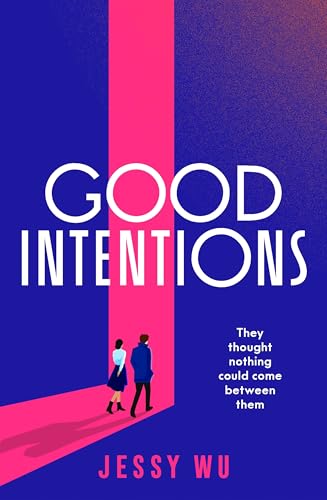
As always, Colin Steele did the introductions. Our participants were debut author, ex-ANU student and ex-venture capitalist, Jessy Wu, and ex-ANU student and Canberra Times journalist Jasper Lindell. They attended ANU together around ten years ago. The novel, Good intentions, explained Colin, draws on Wu’s experiences, and the decisions she made. But, it is a novel, and Nadia is NOT Jessy Wu.
The conversation
On her inspiration, and its relationship to her life
Of course, given Jessy’s life, Jasper started by asking her to talk about her decision to extrapolate from her student life and corporate work in a novel. Jessy explained that about two years ago she had suddenly taken a look at her life, and wondered how she had ended up in corporate finance after her idealistic youth, how she had ended up being, essentially, “a handmaiden in late stage capitalism”. How does this happen to someone? How do you become a cog, and, perhaps, someone you no longer recognise?
She then provided an in-depth synopsis – without spoilers of course – of her novel, which, if I understood correctly, is divided into two main parts, protagonist Nadia’s student and corporate finance-in-New-York days, followed by what happens when she returns to Australia. All this is framed by a student-days romance with Jake, with whom she had uncovered corruption in the university chancellery, and who has gone on to become a “muck-raking” investigative journalist.
Prompting by Jasper to share the experience of the first taste of power through student journalism, Jessy talked about how intoxicating campus life had been, for her. What a heady and hopeful time it was, including first love which she described as being unsullied by baggage from past loves, and involving “intellectual chemistry”. Everything is ahead of you, and you have the sort of certainty that is only visited on 20-year-olds.
On whether the two characters are two sides of the same coin
Jessy agreed that Nadia is more aware than Jake that compromise is coming as they end their student lives. She reflected that love stories are good for exploring dualities, and outlined the backgrounds of her two. Nadia is the only child of immigrant parents who have sacrificed and worked hard to create a better life for their daughter. She feels the weight of parental expectations, has learnt that compromise is sometimes necessary, and is torn between wanting to be good and to make good. Jake, by contrast, was brought up by a single mother who modelled what she told him, which was that you must live your ideals, hold the line, sacrifice for your ideals.
Continuing this duality idea, Jessy talked about the two theories of change: that you can change from within (and she later talked about how Peter Singer had convinced her that this was possible, when she was choosing her path); and that you can only effect change from the outside, which is the path taken by Jake.
These are not absolutes though, suggested Jasper, who asked whether the two were attracted to things in the other that they didn’t have. Jessy felt it was not so much that they are drawn to what the other has, but that the other person acts like a meteor that calls forth the excellence in you.
Jasper found Jake a frustrating character, too dogmatic. He wanted to shake him and tell him it’s not that simple. Jessy saw it more that his resoluteness had set him up well, but had cost him something in his personal life, because it is difficult loving someone so resolute. Sometimes Jake can’t see the world clearly, because the real world exists in shades of grey.
Here we returned to the choices Nadia and Jake had made at the end of university. Nadia recognised that journalism is precarious, and career progression is slow, but through her parents she also saw the stress of small business. How could she provide a good future for kids and her family? She discovers that she has a rare talent for Wall Street trading. Jessy wanted to show how people can be attracted to this.
Jasper said that this can be seen as a sell-out, but he couldn’t fault Nadia for her choice. This is where Jessy mentioned Peter Singer’s lecture about choosing the career where you could best do good through “the lens of effective altruism”. He argued that you can work ethically in, say, the weapons industry, that is, you could effect change from within. However, Jessy found that it is a rare person who can hold the line, that once in this world you start to adopt its ethos of where, your character is corroded, and you become complicit.
She then briefly explained how venture capital worked. You can, say, choose to support a good initiative, which in venture capital also needs to be one that will grow exponentially. Then, you might catch little hints about aspects that are a little dark, that don’t quite meet the ethics you had supported. What do you do? As an investor, the incentive is to look the other way.
On using romance
Jessy had spoken to this a little earlier, but she added that love is universal, so it provides a great entry point into a book. But, books rarely render what happens afterwards if you don’t end up with that love. There is less reflection in literature of years later when you wonder about that person you left behind.
Q&A
The Q&A was interspersed with more conversation and questions from Jasper, so they are intertwined below…
On the quote in the book that you should “pick your battles and fight them well”: Jessy told an anecdote about the way this quote appears in the book, and then said, you can’t fight every battle, you will exhaust yourself. Jasper picked up on this, commenting that both protagonists learn to pick their fights differently, to which Jessy added that moral clarity is not so much picking the right side but understanding the tradeoffs.
On nostalgia: Somehow the conversation turned to physical reminders, which turned to nostalgia. Jessy talked about the etymology of “nostalgia” which incorporates ideas about “home” and “ache”. She talked about the pain of starting out bushy-tailed and starry-eyed only to find it not what she expected or wanted. Writing about it made this time in her life alive again. Jasper commented on campus novels, but how the post-campus transition period is often unexplored.
On moral clarity: Jessy returned to the insider versus outsider view of change. She suggested there was no right or wrong, and that your choice depends partly on disposition. She mentioned Canberra’s Shane Rattenbury who had tried the former via a coalition with Labor Party. This led to a discussion about relationships between the two – outsider (journalist) and insider – which Jessy heard as a gesture to whistle-blowing. When the centre can’t hold, she said, there’s rupture. Jasper added that decisions become real when you move from campus theory to practical life. This resulted in Jessy mentioning her novel’s title, and the idea that good intentions pave the path to hell. Good intentions are rarely enough. She wanted to show how you make choices and the costs.
On how Jessy has crossed the two worlds: Jessy feels comfortable pushing the window. The business and tech world believes things can be done, can be made to happen. There is something positive and hopeful in the idea that tech that can improve the world, that it can be progressive and democratising. We can learn from the way tech orients towards the world but it has blind spots. Take Elon Musk and his early progressive ambitions, but much tech is now moving to the right. Tech is inert, morally neutral, but we need to scrutinise it so it doesn’t take over. This novel pays homage to the good parts of tech, but holds a mirror to its negatives.
On whether writing a novel can be an antidote: Jessy described her second novel which involves an AI company, and a character who “rage-quits” his job when he sees AI creating “badness” in the world. She sees this novel as providing a way into understanding AI and its power, to forcing a national reckoning against Al.
The power of fiction is that you can get people’s unfettered attention, and illuminate the world. In this way, fiction can be part of the world of change.
Finally…
The vote of thanks was given by local author Karen Viggers. She said she didn’t want to shake Jake. She liked that he was principled and idealistic. She also loved how the novel threw her back into university days, though as a veterinary student with much study occurring off-campus, the university newspaper life was not hers. She thought the novel shows how university has both changed and not changed. She loved the Nadia-Jake dichotomy, the pragmatism versus principle, and that it was more than pure romance, but was realistic about the messiness of love. Part 2 of the book was completely unfamiliar world to her, and she learned a lot. But, she most loved the moral and personal struggles faced by the characters. She praised the book for many aspects, but concluded on the way it exposes truths about ourselves and society.
Mr Gums and I attended this talk with a party of seven, comprising an old (as in from a long time ago!) schoolfriend visiting from Sydney, a couple of reading group friends, and a husband or two! It was a delightful gathering made even more so by the lively, engaged conversation between two young people who reminded us of our own university days. Jessy talked about being inspired by “nostalgia” and we knew exactly what she meant. Her clarity and ability to articulate important concepts were impressive, and we came away inspired.
ANU Meet the Author Series
MC: Colin Steele
Lowitja O’Donoghue Cultural Centre, Australian National University
16 July 2026


Sounds really interesting! In Australia, are millennials and gen y two different cohorts?
Sorry, you are right Laura, they are the same. That was a brain fade. I recently explained to some friends that they are the same and then what do I do?! I meant Gen Z. Will change that in the morning – hopefully I’ll remember. (Am on my phone now and don’t like editing posts on it.)
What a lot of information. I have always shared the statement with my brother and I you need to choose your battles. You can’t fix everything and to tell the truth I am over fighting most battles now except animal welfare.
Thanks Pam … I reckon with age we can relax on some battles.
Many years ago, I was the author who was supposed to do a reading, but no one showed up. The facilitator who set up the room and made sure everything was good for me asked if I just wanted to do my presentation for him sitting in the audience. I declined, and they rescheduled it to a different time. It was a weekend-long conference, so that was possible. I’m not sure what’s worse, having a small audience or having a really full audience knowing that professors required their students to be there anyway, which is something that I saw during my University days.
Oh poor you Melanie but I’m glad the facilitator handled it well. Did it affect how you approached the second go at it? But your point about people having to be there is a fair point. I guess in that case there’s the challenge of seeing if you can turn around their potential lack of interest!
I don’t remember if it changed how I approached the second reading. It’s been so long; almost 20 years.
Evan young you now have adult memories from decades … well a couple … ago!
I’m glad there was more than one perspective offered: one person wanting to shake the journo who has ideals, and another person grateful those ideals are prioritised by someone (however imperfectly). Although I agree with everything reported, around this issue, and I haven’t read the book so how can I really know anyway, I worry that it’s not just that priorities are different but actual perspectives are different, and shaking someone never helps! heheh So lots of people are operating in what on-lookers consider a grey-zone but the operators believe they are solidly on one side or the other (which I suppose in this analogy, unfortunately, is either black or white, if a shade of grey is the spectrum between). I can’t tell if I would actually enjoy this novel, but I can tell that I would have enjoyed the discussion and Q&A: thanks for taking us along on your evening!
Thanks Marcie as always for engaging with what I wrote here. I love your idea that on-lookers might see someone as operating in a grey zone, but they don’t see it that way. I’ll have to think about that, but I think it’s related to her suggestion at one point that some of this comes from disposition? I also think your assessment that you can’t tell whether you would like the novel but can tell you would have enjoyed the discussion is a fair one. An author can be engaging and articulate about a book that on reading you may not like anywhere near as much!
That’s interesting: and I guess, then, inclination comes down to how one understands personality? and to what one thinks/believes is permanently attached to one’s way of being in the world and what shifts (whether in a few moments or across longer periods of time)? My ideas and understanding of that are always in motion, having come-of-age in a time when personality was understood to be static. (Maybe that comes down to a fate/free will debate? I’m not sure.)
True, sometimes I read a book and think, well, author and I could very well be friends, go for coffees and such, because we seem to see the world in very similar ways, but this novel sways just a wee bit too much towards instructive, rather than novelistic, for my taste (in which case, we certainly wouldn’t be friends, because nobody wants their friend to think their novel isn’t really a novel /sigh). lol