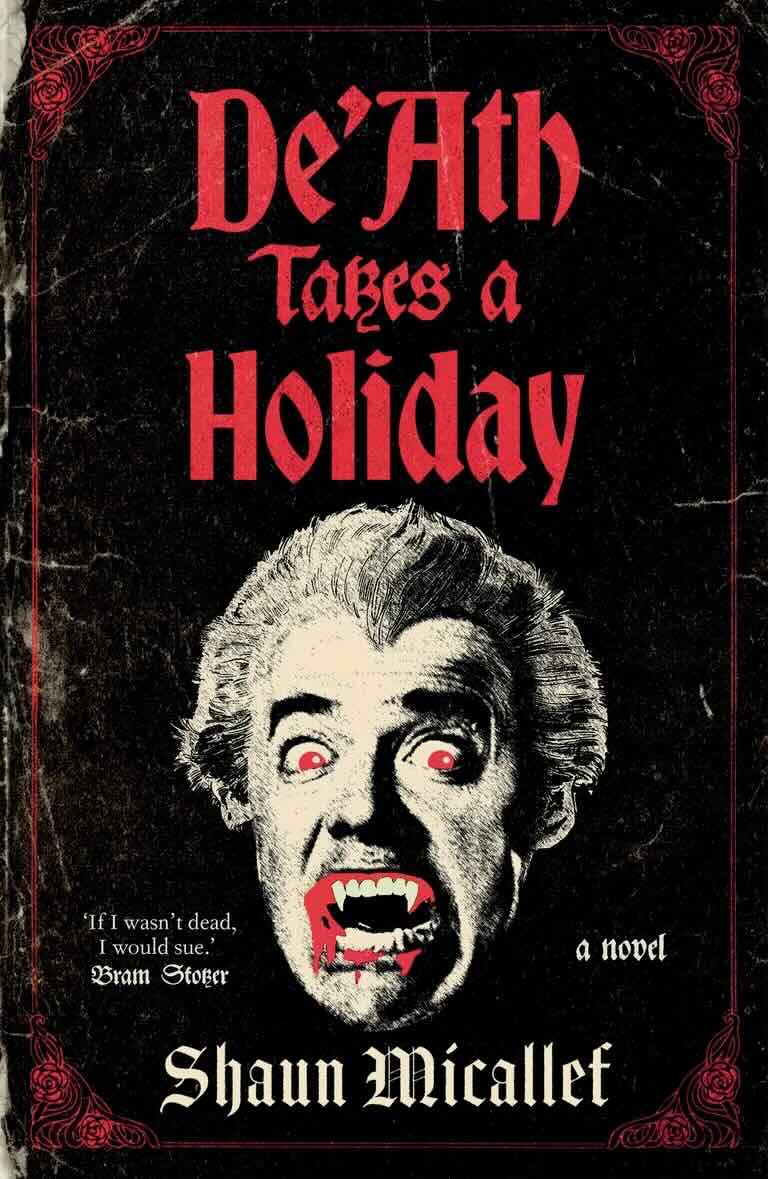
We got to this week’s Meet the Author evening early, and found the author, Shaun Micallef, signing books, so I bought a copy and got in line. When it came to my turn, I told him that only he could get me to read a book about vampires, to which he answered, teasingly but also seriously, that if I hadn’t read Bram Stoker et al, I wouldn’t get the in-jokes. Oh well, I guess I’ll have to take my chances. Hopefully the book, De’Ath takes a holiday, can stand on its own. Described as “the origin story of the first real vampyre (not Dracula)”, it’s a comedic, satiric romp through history – with deeper meanings for those who care to find them.
For non-Aussies, Shaun Micallef is a loved comedian, actor, writer, and host of satirical news comedy on television. Ben Elton, says the book’s blurb, has described him as “perhaps Australia’s finest satirist”. Adam Shirley, who conducted the conversation, is an investigative reporter and radio presenter for our local ABC.
As always, Colin Steele did the introductions. Indeed, he introduced the book so well, including describing it as a backdoor satire on how things operate, that the participants suggested we could all go home – or, go back outside and buy books! However, fortunately for us, they soldiered on …
The conversation
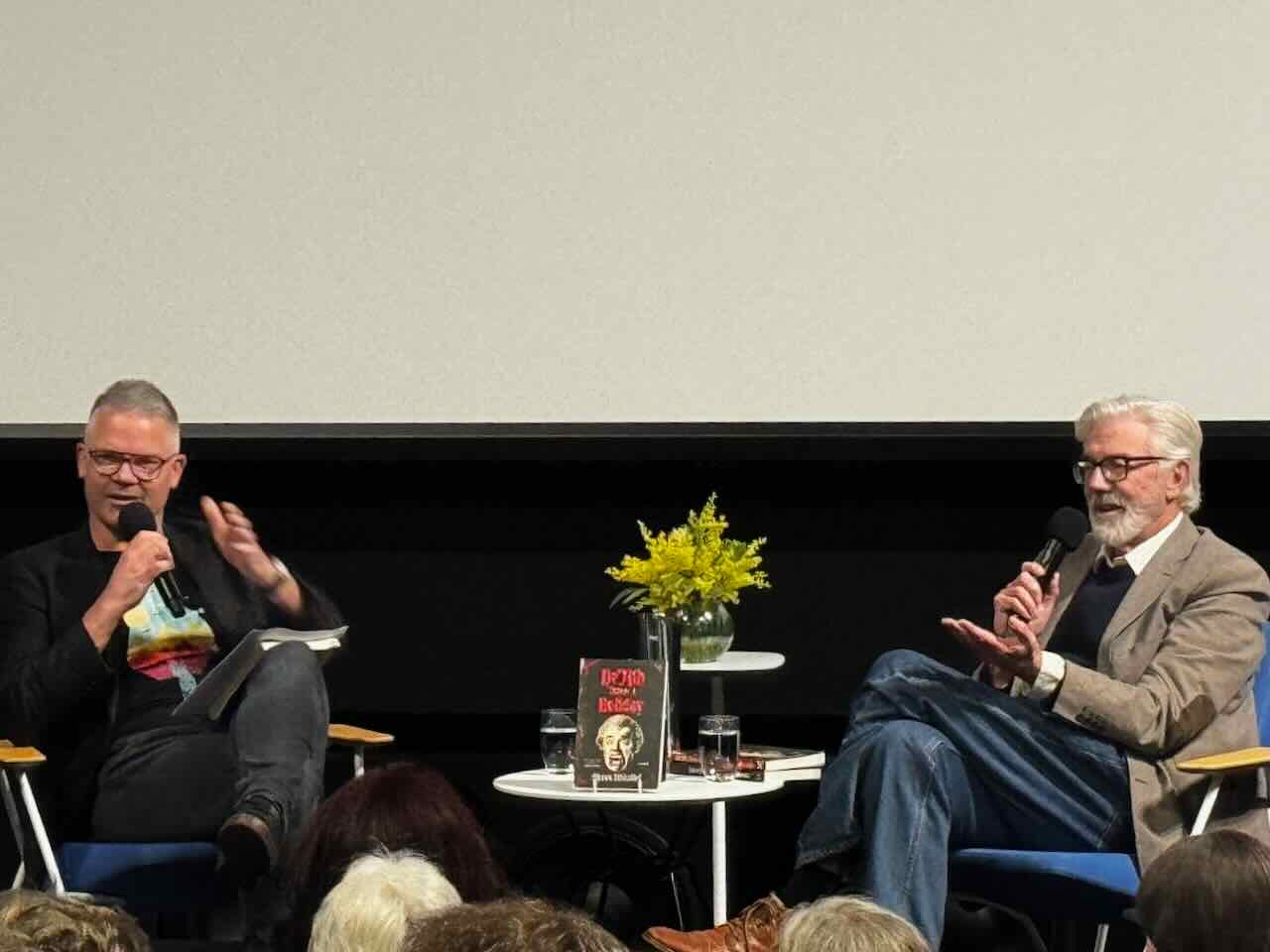
Adam started by describing Shaun as one of our “sharpest minds and funniest people” which drew the immediate quip, “did you interview Tony Abbott?” (Australians will understand the allusion.)
Adam then picked up Colin’s metaphor idea, and gave his metaphorical reading of the book as a timeless tale about a billionaire tech bro. Shaun agreed that it is fundamentally about human labour as capital wealth.
The conversation then turned to his experience of writing the book – more like a marathon than the sprint of TV – and a discussion about optimism versus hope. Referencing the Pandora myth, Shaun said he prefers optimism to hope (which was left in the box!) He is optimistic that things will turn around, but his book is more about how we got to today.
On comedy, reading, his inspirations
Adam asked him about his interest in comedy, in reading, and his inspirations. The book’s narrative style harks back to the 1892 book, The diary of a nobody, by brothers George and Weedon Grossmith. This book, which I too loved in my teens, starts from the conceit that everyone writes a diary (which drew a brief discussion about people’s use of social media, today, to communicate – if not, perform – their lives). Shaun also loved Robert Louis Stevenson’s The wrong box. He loves the language, the circumlocution, what he described as “luxuriating in language”. Shaun talked about his early difficulties with reading, but once he cracked the code – that you could read in clumps, in lines – he was off.
Adam and Shaun talked a bit about comedy. Shaun loved comedy from a young age. It’s the thing that occupies his mind, and is almost more fun when it doesn’t work. He enjoys analysing why. He loves the tension between when a joke comes out of the mouth and the laugh. You don’t get that immediate response when you write a book.
What then was enjoyable about writing the book? It was having time, and using the same muscles but in a different way. It can be lonely, but the world building is fun. He hears voices of his characters in his head. He also had fun emulating the style of writers he admires, like Oscar Wilde in the blood transfusion scene!
On zombies and other subjects
Adam, who later described himself as Team Zombie, asked whether they are the unacknowledged heroes of the book. Not exactly, but the book is about human labour being the foundation of capital wealth, and zombies do prove to be better workers than vampires (for reasons that are made clear in the book). The book’s protagonist, the Comte De’Ath, shares his ideas about labour with Henry Ford who takes them back to America. Today’s corporations are modern-day vampires – immortal, with no empathy.
At this point Adam read a small excerpt referencing the zombies …
Left to their own devices and without anyone to tell them what they could and couldn’t do, the zombies fell to cooperating with each other and creating a society. (p. 150)
… and asked Shaun about his thoughts on authority. Shaun is always interested in authority, specifically in the idea that if you have strength you should lean on someone, and are weak if you don’t. In this novel, he looks at thinking about strength and might, and its role in the world. The novel’s narrator, Roger Bracegirdle, is on a journey in which he learns what life is (which the Comte can’t do because he is immortal).
On Shaun, now
Shaun admitted that he was burnt out by the time Mad as Hell ended. He “stepped off the train” to give space to younger, more diverse authors. Describing his Origin Odyssey, he suggested he has entered his Michael Palin era; he is interested in telling more serious stories, like his current TV show on gambling. If there’s value in his holding the microphone, he’d like to do it. Shaun admires Palin, whom he has met a couple of times, and who, like all the Pythons, listens and is generous with his time. Terry Jones, he shared, once described a book as having the author sitting on your shoulder, whispering into your ear.
Concerning the book and his expectations, Shaun would like people to laugh – even if they laugh at different things. It’s a comedy, and if people find the deeper strata or message, that’s good too. As to whether he needs affirmation that the book is good, Shaun admitted that he’s a performer so needy! He talked about doing the audiobook version, himself, and searching for the right voice for his protagonist, Comte De’Ath. Alan Rickman? Jeremy Irons? He treated us to a recitation of lines from TS Eliot’s Ash Wednesday in a Jeremy Irons voice – and asked if we knew what “The infirm glory of the positive hour” meant!
As for his own reading, Shaun reads books about comedy and books by comedians on their journeys. He likes books that offer little signposts to navigate your own life. We write, he says, to make sense of what has happened.
Adam returned to his tech-bro metaphor, and to the spectre of AI, which he suggested is inevitable. Shaun’s not so sure! He said you can feel the humanity in Chaplin’s films, less so in modern Marvell films say, with their artificially created special effects. Speech is thought, he argued, but all AI does is talk. There’s a difference. (At this point he did one of the best Trump impersonations I’ve seen.)
Shaun is not on social media, not glued to his devices, and definitely not a fan of AI, which he sees as “cravenly Uriah Heap-ish”. This made me laugh given my recent interactions with Chat GPT and its determinedly positive responses.
Q & A
There weren’t many questions from the audience, so the Q&A included questions from Adam interspersed with audience questions.
On whether AI can be useful as an adjunct to human thinking and creativity: Shaun would not let AI into the room, but admitted that he was 63, and had “brought the shutters down on everything” when he was 45.
On whether we can take the Gothic seriously: Shaun doesn’t think they did. Gothic is funny. It can be both parodied and loved. Anything that handles that and survives is worth considering. I was interested in Shaun’s aside around here that he sometimes thinks it’s a pity that spareness of language is taking hold. Gothic is over the top – and fun – but I think there’s a place for both approaches to writing.
On whether our civility is just a front: Shaun recognises that at heart we are transactional. We decide how to relate to people depending on how we feel about them.
On whether humour is an antidote or answer to our troubles: Shaun believes the best laughs are those in which we recognise ourselves. However, he doesn’t think satire is enough if you really want change. The “soft revolution of representational democracy” is more the way.
Finally…
The vote of thanks for this most entertaining evening was given by Canberra’s queen of horror (and more), Kaaron Warren. She was the perfect pick for the job. As she knows, writing horror well – turning human fears into meaning, mixing humour and horror – is hard. But, horror is the genre of metaphor, meaning you can sneak in a message. Micallef made her laugh, and think, and creeped her out. What more could you want!
ANU/The Canberra Times Meet the Author
MC: Colin Steele
Lowitja O’Donoghue Cultural Centre, Australian National University
25 May 2026


Looks like you had a fun time. I do not like vampire stories at all and never have. No idea why. I hope you enjoy the book.
Thanks Pam, I did and me neither. But, I do like spoofs and satires, and I think I understand enough about vampires – and about politics and history – to enjoy this. I am rather looking forward to reading it. What first – a graphic novel which I don’t usually read or a vampire origin story which I wouldn’t normally read! Choices, choices!
I always mean to read one book then get sidetracked on something entirely different‼️
I know what you mean.
This sounds great!
Thanks Cathy … I will try to read the book soon. But the event was good.
Shaun Micallef is always good value. I went to his last book launch and he was both hilarious and thoughtful. In the signing queue, I mentioned that I loved that he had chosen a Gavin Friday song to end his final Mad as Hell show and he was delighted, saying something along the lines of I must be the only person in Australia to understand the reference! (I’m a long time Gavin F fan… he’s an Irish singer-songwriter, best friend of U2’s Bono and performs in a kind of over-the-top camp cabaret style and just has the most marvellous throaty voice. I used to order his CDs on import back in the 1990s because there was no other way to get them in Australia)
Thanks Kimbofo … I think you probably won him over more than I did then.
I will wait for your review Sue to see if I venture down this path or not. I do enjoy Shaun’s TV work (in small doses), but vampires and satire? Two of my least favourite genres.
You don’t like satire Brona? I hadn’t realised that. I do like satire. Not all of course but a lot. I know what you mean about Micallef’s work … some I love. I
Don’t automatically love sketch comedy. Some can be too OTT. I think comedy is much less universal than tragedy.
I’ve never been able to finish Catch-22 or Don Quixote. The only one I can think of that I have enjoyed is Animal Farm (and if you call 1984 a satire, then that too, although I think it is much too dark and serious to be satire). Although I did enjoy the TV series MASH in its day, so I guess it’s more of a depends on the circumstances, what it’s satirising, how it’s achieved etc.
I’ve read quite a lot of satire, but not Don Quixote nor Catch-22! Kurt Vonnegut’s Slaughterhouse-five is a recent one that I read.
I thought 1984 was satire. I think satire can absolutely be dark and serious?
I’ve been thinking about it since we first spoke on this and I think for me it is satire with ridiculousness that I don’t get on with (DQ and Catch-22) but frightening dystopian-style satire like 1984 I do like. Thanks for helping me to clarify my thinking around this! You’re a good sounding board 🙂
Haha, thanks Brona… I think one of the very best things about blogging is the sounding board thing. I love reading groups because the immediacy and the liveliness that can happen are just beautiful but blogging has a different value. It gives us time to think before we respond and thus to develop ideas.
I agree with you to a point. I do like dystopias, and satirical takes can be the best. But here’s a tricky thing to explain because I’m not sure I can explain it … I don’t really like ridiculousness but I love absurdity. And these might partly be in the eye of the beholder. Ridiculousness just feels silly while absurdity to me includes wit. If that makes sense.
That does make sense and as I read the first part of your thought ‘eye of the beholder’ and then you went and said the same thing. My threshold for absurb must be very low as I can see how Catch-22 and DQ are absurd, and I initially enjoy that, but around the third to halfway mark it tips over into ridiculous and silly for me. And that’s when I lose interest, or perhaps it is better to say that I get tired of the joke.
Yes, I think it is probably hard to sustain the absurd for the long haul. Not having read those two I can’t comment, but I think absurd is probably most effective when kept short so, as you say, the joke doesn’t pall.
I’m sure I read a novel where the protagonist, or maybe more than one, had names which were a variation of de’Ath, but I can’t find it. And wikipedia’s no help, except to reinforce it’s a real surname. I’m wary of novels by people who got famous for something else (looking at you Ben Elton). I’ll wait for your review.
I take your point re wariness Bill although Micallef does have a writing track record – nonfiction, children’s books, short stories not to mention his own comedy sketches (though presumably for the tv shows he had other writers too). This is his first novel I think.
Where IS Jeremy Irons?? And why isn’t he in EVERY movie?! Actually, I would settle for him narrating all the audiobooks. Of course, we want Alan Rickman too, but, like, does Adam Shirley know he’s dead?
Oh man, I would have to NOT do whatever someone deemed “cravenly Uriah Heap-ish.” That cracked me up, and no one wants to be like Uriah, the sniveling tissue!
Your last paragraph reminds me of my recent review of American Psycho, the comment section of which is full of people admitting they laughed at the quotes from my review and felt bad for doing so. That’s definitely humor and horror mixed!
If you want to read your new vampire book together and we each answer the same questions about it (we can email to figure out the questions) to post on our blogs, let me know! I’m up for an adventure.
Lastly, if you are curious about Dracula, it is an excellent classic novel. Lots of good moments during which people race across Europe via horse and carriage and epistolary chapters.
Love all this Melanie … I saw your American Psycho review pop up on my feed and will be reading it. I’ve had a super busy week. I know I should read Dracula. Maybe I’ll put it on my reading group’s classic suggestions list! I think this book riffs on all that …
BTW can you get this vampire book I’m talking about? I am tempted by your idea, though feel a bit panicky about reading to a set schedule!
I can get it, yes. No need to read to a specific date. Maybe something like by the end of X month we’ll both have read it and emailed each other some questions.
That sounds a goer Melanie … and could be fun … I’ll email you about timing?
Yes, please do!
That sounds like a delightful evening, with humour and smart stuff all mixed in together. I like the idea of learning that you can read in clumps. And I abhor the idea of “bringing down the shutters” at only 45, but I have seen it happen sooner too. Is that a common phrase or something he says? (Although on very hot days, that’s survival.)
It was delightful, Marcie.
And yes, bringing down the shutters is a phrase Australians would know, although it’s not commonly used now. I found it a little surprising, both to hear it used and for him to use it. But we have to remember that he is a satirist, so it’s hard to know how serious he was. He has an engaged active witty mind so if he did mean it seriously I think it was to do with not wanting to engage with the complexities of modern technology. But, I have no desire to “bring down the shutters” re technology. I see it as being a lifeline as I get older and less mobile. I see it as a way to keep connected and I think we are lucky.
True, it might have been a deliberately hyperbolic thing to say, simply to draw out the point. And of course one can stay active and engaged in so many different ones; one person’s way of doing so needn’t be the same as another’s. He’s clearly found a groove that works well now. But it does seem a little short-sighted to overlook the future benefits we might be able to enjoy if only we pay attention. I’d planned to stick with a flip-phone myself, but one day my boss handed me her smartphone and asked me to look after something, and I realised that I was going down the wrong path if I wanted to remain employed/employable (and not being a trust-fund baby, that’s also a Thing).
Yes, I agree about the short-sightedness re future benefits.
One of my groups is my old patchwork group – we now longer do patchwork but we meet twice a month for coffee and chat. Five are in their 80s while two of us in our 70s. The difference in their attitude to technology is very interesting. A couple are well-engaged with using phones and smart features/apps which help their lives (including connecting to hearing aids, navigation). One uses her iPad for entertainment, but refuses to use email! The other two use their phones to some degree. (I was anti-phone to start with because of the way they can intrude into personal communications BUT then I realised it is like anything we do, any change that comes our way. You work out the courtesy/etiquette. After all they are based on principles which are pretty easy to apply, and you apply them. If people don’t then that’s something you take into consideration when developing your friendships and relationships?
True, there are plenty of ways in which communication can break down in any relationship, and it’s easy to spot when there’s a device between the people, but that doesn’t mean that the other kinds of breakdown are any less detrimental. You can disregard or denigrate what someone else is saying without having a screen in front of your face. You can be the taker always and the giver never, and no wi-fi required. !!
Well said!