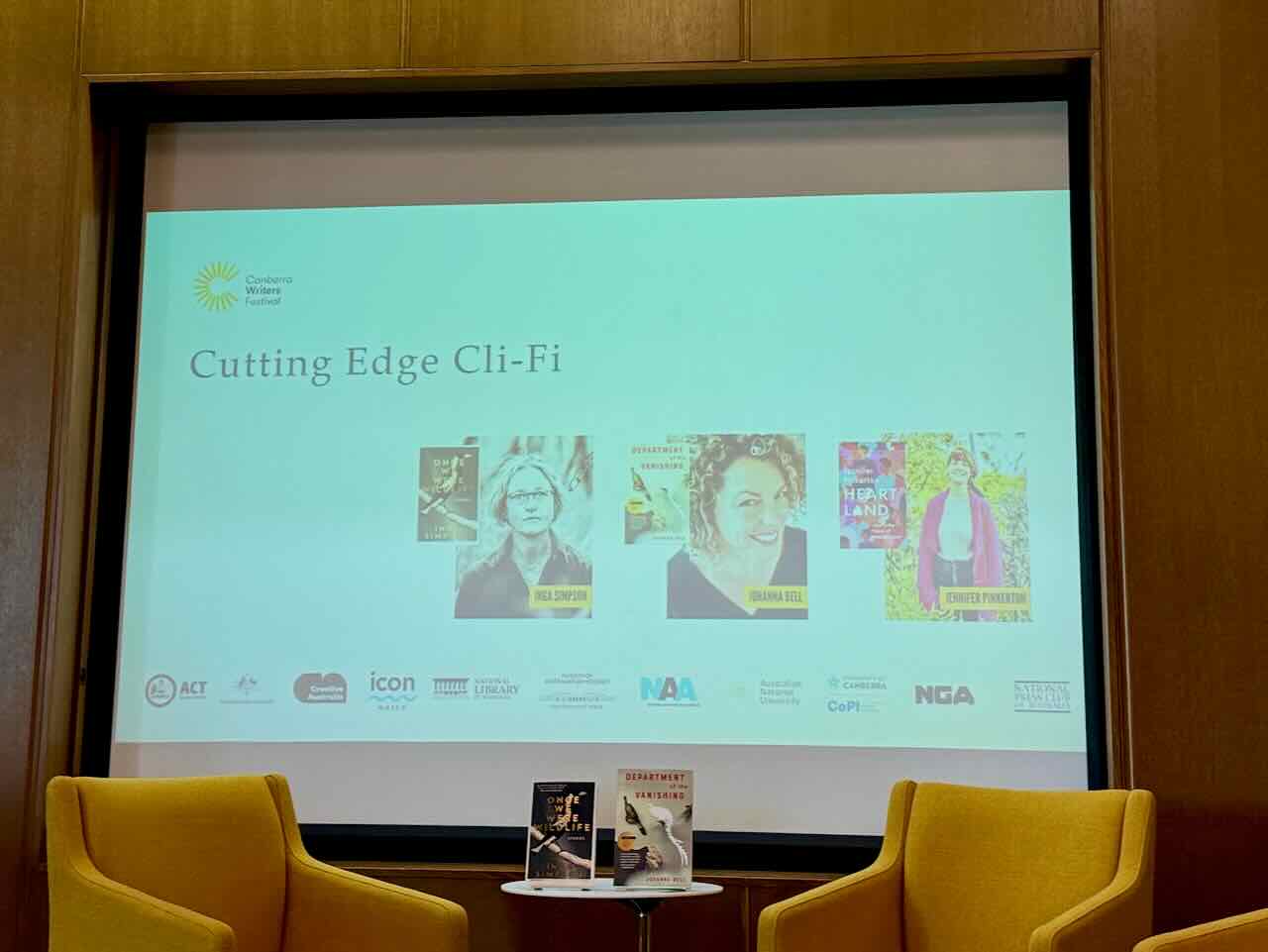
Johanna Bell, Inga Simpson with Jennifer Pinkerton
The program described the session as follows:
The facts of climate change and the large-scale loss of animal and plant species are all around us. To truly understand, we need new creative forms that speak to the grief, absurdity and banality of our situation as well as capture the beauty of all we have that is not yet lost. Join Johanna Bell and Inga Simpson in conversation with Jennifer Pinkerton for a discussion about the vitality and originality of climate fiction.
The two books discussed were Johanna Bell’s Department of the Vanishing (my review) and Inga Simpson’s When we were wildlife (on my TBR and currently reading).
The Conversation
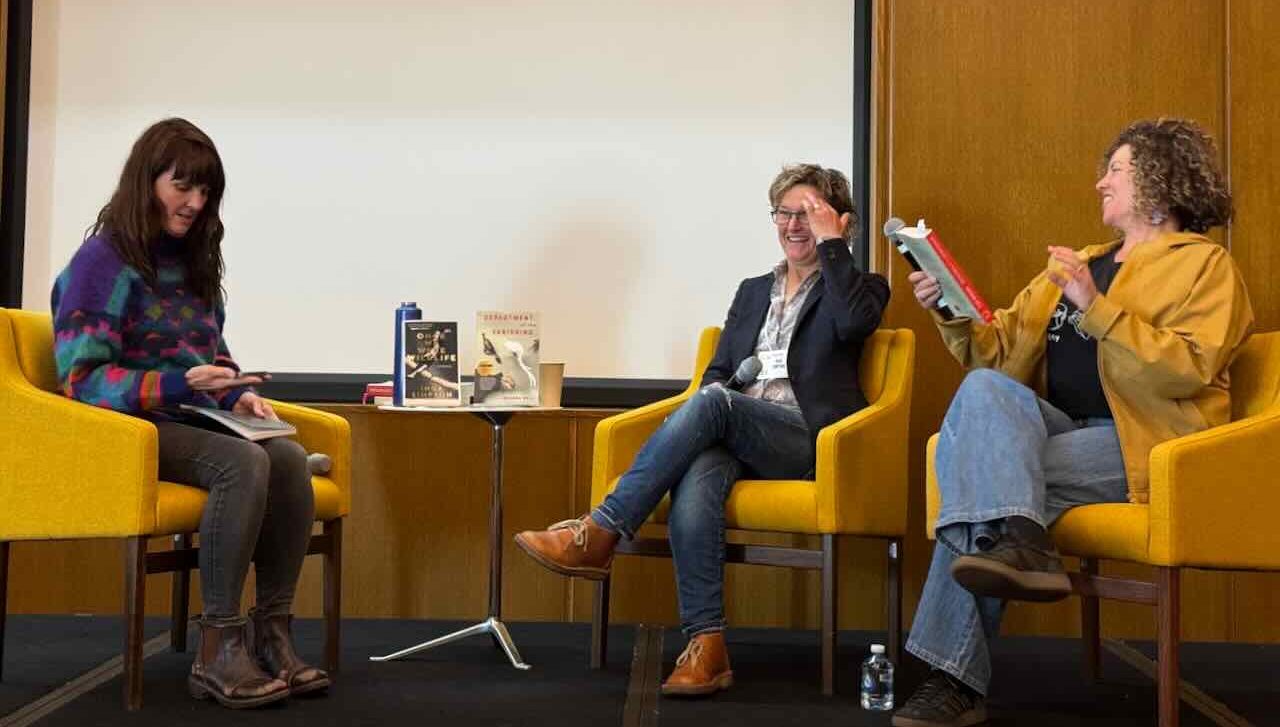
Moderator Jennifer Pinkerton introduced herself as an environmental journalist and Executive Director of the Canberra Environment Centre, and then acknowledged country.
She said the session would discuss what fiction can do when the natural world becomes more than a setting, and is central to the story. Johanna’s book is about extinction, disappearing birdsong, death, grief and more, while Inga, who has written multiple novels and has another, with art exhibition, coming later in the year, will focus on her recent collection of eleven short stories and one poem!
On what stories offer us during times of ecological loss
Jo said her book began with a 2018/19 article in The Guardian, which focused on the Regent Honeyeater. The critical shortage of mature wild males to pass on traditional mating songs to younger generations, means fewer male birds to woo female birds and an increasing loss of population. She feels she is trying to sing birds back into existence. She’s an obsessive listmaker and collector of ephemera (which makes sense if you have read her novel). After reading this article, she wrote a long, ultimately unpublishable list poem, but then wrote Department of the Vanishing. There is a big vanishing in the novel – her protagonist Ava’s father – along with multiple species extinctions. The novel is set in the near future at a time in when birdsong is vanishing, but Ava discovers something that could reboot all this.
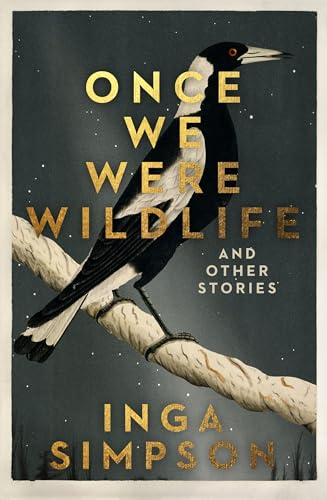
Inga never expected to publish a collection of short stories. They are not her form, she is too long-winded! The opening story, “The Wash”, is based on a real life near-drowning experience, while the next story, “The blue crane”, came out of small experience during lockdown. She observed this bird. After it took flight she noticed the strong impact it left in the sand, which was evidence of the power of take-off. By the time she got home she had written the story in her head. She enjoyed injecting a touch of weirdness into the story, one which represents a transformative moment. She’s interested in the boundary between the human and extra- human world. This idea informs the journey the collection goes on, as a whole, gradually leaving behind an anthropocentric view of the world. [I heard this as her telling us that the collection should be read in order.]
On why Bell chose a deviant archivist as her protagonist
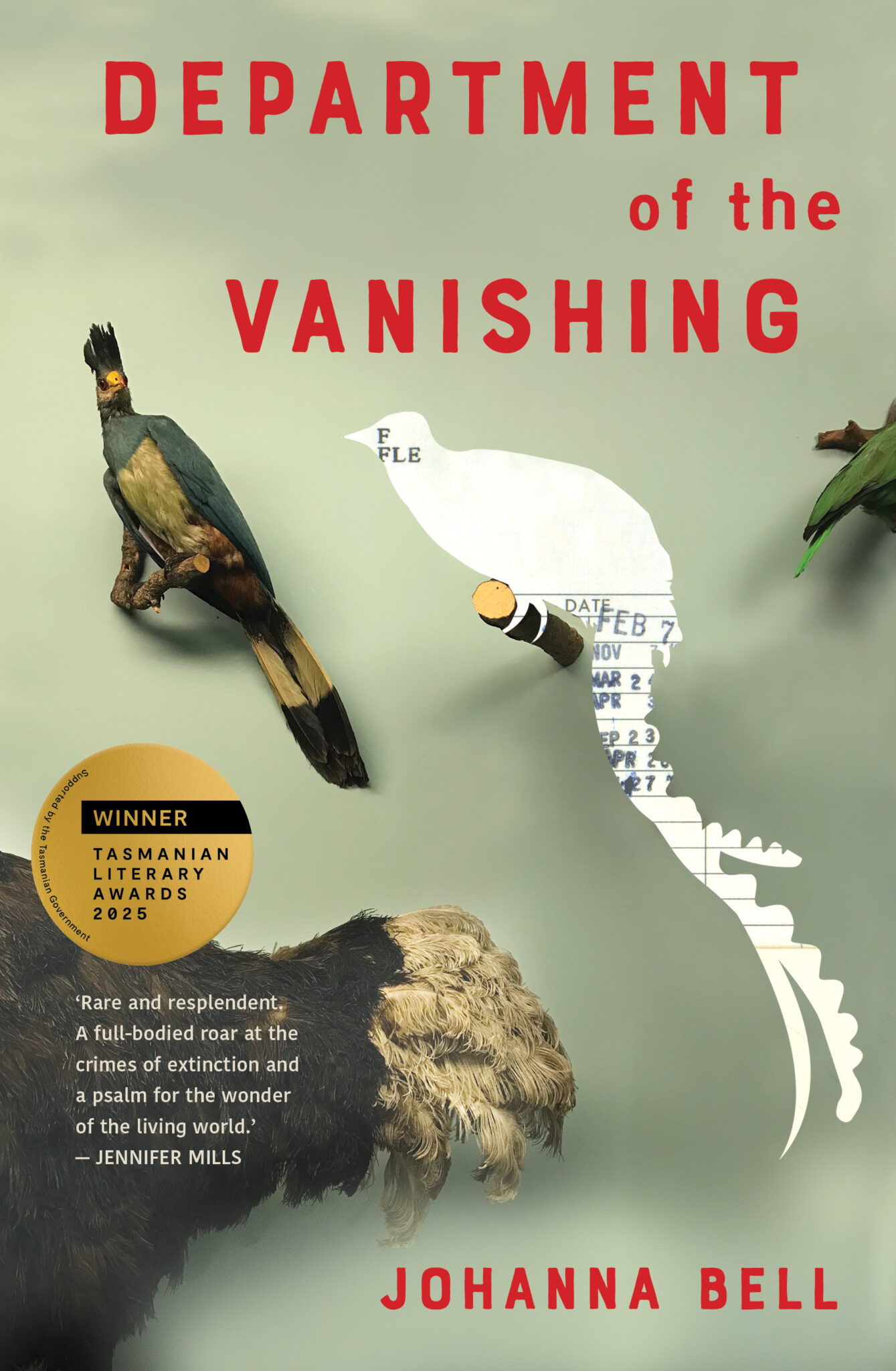
Jo gravitates towards books that are surprising! She feels our opportunities for being surprised are rapidly disappearing in our app-driven world, where we can check locations, weather, etc in advance. (I take her point, such as with restaurant menus!) She was also driven by the archivist aesthetic. (At times she conflated archivist and librarian, but in terms of the book, this is immaterial). She looked at every book in the NLA that had “lyrebird” in the title! After all, the lyrebird is one of the original archivists. Ava does things that she, Jo, a rule-abiding public servant would never do!
She talked a little more about Ava, including her dating rules which include never having a second date – until Luke, the man with the lyrebird tattoo appears! The trouble is, he asks her to take things. Fiction allows you to do things you can’t do in real life.
FIRST READING. We had two readings during the hour. First off, Inga read a distressing road-kill experience from the titular story in her book, while Jo read one of her fictional obituaries (the one for “The red-tailed cockatoo”).
On how writing can work as a space for processing loss and grief
For Inga, fiction derives from both her desire to communicate, and to crossover to another species. She wants to help readers reconnect with the natural world. There is a tendency to think hopelessly, to think that after events like Black Summer, all is gone and the natural world can’t, won’t recover. But it does. Not the same way but it does recover, so she realised she had to toughen up. If she has an agenda, it’s that all is not gone, it’s not too late, and there’s beauty to enjoy every day. But also, there’s much we can do!
Jo, who described her book as a verse novel and a bricolage, said the question at the heart of her novel is that we can create a new whole with what’s left over. We will lose a lot, but we can remake. Climate change is a strange phenomenon. It’s everywhere (we know it) but it’s nowhere (we can’t see it around us); it’s enormous and it’s nothing. She loves poetry and metaphor, so the lyrebird in her novel stands in for many aspects of the grief process. Her book is a work of fiction laced with lots of nonfiction. She can’t stay in one lane.
SECOND READING. Jo read part of the lyrebird poem in her centrefold section, while Inga read an excerpt from the second story, “The blue crane”.
On whether they had a memorable nature book in their childhood
This question referenced CWF’s theme concerning the books that changed us. For Jo it was Tim Winton’s Blueback. She had relationships with fish. This was her first taste of nature writing. For Inga, it was Blinky Bill, with its wonderful population of Australian animals.
At this point, Jo had a whinge about the children’s publishing industry which is now risk averse now about darkness, something that was common in older children’s literature. “We are sanitising the emotional world“. (Interestingly, in yesterday’s ACT Book Awards session, Emily Gallagher talked about how children look for ghosts and monsters.)
On rule-breaking, and their writing craft
Inga enjoyed the freedom she found in writing short stones. She could get away with more, such as write from the point of view of a gannet colony. The short story form gave her licence to play with form and perspective, to write away from human-centric narratives, though she admitted that the titular story is mostly human.
Jo, on the other hand, didn’t know what she was doing. After all, she had started with that unwieldy list poem. But she was encouraged to keep doing her thing, and guided to find more connective tissue. She talked about burning her darlings in the evening gatherings at Varuna!
On what they hope will stay with readers
For Inga, it would be the experience of inhabiting other skins, while for Jo, whose whole life has been inhabited by birdsong, it’s the idea of the world waking up to silence. That would be the saddest eventuality.
Q & A
On whether there is a place for humour in such a serious subject as climate change and cli-fi: Jo said that humour offers a side-eye into serious content. Hers is not a funny book but does have some humour. She would like a “comic pass” (like a sensitivity read, but for humour) for her next book.
On the curative aspects of their books and reading: Inga saw escapism and healing in nature. Jo talked about dealing with her own climate grief, and that her book can offer an antidote to grief, an opportunity to experience grief. Hope is a complex issue in the climate change world. It is not enough, on its own, but it can be a salve.
On writing about anger without losing the reader: Inga said you need to play close attention, and write to learn and discover. Jo said that Ava is not enraged enough! Maybe that’s her answer: make readers notice and be angry.
On finding sentence in another being – when we cannot know – and not anthropomorphise: Inga looked at this a different way, saying we’ve been taught we can’t anthropomorphise. But this is not true, animals do feel, they use tools – in other words they exhibit human-like traits. We can’t know of course, but she thinks it’s an interesting (important) exercise to try to shift from being anthropocentric. We fear anthropomorphism, but why? In her experience, animals – like kookaburras – try to communicate with her.
This was a quietly engaging and well-structured session that conveyed something about the breadth of writing in the eco-literature (cli-fi) field, while also teasing out some relevant issues, including anthopomorphism, the issue of hope, and variety in form.
Canberra Writers Festival, 2026
Cutting edge Cli-Fi
Saturday 17 October 2026, 10.00-11.00am

