Steve Toltz and Elaine Castillo with Beejay Silcox
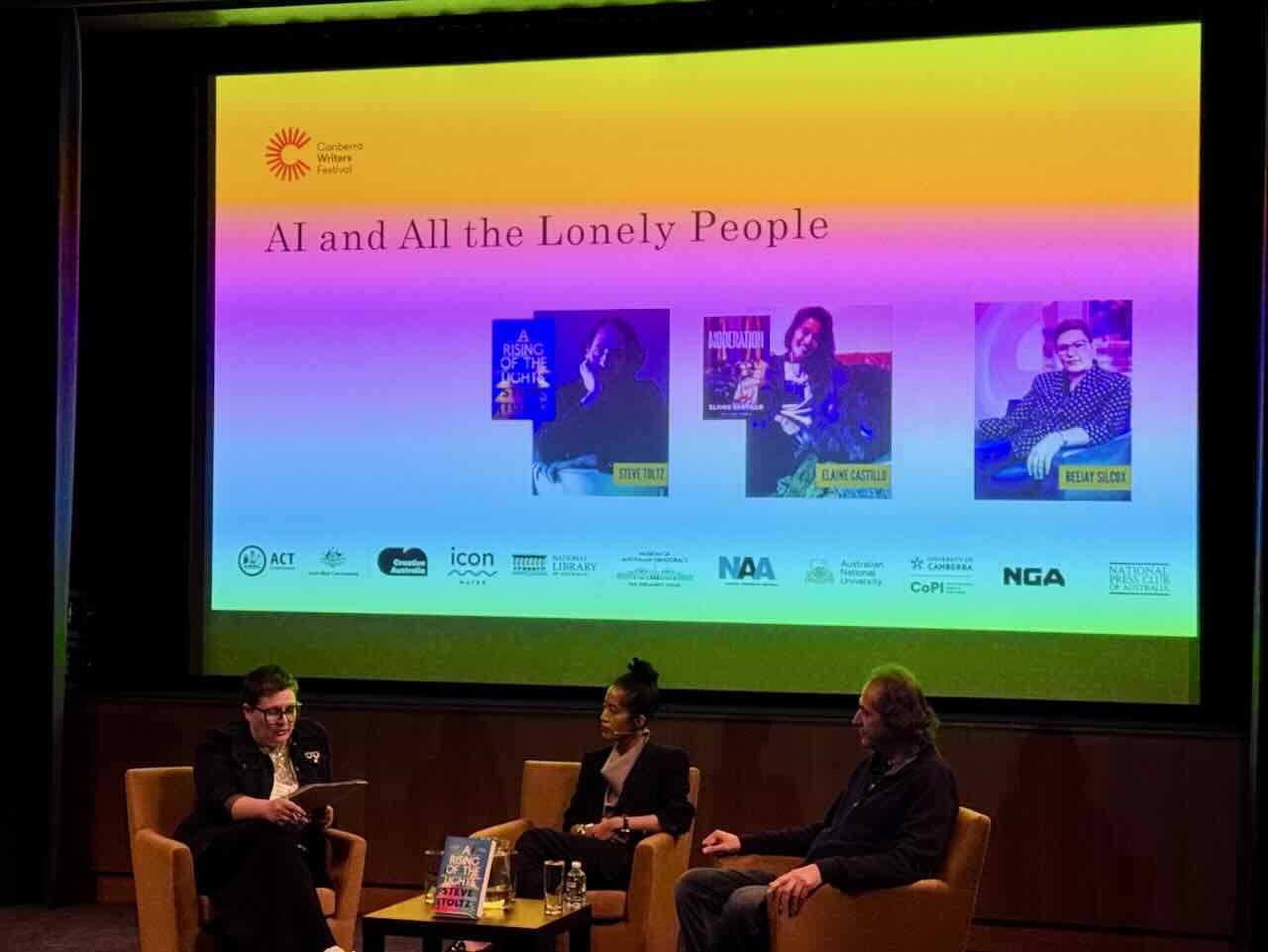
The program described the session as follows:
Join internationally acclaimed authors Steve Toltz and Elaine Castillo for a conversation with Beejay Silcox about how setting out to explore loneliness led to the creation of two satirical, darkly funny and moving novels about human connection. In a world increasingly dominated by virtual reality and AI, our humanness is also held up to the light. Don’t miss these two master novelists in full flight.
The books discussed were Elaine Castillo’s Moderation (sold out worldwide, so no copies available) and Steve Toltz’s A rising of the light.
The conversation
Session Moderator Beejay Silcox was on fire, clearly excited by the books and topic she was dealing with. I found it nigh impossible to keep up with all that was said. I hope what I captured is accurate, but whether I always got the most salient points is another question. I discovered afterwards that I wasn’t the only one who was a bit challenged following all the threads.
I was interested in this session because I am not a doomsayer. Neither, however, am I a gung-ho adopter of the next new thing. I was slowish to get a smart phone, and even now I do not live my life by it, much to Mr Gums’ frustration at times when he can’t raise me! But, as a tool, it can be very useful.
Anyhow, of course Beejay acknowledged country, with sincerity and relevance. She then started off with her well-written intro, which I’m afraid was too fast for me to take in, but she commenced along the lines of these being strange times in which we speak to machines which sound like humans and to humans who sound like machines. She continued in this vein articulating our current technological state, and concluding that despite all these tools, loneliness persists. She wondered whether machines are better at being us than we are – or, are they just as awful?
On their opening scenes, both of which are powerful, brutal
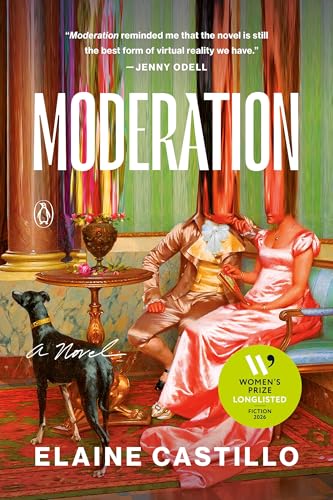
Elaine’s book opens with a brutal unsparing look at her character, Girlie Delmundo (Girl of the World) being a content moderator. But she refuses to write a tech dystopia, despite the PTSD-inducing nature of her character’s work.
Steve’s book starts with a “nice” family, but the parents of 8-year-old-twins are divorcing and rather than spend money on sorting out custodianship etc, they settle custody with a dice (starting with the dog and cat, then moving to the twins). So cruel.
On whether they would call their novels ”tech novels” (Beejay wouldn’t)
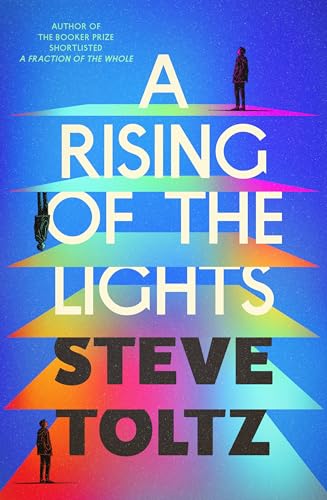
Steve agreed with Beejay, saying that to label anything containing tech as a “tech novel” is meaningless. Tech is moving so fast. He says he writes “human comedies”. His book’s young male twin, Russell, now grown up, is an ex-child psychotherapist, which he left to get a computer job, but that is replaced by Al, so he becomes a guidance counsellor.
Beejay suggested that Elaine’s novel is a labour-force novel, with which Elaine agreed. The father was a surgeon in the Philippines but is a security guard in the Bay Area in 1998. She did not want to write a tech dystopia. We are surrounded by it. Just turn on CNN to get tech dystopia. Zola’s Germinal is a tech novel, in that its technology is informing and deforming world. Industrial novels are tech novels. It got to the point where the panel agreed that almost all novels are “tech novels”!
On why are we bad at writing digital lives
Beejay suggested that people are setting novels in the 1990s and 1980s, to avoid writing about digital lives.
Steve understood this, recognising the desire to go back before the mobile phone. Before them, plots hinged on the fact that you can’t contact someone. He sympathises with that. He mentioned Tony Tulathimutte’s novel, Rejection. It’s a dark novel, immersed in the language of our time, writing about today’s knowledge with hyper-specificity. He is not worried about writing about digital lives because we aren’t going back!
Elaine feels some of the hesitation has to do with embarrassment about the language. We need to be hyper-specific to our time if we are going to talk about. But there has been a collapse of literacy alongside hyper-literacy, meaning that people are reading a lot but critical thinking has been replaced by conspiratorial thinking. It is imperative to write about our time, otherwise it will wash over us, we will become it!
Steve suggested that we are embarrassed about our digital lives, but we need to face it. Elaines described our digital behaviour as an addiction.
On writing romcoms, which are simultaneously grotesque, humiliating
Elaine said, isn’t this life? So much journalism is about how harrowing life is BUT the job of fiction is not to reduce characters to the worst thing that happens to them. Who is this person in love? Maybe someone who self-identifies as “the terminator” finds they are Elizabeth Bennet.
Is falling in love a radical act, asked Beejay. Elaine suggested that questions of love and desire are not that separate from class and power.
Steve argued that romcom is about connection. He identified the three main things he writes about (and I think I got them): we are all going to die, life is meaningless (so we have to make meaning), and what do others think of us? He adds to this, that we are essentially alone. Romance is about trying to connect with another person. But Russell’s life is falling apart. He is completely isolated. He is estranged him from his twin, which is traditionally a lifelong connection.
On children parenting upwards
Why would Girlie stay in a job for 10 years (that most people only do for 2 to 12 months)? Because she has to, as eldest daughter. She feels obligated to rectify their exploded American dream. She is the good daughter who keeps her Mum in dignity.
Steve talked about the aged care crisis, and how his character has to retrieve his 42-years-divorced parents from aged care, to live with him in his one-bedroom-one-study apartment. It’s mildly satirical, but it’s what is coming for us.
On writing about aspiration – telling people they can be anything they want – in a world where opportunity is in short supply
Elaine’s character has a love of handmade beauty; there is someone in there yearning for beauty. She reads narrative in others, but someone else sees it in her.
Steve has tended to reject the repetitious doomsaying re technology, but feels AI is different, because this technology is here to wipe out the whole labour force, blue and white colour.
On Satire
Beejay wondered whether Steve were really a satirist, and suggested it’s more like he’s writing what he’s seeing. Steve agreed that he does not see himself as a satirist. He quoted Fellini who said, do I want to know what Rome is or how I see Rome? It was the latter of course! So, Steve is writing Australia as he sees it. He doesn’t see fiction as having (or having to have) a social purpose.
On whether criticism is antithetical to joy in reading
This discussion foreshadowed, somewhat, a Sunday afternoon session, but Elaine does not see that thought is antithetical to enjoyment. You can talk about Austen and slavery, without spoiling your understanding of the other aspects of Austen. But, the Daily Mail felt that talking about slavery denigrated Austen’s reputation.
Elaine also quoted the critic Clifton Fadiman who said that Tolstoy knows a lot, but that what’s important is Tostoy’s his love for what he knows. There was also talk here about Dostoevsky whom Beejay suggested was more “vertical” while Tolstoy’s more “horizontal” in the way they think.
Steve said that the pleasure principle drives his writing. He likes narrative, but he also likes characters wandering around doing nothing. The Norwegian writer Knut Hamsun said you can do the mind, heart and soul all at once.
Steve believes that the problem with digital life is with people who have bad faith. He proposed that talking with Chat bots is healthier than with other people on online. Real people can be cruel.
What is lost when we talk extremes (between Tech’s promised solutions and a deep existential dread)
Novels, suggested Beejay, exist in the messy middle.
Steve’s goal is to escape into the present, because a hyper focus on the future ignores the shitty present. We complain about Amazon, Chat GPT, but we use them, so we are culpable; we blame the oligarchs for things we are participating in.
Elaine said that science fiction writer Ted Chiang sees Al as just a bad turn of phrase from 1957 computation, and that it is masking over the real issues. 2016 America saw Tech’s deliberate engineering of a Far Right agenda. There is an existential crises around Al, including issues involving intellectual theft, and resources theft (particularly from poorer countries).
Karen Hull has written that there are ethical ways of using technology, including AI.
My takeaway from all this is that we are all trying to find our way. No-one has answers, but the more questions that can be posed and explored the better.
On what question they would like people to take away from their books?
Steve’s: Why are you pretending you are concerned about this when you are spending 9 hours a day on the phone. You can logoff.
Elaine’s: What types of world-building are you participating in, what stories are informing your life? Far right storytelling is happening in America right now, and we need to be alert to it.
And here the session ran out of time … there was no Q&A!
Canberra Writers Festival, 2026
AI and all the Lonely People
Saturday 17 October 2026, 1.30-2.30pm

