Once again it’s Karen’s (Kaggsy’s Bookish Rambling) and Simon’s (Stuck in a Book) “Year Club” week. This time, it is 1949, and it runs from 12th to 18th October, and, as is my practice, I am devoting my Monday Musings to the week. I do enjoy writing these posts, but this one has been a bit of a struggle as a few days after returning from our overseas trip I tested positive for Influenza A. Hence, I have been slow to return to blogging. In other words, I am not ignoring you all, and hope to resume usual patterns soon.
I have written about 1940s once before, for the club, but that was 1940, at the beginning of the decade – and a very different time, because of course, the world was at war. By 1949, the Baby Boomer generation was well under way! It was a period of transition and transformation, as society moved from wartime endurance to post-war recovery, a recovery that was significantly affected by the major waves of European migration. Europeans introduced their culture – food, music, and particularly their politics. But, ideologies were clashing, with fear of socialism and of communism growing. At the end of 1949 – in December in fact – conservative politician Robert Gordon Menzies became Australia’s Prime Minister and remained in the job until January 1966.
A brief 1961 literary recap
Books were published across all forms, but my focus is Australian fiction, so here is a selection of novels published in 1961. I have annotated the list to show how well it encapsulates this transitional period. Social realism and politics sit next to genre novels written by some of Australia’s most popular writers of the time. Modernism was also in play, but is less evident in this list.
- James Aldridge, The diplomat : espionage and political drama about the Azerbaijan Crisis of 1946, which was a precursor to the Cold War
- Martin Boyd, Such pleasure : “comedy of manners” (from The Argus‘ Gladys Hain)
- Jon Cleary, The long shadow : thriller set in rural Australia
- Dale Collins, Simple Simon Smith : diverting, frothy yarn set on the high seas (from The Sun‘s Don Joinson)
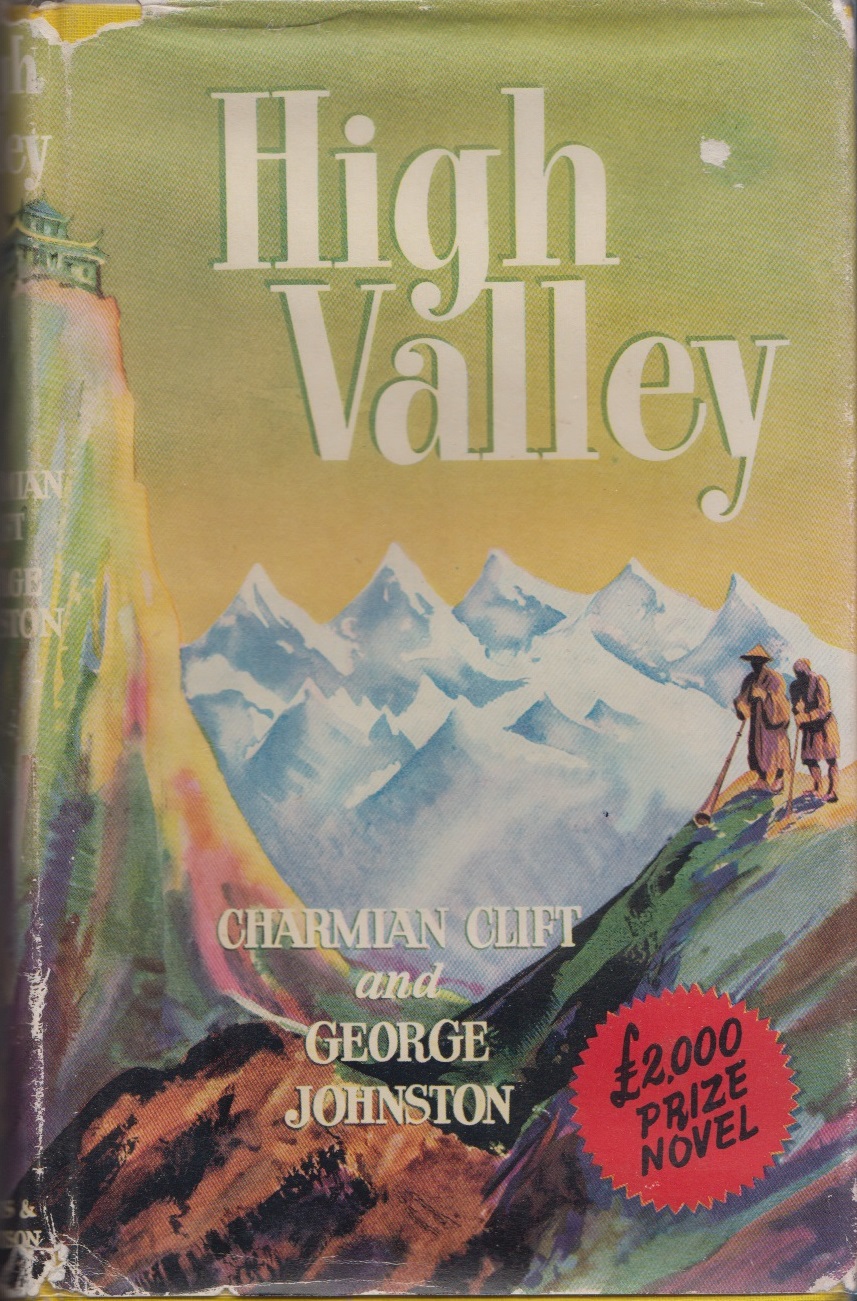
- Charmian Clift and George Johnston, High valley : mystery set in the Himalayas; won the SMH Literary Competition (1948)
- Jean Devanny, Cindie: A chronicle of the canefields : the Communist Party of Australia’s treatment of this book about the North Queensland sugar industry apparently provoked Devanny’s final resignation in 1950
- Lawson Glassop, Lucky Palmer : SMH quotes Norman Lindsay’s description as “the first truly vital racing novel yet, produced in Australia.”
- Adrian Lawlor, Horned capon : privately published, semi-autobiographical novel by this modernist artist
- Philip Lindsay, All that glitters and The loves of my lord admiral : historical novels from the son of Norman Lindsay
- Alan Marshall, How beautiful are thy feet : urban social realism about poverty and poor working conditions for factory workers
- David Martin, The stones of Bombay : about a young refugee from Pakistan who finds his place in the world through communism (see more on Martin below)
- Ruth Park, Poor man’s orange (read long before blogging) : urban social realism, sequel to The harp in the south
- EV Timms, The pathway to the sun : second novel, in a 12-part historical series, The Great South Land Saga
- June Wright, Pathway to death : see my Monday Musings on this crime novelist
Wikipedia lists just three short stories, by Vance Palmer, Dal Stivens and Judah Waten, but clearly this is minimal compared to what was really published, given short stories were still appearing regularly in magazines and newspapers. I might return to this next week.
The only literary competition for novels that I found was the Sydney Morning Herald’s Literary Competition. It was won by T.A.G. Hungerford’s Sowers in the wind, but the novel was not published until 1954. The ALS Gold Medal went to Percival Serle’s Dictionary of Australian Biography, and the Grace Leven Prize for Poetry went to Judith Wright for Woman to man.
Novelists born this year include Garry Disher and Alan Gould, both of whom have appeared here. , but several poets were born, including Laurie Duggan, Jamie Grant, Susan Hampton, and Jennifer Maiden. Children’s book writer and biographer, Nadia Wheatley was also born this year, as was the screenwriter John Duigan.
The state of the art
As for previous club years, I checked Trove for what newspapers were saying about Australian fiction, but I also drew on the Australian dictionary of biography for this one.
Migrant communities
This was a time when migrants, particularly from European displaced persons camps, were coming to Australia in large numbers, but I was still intrigued to see articles about Australian literature appearing in migrant newspapers.
One such paper, Meie Kodu (Our Home), was first published in August 1949, and, as Wikipedia says, it kept “newly arrived Estonians aware of the domestic situation in Estonia” and provided “information useful for daily living in their adopted home of Australia”. In October 1949, that useful information included an introduction to Australian literature! It can be revealing to see how “our” literature was framed for new migrants. You can read it here. For the Greek Community, the somewhat older paper, To Ethnico Vema (Greek National Tribune), published in August the first in a series of articles on Australian literature.
Both articles provide context, explaining that Australia’s early literature tended to be stamped with its creators’ English upbringing, but that by around the 1870s Australia had begun to establish a literature of its own. Both mention The Bulletin as contributing to the development of Australian literature, particularly through short stories. Meie Kodu‘s article which is a one-off, concludes, on a positive note that there was increasing demand from both England and the United States for Australian writing, and that
the country’s literature, at last on a sound basis of appreciation, would seem to have a bright future compared with the struggle and gropings of its early days.
Spotlight on David Martin
Communists – members of the Party or not – made a significant contribution to Australian literature through much of the first half of the century. They are represented in the above list by writers like Jean Devanny. Postwar migration brought more, one of whom was another who appears in the list, David Martin. (The National Library gives its publication as 1950.) He was writer and political activist who was born in Hungary in 1915, as Lajos Frigyes Detsinyi. He led a peripatetic life in his youth, fleeing persecution as a Jew, ending up in London in the late 1930s, where he married in 1941. From there he moved to Mumbai (then Bombay), and finally to Australia in 1949, where he and his wife decided to stay. David Martin was initially a pen-name, but it later became his name by deed poll.
He started writing poetry in England and published his first novel there. In 1946, he also published The shoes men walk in, which was a collection of autobiographical realist stories. He did not want to be completely tarred with the social realism brush, but McLaren writes in his ADB biography that Martin wrote two essays for Meanjin, in 1959, in which he “dismissed the work of Patrick White and the modernists in favour of the realists Frank Hardy, Judah Waten, and John Morrison”.
According to the National Library of Australia’s listing for his papers which they hold, Martin corresponded with many Australian writers, such as “Phillip Adams, June Factor, Miles Franklin, Dame Mary Gilmore, Dorothy Hewett, Ken and Amirah Inglis, Nancy Keesing, John Manifold, Leonard Mann, Tom Inglis Moore, Pixie O’Harris, A.A. Phillips, Katharine Susannah Prichard and Kylie Tennant”. (If you know your Aussie literary culture, you will know that many of these writers also had communist or left-leaning politics.)
Martin has a long, successful career, and received many accolades, including an AM (1988), the Patrick White award (1991), and an emeritus award from the literature board of the Australia Council (1966).
Lectures on Australian literature
It seems like there was a huge appetite for, or interest in, learning about Australian literature at this time. My Trove research brought up advance notices for or reports of lectures on the subject from all over Australia, and given by a wide range of people, including writers, academics and reverends! The critic Nettie Palmer, for example, gave a series of talks in Hobart, while a former Principal of the Toowoomba State High School, Mr. J.A.C. Wilson gave a series on three lectures for the Ipswich Adult Education Centre.
But the report I will quote from comes from a lecture given by a rector, Rev. H. P. Reynolds, to a combined meeting of C.W.A. and Red Cross members in Yass (just an hour’s drive down the road from where I live). His subject was “Browsing in Australian Literature” and apparently he brought along books from his own collection, including some valuable first editions, The report starts by saying that he said “that Australian literature had advanced from the days when people accepted almost anything”. He apparently followed this by saying that “Henry Lawson was no longer thought of as a first class poet”, and that it was on his short stories that Lawson would survive.
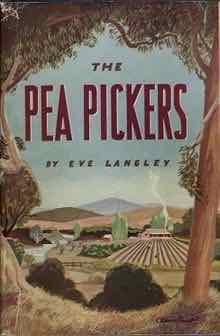
Regarding fiction, he apparently suggested that the writers were “almost without exception women”, and he named Henry Handel Richardson, Katharine Susannah Prichard, Miles Franklin, Eleanor Dark, Barnard Eldershaw, Nettie Palmer. Eve Langley, Kylie Tennant, Helen Simpson, and Dymphna Cusack. He had a point about the decades leading up to 1949. The women did feature strongly. This is one of the reasons I am sharing this report. The other reason is for the article’s conclusion:
At the conclusion members who never speak at meetings fired a succession of questions at the speaker, thinking he had forgotten their favourite writers. But tactfully Mr. Reynolds showed why these names could not be classed among great poets or novelists. An occasional “Um-m-m” of surprise showed that his hearers were thinking things out, and when his talk was over, members flocked to the table on which the books were displayed and asked more questions, and borrowed books to “see for themselves.”
The Reverend clearly engaged his audience … Meanwhile I was engaged just by reading report after report of these lectures and talks.
Sources
(Besides those linked in the post)
- 1949 in Australian Literature (Wikipedia)
- Joy Hooton and Harry Heseltine, Annals of Australian literature, 2nd ed. OUP, 1992
- John McLaren, Martin, David (1915–1997), Australian Dictionary of Biography, National Centre of Biography, Australian National University, 2024 [Accessed: 11 October 2026]
Previous “Year Club” Monday Musings: 1925, 1929, 1936, 1937, 1940, 1952, 1954, 1961, 1962 and 1970.
Do you plan to take part in the 1949 Club – and if so how?


What a fascinating post! I love how you have out the literary year into context. Might steal this with an Irish slant for the next Year of Reading!