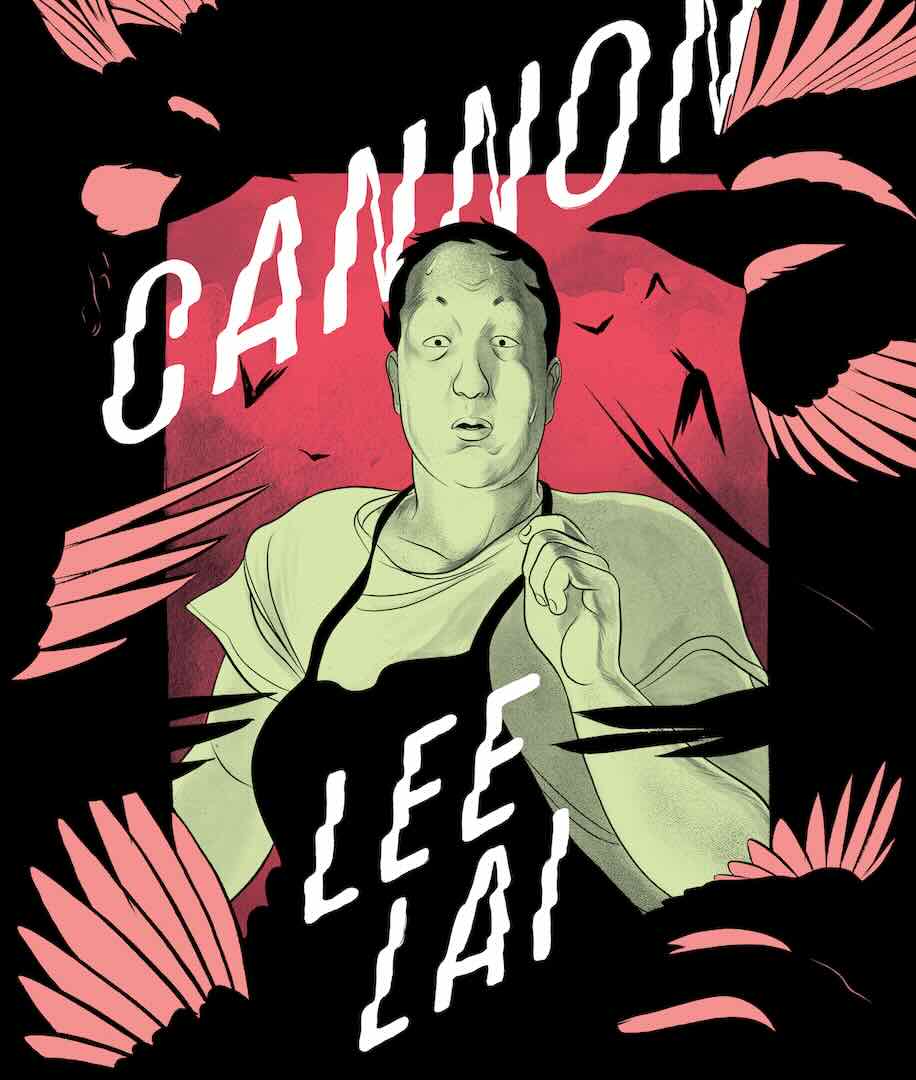
Lee Lai’s second graphic novel, Cannon, won this year’s Stella Prize, and so, while I’m not a graphic novel aficionado, I was intrigued to read this one. I’m not embarrassed to admit how surprised I was by how completely I was drawn into Cannon’s world, and how much I felt for her predicament. How did this happen?
So, this is what I want to focus on here, or, to be more clear, I’ll be focusing on the education of Whispering Gums in reading graphic novels, on how I learnt the “language” of graphic novels. But, I should introduce the story first. The titular Cannon, aka Lucy, is a cook in a restaurant in Montreal. When she is not working, she is looking after her aging grandfather, spending time watching and deconstructing horror films with her friend, the writer Trish, or running. Cannon and Trish have been best-friends since school, where they were queer second-generation Chinese nerds, but cracks are showing. Now on the “uncool side of their twenties”, Cannon is burnt out by her pressured job and being her grandfather’s primary carer, while Trish is trying to establish herself as a writer by mining Cannon’s life for her stories.
“You’re solid, Cannon. I dunno how you keep a cool head” (Benji)
Cannon is your quintessential stalwart, but it is coming at a personal cost. She holds it together when those around her lose it, and steps up for her grandfather while her mother makes herself scarce. Her so-called best friend Trish is nowhere to be seen when Cannon needs her the most.
This is a novel about millennials reaching that point in life when things should, perhaps, be coming together, but instead they are facing burnout, professional insecurity, care responsibilities, and more. Cannon copes – or tries to – through her generation’s coping mechanisms, things like meditation and mindfulness apps, running, dating, and deconstructing horror movies with friend Trish. Eventually, though, the cracks split open and Cannon loses it. There is only so much a human being can take. Hold this thought …
Cannon starts on the cover with its evocative jagged font, and sickly green colour for Cannon. It then opens to a double-page spread depicting a variety of kitchen utensils scattered willy-nilly, along with broken plates and splashes of liquid. Functioning like a prologue, the next few pages contain mostly dark-grey-shaded panels depicting up-ended furniture and a woman on her knees, all watched over by birds that look like magpies. Another woman enters, another plate is broken “for the road”, and this second woman, clearly a friend of the first, leads her friend out into the night. Then comes the Title Page, followed by the next page announcing, simply, “Three Months Earlier”. We are off …
The story is then told chronologically – except for three short flashback sequences to Cannon and Trish’s schooldays in Lennoxville in the mid-2000s – up to Cannon’s breaking point, that opening scene when she smashes up the restaurant. From there, it moves to some level of resolution, albeit life is not easily fixed. Relationships can be, however.
So, the story, on its own, is not an uncommon one. What makes it, of course, is its form, and I loved learning how to “read” it. It wasn’t as hard as I thought, due to Lai’s ability to render action and emotion with clarity while retaining nuance.
Most pages contain four equal-sized panels containing (mostly) black-and-white drawings using simple, strong lines, that avoid extraneous detail which might detract from the point. It doesn’t take long to recognise who is who, and where we are at any point. Pacing is managed partly by the occasional introduction of a single page panel, or other physical variations.
Now for some of my graphic-novel-reading learnings, so bear with me. Just as prose fiction uses recurring motifs to convey meaning, so can graphic novels, and Lee Lai does here. These motifs can be visual and/or textual. Take, for example, the recurrent panels depicting Cannon running (or engaging in other activities) while listening to her meditation or mindfulness apps. These apps include common, repeated phrases like In, Out, Exhale, which are used by Lai literally but often accompanied by visual jokes and wordplay. The running occurs when Cannon needs “relief”, not, as her podiatrist assumes, for the endorphins to experience a high!
Also recurring are those aforementioned birds. They appear frequently in panels when Cannon is experiencing stress. Late in the book, she asks Trish whether she sees them too. Cannon finds them unnerving, but Trish suggests they could be looking out for her. My sense is that they fulfil both roles. Sometimes they seem creepy, representing discomfort, stress, fear, harbingers of doom even, but other times they seem more tender, like companions or guardians, even. Either way, they seem to represent Cannon’s mental state.
Another feature that guides our reading is the use of colour. Grey-shaded panels convey what you can imagine, feelings of anxiety, monotony, dullness, or just general blah-ness. Then there are the sudden splashes of red, which need little explanation. Introduced early in panels depicting Cannon and Trish’s interest in horror movies, red then naturally moves on to expressing rage and frustration.
These are just some of the techniques Lai uses to tell this story, but there’s one that felt more particular, Lai’s use of overlapping, incomplete and obscured speech bubbles to convey problems in communication. The first time this appears is on page 24, and Cannon’s bubbles are overlaid by Trish’s, meaning we can only read Trish’s in entirety. The reason is made clear near the end, if we hadn’t worked it out before, when Cannon tells Trish she’s “got to stop interrupting so much”. Others do it to Cannon too, including her boss, her mum. The meaning is clear. Cannon and her needs are not being listened to, and she’s not pushing back. Lai’s use of speech bubbles could be a study on their own, but this will do as an example.
Finally, there’s what I assume is a visual joke. A couple of times Trish refers to Cannon’s smallness, you’re “small, quiet and Chinese” she says, but the drawings of Cannon are of a solid person, making her visual representation metaphorical rather than real.
It will be clear by now, why I was drawn completely and willingly into Cannon’s life. But I do have one more thing to say before I let you go! Early-ish in the novel, Trish is told by her writing mentor that her project funders “want a young queer Asian voice”, when Trish has a different story she wants to tell. This is surely a comment on a common problem diverse writers face. What Lee Lai has written in Cannon is a story about human beings regardless of colour, sexual orientation or any of the other “others” Cannon might represent. We know Cannon is a queer Chinese, but this has nothing to do with what she is going through. And this is how it should be, unless a writer wants specifically to write about identity. I can see now why the Stella judges loved it.
Jonathan also admired this book.
Lee Lai
Cannon
Willoughby: Giramondo, 2025
304pp.
ISBN: 9781923106406


great review Sue! I’m tempted to read it! I might buy it for the young ones.
Thanks Kate … I was hoping it wouldn’t sound too naive! It’s a beautiful read.
What a wonderful review, Sue. Your plot summary is superb and I love your deconstruction of the story-telling devices
Thanks very much Jonathan. I’m really glad it has come across well to you, given you’ve read it. It’s a wonderful read isn’t it.
Yes, I agree. You’ve brought out a lot of it’s excellence
I am happy to read this as I’ve wondered what it is like. I enjoyed your review of it. Graphic novels are quite appealing at times. I quite enjoy the format at times. I wonder if it has anything to do with the millions of comic books my childhood girlfriend and I read lazing under a huge Willow tree on her farm in Michigan.
Sounds idyllic Pam. I was never a big comic fan which is why am always anxious reviewing graphic novels. This was so warm-hearted.
I wasn’t supposed to be teading comic books. My mother didn’t like it but my friend on the farm had a mother who let her buy lots of them so we happily dug in. We loved them. 🙂
You were reading! I don’t remember being told I couldn’t. I seem to remember reading Phantom occasionally. I quite liked him! Didn’t he have a dog?
He may have. We read Superman more than the Phantom. Plus Veronica, Betty and Archie. Then all theDisney ones from the 1950s. So much fun.
I loved Superman on TV but don’t recollect reading many of the comics.
Cultural deprivation? Lol😉
As someone who hides in a corner every time I hear the words graphic and novel in the same sentence, I’m thinking it’s time I give it a chance, and I’d say this might be a good one to cut my teeth on, going by your review. Thanks for not only a great review, but also for your insight into the ‘way’ one might read it.
That’s usually me too, Karenlee, but I felt drawn to this one partly because of its Stella win. I’d be thrilled if my post encouraged you to read it. It takes concentration at the beginning because, obviously, some of that information that we are used to being in text is in the visuals and design.
I’m oddly surprised you labeled Cannon a millennials if she’s in her mid-to-late twenties. That’s much closer to Gen Z, I think, but these days, I’m not sure anymore. Most millennials I know are in their late 30s to early 40s. Does it really make a difference. I’m not sure except that millennials graduated high school with the threat of 9/11 and the war under President Bush, were adults during the 2008 financial crisis, and are struggling to buy homes well past the time when their parents and grandparents had already bought a home and had children. Now that I’ve gotten off my talky box….
This is absolutely a beautiful review, and you’ve convinced me to read Cannon again. I think I might have picked it up when I had other books that I had to read for book clubs, etc. and perhaps I was more impatient than Cannon deserved.
Fair question Melanie, but I’m pretty sure these characters were born – my guess – around 1990. There are three flashbacks to their hometown in the mid 2000s when they were teenagers. I’m on the plane right now and the book is back home but my memory is that the two girls met around 2004 when Trish stepped in to stand up to schoolmates who were bullying Lucy. I think we’re told they were 14 when they met. I think you probably read that quote about their being on the uncool side of their twenties as being around now. That would make them more Gen Z as you say, but from the dates in the book, I believe it is set around 2017 or so.
I hope you try it again. I thought about you a lot as I was reading it, thinking you would love the story. At least, I think you would. It has such heart and honesty.
Silly me! I didn’t even think about the book not being set in 2025. You’re totally right.
No worries, Melanie. I just expected readers to trust me but as they say, Trust No-one! It’s always worth questioning. My reading group just did another book about millennials which I’m going to struggle to find time to post on in the next few weeks! But my point is we had a similar question about whether the characters were millennials or not!
I definitely enjoyed your review, and further, I trust the Stella judges so am sure it is an interesting work of literature. But, I’m not going to read it. Just as I am never going to be literate in movies or art. I don’t want to make the effort to decipher pictures, I have enough trouble deciphering text.
Thanks Bill – I’m glad you are positive about my review and the judges. I do understand your decision though. At our age you start to wonder about new tricks don’t you.
Lovely review Sue, it sounds like such a good story!
I got notified last week that my request for this book at the library was complete and I could pick it up… sadly I am still overseas so I have lost my place for it! Will try again when I get home!
Thanks Rach, it truly is.
I love the way you’ve written about the way you moved into this story, and I can totally see how it would be an exemplar of the form, the sort of graphic storytelling that could aptly surmount any thoughtful reader’s reservations about the wedding of image and text into narrative. The birds were my favourite part because of the way that, I think, we are invited as readers to see the validity of both their perspectives, that the birds are protectors and predators depending on your view, which invites us to feel what Cannon is feeling when articulating the sense that they are definitely predators (and unseen by others, at that). We can see that they aren’t (just one advantage of an image), that they are simply present, but we can also feel what Cannon’s feeling. I think Lai’s earlier book was also nominated for the Stella in another year, wasn’t it? I’m very curious about it now, too.
Thanks very much, Marcie. You know, as I was writing this post I was thinking, I think Marcie will enjoy how I’ve done this one! I like your reflection on the bird motif.
And yes, Lai was long- if not shortlisted for her previous one about this pair. Stone fruit, I think it was called.