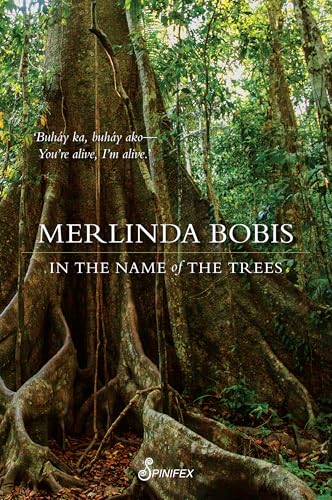
In July, Philippine-born Merlinda Bobis’ latest novel, In the name of the trees, won the ACT Literary Awards prize for fiction, and in August it was shortlisted for the Prime Minster’s Literary Awards. But then, Merlinda Bobis is no stranger to awards, in Australia and her country of birth, the Philippines, as you will see at her Wikipedia page. She is a novelist, poet, short story writer, performer, academic, who has lived for some time now in Ngunnawal Country (Canberra). And, for the record, my post on her novel, Fish-hair woman, is currently my 10th most popular review of all time. My point in sharing all this is that I believe Bobis is not as well known, despite her extensive body of work and achievements, as she should be.
Now, having made that point, I’ll get onto the book … The press release which accompanied my copy of the book uses the tagline, “four generations of women endure war, colonisation, and displacement – sustained by memory and the language of trees”. These woman – great great grandmother Banaba, grandmother Narra, mother Pili and daughter Dao – are all named for hardwood trees that grow in the Philippines. They refuse, says the back cover blurb, “to be cut down”. Their story is told in chapters titled for trees or, in the case of two chapters, titled, simply, “No tree”.
At the novel’s opening, it is Autumn 2005 and 17-year-old Dao has been confined to bed for a year after a car accident that partially paralysed her and killed her father. Her grandmother, Lola Narra, a parabulong (traditional healer), wants to heal her physically, culturally, and spiritually. She is determined that her granddaughter know her culture, which means knowing her language and the stories from home, but mother Pili wants none of it. She wants her daughter to focus on the future, which means knowing English. Indeed, Pili harbours an ambition to become a teacher of English to other migrants. The narrative moves between the women’s current home in Canberra and Narra’s and Pili’s past lives in the Philippines, but is structured around a traditional healing ritual, the Santigwár.
“trees are our story bearers, the witnesses and carers since the beginning of time”
So, as Narra ministers to Dao, she tells her the stories of their family, of the trees they are named for and how the trees have sustained them. The trees are both real and metaphorical – their trunks are our spines, their roots our feet, we are intertwined. These trees (and others), whose properties are introduced in the opening to their specific chapter, have physical, symbolic and practical import, but, as Narra tells her stories, passing on culture as she goes, the disengaged Pili is muttering in the background.
Of course, there are secrets. Why is Pili so determined to eschew her old Bikol culture and language, particularly when it creates a wedge between her, her mother, and her daughter? Gradually, over the pages of this intricately woven novella, the truth comes out. It is a truth bound up in personal and political betrayals, with its origins in the ongoing fallout from serial colonisation and accompanying wars. This destructive cycle started with the arrival of the Spanish in the sixteenth century and continued through British, American, and Japanese occupations and invasions. It is a fraught history, and, naturally, the local populace suffered most.
It is not an easy read. Perspectives and time-frames shift frequently, and a lot of Bikol language is used. While most of the language is translated or is clear from the context, it makes those of us unfamiliar with the language work a bit harder than we might be used to. Perhaps this was intentional, given it forces us to feel the discombobulation of being in unfamiliar territory? I don’t think we have to understand every word for a book to be worth reading, and In the name of the trees – with its slyly subversive title – is such a book. Perseverance pays, because there is so, so much to like in, learn from, and yes, enjoy in, this book.
What made this novel especially interesting, my having read it so soon after Warra Warra Wai (my review), was a growing recognition that this story about dispossession and brutality in the Philippines had many parallels with the history and experience of First Nations Australians, particularly regarding their deep connection with land/country, the fight to retain this land, and the importance of maintaining language to preserve culture. Narra knows that it is through language that she can connect Dao with her family’s culture. Pili also understands the connection between language and culture, but for her it is more complicated:
How you teach foreign language is not only about language. It’s also about land: the land that speaks it and the land where the students grew up because it shaped their tongues, and ears, eyes, minds. Her mother carries on about this: ‘Ano ang pigsasabi kang dagâ’–what does the land say? How do the birds call, how do the leaves hum, how do the waters sing? But which birds, leaves, and waters, Nay–which land? The land that betrayed me?
As the novel progresses, Pili is drawn into the Santigwár ritual her mother is performing on Dao. Slowly, as Narra’s story comes out about her grandmother Banaba, the family’s loss of land, and Banaba’s exhortation to Narra to get that land back, Pili softens. But, for her, “truth telling drags our insides out”. When she finally tells the truth to her daughter, she does it in English, which “feels right” to Narra “for the first time”.
I found In the name of the trees a passionate and compelling, but also warm and tender read. Through characters who are real in their flaws and their pain, and language that entwines story and place, Bobis illuminates the struggle to find a way through and out of an ugly past while retaining what is good and sustaining about home and culture. Consequently, although it is firmly grounded – dare I say, rooted! – in a particular place, it also speaks more broadly to shared histories of survival and cultural endurance. It deserves the recognition it has received, and more.
Merlinda Bobis
In the name of the trees
Little River/Mission Beach: Spinifex, 2025
139pp.
ISBN: 9781922964281
Review copy courtesy Spinifex Press


I’m so glad you reviewed this, because I was intrigued by the title when it was listed for the Prime Minister’s Lit Awards. It sounds intriguing.
And I think you’re right: Bobis is not as well known as she should be. Indeed, I didn’t really know of her until this listing, which is why these kinds of book awards are so good — they bring writers and books to our attention that might otherwise slip under the radar.
I’m sorry, but not surprised, kimbofo, that you’ve confirmed my suspicion. She has won or been shortlisted for quite a large number of Australian awards, and yet I never hear her mentioned by bloggers or in other circles. This could partly because her publisher, Spinifex, seems to not be known much either. I have been trying to get to The kindness of birds for some months – even moved it from my TBR shelves to next to my bed – but still haven’t got to it. But when this won the ACT award in July, I decided I WOULD read this one.
I agree with you re these awards. I think the Stella and the PMLA are particularly interesting. (But I did wonder why this one wasn’t longlisted for the Stella. It feels like it would be right up that alley.)
I agree with Kim and you, I did not know of this author at all… and I am aware of this book more because of the trees than the author. I will add it to my list, but I might wait a while to read it as you indicated the difficulty with the language and I ma 70% through ‘The Disappearers’ by Marlon James and all the Jamaican slang and terms have warn me out, so I need a book where I feel like I read words that make sense to me without having to google next 😀
Oops Rach, I knew this author as I’ve read her before and have another on my TBR. I should say the language is mostly translated, and it’s essentially a novella so not long (unlike James!) But still I understand wanting a break between books that demand closer attention!
I have read so much Jamaican, I feel like I could bomboclat rass like a battyman! haha.
Haha! We’ll done. I believe you.
Your review reminded me of how afraid I’ve become of nature. Between the massive increase in disease-spreading ticks to the unrelentless sunshine that burns even on a cooler day, everything feels problematic anymore. I remember when I used to just go walk in the woods without a care in the world. I spent so much time in woods when we were kids.
Oh Melanie, that makes me really sad to hear. I don’t think we’ve got to that yet here though natural disasters are increasing. Certainly not most of my friends. Most of us feel that nature is good for us, and that there are many terrors in built environments that are equally risky? I am so sorry you are missing out on the benefits.
Oh wow, this sounds like a book I would really like. I’m going to have see if I can get it through interlibrary loan sometime. Thanks for the lovely review.
I think you would Stefanie … trees, women, nature, and more. I hope it is available over there to you.
I was just reading about a small town in Quebec which has affirmed the rights of trees, following the lead of many other communities striving for this kind of change. (Terrasse Vaudreuil, QC) I love it when fiction brings to life the importance of this kind of shift in perspective.
Oh, Marcie, you wrote this while I was travelling and I missed it! Affirming the rights of trees is a wonderful thing, and I reckon Merlinda Bobis would be right behind that too. I agree with you about loving it when fiction reflects these shifts. We should expect no less, but not all writers are interested in these things are they?