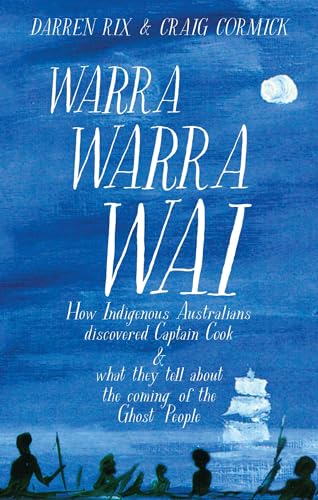
What most struck me as I got into the flow of Darren Rix and Craig Cormick’s book Warra Warra Wai: How Indigenous Australians discovered Captain Cook, and what they tell about the coming of the Ghost People was that I was reading something that felt like a model for a new way of telling Australia’s shared history. This made it not only compelling for its content, but exciting to contemplate as a way forward.
Warra Warra Wai was my reading group’s 2026 choice for our traditional July commemorating-NAIDOC-Week read. And this year, we had the authors present at our discussion. How lucky were we.
Darren Rix and Craig Cormick are both Canberrans, and had known each other over some decades as dads with kids at the same school, but when Craig had the idea for a book that would tell the story of Cook’s journey up the Australian coast from First Nations perspectives, he wanted – needed – to work with someone with First Nations heritage. So he asked Darren, a Gunditjmara-GunaiKurnai man, about his past experience. When Darren said he’d been a radio reporter, Craig knew he had his person. Craig, himself, is a science communicator and author of over 40 books.
Their plan was to travel to all the places on the east coast that were renamed* by Cook to hear and document people’s stories. But, Warra Warra Wai turned into something much bigger than Craig’s original idea when the first groups they contacted said that yes, they could share their people’s stories about Cook, but what they really wanted to talk about were things like truth-telling, colonisation, massacres and native title. This is what turned the project into something truly special. We weren’t surprised that the book, now in its third printing, has six award stickers on its cover.
“It’s Aboriginal and non-Aboriginal history”
It’s Aboriginal and non-Aboriginal history. It’s the history of the land, and we should all know the history of the land where we walk. (Aunty Rhonda Radley, Birpai-Dunghutti woman, p. 120)
Now, I’m not an historian, and I know that historians can be feisty when they feel someone is playing in their well-honed patch, so my thoughts here are those of a lay reader of history. And these thoughts are, as I hinted in my opening paragraph, that Warra Warra Wai has been intelligently crafted to tell a shared First Nations-settler history. The chapters follow Cook’s journey from where he first met the Australian coast at Tolywiarar/Munda Bundal (Point Hicks to Cook) to where he left it around Thuined/Thundah (Cook’s Possession Island) in the Torres Strait. Each chapter is titled for the place and the Country in which it is located, and then opens with some words in a language from that place, with an English translation, followed by a short excerpt from Cook’s journal about the crew’s experience of that area.
From this point, each chapter provides more about Cook’s interaction with the Country (mostly from the boat, rather than on land, as Cook rarely set foot on the continent) intertwined with the local people’s stories about that time. All chapters include a Dreamtime story, tell stories about colonisation’s impact today, and conclude with a section titled “Contact” where stories about early contacts in that place are shared – explorers, missionaries, anthropologists, settlers, miners, the massacres, and more. Each, also, ends on something positive, often concerning what the people would like their fellow Australians to know. There is, naturally, much similarity between stories – colonisation is colonisation, after all – but every Country had something unique to tell.
Finding a structure for telling a shared history is not the only significant thing about this book, and is certainly not the most contentious aspect. That belongs to the issue of sources, and the fact that Rix and Cormick have given equal weight to oral history. First Nations culture was – and still is at heart – an oral culture, and to deny the truth of their stories because western/settler academic historians privilege the written word is to colonise them yet again**. As one interviewee said, “just because something is written doesn’t mean it is actually true”. Rix and Cormick give examples of written records that got it wrong, not to mention those affected by biases, such as male anthropologists overlooking, if not being oblivious to, women’s role in First Nations cultures. (Even where women may not have been interested in sharing their business with men, some recognition of their significance would be appropriate). The point is that no source is infallible – and that, in oral-based and/or any oppressed communities whose stories have not been documented, oral evidence is critical.
Early in the book, the authors share an undocumented story, commenting that so many stories have been lost that “we may never really know the actual truth of the matter”. Worimi man, Professor John Maynard, describes First Nations history as “a giant jigsaw puzzle with the majority of pieces missing”. The race is on to capture what can be captured before more is lost – however that can be done.
The other point to make about this history is its tone. It is thoroughly footnoted, but its tone is what I would call educated conversational English. This, together with its thoughtful design and coherent structure, makes it a pleasure to read.
“The truth … It will heal you”
Darren and Craig were wonderful reading group guests. They openly answered our questions, including those about the complexity of bringing it all together, from finding the right people to talk with to checking off the final drafts with participants at the end. When you think about what they did, it’s breathtaking in breadth and depth: the coordination of people and places up the coast, and the wrangling they needed to do of a plethora of events, people, records (oral and written) to create a coherent whole. It was a careful and thorough process, and while a couple of communities pulled out, most are thrilled with the outcome, feeling they have something true and meaningful that they can use in education and cultural programs for their own people and for others. It was not cheap to undertake, and while the publisher provided a decent advance, there were funding challenges, which the book’s prizes have helped turn around.
I’d love to share more of the learnings and insights I gained from this book, because there were many – some aha moments, some simply adding depth to my existing knowledge – but I’ll leave it here. A book of this length, dealing with this topic, cannot be comprehensive, and there are sure to be disagreements about some of the stories and viewpoints shared, but none of this detracts from the achievement, both conceptually and in terms of the history told.
For the record, the title Warra Warra Wai was what the Gweagal people shouted to Cook and his crew when they tried landing in Botany Bay. It has long been interpreted as ‘Go away’, but is now known to refer to the fact that the white men looked like dead spirits, and means something like “we don’t want dead spirits here”.
Warra Warra Wai concludes with Kuarareg cultural historian and owner Waubin Richard Aken’s response to the question about what Australian whitefellas need to know:
The truth. Coming from our people. Tell them the truth, that they don’t be afraid of the truth. It will heal you. Once the country recognises the truth. It will heal you wherever you are. (p. 310)
The truth, as we know, is a contested space about which each of us needs to make up our own mind. One way we can do this is to read books like Warra Warra Wai. It is a book for all Australians.
* Throughout the book the authors use the word “renamed” for the place-names given by Cook (or other settlers). The reason, of course, is obvious.
** Ironically, this book has been used as a second written source by a community who needed two written sources, but only had one, to get a massacre included on the Massacre map.
Darren Rix and Craig Cormick
Warra Warra Wai: How Indigenous Australians discovered Captain Cook, and what they tell about the coming of the Ghost People
Cammeray: Scribner, 2024
334pp.
ISBN: 9781761424021


Okay, I really must get to my copy of this book. And how fortunate was your book club to have both men and talk with you.
Did the book create any issues for members of your group?
We were very lucky Brona … Darren did a musical acknowledgement of country with didgeridoo and clapping stick.
No, no issues came up. Of course having authors present can have some impact on what people say but my sense of the vibe in the room was very positive. People were greatly engaged with what they had done and were trying to do.
It sounds like a very special gathering in so many ways.
It truly was, Brona. It’s always a privilege when we have an author at our meetings, but for a truth-telling book like this it was extra meaningful.
I was glad to read this review and know that this book was on your reading group list. I loved this one too and learnt so much. I especially applaud the inclusion of oral history which is so often overlooked or looked down upon. I agree, it’s a book for all Australians.
Oh thanks Denise, it’s really lovely to hear that you also read and liked this book – and your saying so here helps confirm for others that it’s worth checking out.
I think this book needs to be on my TBR! Thank you.
We haven’t had any authors at either of our book clubs… We had one author going to attend once but it never occurred. I think for our Fitzroy group it would be difficult as the views are always so diverse.
I’d say it does Rach! I don’t usually say that because I know there’s so much out there to read, and I don’t think I should add to the pressure, but for Australians I am prepared to say that this is something we should all read!
As for authors attending, yes I understand that. Our group also can have diverse opinions and we can get a bit excited in expressing our opinions. It’s more rare for us to be in agreement than not. But, an author present provides a wonderful opportunity for people to ask the questions that might be behind those diverse opinions. So while different opinions may not come out in a meeting with an author present, people get to ask questions about those things that concern them. If that makes sense. You know, like, “why did you decide to …” Behind that question might be something like “I didn’t like…“ We’ve had many authors over the years and no one has ever said, let’s not do that again!
Okay noted this is on my TBR and I will remove my close mindedness to authors attending 😀 I just worry that we will offend them… as like you opinions are often very different.
Haha … Rach, do. This is not an unusual concern at all but I think most readers do appreciate being able to talk to an author, and find it worth reframing their responses every now and then for the benefit that comes. If that makes sense. I wouldn’t want authors every time but it is a real treat to have occasionally.
I appreciate that Cormick wanted to tell the story with a First Nations co-author, but what made him want to write from a First Nations POV in the first place, I wonder.
I’m intrigued by the part that says we may never know the true story because that suggests that there is some singular true version of events. Of course, when we get different perspectives of a single event, each person has their own truth. It makes me wonder if it’s possible to ever get the truth-truth of something experiential.
Great questions Melanie. Cormick has written an alternative-history novel collaboratively with another First Nations man imagining a different Cook scenario, so it’s an area he’s been interested in for some time. I think perhaps saying that he wanted to write from a “First Nations POV” isn’t quite how I’d put it. That sounds more like what a fiction writer might do. How I would describe this is that he wanted to capture the history of Cook’s journey up the east coast of Australia from First Nations people, which is a bit different to writing from their POV? He knew however that he could not do this on his own. For a start FN people have had so much taken from them, and so many of their experiences and history misrepresented, that he knew he as a white person could not easily gain their trust. It needed an FN person to suss out who to talk to and to lead that conversation. It sometimes took days in a community for the community to feel they could trust Darren and Craig.
As for “the true story”, yes, that’s a complicated one. I agree that there is no one/singular version of events. I how I see it is a history that tries to capture the variety of perspectives, and not just one (usually the victor, as they say). Each person’s truth will be different, but I think in terms of history we can talk about a “truth” that genuinely tries to encompass what happened on all sides and the complexity of that (the cultural perspectives, the assumptions, the misunderstandings, the violence on all sides, the kindnesses and attempts at conciliation on all sides, etc.) Individual truths will be different, but I think we can come to an agreed understanding – truth – of the bigger picture of what happened, than, for example, I grew up with. Oh my, this is tricky isn’t it?
I just went to add this to my “want to read” pile on Goodreads and realised it is already there. Oh! To have enough lifetime to read everything on that list.
Exactly, Gwendoline – and oh, to remember everything the list!!
Wow, this just sounds amazing, for all the reasons you’ve articulated so well. (It reminds me of having read Kim Scott’s True County in the past year or so, the melding of “history” and “truth” and experience.)