As most of you know, crime thrillers are not my go-to, but I get to so few meet-the-author events that when this one featuring a writer of thrillers popped up, we decided to go. It turned out to be a good decision.
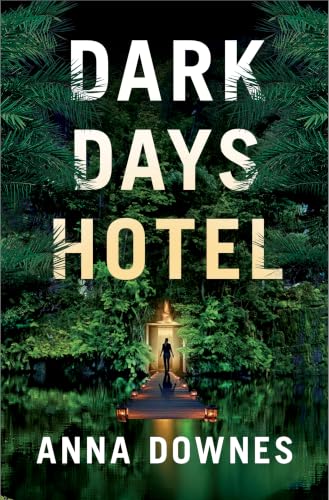
As always, Colin Steele did the introductions. Our participants were author of now four novels, Anna Downes, and our wonderful local crime writer, Chris Hammer. Downes’ latest novel, Dark days hotel, said Colin, was inspired by the recent rise of longevity clinics, and the plethora of issues, ethical and more, that they raise.
The conversation
On her writing journey to date
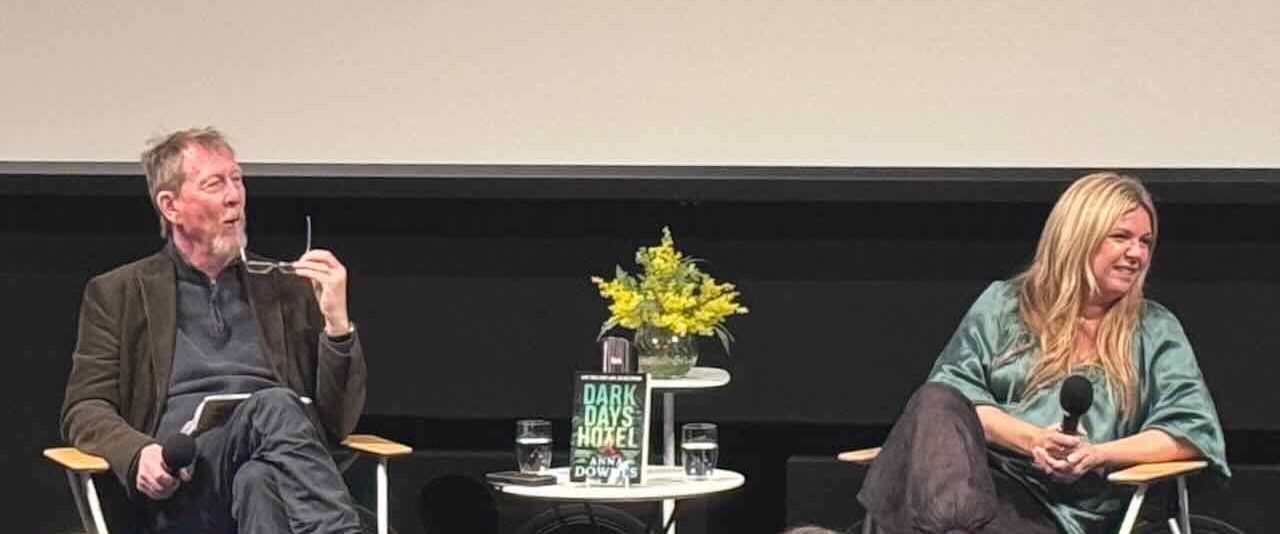
Anna gave us a brief bio. English-born, she trained at RADA as an actor, but decided that acting and its lifestyle did not suit her temperament. Sometime later she ended up in Australia, having fallen in love with an Aussie boy! Her first novel, The safe place, which she wrote at a time when she felt “unmoored”, came out in 2020 during COVID, so it was not the experience she expected. This novel was followed by The shadow house (2022) and Red River Road (2024).
On the origins of Dark days hotel (which Chris suggested has echoes of The safe place)
The novel is set in a fictional health/wellenss hotel around Strahan in Tasmania’s west. It’s an eerie, isolated place, which lends itself to mystery. The story starts with exhausted emergency nurse, Liv, standing outside the hospital on a dark winter night, when a young woman, barefoot and wearing flimsy silk, walks towards her, only to soon collapse and die. All she is carrying is a hotel room key. Liv is guilt-ridden about her inability to save the young woman and is determined to find out who she is and why she died.
A second storyline features Annika. She works at the hotel as a massage therapist, and, like many workers in this industry, is obsessed with her own health. She is competitive and wants the coveted role of host, as these are the staff who get to look after VIP guests. Luckily for her, a person has quit so she achieves her goal. But, she smells a rat!
Anna explained that she has been a massage therapist, and has met many dysfunctional people and experienced toxic workplaces. Spas don’t want to acknowledge the staff-patient/guest dynamic, but staff are there to be friendly and liven people up.
On how she develops her characters
An actor by training, Anna feels her characters. She has felt lesser, has experienced the power imbalance in which you can be patronised, and exploited. She did a “deep dive” into organisations, like Jamie Oliver’s Fifteen, whose goal is to lift people. They might be well-intentioned but often don’t understand the huge trauma in many of these people, the trauma that poverty can induce.
On how she was able to make the hotel and location feel sinister
Anna explained that the hotel was inspired by Fogo Island Inn, in Newfoundland (see Wikipedia and this article). It is a social enterprise intended to support local working people whose livelihoods had been lost due to the collapse of the local cod industry. Their economy is tied to the hotel. She was interested in the symbiotic relationship which looked good on paper but must surely involve some “fraught tensions”.
In terms of her hotel and setting, Macquarie Harbour and Tasmania’s west coast are naturally wild, isolated and “extraordinarily remote”, like Fogo Island. This, and Tasmania’s “history of extraction and brutality”, made it a perfect setting for “plonking” something so exclusive and expensive – and so intrinsically out-of-place – as a luxury hotel.
She discovered that Newfoundland and Tasmania are seen as mirror islands, and described Strahan as one of Australia’s loneliest and remote towns.
On her inspiration for what Chris described as a “marvellous plot”
The novel is set in a wellness resort, which is not only about things like diet and meditation but also about “chasing longevity”, which feeds into the idea of biohacking. Where did all this come from? The seeds go back to 2022 when Anna became interested in people like Peter Thiel and Brian Johnson (whom she described as “batshit crazy”). They seem to believe they can opt out of mortality, that they can do away with death, and they engage in some bizarre experiments and practices to achieve these goals. There is a strange loophole where what they do can become “products” rather than seen as clinical trials, making them hard to regulate.
The thing about technology, and biotech, is that reality outpaces our ability to properly comprehend and manage what is happening. She was interested in these billionaires, in what they believe they can transcend, and the fact that their endeavours are limited to the privileged. It is not about the rest of us. They are pouring enormous amounts of money into these enterprises, while our health systems are underfunded and struggling. This is “infuriating” and “flat out wrong”.
On her writing process, and whether she’s a “pantser” or “plotter”
Anna laughingly passed on advice she’s heard, which is that if you want to know how to write a book ask a debut author, because the more you go the less sure you become! Then, being serious, she said that she knew this book was going to be plot heavy.
Anna was wonderfully clear about her process, starting with the fact that her acting background made her a planner (aka “plotter”). She likes to figure out the structure, and then she works her way into it. She values highly the craft and art of structure. She is excited if she sees she has a good arc. For her, a story works like an obstacle course at the end of which her protagonists’ world will change. She needs to figure out this journey, and find the interesting things that make it. Then she needs to work out the characters who will facilitate and those who will stall that journey, and decide what scenes she needs to convey this. She did a lot of structuring at the front end, with her publisher/editor (I think she said).
On how she managed to pace her two story-lines, and keep them working in tandem
Chris described the novel as a page-turner and wondered how she achieved this while wrangling her two point-of-view characters, Liv the pampered guest and Annika the worker. These characters don’t meet until near the end, so Anna had to pace both stories, keeping our interest in both. She has the two characters circling each other but not touching, and does this through “breadcrumbs”, such as a question posed in one story being answered in the other, or an object appearing in both, and so on.
On why she writes crime, and specifically mystery
This is another area where Anna was wonderfully clear and articulate. (Grab-the-Lapels Melanie, will love this). Anna loves “to be scared, to be tricked, to be on the edge of her seat”. She loves figuring things out, and being able to look at dark things. She thinks the whole idea of windup (in which you feel intensely) followed by release is a healthy thing. In mysteries and thrillers, readers are asked to follow clues, and engage in “extreme empathy”. These stories enable us to look at things that scare in a safe way, they enable us to contemplate things like, what is happening, why does it want to hurt me, how do I escape it? This is particularly appropriate for our current world, she said.
Chris then commented that so far she hasn’t had a continuing character, nor an outside investigator like many crime writers do. Anna said that while as a reader she can appreciate/enjoy procedurals, she is not interested in writing them. She doesn’t find the law interesting, doesn’t think it works well. She prefers to explore the ripple effect of crime, to put herself in a situation and feel it in her body rather than be in her head, as you are with a procedural.
There was some talk about editing, and how she builds more of the emotion into her stories in the editing phase.
Q&A
On her reading preferences, particularly when writing: Anna reads all the time – and widely. She subscribes to Stephen Fry’s idea that the quality of our intellect is related more to curiosity than intelligence. However, when she is writing, she does tend to veer to reading the style she is writing. “You can’t dance without music”, she said, you need the right vibes and mood. So, when she wrote The safe place (I think it was), she read Liane Moriarty.
On whether she and Chris find writing the first or last sentence the hardest: Chris said writing the first is not so bad as it probably won’t survive, and with the last he just feels relief. Anna said that these sentences often come later. Sometimes they can be intuitive, other times she has to work hard. Both came late in this book.
On what next: Her ideas usually change dramatically from when she starts to when she gets to the end, so she doesn’t always like sharing this, but she did say that she is interested in Gothic suspense. Most of her books have a hotel or house. She is thinking about how blood is the blood is stuff of horror stories, but blood is also a resource. What does Gothic mean now?
Finally…
The vote of thanks was given by local author Karen Viggers. She started by thanking Colin whose work in running the Meet-the-author events is a true gift to the Canberra community. And she thanked Chris for conducting a wonderful conversation. She then spoke briefly, and eloquently as always, about the book, which she saw as a cross between Kazuo Ishiguro’s Never let me go (which I read before blogging and can see the connection) and Liane Moriaty’s Nine perfect strangers (which I’ve not read). She described Anna’s novel as serendipitously timely, given the way we are being hounded, particularly via social media, with advertising claims for new products. Longevity is not new, but we are being newly bombarded with claims and products.
I got way more out of this conversation than I expected, given my lesser interest in thrillers than other forms of writing. But, once again, I was reminded of the truth that good writers can make the best conversationalists. Chris’s questions were excellent at teasing out the essence of this book and of Anna’s authorial practice, and Anna was beautifully articulate in response, giving me both insight into writers and writing and, even better, some things to think about in terms of my own reading practice and preferences.
ANU Meet the Author Series
MC: Colin Steele
Lowitja O’Donoghue Cultural Centre, Australian National University
25 November 2026


I do love that answer about being scared, and I think she spoke on it better than I do! I also really like that quote about being curious and how it’s more important than being an intellectual. I have to say, I’ve met some really dumb intellectuals. I actually gave a talk about being a blogger via zoom, and at one point I did a screen share to show them the homepage of my blog. I asked them what they noticed about my reading habits. They couldn’t figure it out. I noted that that’s kind of the point; I don’t tend to read the same thing over and over again. If it strikes me as interesting, my curiosity makes me want to read it.