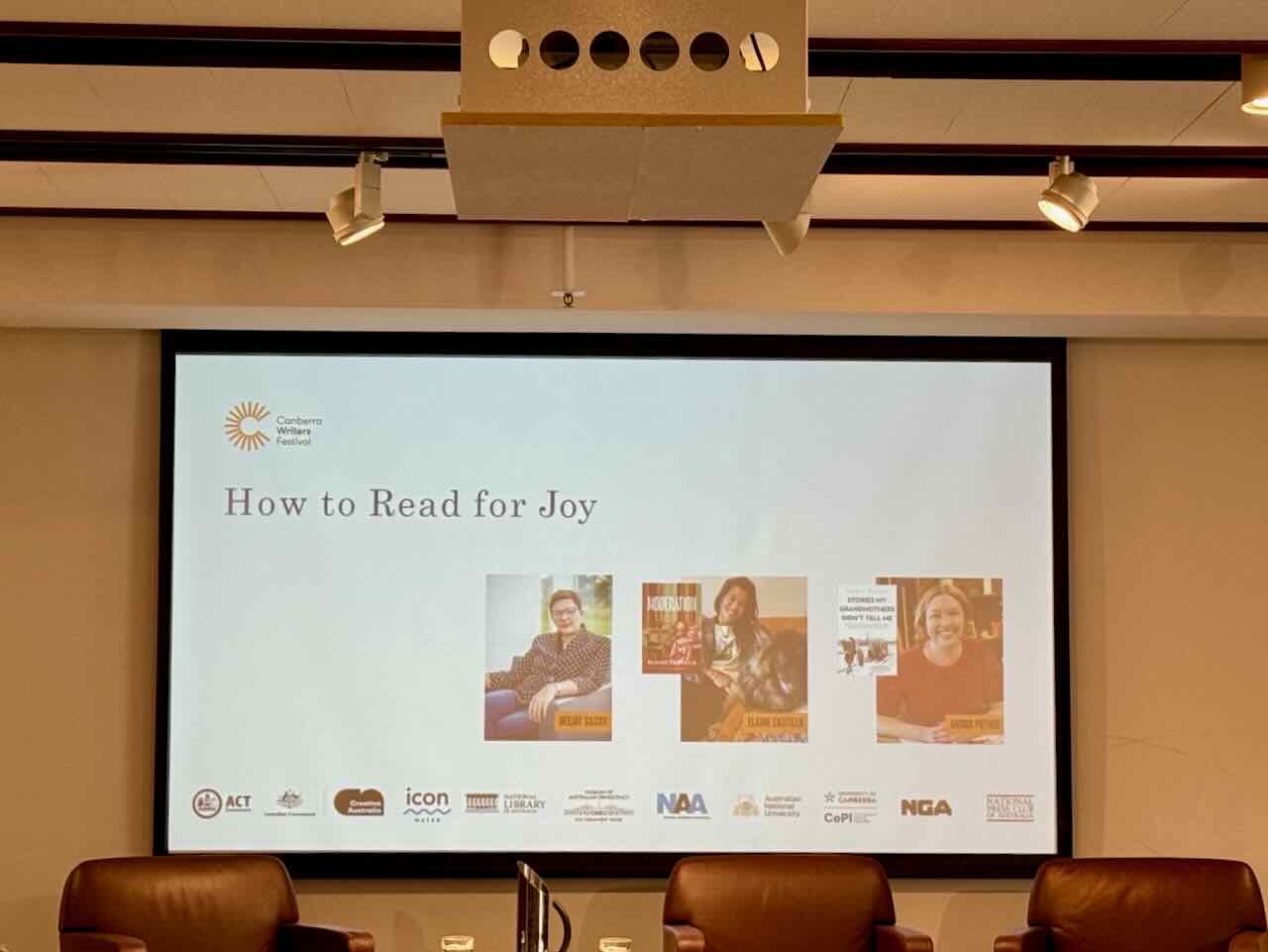
Elaine Castillo and Beejay Silcox with Andra Putnis
The program described the session as follows:
With the brilliant book under threat, it’s time to raise the stakes – by reading in a way that brings us more joy and satisfaction! We get more from books when we think deeply about the questions they unleash. Join Elaine Castillo and Beejay Silcox as they invite us to approach our books with a critic’s eye. It’s time for a more exciting relationship between us and our bookshelves.
Moderated by Canberra Writers Festival Artistic Director, Andra Putnis
While this was not a panel set up to discuss specific recent books, it’s worth mentioning that Elaine Castillo has written a book of essays, How to read now, which, I believe, partly inspired this session.
Now, here’s the thing. It was a lively, passionate – and generally uncontroversial – session about the value of reading and criticism, but my reading group friend and I had hoped for more depth on “how” to approach books with a critic’s eye. What does this look like? How do critics do it? And how can we translate that to our reading group discussions? There was no Q&A so we couldn’t ask.
The conversation
Festival Artistic Director, Andra, started with an Acknowledgement of Country, then introduced the session as being about finding joy in reading, a joy that can include beauty and wonder but also sobbing with pain.
She introduced Elaine Castillo who has been listed by Britain’s Financial Times as a change-maker, as one of the planet’s 30 most interesting young people. Her latest novel, Moderation, was nominated by several sites as one of the top books of 2025. Beejay Silcox, Andra’s predecessor as the Festival’s Artistic Director, needed little introduction, but in terms of this session, Andra said she is recognised by her industry peers as “the most significant new Australian critic in decades”, and is known for her “resolute, foolhardy honesty”.
We started with their childhoods, and, interestingly for both, the most significant reading bond was with their fathers. Both fathers enabled, supported and didn’t limit their daughters’ reading. Beejay talked about the importance of audiobooks to her insomniac childhood – stories just seeped into her. Later, burnt out from getting the right degrees, doing the right job, carrying the hopes and expectations of those around her, Beejay was “saved” by books, and turned her life and career around to be book-centred.
Californian Elaine grew up in a working class Bay area where there were no bookshops, so her sources were the library and the book sections of charity shops. Elaine’s understanding of reading was politicised early, as she saw how class and race affect who is seen as “literary”.
On critics as celebrators of books
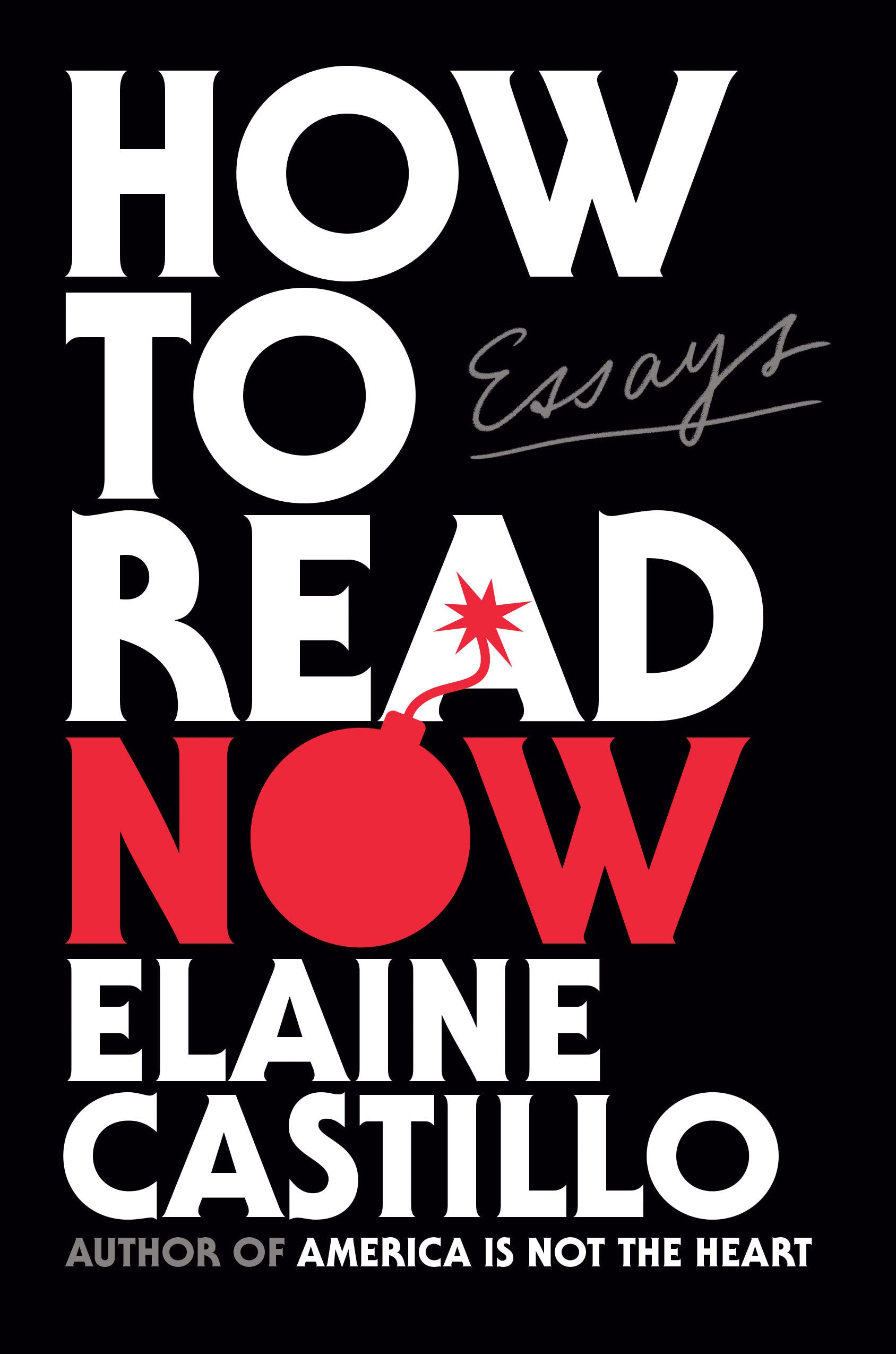
An issue that frequently confronts critics – particularly if they dare to “criticise” a work in any negative sense – is that they are destroying books and writers lives, and, by corollary literary culture. Beejay is passionate about the fact that this is not what criticism is. First, though, Andra asked Elaine to read the last para of the first – and titular – essay in How to read now:
Post-2020, it feels impossibly hard and incalculably stupid to say that you love the world. Why bother? Why does reading matter? Why does truly trying to know the world we live in, the history that makes us, matter? It feels impossibly hard and incalculably stupid to commit to that love, to bear it and be borne by it, but that is what I feel—it is the wellspring that reading leads me to, every time. Loving this world, loving being alive in it, means living up to that world; living up to that love. I can’t say I love this world or living in it if I don’t bother to know it; indeed, be known by it. It’s that mutual promise of knowing that reading holds us in—an inheritance that belongs to us, whether we accept it or not. Whether we read its pages or not. This book remains just one small part of that work: that inheritance, and that love.
So, why read widely, and how are reading – and criticism – acts of co-creation?
Elaine did not set out to be a book critic. She just assumed she belonged to the world of literature, but in 2018 she came to realise that the white middle class can write about relationships, marriage, and so on, while writers of colour were assumed to provide information about war and trauma, and that white people expected that world to be translated for them. She developed the concept of the “unexpected reader”, that is, being the interloper, the reader that the authors were not expecting, were not writing for (that is, not the white middle-class reader).
Beejay talked about her idea of co-creation, which encompasses the idea of being trusted as reader to make your own meaning. She referenced Kitamura’s novel Audition, which has three parts, one of which is empty for the reader to complete. And, she mentioned a favourite author, Rodney Hall, who says he writes 50% of his books, with the other 50% being finished by the reader. In other words, reading is not passive. You show up. It is joyful when you are invited to join in, to make the book together. On a different tangent, she sees classics as inviting us to be part of a long conversation. With Austen, it’s lasted 250 years; with the Iliad it’s centuries.
Elaine picked up on this idea. Criticism is not about diminishment of literature. The history of Austen is also the history of colonialism, but Britain’s Daily Mail castigated Chawton House for daring to sully Austen’s name by suggesting a connection to slavery. How is having more information a diminishment? When you read, you bring your entire force, intellectually, historically, emotionally to the work.
Beejay talked about feeling she is seen as a “necessary evil”. She has been called a “national killjoy”. People think disagreement is personal but disagreement is generative. She wants to be disagreed with, she does not want to be the verdict-maker, or king-maker. We need a chorus of opinion. Why, otherwise, did we love David and Margaret? Because they disagreed and had a conversation – which we then wanted to join. Best friends are not acolytes.
Elaine added that the economics is clear. Literary columns are disappearing, there is no space for longform criticism. They are not lucrative, or, are only so if a hack job on celebrities goes viral. Beejay said there is some good criticism on substack, but these are read by people who agree with them, so the culture is not enriched through to-and-fro.
Returning to her main concern, Elaine took Joan Didion as an example of how people are elevated to be the Californian voice, a settler Californian. What are the Californias not being seen?
Is the book, or are types of books, under threat AND What have you recently read?
Those were the questions, but the discussion was more about reading as a political act.
Elaine came to Lord of the rings late. (She made the interesting observation that instead of asking authors what books inspired their book, we should ask what did they read immediately after because this says something about what they are searching for!) She has now realised that Lord of the rings is about how to read/use history. She doesn’t want freedom and valour if it means oppression of other people.
Regarding the issue of escapism, Elaine said, escapism for whom? Is Harry Potter escapist for transpeople whose rights are being trampled by JK Rowling’s funding of single-sex policies? Escapism doesn’t take us out of the world but puts us more deeply into ourselves.
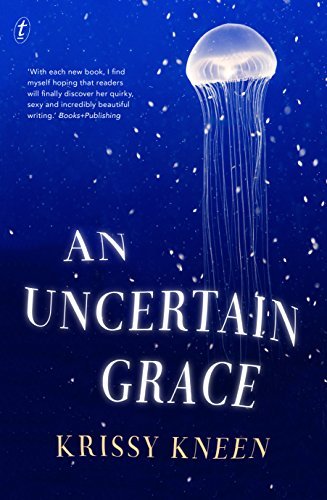
Beejay would like to break down the snobbish hierarchy about what is worthy reading, a hierarchy that puts genre beneath literary fiction. But, she said, and I agree, literary fiction is a genre. We conflate slop and genre, but they are not the same thing. She named some recent novels, including genre, she loves, such as Agustina Bazterrica’s Tender is the flesh, Kriss Kneen’s An uncertain grace, Susannah Clarke’s Piranesi, and Anjet Daanje’s The song of stork and dromedary. She said of An uncertain grace that it starts with an act that is so taboo. It was her number one choice for Australia’s Top 100 books!
Take me, she said, to where I know I’m certain and then shake that certainty.
Elaine spoke of finally finishing War and peace, and falling in love with it, partly because of Clifton Fadiman’s intro. Tolstoy knows a lot, but what is important is that he loves what he knows, and knows how to make that knowledge live for us. (I think that was the gist). He showed what a Napoleon could do, but unfortunately there’s no Tolstoy for the US right now.
Ever political, she talked about using storytelling to fight the good fight again imperialism. She also referenced a Tolkien essay on happy endings. A happy ending does not deny the possibility of total destruction, but if we can’t envisage how the world can be, what is the point? Beejay agreed, referencing the glut of dystopias. She wants someone to dream a bigger future.
The nihilist vision is lucrative for late stage capitalism, so to write against dystopia is a political act, said Elaine. Beware, because the Far Right is telling stories. She has no patience with those who say “I’m just writing little stories”. For her writing is political – whatever you write.
So …
This was a thoughtful, lively session. And, although it was mostly preaching to the converted, it did explore some of the issues facing contemporary readers. My friend and I would still have loved a bit more focus on the “how”!
Note: This post is in lieu of this week’s Monday Musings.
Canberra Writers Festival, 2026
How to read for joy
Sunday 18 October 2026, 3.15-4.15pm


I have Castillo’s Moderation on my stack of books to get around to reading. This makes me even more interested.
Right now I’m reading a novel by a Kenyon alum, Rioghnach Robinson, entitled Bad Words, and it’s about a woman who wrote a review of a guy’s book and said it wasn’t good. It’s getting to a lot of the issues about current book reviews, including that a lot of people read the online magazine where the review appears without paying for it and the magazine management keeps threatening to expand the number of books they can review by using AI. A review will follow in the next few weeks (maybe not until November, as my daughter is getting married on Oct. 31!)
Oh thanks Jeanne… that sounds interesting and on point. Enjoy the wedding. Our daughter got married earlier this year and it was so lovely.
I think book critiques have disappeared from periodicals to podcasts. There seems to be an abundance of book podcasts but reading from a newspaper or magazine is always nice. My favourite book about reading is How to Read a Book by Mortimer Adler. Published 1972 and maybe aimed towards students but I have read it twice and like it. I go to a lot of talks at Fullers book shop by authors and I enjoy the format. 5:30 to 6:15 pm is the talk. Then 6:15 to 6:30 is question time. They are good at sticking to that timetable. It’s too bad you couldn’t ask your question. Why wouldn’t an author want that interaction time with the audience. Especially at a Lit festival.
Do you think her book is worth reading as I enjoy books about reading.
Thanks Pam. Yes, that format – about 45-50 minutes for the conversation, and then 10 minutes for Q&A is the common format here (for our Meet the Author events, for example) and for many of the Festival events. However, there is a counter argument that questions are often not great (at best) or self-serving (at worst). So, I do have mixed feelings about Q&As. I rarely ask questions, though I did at one of the sessions this time.
I can’t comment on her book because I haven’t read it, but I feel that it probably is – because of what I have heard her say, and because she’s coming from a diverse background and is perhaps shaking up the establishment a little in her ideas about reading.
Thanks for that. Interesting about the questioning. I do hear a few self serving questions. But I can put up with most things for 15 min. Some people just li,e the sound of their own voices. Haha
They do … but it can be irritating if you’d rather hear the authors! And someone goes on a story about their own ancestor, and then asks how you research difficult ancestries.
I know what you mean. I think there is an art about asking intelligent questions.
There sure is!
Is that the end of your posts on the festival? If so I have enjoyed them immensely. A big thanks Sue.
Yes it is John, though I sometimes do a wrap a week or so later. Still thinking about that.
I’m thrilled that you enjoyed them John. Means a lot that they meant something to someone else. I mostly do them as a record for me so I can come back and remind myself of ideas I heard, but it’s still nice to think that someone else found them interesting too.
I wonder in history if your reflections of these sessions will become history in and of themselves. I can just imagine someone, researching one of these authors and then using your accounts as part of that research…
You bring a view of an author in these sessions that differs to what we read and while some of the authors are a little beige when they talk at these events, a Kate Grenville or an Anna Funder of the future will interrogate the gaps and facts in their lives and your account will serve to enable different and interesting conclusions to be drawn…
As you can probably tell, I am reflecting on what remains of us 150 years into the future (not in a grim way) but in a mildly fascinated way. What sort of trail do we leave and what can creative people (if they were so inclined) weave into our back stories…
Love it Rach … though it also makes me slightly nervous. Still, I guess for researchers a variety of perspectives enriches the picture they might be trying to build.
Yes, sorry it was a weird thought yesterday as I had just finished ‘The Country Schoolmaster’ by Kate Grenville, which is about researching and then I read your post and was thinking how some of these marks we make will create bread trails in the future…
But I think it is important, not to mention interesting for all of us that are not in Canberra to attend directly!
Oh now you have me more intrigued about this book ! I’ve read a few Kate Grenvilles over the years, but not so much recently.
Interesting! I read Castillo’s book of essays not long ago. There is some foundational overlap in our thoughts about reading and writing, but there were many instances in which I disagreed. However, what I appreciated is that she quotes in detail and she explains and illustrates how certain passages contributed to her opinions; she really gets into specifics. So you can think to yourself, well, I don’t think that’s what’s being said here in these very lines, and therefore the piece resonates differently with me, but you understand her view as well. (But, as this talk repeats, there’s no money in longform lit crit these days.)
Oh thanks for this Marcie. They sound like just the sort of essays I would like to read, writers who properly illustrate their points. I can imagine what you are saying, because she is coming from a very different cultural perspective so it’s likely that we wouldn’t always meet at the same point, but if she can help us all understand “how” we might read differently, that’s a significant achievement. Oh, and also open our eyes to seeing what we are reading a bit differently, even if in the end we see it our own way.
It may not have been quite what you were hoping for, but what a fun discussion to sit in on, even one preaching to the choir. I have Castillo’s book, just have to get around to reading it!
You mean the one on reading Stefanie? I do too – have it and need to get around to reading it.
Yup, the one on reading. I heard her interviewed on a podcast about it and it sounds great. I also have my eye on Moderation which you mentioned in a different festival post. There’s just too many good books to read!