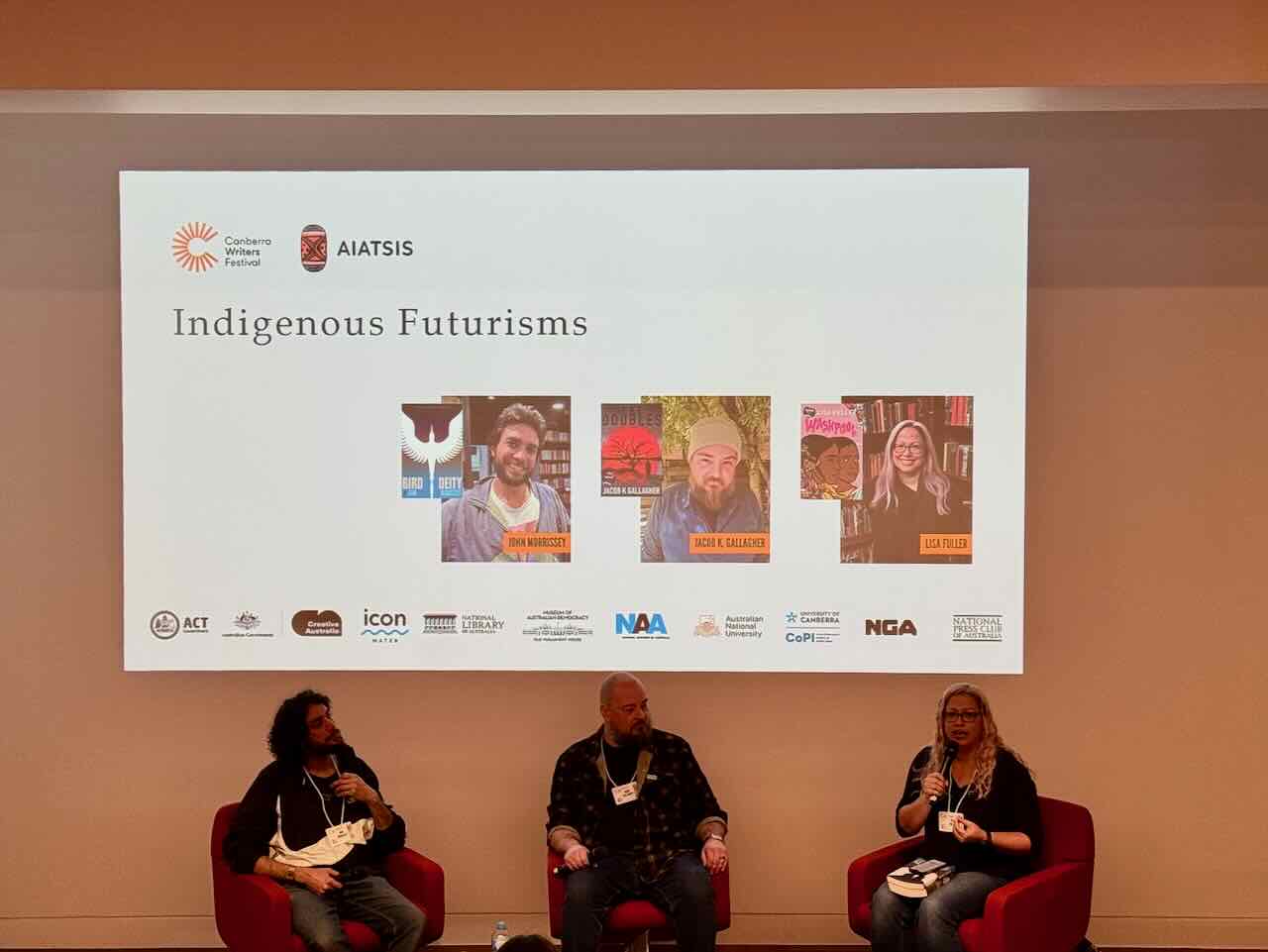
John Morrissey, Jacob K Gallagher and Lisa Fuller
The program described the session as follows:
First Nations speculative fiction takes us to other realms and distant planets while tackling home truths. This panel will talk celebrating diverse worldviews, surviving and thriving beyond apocalypse, reframing timelines (and time) and much more. An event for those that revel in the art of world building across science fiction, fantasy and mystery. Join First Nations panellists John Morrissey, Jacob K Gallagher and Lisa Fuller as they fly us to amazing places and ask big questions about the future.
The conversation
Session moderator Lisa Fuller commenced by acknowledging country, and then asked the authors to introduce themselves.
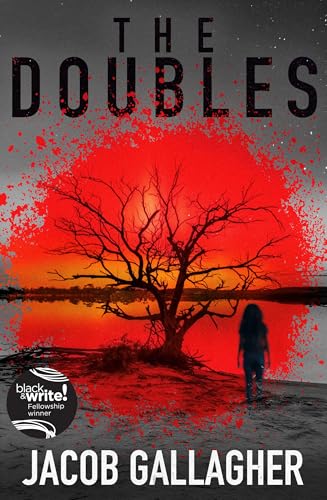
Jacob said he was interested in speculative fiction and urban fantasy, that he likes dinosaurs, robots, angels, and more. His debut novel, The Doubles, is an urban fantasy set it the bush! GoodReads describes it as “A fast-paced, genre-bending debut from the winner of the 2023 black&write Fellowship. For lovers of thriller, crime and fantasy, The Doubles combines First Nations culture with compelling speculative fiction to create a mesmerising mystery”.
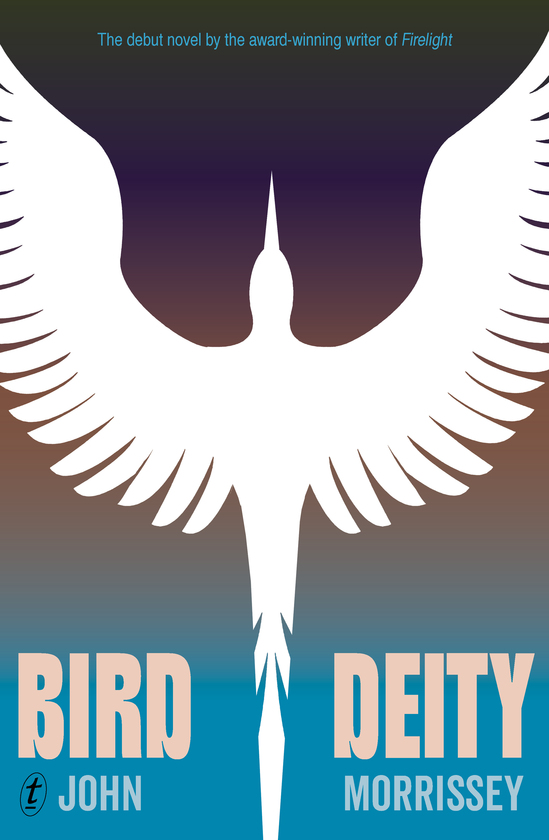
John simply said that he writes science fiction, and introduced his book as being cosmic horror which starts in an alien world. GoodReads provides a lengthier description, but concludes that “John Morrissey’s Bird Deity is a novel like no other. At once disconcerting and eerily familiar, it’s a cosmic horror story about power, theft, love, loss, and destiny.”
Lisa then started the conversation proper by asking where the idea for their books came from. Jacob’s started as a short story but took on a life of its own, while John said his started from a vague idea he had while walking during lockdown.
This conversation flowed quite differently from others I attended. The moderator was more actively involved in the discussion, some audience questions were interspersed through the discussion, and there was some repetition of ideas, so I will present this a bit differently – and hope I haven’t taken too much licence in moving things around.
Science fiction, speculative fiction and colonial allegories
A strong thread that kept popping up was that speculative fiction is a way of critiquing colonialism, and that their stories are colonial allegories. John said that most science fiction works are colonial allegories, one way or another.
There was discussion about the worldbuilding aspect of their books. Jacob didn’t want to write a space opera and kept his book tightly focused on character, on the character’s journey. There is another world, but he kept it more contained than he originally planned. His aim was to blend real and fantasy, so he wanted the get the real exactly right, and got his father to fact-check, down to such things as the location of roundabouts. It took him nine years – in fits and starts – to write the book, which started as a 15,000 word novella.
Jacob would love to write version of Lord of the Rings with Dinosaurs, an allegorical fantasy about colonialism.
John had several false starts, partly because he was doing too much world-building and had problems with his colonialist character who was too sadistic, so he needed to work on him. But, the writing was quick at the end and it took him two years (with new baby, no less!)
Related to this was the question of why mob is attracted to speculative fiction. Jacob has always been attracted to “weird stuff”, though he reads crime and other non-weird fiction. John is drawn to the idea of a radically different Australia. Also, ghost stories are a comfortable fit within Aboriginal culture. Lisa added that mob does the best scary stories.
An audience member asked about Ellen van Neerven’s discussion of First Nations Australian writing and genres. Unfortunately I don’t know which piece of writing, if there was a particular one, the question related to. Also, the authors didn’t take on board the issue itself, but rather talked about their own writing. Jacob, semi-jokingly, said that people describe his work as genre-bending which may be because he encompasses too many genres! But, he does see genre as offering a shorthand, or way into a work. John generally agreed seeing genre as a useful aid to the creative process. But you can also play with readers, bouncing off conventions, retelling them, and so on. We are living, they said, in a post-apocalyptic world.
Other essays on genre were also mentioned, one by Mykaela Saunders and another by Ambelin Kwaymullina. I’d like to try to find them!
On craft
There was also discussion about craft. Lisa asked about writing strange scenery. For Jacob, some ideas are intrinsic while others develop as you write. To keep it all contained, you keep filtering. John had to focus on the physical environment because his story takes place outside. It deals with ruptures, and he needed to develop a fictional mythology to explain the ruptures.
Regarding characters, Jacob does draw on real people. When he “cast” his partner as a character he got the physicality better. John drew less directly on others, but he did draw on a negative version of his self.
Again, with locations, Jacob’s inspiration was stories his grandfather told about Mt Terrible (near Werris Creek), so he wondered what if it started killing people. For him, setting is character. John’s story is set outside, and he had to make it threatening.
In terms of making time for writing Jacob said you just have to do it, and that deadlines work for him. Without that, it’s just inspiration that comes and goes. John tries to work semi-regularly for around an hour a day, but it is often in fits and starts. It’s difficult with a young child.
Their books are only recently out. Jacob has “been sent” good reviews, so as far as he knows that’s all he’s had! John has had both, but he observed that those who know the cosmic genre have been positive, whereas others don’t always get it.
There was also a discussion about writing their bios! Lisa and Jacob started by writing rather full bios, while John kept his minimal. Jacob suggested his next one might simply be, “sometimes he talks too much”.
Lisa also asked about winning awards. For Jacob, black&write was a good experience. He particularly gained a lot from the yarning circle/community that came with the process. John commented that you don’t make a lot of money from writing, so awards, or being well-viewed critically, are nice to have!
On editing, permissions and appropriation
Jacob was edited through the black&write program which he found good. They were committed to his voice, but it is helpful having the perspectives of different editors. John had experienced some good structural editing, but said editors had questions his ambiguous ending. In the end, he stuck with his ending.
Lisa commented on the challenge of being edited by those who don’t have the same cultural background (which is why black&write is a good program). For example, an editor wanted to change “do it proper way” to “do it the proper way”, but the former is how mob speaks.
In terms of permissions, Jacob was working through the black&write program, so permissions were part of that. Otherwise, he was writing his family’s story. Also, its being urban fantasy enabled him to avoid some of these issues. His main concern was to get the facts/details right about his setting.
John’s story is allegorical so permissions are not so much an issue. However, he did say that Aboriginal writers are sensitive about not writing outside their own culture. He consciously tries to think of creative ways to avoid the issue.
Lisa never wants to write a story set in her home town. It is difficult stepping into contested ground. It is very important for mob, in particular, to get permissions done.
Q & A
On whether there is any Utopian amongst the dark and Dystopian: Not in Jacob’s current book, but in another work he realises his characters think they are living in something different. John said his book is definitely bleak but offers some hope or connection. Lisa believes it is important to recognise the horror but she also wants to recognise what she loves.
On books which influenced them: Jacob read a lot when he was younger, particularly Animorphs and Dinotopia. He is also a big Michael Crichton fan, including Jurassic Park. Crichton’s Eaters of the dead take you to the edge of believability. John said that a significant book for him was Annihilation by Jeff VanderMeer, partly because it showed him that you can write a good, effective short novel. Lisa said she loved it when she found Victor Kelleher and Isobel Carmody, people who were writing what she liked. These inspired her novel Ghostbird.
On whether they had a readership in mind: Me, said Jacob! He writes what he likes and assumes some others might too. John simply said he writes for those who like reading science fiction. At some point John commented that he was aware that people would read him through the lens of his Aboriginality but would like people to be able to read it without that knowledge. This point was not teased out, but it goes to the heart of the tension many, or some – dare I say, “diverse” – writers speak about, that is, the desire to write what they want to write not what is expected of them as representative of a group. This might have been a good question to explore?
Canberra Writers Festival, 2026
Indigenous Futurisms
Saturday 18 October 2026, 1.30-2.30pm

