Mirandi Riwoe with Qin Qin
for the first time in a couple of years, today I ventured away from my favourite Festival location – the National Library – to a couple of other cultural institutions just across the way, the National Archives of Australia this morning, and the National Portrait Gallery this afternoon.
The program described the session as follows:
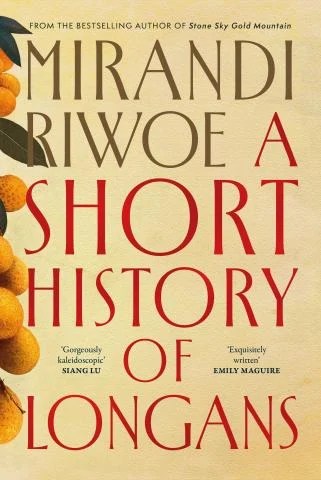
Join Mirandi Riwoe and Qin Qin for the Canberra launch of A Short History of Longans and to share a love of beautifully written family sagas. This story is inspired by Mirandi’s great-great-great grandmother, Maria, who arrived in Australia on the Mayo Orphan Scheme during the Irish Famine, and a Chinese bushranger based in the Queanbeyan area. Queue stunning prose bearing tales of intrigue and heartache down generations.
The conversation
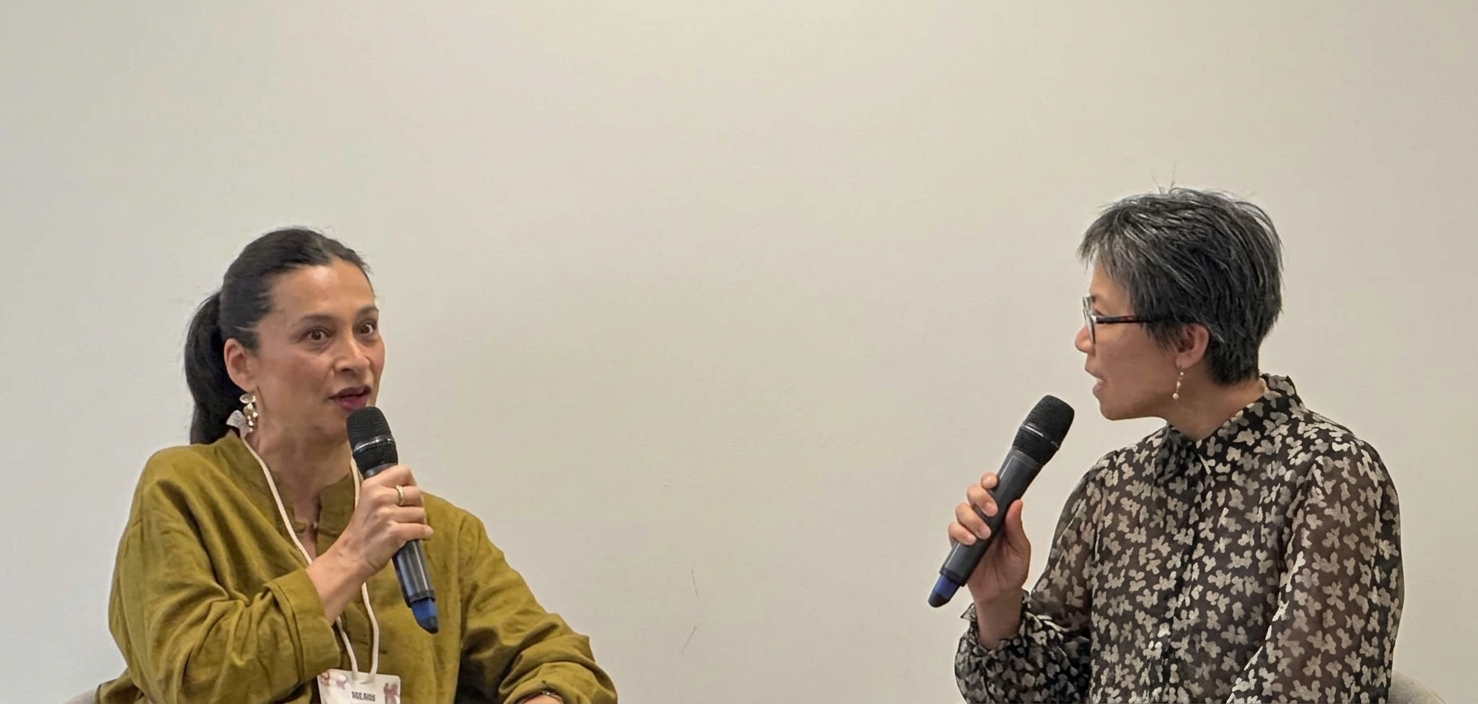
Session moderator Qin Qin started with loveliest acknowledgement of country I’ve heard for a long time. She suggested we start with a soft gaze and our feet on the ground, that we feel the country we are on, the country she would like to acknowledge. Respectful and lovely.
She then introduced the session by saying we were here for the Canberra launch of Mirandi Riwoe’s new book, A short history of longans, which she described as a “delicious morsel of chocolate without the bad side effects”! The novel opens in the past with a fictional biography of a Chinese bushranger who was active in the 1850s, and then moves immediately to a character named Daniel in the future, 2049. What is their connection. The book explores questions like what it takes to belong. Qin Qin suggested that it was particularly apt to be meeting in rooms at the National Archives, an institution which holds our secrets and our memories, not to mention the questions about who belongs.
On Mirandi’s ideas about history, and why she felt she had to write this book
The book is loosely based on Mirandi’s great-great-great grandmother, but she’s been trying to write this story – a cross-cultural love story of a marriage between an Irishwoman and Chinese man (Mirandi is Eurasian) – for a long time. That was the plan for Big sky, stone mountain, but while researching it in Far North Queensland, she came across Aboriginal massacres, and this redirected her original intentions to something else.
So, having finished that book, she tried again, starting with a different angle, only, this time, she bumped up against the White Australia Policy, so again her cross-cultural love story got diverted. She’s hoping it will be third time lucky (but she may have had tongue planted in cheek. We’ll have to wait to see.)
During her research – for Stone sky, cold mountain, I think – she had read the journal of a woman who never mentioned that her husband was Chinese. Why? She wanted to hide it? Or it wasn’t an issue in that town? Regardless, this question and other discoveries got her thinking about what did happen to an Eurasian family under the White Australia Policy? Her aim was to explore what is not shown in historical record.
On this being the world’s only novel with longans in the title
Mirandi’s father came to Australia in 1960, and was astonished to discover a longan tree outside a temple in Innisfail. The book’s first story about a longan tree happened to her father.
On characters – and objects
Mirandi wanted to write a saga but not a rolling saga. So, she wrote it in four sections, with the longan tree providing a link. She wanted each section able to be read separately, though some characters do appear in other sections. She also likes to use objects as sort of character totems (though that might be my word, not hers!) The characters are:
- Daniel (in 2049) is fractured by something that has happened in the past, and is associated with a piece of broken china.
- Wendy, his aunt, is in the early stages of dementia. She is interested in family. Something has happened in the past but she can’t quite grasp it. Riwoe, who once thought she might become a crime writer, used crime-like clues she said.
- Ruby is based on a real person, Rose Quong (1879-1972), an Australian-born performer of Chinese heritage, who was an “Orientalist”. She apparently performed with Laurence Olivier, but Riwoe has her working in Hollywood.
- Maria came to Australia from Ireland in 1900 as a “Mayo orphan”, and is the character based on Riwoe’s great-great-great-grandmother
Qin Qin commented on Riwoe’s craft, on her exquisite writing and the fact that even minor characters are described deftly.
There was then more talk about the issue of objects, focusing on Mirandi’s Mum’s recipe book, which inspires Wendy’s recipe book (her object). Mirandi said that these books, which pass through families, not only tell of culture of the time (Italian sausages, offal that people don’t eat anymore, Chinese dishes) but they retain the writing of the people. Recipes create obvious links within family.
Writing about objects shows not only the actual objects we keep but what our keeping them says about us. (Hmm … I’m thinking about what I did and didn’t keep after our recent downsize, and what I’m now ready to move on!)
On historical research, and filling in the gaps
Mirandi then did a short reading from the Ruby section. Ruby struggles to work in Hollywood, because her Chinese background comes up against the Hayes Code and miscegenation rules.
This reading exemplifies why we read historical fiction, which is for what is missed in the historical record.
Mirandi then talked about her research. For example, for the White Australia Policy, she went to Melbourne’s Immigration Museum, with its exhibits relating to the Dictation Test, which was geared to keeping out non-Europeans. The Museum uses reenactment to show the impact of this policy at an individual level. She researched dementia for Wendy, wanting to understand how her character might understand what she thinks she knows.
On various contemporary issues – oppression and racism, appropriation
Mirandi talked about how racism and oppression is structural rather than personal. Her book contains many examples.
The discussion also turned to the complex issue of cultural appropriation, not only in story but in fashion, and food, for example. This included recognition of that idea that “you” are not wanted, but we will adopt your fashion, and eat your food.
Re story, Mirandi talked about stories being appropriated, and then we had the “own voices” movement, but now some rethinking is happening. These are interesting times! I – but it’s easy for me so say, I know – would like to see more nuance accepted in this space.
On craft, and how her way of seeing helps her as a writer
What a fascinating – and different – question on craft! Qin Qin exemplified her question by asking, “What do you see when you look at a wattle tree?” Mirandi said she sees a wattle through her through her characters’ eyes. So, Irish Maria would look at the wattle in terms of its similarity to gorse, while gardener Daniel would think about how he could grow it in a different place!
But, it’s also about craft and practice! About writing, reading, and “I love a workshop”!
Q & A
On whether the Easter eggs she “planted” happened organically: she knew where the questions would be in her sections, so she built them in as she went.
On how to research difficult backgrounds: ask a librarian, said Mirandi! Do your research, and then follow Margaret Atwood’s advice to “write in the gaps”.
On challenges in editing: this is the first book where she had to make a major change! She wanted each section to be different, and so she wrote the Ruby section in epistolary format, but her publisher/editor said it had to go. She realised they were right, but the rewrite – from Ruby’s POV – was easier because she knew the characters well from all those letters!
On the structure she’s chosen means leaving the characters hanging: this gives the readers freedom to wonder what might happen.
On how you know that an idea is not not going to work, the reality check: you can test things as you go, and tweak, but once you’ve handed it over you can’t know.
On whether her perceptions of time have changed: she started writing from a position of rage, feminist rage, but historical fiction needs to be about now. Much doesn’t change, such as the experience of trafficked women. Nonetheless, if you want to read a book set in 1800, read a book written in 1800. Historical fiction looks at 1800 through a different lens. (Yes!)
Qin Qin concluded on an interesting statement, which is that Art is the only way things can change. Did she mean that we can only see change in art, or that art can create change, or both?
This conversation covered some interesting ground, particularly about the craft of writing and structure, and about writing about history. I enjoyed learning something of Mirandi’s writing trajectory, but in terms of specifics, I particularly enjoyed her “wattle tree” answer, and the discussion about the complex issue of appropriation.
Canberra Writers Festival, 2026
Mirandi Riwoe: A short history of longans
Saturday 18 October 2026, 10-11.00am


Another book from your sessions on my TBR. I really, really enjoyed Big Sky, Stone Mountain so I’ve been looking forward to getting into it. Your report has bumped it up my list – thanks 🙂