Many moons ago, I started a little ad hoc Favourite Quotes series which I would really love to maintain way more frequently than I have, given I’ve written five in the last ten years, not for lack of quotes but for lack of – well, who knows? Time? Energy levels” Just remembering to do it? The weather? Let’s just blame it on the weather … which brings me to this post.
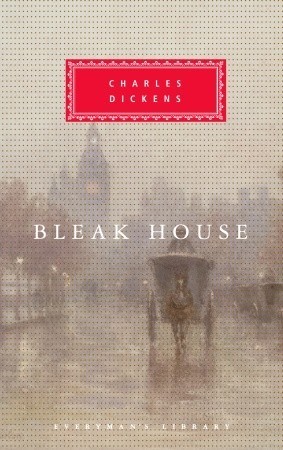
Weather is not a rare occurrence in novels given the way it can be used – for scene setting, for establishing tone, as a plot device, metaphorically or symbolically, or …. you fill in the blanks. One of the most memorable novel weather openers, for me anyhow, comes from Charles Dickens’ Bleak house (read before blogging). In the first paragraph the time of year is set by reference to the “implacable November weather”, in it includes references to “mud” and “smoke”. Then in the second paragraph comes the famous foggy opening:
Fog everywhere. Fog up the river, where it flows among green aits and meadows; fog down the river, where it rolls defiled among the tiers of shipping and the waterside pollutions of a great (and dirty) city. Fog on the Essex marshes, fog on the Kentish heights. Fog creeping into the cabooses of collier-brigs; fog lying out on the yards and hovering in the rigging of great ships; fog drooping on the gunwales of barges and small boats. Fog in the eyes and throats of ancient Greenwich pensioners, wheezing by the firesides of their wards; fog in the stem and bowl of the afternoon pipe of the wrathful skipper, down in his close cabin; fog cruelly pinching the toes and fingers of his shivering little ‘prentice boy on deck. Chance people on the bridges peeping over the parapets into a nether sky of fog, with fog all round them, as if they were up in a balloon and hanging in the misty clouds. (p. 1)
It’s memorable because it’s beautiful to read – and because, along with the first paragraph, it sets the scene of physical and moral dankness, of gloom and decay. Nothing is clear and there are just enough but not too many words – “defiled”, “pollutions”, “creeping”, “wheezing”, “wrathful”, “shivering” – to convey this murkiness is not just physical.

Rather different to Dickens’ gloom is Niall Williams’ This is happiness (my review). It is framed by an unusual weather event – the rain stops at the beginning of the novel – indeed, Chapter 1 comprises one sentence, “It had stopped raining” – and returns at the end having been absent over summer. Rain coming and going is not, of itself, unusual, but it was unusual for there to be no rain for a few months in that part of Ireland. In any part, really, but the novel is set in the fictional Faha, County Clare. Early in the novel though, is a beautiful description of the rain from the narrator’s earlier visit to Faha as a boy:
Rain was falling, though not exactly. Rain in Clare chose intercourse with wind, all kinds, without discrimination, and came any way it could, wantonly. (p. 28)
Why I like this quote in particular is the agency it gives the weather – rain – it “chose intercourse with wind …”. It is an active player and it is in charge. But, for a period it disappears, and its absence heralds sunshine and metaphorically, the coming of the “light”, of change. This “light”, this change, has a physical basis in the electrification. It’s not, however, a happy-clappy story, the coming of “light” is not a simple thing, and Williams recognises that no “light”, no change, is absolute. In a great ceremony, the lights are turned on, and the novel concludes, “It had started raining”.
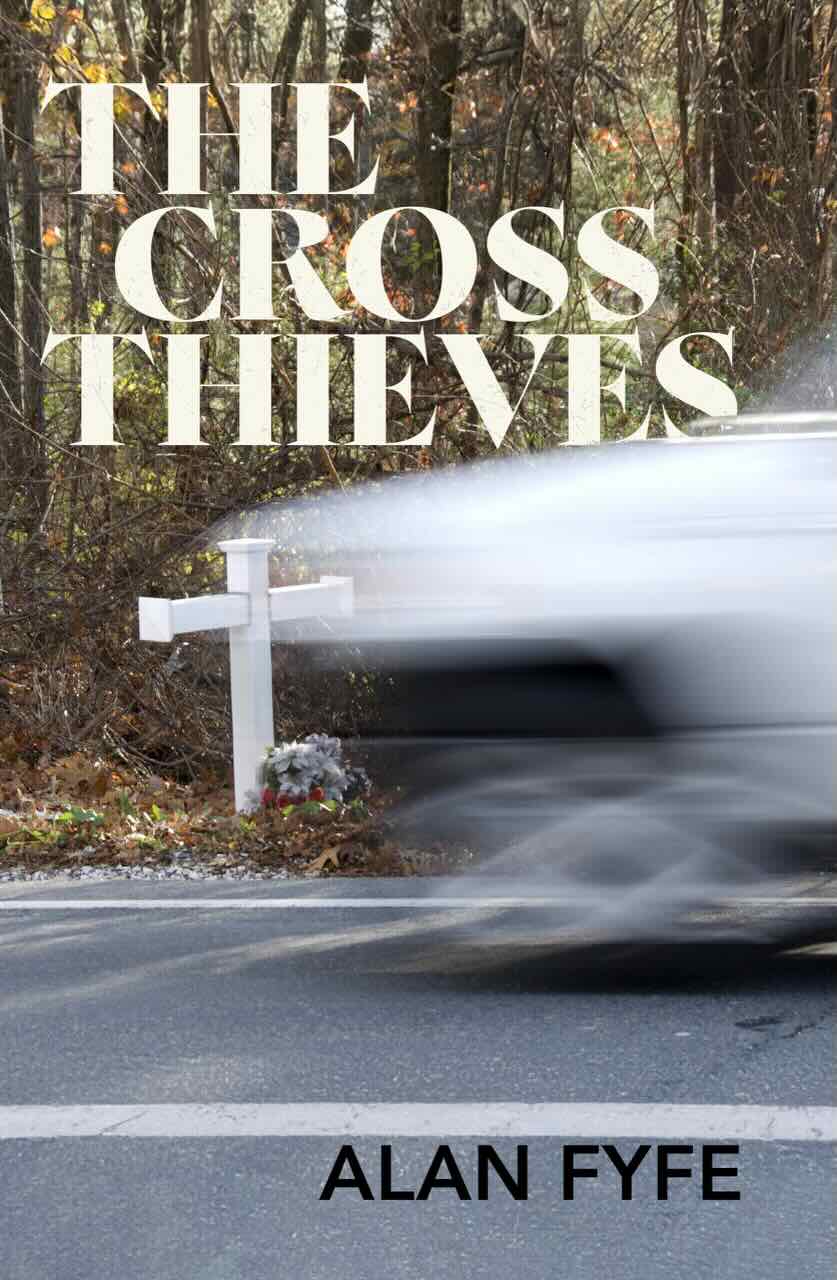
So, Niall Williams’ novel is framed by a rainless summer. Alan Fyfe’s novel, The cross thieves (my review) has a very different – non-weather-related framing. It is one of those novels set in a day (and is also written in the ring or chiastic structure), none of which is entirely relevant to my chosen quote, which is:
In late autumn, the summer heat hadn’t quite fallen off, but the sky was overcast and gossiping about rain that might never break – the weather was having an argument with itself, contesting for the supremacy of oily humidity or a night chill. (p. 10)
You might guess why I chose this as my final quote for this post? It’s the agency given to the weather again: the sky is “gossiping” and “the weather was having an argument with itself”. It occurs near the beginning with Gark heading off on his wild, avenging mission, and brother Pell in pursuit. What it conveys is a sense of volatility and internal and external conflict, which is perfect for this novel about economic precarity, emotional trauma, and physical violence.
Writing like this is part of the reason why I love these books. The language used is intrinsic to our understanding of the stories and their themes.
Do you have any memorable weather quotes – from novels? Or poetry? I will allow that too!


I enjoyed your post and glad you got around to adding to this series – maybe your muse wil
Lead you to more
My favorite part was reading that dickens opening
– I read the book but reading it here just now was powerful!
And reading your question did have me think of Emily Dickinson poems and so real quick I looked up her mention of weather
–
Emily Dickinson & Weather
Her most famous weather poem, “There’s a Certain Slant of Light,”* links winter light to despair.
She also had 500 poems about the seasons, favoring spring and summer (~400) over winter and autumn (~100). She used the word “weather” in only **two** of her ~1,800 poems, yet weather imagery is everywhere: **sun** appears in ~165 poems, **wind** in ~80, **snow** in ~57, **cloud** in ~26, and **storm** in ~15.
She never mentioned hail, tornado, or blizzard.
Thanks so much Yvette. I’m glad you enjoyed the post. I will try to do more as I enjoy doing them. It’s all about time, isn’t it. The Bleak House opening is memorable isn’t it. But thanks particularly for your Emily Dickinson contributions (including your numerical analysis. Love it.)
Well, thank you for the great comment reply, and it has been fun connecting over such a fun topic
Hi Sue, there are some wonderful quotes, I write them down, and then cannot find them. However, for me one of the best quotes on weather is from Shakespeare’s The Tempest:
Here’s neither bush nor shrub, to bear offany weather at all, and another storm brewing;I hear it sing i’ the wind: yond same blackcloud, yond huge one, looks like a foulbombard that would shed his liquor.
Thanks Meg, it’s really hard to keep track of things isn’t it. I used to have a “favourite quotes” document but I stopped keeping it up ages ago.
That The tempest quote is great. Thanks for sharing. It’s not one of my best-known of his plays.
I love this post and I love how much a great description can take you into a season or mood.
I don’t have any exact quotes that I can think of off the top of my head, but I did find ‘The Land in Winter’ by Andrew Miller to be particularly evocative! Snowed in landscapes. Oh and that reminds me of ‘Venetian Vespers’ – John Banville, I still feel the effects of the eerie frosted prose as the boats bang against their metal tethers in thick fog. I almost can visualise it!
Thanks Rach. And thanks for adding your suggestions. I haven’t read that Banville, but he is good at evoking atmosphere that’s for sure.
In the part of Beppo beginning “England! with all thy faults, I love thee still,”, there occur the lines “I love the weather, when it is not rainy,/That is, I love two months of every year.”
Clive James quotes from Nirad Chaudhuri’s The Autobiography of an Unknown Indian, “The rain came down in what looked like already packed formations of enormously long pencils of glass and hit the bare ground.”
For some reason I find it easier to think of writers from a mild climate complaining about cold ones–Xenophon and Ovid for example–than of writers from a mild or cool climate complaining about heat. There is plenty of that in Kipling, of course, and David Halberstam’s novel of the advisory period in Vietnam has the title One Very Hot Day.
(A special case might be Joseph Brodsky’s Watermarks, a short book about Venice. The man grew up in Russia and settled in Michigan; but his descriptions of the penetrating winter chill in Venice are memorable.)
Haha, George. I love your first quote – and of course enjoyed all your contributions. Your point about writers from a mild climate complaining about cold ones more than about heat is interesting. Do you have reason for this? Are more books set, perhaps, in cold climates. Though, I think, we could find a good number of books by British writers set in colonial India, besides Kipling? EM Forster for example in A passage to India. Oh, and Joseph Conrad in The heart of darkness. My feeling is that oppressive tropical heat is used rather a lot in literature – but dry desert heat less so (though, hmm, shimmering dry heat and mirages? You’ve got me thinking now …
I think that the world has (so far) relatively few places where the heat is life-threatening to those who know how to manage it–breaks at midday, shade, calibration of effort. On the other hand it has plenty of places where cold will kill the unsheltered. Los Angeles has a large homeless population, Chicago a very small one. This may affect the tendencies of writers, or maybe just my perceptions.
Yes, British writers are good on the heat of Africa and southern Asia.
Hello! Always enjoy your posts. Ref: weather.
Not forgetting Brisbane writer, Fiona Robertson, and her award-winning collection of short stories, If You’re Happy (UQP), which features many wild weather events and still remains tender, subtle and humane. The opening line of the book is: “They are having sex when the wind starts up, whispering and sighing outside.”
Best regards, Amanda
>
Oh thanks very much Amanda… that’s a wonderful contribution!! Sounds like I’d enjoy this book.
“The sun was like a huge fifty-cent piece that someone had poured kerosene on and then had lit with a match and said, ‘Here, hold this while I go get a newspaper,’ and put the coin in my hand, but never came back.”
This is from Trout Fishing in America by Richard Brautigan that I am reading right now. When I read this line a day or two back I checked it out on the www and found that “huge fifty‑cent piece soaked in kerosene and lit with a match” is a Ray Bradbury line from Dandelion Wine, a book I read 40 years back and have no recall of. I think Brautigan has used Bradbury for the oppressive heat of the sun
Thanks very much John … great quote too. I should read Brautigan, but I think we’ve mentioned this before.