William Gilpin, Jane Austen and the picturesque

I was introduced to William Gilpin by Jane Austen. Well, not by her so much as by her brother, Henry, who told us* that she was “enamoured of Gilpin on the Picturesque at a very early age”.

Engraving of Rev. William Gilpin.

William Gilpin (Harper’s New Monthly Magazine, No. 231, August, 1869.Public Domain, via Wikipedia)

This month my local Jane Austen group decided to look a little more deeply at Gilpin, his Picturesque, and what Jane Austen really thought. William Gilpin (1724-1804) was an English vicar, schoolteacher, prolific writer and amateur painter. He is remembered primarily for his theory of “the picturesque”. The “picturesque”, according to my Shorter Oxford English Dictionary, dates back to 1703 with the meaning, “in the manner of a picture; fit to be made into a picture”. In his Essay on Prints (1768), Gilpin defined it as “… a term expressive of that peculiar kind of beauty, which is agreeable in a picture”.

The blogger at Austenonly has written an excellent post on Jane Austen and Gilpin in which she proposes – and my group here agreed with her – that Austen was enamoured of him because he appealed to her sense of the ridiculous. He expresses his opinions so dogmatically, he is so opinionated, that she can’t help mocking him. How could she not satirise a man who seriously suggests (“Essay 1: On Picturesque Beauty”, Three Essays) that, when it comes to a portrait, “the highest form of picturesque beauty” is not “the lovely face of youth smiling with all its sweet dimpling charms” but “the patriarchal head” with its “lines of wisdom and experience … the rough edges of age”. Being a woman of a certain age, I rather like Mr Gilpin! But, seriously, is it really a matter of either/or?

Or someone who writes (in the same essay):

A piece of Palladian architecture may be elegant in the last degree. The proportion of its parts — the propriety of its ornaments — and the symmetry of the whole, may be highly pleasing. But if we introduce it in a picture, it immediately becomes a formal object, and ceases to please. Should we wish to give it picturesque beauty, we must, use the mallet, instead of the chisel : we must beat down one half of it, deface the other, and throw the mutilated members around in heaps. In short, from a smooth building we must turn it into a rough ruin. No painter, who had the choice of the two objects, would hesitate a moment.

We must presume that he is not speaking literally when he suggests taking a mallet to a pleasing building in order to make it picturesque! But Jane Austen is sure to have laughed and, as you’ll read in Austenonly’s post, there are many examples in Austen’s novels, particularly Pride and prejudice, Sense and sensibility and Northanger Abbey, in which she satirises the picturesque.

On the other hand, there are also places where she seems to exhibit an appreciation and understanding of Gilpin’s theory because, while Gilpin could be dogmatic, he also argued convincingly for a seeing nature with “a picturesque eye”. He writes in “Essay 2: On Picturesque Travel” about enjoying “the great works of nature, in her simplest and purest stile, open to inexhaustible springs of amusement”, and says

Nor is there in travelling a greater pleasure, than when a scene of grandeur bursts unexpectedly upon the eye, accompanied with some accidental circumstance of the atmosphere, which harmonises with it, and gives it double value.

I’ll illustrate this with two examples of travellers in Austen. First is her description of Fanny’s return to from Portsmouth in Mansfield Park:

Her eye fell everywhere on lawns and plantations of the freshest green; and the trees, though not fully clothed, were in that delightful state when farther beauty is known to be at hand, and when, while much is actually given to the sight, more yet remains for the imagination.

There is also a lovely, similarly genuine, description of the environs of Lyme in Persuasion in which she writes of a “sweet, retired bay, backed by dark cliffs, where fragments of low rocks among the sands make it the happiest spot for watching the flow of the tide …”

The question that comes to mind then is whether she is satrising the picturesque or slavish adherence to it or, even perhaps, its somewhat slippery nature. In fact, Jane Austen, landscape and the Regency is a pretty inexhaustible topic. And so, while I thoroughly enjoyed my brief introduction to Mr Gilpin, I’d love to find time to read more, particularly his travel writings about various parts of the British Isles. Meanwhile, I can’t resist leaving you with another Gilpin satirist, William Combe (1741-1823), who in 1809, as Dr Syntax, wrote the poem “The Tour of Dr Syntax in Search of the Picturesque”. It starts with

I’ll make a tour – and then I’ll write it.
You well know what my pen can do,
And I’ll employ my pencil too:-
I’ll ride and write, and sketch and print,
And thus create a real mint;
I’ll prose it here, I’ll verse it there,
And picturesque it everywhere.
I’ll do what all have done before;
I think I shall – and somewhat more.
At Doctor Pompous give a look;
He made his fortune by a book:
And if my volume does not beat it,
When I return, I’ll fry and eat it.

What a hoot …

* in his biographical note to the posthumously published first edition of Northanger Abbey and Persuasion
Monday musings on Australian literature: Some thoughts on specialised literary awards

Did you hear last week that the Man Group is, after the current award, withdrawing its support for the Man Asian Literary Prize? I heard it via a tweet from a member of our prize team for the 2011 prize. This, in the same year that the Queensland premier cancelled the Queensland Premier’s Literary Awards. What is happening? Is there something in the international waters? Has climate change somehow blown the winds in the wrong direction?

And yet, fortunately, other awards keep appearing. Late last week I reported on the shortlist for a new award here, the Most Underrated Book Award (or MUBA). In the same week the people behind the new Stella Prize finally called for nominations for the inaugural award. Winners will be announced in April next year. This award, appropriately named for Miles Franklin – her full name was  Stella Maria Sarah Miles Franklin – is “for the best work of literature [fiction and non-fiction] published in 2012 by an Australian woman”. Fiction and non-fiction! This will be interesting.

All this ground-shifiting raises the question, yet again, regarding whether new (in fact any) prizes are warranted, particularly prizes targeted to special groups. Author Chris Flynn, writing on the Meanjin Blog regarding the Stella Prize, said, in support of a prize for women writers:

At this point in the process the argument over whether or not a dedicated prize for women is needed is moot. We can, after all, have as many prizes as we like in literature and even if the Barbara Jefferis Award already exists, so what? Men are eligible for that anyway, as the $35K goes to ‘the best novel written by an Australian author that depicts women and girls in a positive way or otherwise empowers the status of women and girls in society.’ Frank Moorhouse was shortlisted this year, and Anna Funder won. If I came into some moolah and announced I was starting up The Flynn Prize for, say, the best first novel of the year, would anyone seriously be shouting me down and saying it was unnecessary, that there are already plenty of prizes out there and debut novelists should just suck it up and hope for the best? Yeah, I don’t think so, somehow.

I like his point that “We can, after all, have as many prizes as we like in literature”.

This brings me back to the Man Asian Literary Prize, which started in 2007. The executive director of the prize, David Parker, thanked the Man Group for its support and argued for the value of the prize:

We look forward to the future with a new partner, confident that Asian fiction is now beginning to secure the global readership and recognition it deserves. Our most recent winner, Please Look After Mom by South Korean writer Kyung-sook Shin, has recently sold its two millionth copy worldwide – an amazing achievement. One third of the shortlisted writers for this year’s Man Booker Prize are from Asia, and international publishing houses such as Pan Macmillan and Hachette have recently opened offices here in Hong Kong. Clearly, Asian literature is on the march.

I don’t know what part the Man Asian Literary Prize played in these encouraging results, but have to assume that the increased international profile it provided for Asian writers played at least some part.

Not all awards, of course, can hope to bring about such high profile change. Some certainly carry more weight (read “status”) than others, but I’d liken it to the Olympics versus national and state championships. This network of championships all play a role in the development and recognition of athletes – and so surely do the international, national, state, local and specialised awards for writers.

For writers and publishers, then, I think awards – both general and specific – have value. What about for me as a reader? I’m not a close follower of literary awards. That is, I don’t aim to read all the long- and shortlists in specific awards, or even all the winners, but I do like to keep an eye on awards and they do help inform my reading choices. I find them particularly useful as a guide in specialised areas that are out of my comfort zone – and hence my involvement in this year’s Man Asian Literary Prize. I was introduced to the literature of countries I’ve never read before. I’m hoping MUBA and Stella will do the same for the writers (and readers) they are targeting.

The Most Underrated Book Award 2012

A short post! I have just read on the SPUNC site that Kobo is sponsoring an award to highlight books that were released by independent publishers and members of the Small Press Network (SPUNC) and that did not receive wide recognition.

The shortlist for the inaugural award was announced this week, and the titles are:

The award apparently recognises both the publisher and author. The winner will be announced, the SPUNC announcement says, on 8 November at the opening of the Independent Publishing Conference during a special gala night and literary debate at the Wheeler Centre.

Good on Kobo I say. Books published by smaller presses are often overlooked in the major literary awards partly, I presume, because the authors usually aren’t well enough established to be noticed and partly because small publishers don’t have the marketing clout and distribution networks to get their books out to enough readers and reviewers. I hope this new award will help raise the profile of the authors and their hardworking publishers.

* I have a soft spot for Irma Gold, and not just because I’ve read and enjoyed her book. She lives in my city, and is currently coordinating the production of, and editing, The invisible thread, an anthology of works “by writers who have an association with the Canberra region”. The book represents a major literary contribution to Canberra’s 2013 Centenary Celebrations, and is planned to be the focus of many literary events over the coming year. Watch this space!

Sefi Atta, A bit of difference (Review)

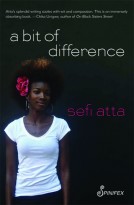
Sefi Atta, A bit of difference

Book cover (Courtesy: Spinifex Press)

Nigerian writer Sefi Atta was once an accountant. Interesting switch that, accountant to writer, but Atta seems to have made it with great success. Her first novel, Everything good will come, won the Wole Soyinka Prize for Literature in Africa, and received an Honourable Mention in the Aidoo-Snyder Book Prize. Her short story collection, News from home, won the Noma Award for Publishing. I don’t usually itemise awards but it seemed appropriate to do so for a writer who is probably little known to most of my readers. It provides some context to her standing.

However, I mentioned her previous profession for another reason. The main character in her most recent novel, A bit of difference, is a Nigerian accountant. I’m not sure how autobiographical the novel is but Atta clearly understands something about the world of accountants!

The novel is set in the early-mid 2000s, just post the war in Iraq, and takes place over a few months in the life of its protagonist, Deola (pronounced, we are told in the first chapter, “day-ola”). Aged 39, Deola is the director of internal audit for an international charitable foundation. Her role is to audit organisations that receive its grants. The novel starts with her travelling to the Atlanta, USA, office and sets the tone for her dissatisfaction regarding where she is in her life, that is, an unmarried, childless Nigerian expat living in London.

Deola and I have little in common, but I have lived the expat life twice, once in my early 30s and again in my late 30s-early 40s and I understood her desire to be with people who have a “shared history”. The trouble of course is that having gone to boarding school and then worked in England for many years, her “shared history” is a little muddy. However, she starts to feel it’s back in Nigeria, despite her own misgivings and those of her English and Nigerian friends in London.

This is not a book with a page-turning plot. It simply follows several months in the life of an unsettled woman who’s trying to make a decision. It’s told 3rd person, but from Deola’s point of view, and is chronological, with flashbacks to explain to us how she’s got to where she is. Despite the potential, given its setting, it’s not a grim novel. There’s humour – in some funny scenes, entertaining dialogue, effective use of irony. And there’s a wide cast of well-diffferentiated and rather colourful but very real characters – from the thirty-something sister in Nigeria who still likes hip-hop to the not-yet successful Coetzee-enthusiast Nigerian novelist friend in London.

What is most interesting in the novel is its multiple, intertwining themes: the often lonely life of the middle-class expat, race relations in England, African identity and politics, and the way even the enlightened or educated people in both cultures don’t always meet eye-to-eye. I was reminded, as I was reading the book, of Anita Heiss’s talk at the Readers Festival I attended last month. She said she wanted to write novels about young, professional, urban indigenous women to show that their concerns are much the same as their anglo-Australian contemporaries, with the added issue of racial identity and politics to contend with.

And so, as I believe Heiss’s “chicklit” novels do, Atta’s novel explores those universal concerns of belonging and identity, but set against a particular environment where ethnic distrust and/or racial and class hierarchies threaten the self, both at home and in the “adopted country”. Deola feels somewhat of an outsider. In England, she feels her views or experience are not respected by her employing organisation and she is conscious always of being black in a white country. Back home in Nigeria, she’s aware of corruption, and of the way Nigerians rank and distrust each other on a whole range of grounds. England may be characterised by “phony egalitarianism” but Nigeria doesn’t seem much better. Through a character like Deola, Atta can tease out the misunderstandings – or arrogance even – of western organisations trying to “do good” for developing countries while also showing the lack of cohesion in those very countries receiving the help. Fortunately for Deola, at least on a personal level, help might be on the way in the form a man she meets on a business trip to Lagos. But, like most modern novels, nothing is quite as simple as it seems …

Two motifs run through the novel – the fear of HIV/AIDS and the threat of “armed robbers”. These are the “bogies” of contemporary Africa, and serve as a constant reminder that for all the universalities, this novel is also particularised to Africa. A bit of difference is an interesting and satisfying book primarily for this very reason, for, that is, the fact that it so beautifully integrates an engaging personal story with one having a wider political resonance.

Sefi Atta
A bit of difference
North Melbourne: Spinifex Press, 2012
219pp.
ISBN: 9781876756994

(Review copy supplied by Spinifex Press)

The Griffyns go Behind Bars

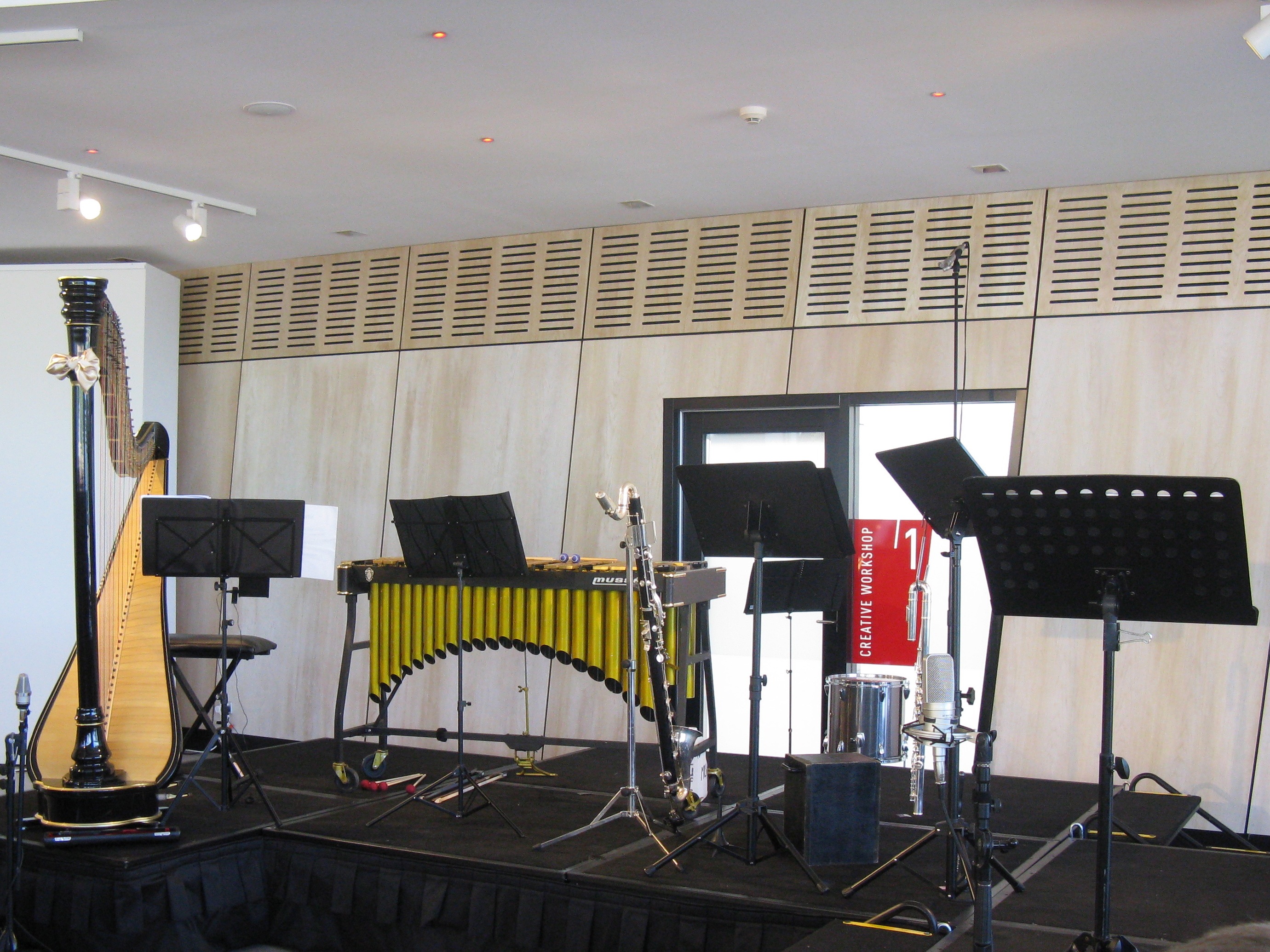
Griffyn Ensemble set up

Before the concert

The Griffyn Ensemble has done it again. They’ve presented a concert that moved, challenged, educated and entertained us. Behind Bars, which was performed last week in Melbourne, Bendigo and Canberra, was the third and final concert of their 2012 season. Like all their concerts it had a theme, this one being, obviously, imprisonment.

This thematic approach is one of the things I greatly enjoy about Griffyn Ensemble. I love the way they marry music with ideas. I guess it appeals to the reader in me. However, while I’ve enjoyed the themes and the music the Griffyns have chosen to represent them, what hasn’t always been clear to me, and I’ve mentioned this before, has been the logic behind the order of the program. Their last concert, which was structured around the four seasons, was clearer, but in Behind Bars the coherence was both logically and philosophically satisfying. Let me describe the program in the order it was presented …

Behind Bars Installation

The concert’s opening introduced us to the main composers and ideas to be further explored in the concert. The performers were spaced around the room, behind, in front of and beside us, and, one by one, provided a spoken and brief musical introduction to one of the concert’s composers. As each new musician performed his/her composer’s snippet, the previous musician/s performed theirs concurrently.  It could have been a mess, but it was lightly and sensitively done and worked well as a concert opener. This section concluded with the ensemble singing Gideon Klein‘s “Poljuŝko, Pole” which was composed in Theresienstadt in 1942.

Abyss of the Birds

Clarinettist Matthew O’Keeffe then performed the clarinet solo movement from Olivier Messiaen‘s Quartet for the End of Time, which was composed in a prisoner-of-war camp in 1941. Messaien apparently said, after this piece was performed in Poland’s Stalag VIII, that “never was I listened to with such rapt attention and comprehension”. This was a lovely piece – though you should know that I’m partial to clarinet. I heard in it strains of jazz and hymns interspersed with the sound of birds. This “birdsong” provided an unexpected sense of hope and freedom amongst the melancholy tones that surrounded it.

Theresienstadt

As you have probably guessed from the heading, the third section of the concert also came from the Second World War and comprised pieces created and/or performed in this Czech concentration camp. The highlight of this section was a performance of the children’s opera, Brundibár, composed by Hans Krasa. WC Fields apparently once said “never work with children or animals” and I must say that guest artist, eight-year-old William Duff, almost stole the show. He sang clearly and sweetly, and his acting was natural and confident. He seemed to have a lovely relationship with his “mother”, the beautifully expressive soprano Susan Ellis. This delightfully entertaining piece was followed by the news that, after performing the work for a Nazi promotional film, the composer, musicians and performers were all sent to Auschwitz and thence the gas chambers. The section closed on the song, “I wander through Theresienstadt”, by poet Ilse Weber (who, with her son, was also transferred to Auschwitz and the gas chambers).

It was in a sombre mood that we went to intermission.

San Quentin

San Quentin was represented by Johnny Cash’s song “San Quentin” composed in 1969 and an earlier piece, “Vocalise”,  by Henry Cowell (imprisoned for “bisexual behaviour”).

March of the Spirit

The concert concluded with an eight-song “folk oratorio” composed by Mikis Theodorakis in 1969 while under arrest at Zoutona during Greece’s military dictatorship of the late 1960s. The piece, March of the Spirit, was set to poems written by Greek poet Angelos Sikelianos during the Greek Civil War in the 1940s. It was described in the program notes as “a collection of eight songs that are a melting post of classical and traditional music elevating the great works of Greek literature and inspiring a new message of democracy and freedom for the Greeks”. Michael Sollis – in a strong, appropriately Greek-sounding voice – and Susan Ellis did the singing, backed, as ever, by the rest of the ensemble on harp, percussion, clarinet and flute. The rousing words – comprising such images as “the earth has been overfertilised with human flesh” interspersed with patriotic calls to freedom – were displayed on a screen for the audience to follow.

What I liked, then, about the concert in terms of its programming coherence is basically this. The opening section provided an effective introduction to the concert’s music and ideas. It was then followed by four sections that were essentially chronological – World War 2 then the 1960s. And, philosophically it ended on a positive note – through a work that expresses the pain of civil unrest but is also a rousing call to freedom and democracy. My only comment, really, is that given the Griffyns are an Australian group performing in Australia, some Australian content might have been appropriate. The toughest issue to tackle would be Aboriginal Deaths in Custody but that would probably be too culturally sensitive for such a group to take on. One day, perhaps, but not quite yet.

I’m aware that I’ve written a lot of words but said little about the music and the musicians. I’ll just say that it was a musically, emotionally and intellectually satisfying concert – and I greatly look forward to the Ensemble’s 2013 season. There are always compensations I find for the years flying by!

Monday musings on Australian literature: Guest post from Marilyn of Me, You and Books

I first “met” Marilyn earlier this year when she decided to take part in the Australian Women Writers Challenge 2012. There aren’t many non-Australians who have signed up for this challenge so Texas-resident Marilyn stood out. She is a retired professor of a small liberal arts school in the USA, where she taught women’s history, black history, US social history, and women’s studies. We started “talking” about the similarities and differences in our respective settler nations, and discovered that we share some interests in the intersection between literature and history. She seemed a perfect person to ask to do a Guest Post for Monday Musings. Luckily for me she said yes … thanks Marilyn! Here is her post:

Writing about Indigenous Peoples: Grenville and Clendinnen

I never set out to become a critic of Australian writers. When I started blogging last January, I joined the Australian Women Writers challenge because I wanted to read more globally. Then I read Anita Heiss’s guest post on Australian Indigenous Women Writers and started reading books by and about Indigenous women. I was hooked.

In the past, as a white scholar, I have researched and taught about African American, Native American, and Hispanic peoples in US history. In Women’s Studies, I also have explored the differences between the stories that women and men typically tell about women. With an African American colleague I researched and wrote about Black Women’s Clubs in Kansas. In my own mind, I have played with questions of how those from the dominant culture can write with authenticity about those our culture has defined as Other. Reading books by and about Australian Aboriginals put me back into those issues.

Kate Grenville and Inga Clendinnen have both written about the original encounter between British settlers and Australian Aboriginals. Both have strong views about how to approach the subject. In 2006, after the publication of Grenville’s The Secret River and in the context of the Australian “History Wars,” the two publicly debated their different viewpoints. Having recently read several books by each, I see their debate as crystallizing the issues for all of us who seek to read and write those who are different from us in essential ways.

Grenville writes as a novelist and Clendinnen as an historian, making some of the differences between their writing predictable. As an historian, I may be biased in favor of Clendinnen. But their initial perspectives on Indigenous people are even more divergent and more critical. Clendinnen speculates equally about the British and the people they found in Australia. Grenville explicitly immerses herself in the characters based on her ancestors and views the Indigenous people as “too different” to attempt to understand.

As many of you know, Grenville is a superb writer, in part because she literally puts herself into the landscapes and characters of her stories. For her Thornhill books, she sailed along the rough Australian coast and stepped into the wilderness just off the path to try and discover how her ancestors would have experienced those places. And she is able to convey what she has experienced to her readers. In part, her method works because people, past and present, share basic human thoughts and feelings. Clendinnen points out, however, that the British whose experiences Grenville seeks to know and describe are really not like those of us who read her novels today. Grenville is able to make people from the past seem real, but she can not know them more accurately than historians, as she may have claimed to do. She later retracted comments which implied that fiction was superior in telling what really happened. It may indeed be better at conveying the feelings, but it cannot prove their reality.

Clendinnen is very aware of the rules that historians agree to follow in their writing. She sometimes chaffs at those rules, describing herself as Gulliver held down by all the little ropes of the Lilliputians. Historians are limited by the “evidence.” They don’t write oral dialogue into their books, and they state the sources of their information, for example. In the end, Clendinnen accepts her identity as an historian. But her discipline is changing as historians, like others, face the implications of shifting understandings of “memory” and “truth.” With some assistance from anthropology, Clendinnen seeks to squeeze out clues to the larger cultural significance of human actions, and she is more willing to speculate than historians have traditionally been willing to do. Looking very carefully at the accounts written by British officials about their first contact with the Australian Aboriginals, she analyzes both groups and the values held by each, revealing both the cultural misunderstandings and the confusion on both sides. She points out how initially both groups were hopeful, even willing to “dance with the strangers.” Gradually, however, each side misread the other and tension between them grew. The British could not conceive of the rituals the Australians were enacting, and the Australians could not grasp why the British lashed and hung members of their own community.

What is unusual here, and in sharp contrast to Grenville’s first and third Thornhill novels, is that Clendinnen explicitly gives the Australian Aboriginals and the British equal treatment. Deeply aware that societies define “truth” differently, she sees both groups as equally human. She explicitly rejects any assumptions that the British accounts are objective rather than filled with their own value judgments. In contrast, Grenville stops at the surface of the Indigenous people, portraying them as if they were objects, not as she treats her fully developed Anglo characters. In doing so, she does recreate her own ancestors’ probable perception of them. However, this approach encourages her readers to go on thinking of Aboriginals as silent and thus less than human.

In The Lieutenant, the second of the Thornhill books, Grenville is able to write with an authenticity and feeling about the Indigenous people not present in the other books. Grenville does a fine job of using history as a starting point for this novel. She uses some of the same source material that Clendinnen used in her historical work, Dancing with Strangers, but she goes in a difference direction. First, she creates the character, Daniel Rooke, the fictional version of William Dawes, who kept the notebooks which Grenville used in researching the novel. She envisions him as a boy and young man with a prodigious mathematical ability but no social skills. When Rooke comes to Australia as the astronomer for the First Fleet, one of task he sets himself is that of learning the language of the people already living there. He realizes that learning individual words, as others are doing, is not enough. He wants to grasp the structure and feel of the language. A bright, young Indigenous girl agrees to help him learn in exchange for his teaching her English. Grenville says she is ten or twelve years old, the age that Rooke remembers his dearly loved sister as being. A delightful exchange develops between the two, not romance but the shared excitement of discovery and learning which Grenville describes wonderfully. In the process, Rooke becomes sharply aware of the native peoples’ humanity and, with joy and pain, of his own. As events unfold, he is forced to realize that these human bonds conflict with his duties as a military officer.

Despite their previous disagreements, Grenville follows Clendinnen’s approach to conceptualizing Indigenous people in The Lieutenant. Her major character is British and his changing thoughts and feelings are the focus of the book. When he gets to Australia and begins to work with the people there to learn their language, however, he is increasingly aware of them as real people, not as the silent shadow figures that appear in her other books. Native and British are equals; in fact he realizes that at times the girl is quicker than he is to figure things out. Perhaps Grenville is capable of doing this in this particular book because she stayed so closely to the actual words written in Lawson’s notebooks. She notes, in something approaching a footnote, that the conversations between Rooke and he young girl were not imagined but taken directly from the notebook. She only creates the feelings and thoughts that might have accompanied those words. Clendinnen and any other historians would be impressed. As I read, I didn’t care whether or not Grenville’s descriptions had actually happened because she stayed so close to what we can know in her imagining.

Grenville shows us in The Lieutenant that an author need not be Indigenous to write authentically about them. Using the notebooks left by William Dawes seems to have helped her achieve this. Sadly, she was not able to do the same thing in her next novel where the documents she used were written by those who did not honor and listen to those unlike themselves. Perhaps listening is the key; listening to documents, listening to voices that are unfamiliar. It is hard work, however, for an author to understand and write from the perspective of the Other. But it can be done, as Grenville shows us in The Lieutenant.

I agree that is easy to expect too much of novelists who write historical fiction. But I believe that the most basic requirement of the genre is that authors not treat any group of characters in their books as empty stereotypes. For years male authors treated women in this way until, finally, women began to introduce women characters that were as fully human as their male ones. Now we seeing fuller and more authentic women in men’s writings as well as women’s. We need to make the same change in how we write about other groups which have been subordinated in the past. That is what it means to move beyond colonization and assumptions of white superiority.

Relevant writings. Links to my reviews and online articles.

Grenville, Kate. The Secret River (2006), The Lieutenant (2008), Sarah Thornhill (2012) and “Unsettling the Settlers.” I tried to obtain her Searching for the Secret River, but no libraries in the US have a copy to loan.

Clendinnen, Inga. Tiger’s Eye (2001), Dancing with Strangers (2005), and her online essay, “The History Question: Who Owns the Past” (2006).

And now Marilyn and I would love to hear your thoughts on the books and/or issues she raises here.

Zane Lovitt, The midnight promise (Review)

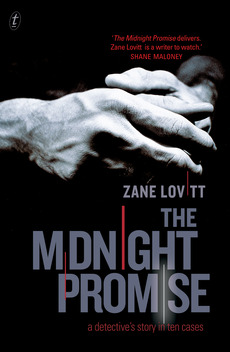
Zane Lovitt, Midnight Promise

Book cover (Courtesy: Text Publishing)

Zane Lovitt’s debut book, The midnight promise, is one of those books for which I can’t decide how to start my review. I could go with the point, previously made in this blog, that I’m not a reader of crime and so cannot speak with authority on the subject. Or, I could write about the fact that one of the chapters in the book, “Leaving Fountainhead”, won the SD Harvey Short Story Award in Australia’s top crime awards, the Ned Kelly awards*. I could start with how Melbourne-based Lovitt joins the growing number of lawyers who write fiction. Or, I could start with the topic that interests me most, its form.

Because, if you haven’t noticed, I didn’t use the word “novel” once in my opening paragraph. There’s a good reason for this: The midnight promise is, if I can draw from the main media through which I consume crime, more like a detective series than a movie. I could have described it as a book of short stories, but that would be misleading. The ten chapters or stories all feature the one detective or “Private Inquiry Agent”, John Dorn, and they are told chronologically. Moreover, even though the book comprises ten separate cases, rather than one main case as would be expected in a novel, there is an overarching, albeit not immediately obvious, plot, defined by “the midnight promise”.

This form may, in fact, be one of the reasons I liked it. Each story is complete in itself while also forming part of a greater whole if you keep reading. The form is also, however, responsible for my only real criticism, which is that, almost without exception, the stories are structurally the same. They follow a present-flashback-present-flashback (and so on) structure. In a “true” book of short stories, I like things to be mixed up a bit; I like to see variety in style, in voice, structure, tone, language. That’s not the case here – but neither, I suppose, would it be the case in a television detective series, so perhaps my criticism isn’t valid. Still, a couple of times, I felt myself saying “here we go again …”.

John Dorn is not, I think, a particularly original character, for the genre. Like many crime protagonists, he’s somewhat of an outsider, a loner with a broken engagement behind him. He’s also a man of some principle which is why his is pretty much a hand-to-mouth existence. In the early stories his fee ranges from $400 a day to $250 a day to nothing depending on whether he wants (or believes in) the job or not. The higher the charge the less he wants it! For this reason we like Dorn, and want things to work out for him, but somehow, more often than not, he manages to shoot himself in the foot.

Being a private eye, his cases are varied, from marital spying to finding missing people to protection (of the innocent or the guilty). But the theme is consistent. It’s “the shitty things people do to each other” or, as he puts it more colourfully when describing roadkill in the final story:

We drive over two foxes, parallel, like one of them couldn’t bear to live without the other. Though what’s more likely is one fox was eating a dead fox and got hit by a car because he didn’t see it coming because he was distracted because the other fox was so delicious.

Not a grammatically beautiful sentence but appropriate and effective in the context. In fact, I liked Lovitt’s writing. The voice is first person, and the writing is generally direct and spare with the occasional well-placed image which works partly due to its rarity. Like this, for example:

I’ve heard rumours about his shady GST schemes, but everything I know about tax offences wouldn’t rouse a chihuahua from its beauty sleep.

The dialogue is realistic. There is humour – mostly in Dorn’s sardonic view of the world – which varies the tone. There is irony, as in the name of the character, Comedy, who is anything but funny, and in the story “Grandma’s House” whose title belies the horrors within.

And this brings me back to the form, to the fact that while each story is complete there is a trajectory in the book, heralded by the occasional bit of foreshadowing. We know something is going to happen that will change Dorn’s life, and probably for the worse. The crisis occurs in the seventh story, “The Crybaby Technique” – and it’s ironic because he was, in this particular case, only a bit player. Things change gear from here, leading to the final crisis in the tenth story which is significantly titled “Troy”. It’s a gripping read with a beautifully controlled out-of-control last page. You’ll have to read it to see what I mean.

So, would I recommend this book? Yes, to non-crime readers, like me, who look for character and good writing, and to crime readers who, I’m presuming, like intriguing cases with a detective who keeps you guessing. If I were a crime reader, I’d be saying I hope this isn’t the last we see of John Dorn, or of Zane Lovitt. In fact, I’ll say it anyhow …

Zane Lovitt
The midnight promise
Melbourne: Text Publishing, 2012
283pp.
ISBN: 978192192230

(Review copy supplied by Text Publishing)

*In 2010. It also appeared in Scribe’s New Australian Stories 2, that same year.

Paddy O’Reilly, The salesman (Review)

I’ve been wanting to read Paddy O’Reilly for the longest time but somehow haven’t managed to get to her so, as is my wont, I decided to read a short story of hers in the Griffith Review. She made her name, I think, with her short stories, but has also written novels/novellas and a screenplay, and is a regular contributor to Australia’s best literary magazines.

I know you wouldn’t expect this of me, but I’ve just told a lie – just a white one, your honour – because I have read a couple of articles by Paddy O’Reilly, and I did read her opening story in Scribe’s New Australian Stories 2, published in 2010. The story was titled “How to write a short story”. It’s a very short piece, just over a page, but it was my first, albeit very short, introduction to O’Reilly. The piece is presented as a recipe, with a list of steps, such as:

Test whether the story is done by inserting a reader. If the reader comes out clean, the story is done. If the reader comes out sticky, place the story back into the situation for another 500 words.

This story suggested to me that O’Reilly is not afraid to let women’s experience underpin her writing. But, this doesn’t mean that she wants her writing to be labelled “women’s fiction”. As she asks in her recent post for the Australian Women Writers Challenge 2012, what is women’s fiction? Writing for women? About women? By women? I’m inclined to agree with her that it’s not a useful distinction. What after all is “men’s fiction”? Categorising works as “women’s fiction” has the potential to (and in fact does already) marginalise, trivialise even, women writers and readers. So, like Paddy O’Reilly, I tend not to think in terms of “women’s fiction”. I do, however, and I’d argue this is quite different, like to focus on “women writers”.  Hence, here I am, reading (more) Paddy O’Reilly …

“The salesman” is set in a working class suburb of Melbourne where there’s 80% unemployment. It features a salesman (obviously), a young woman named Marly, and her boyfriend and his mate. The story opens with the young woman alone at home. It’s hot and life is clearly not much fun. Her boyfriend Shaun and his mate, Azza, spend their days working on cars, their heads “under the bonnet like stupid long-necked emus”. And, the fridge is “moaning”. Such language in the first paragraph makes it pretty clear that Marly is not a happy woman. In fact, we learn a little later on that she has lost part of a leg, creating an effective metaphor for a life that is missing something critical. Pran, the salesman, appears in the fourth paragraph. He’s a Hindu from Delhi but Marly, and later Shaun and Azza, persist in calling him a Paki.

Pran insists he’s not selling anything, but after Shaun and Azza return, we finally learn that what he is “selling” is a free offer! Shaun and Azza, as (stereotypically) men often do in these situations, lead Pran on while Marly is conflicted. Shaun is an “attentive” boyfriend. “She would not do better than this”, not better, she thinks, than a man “who had not once in eleven months raised a hand to her”. But, she’s attracted to Pran, to his “rich burnt-toffee” coloured skin and his “runny dark brown” eyes. It’s not just the physical though.  She senses through him, through her questions about his beliefs, that there could be more to life than hanging around waiting for the men to bring home beer and pizza. She does not want his visit to end in violence as, we are told, has happened before.

I’ll say no more about the plot. This is a story about the underside of modern Australia. It’s about poverty and deprivation and how these result in an arid, goal-less life in which there is little empathy for other. It’s about racism, about how, if you are the wrong colour, years of study can lead you to peddling “free offers” to people who can’t afford them. The ending is clever. While we are told the general outcome, we have to guess what really went down. What we do know, though, is that no-one ended up a winner. This is just the sort of story I like – it’s accessible, it has a clear vision with a tight focus, and it raises more questions than it answers. You can read it online at the link below.

Paddy O’Reilly
“The salesman”
Published in the Griffith Review, Edition 29, August 2010
Availability: Online at the Griffith Review

Monday musings on Australian literature: Australian women’s non-fiction writing

Today’s Monday Musings was inspired by a post last month in Overland literary journal’s blog. The topic – Women and non-fiction writing – is a big one, bigger really than I have time for now, but I figured it wouldn’t hurt to make a start.

In the Overland post, which comprised an interview with writer, Rebecca Giggs, Giggs discusses the issue of authority in non-fiction and the notion that “nonfiction writing is supposed to have a fidelity to the real world. Disgrace comes to the author who adds too much of the unreal to their mix”. She talks of how it is believed that “things must be stated, accounted for, and settled. Declared. The unknown turned into the known” and sees this view very much as a gendered thing. As male, in other words. And then she continues

But of course, this is not how the world actually is. Inner and outer worlds are not so easily divided! And permitting that fact – allowing such things as the corporeal, the uncertainty, the experiential in – doesn’t just make clear that falsity, it also lets in other modes of authority. It questions the role of women’s interior lives in our political discourse.

So much to unpack here that I fear getting bogged down, so will just keep to the surface (more or less). I have always been intrigued by the subjective in history, ever since I read EH Carr‘s What is history in which he argued, convincingly for me, the interpretive basis of history, that the role of the historian is significant in terms of what we come to know as “history”, as “fact”. I have no idea how Carr is viewed now as I’m not an historian but it would take a good argument to shake my belief in Carr’s basic premise.

And so, I like the changes I’m starting to see in non-fiction writing. I like the fact that the role of the historian – or, let’s broaden this to non-fiction writer – is becoming more transparent in the (in some anyhow) writing. And it seems that a lot of this is being driven (championed, even) by women writers (although my impression could be skewed by the fact that I’ve read more non-fiction by women over the last decade or so. I would love to hear whether you agree). In the rest of this post I’ll discuss a few of the writers who have come to my attention, in roughly the order I’ve read them.

Helen Garner

Garner was the first to confront me with a new personal way of writing non-fiction. She put herself in the picture and told us exactly what she thought about the subjects she was writing about: college master-student harassment in The first stone, murder/manslaughter and duty of care in Joe Cinque’s consolation. Garner caused quite a furore with these books, particularly the former, but I’m not going to go into that here. Google if you are interested. My point is that she was fearless in putting herself in the frame, and in documenting her process. It’s exciting writing – and it’s honest. I like that, whether or not I agree with her views and conclusions. I like the fact that she allows us to see her thinking and to engage in the discussion – and engage we surely did.

Chloe Hooper

Chloe Hooper.

Chloe Hooper (Public Domain, via Wikipedia)

In a way, Chloe Hooper in her Tall man did for Cameron Doomadgee‘s death-in-custody what Garner did for Joe Cinque. Chloe Hooper is less emotional, less heart-on-sleeve, than Garner but she does also put herself into the story, taking us with her as she researches the situation, and admitting her sympathies. She specifically raises at one point the issue of “historical relativities” which I read as meaning that the facts can be seen from different angles depending on where you are in the spectrum – in many often overlapping spectrums in fact, the historical one, the black-white one, the power one, to name a few.

Anna Krien

Krien’s book Into the woods and essay Us and them work very much like Hooper’s book. She’s there in the story she is investigating. She researches all sides as best as she can. She makes her sympathies clear as they become clear to her, taking us, like Hooper, on her journey.

Francesca Rendle-Short

The Garner, Hooper and Krien books I’ve mentioned above are all pretty straightforward. They put the “I” in their nonfiction writing, something that was once a no-no. But they still focus on the “facts”, albeit recognising the subjective and/or interpretive aspect to them. Francesca Rendle-Short’s memoir-cum-fiction, Bite your tongue, though, is quite a different matter. And it is, I think, a good example of what Giggs is talking about when she talks about “letting the experiential in”. Rendle-Short’s story is powerful and no less valid or true because she has chosen to write most of it through a fictional voice. It’s a clever book. Most of it is told in the voice of the fictional Glory because “some stories are hard to tell, they bite back … [so] I’ve had to come at it obliquely, give myself over to the writing with my face half-turned” but the “real” Francesca has the odd chapter which comments on, validates, Glory’s experiences. The truths in this book are palpable.

Anna Funder

Funder has said that she initially planned to write Stasiland as fiction but for several reasons turned it into non-fiction. One was that she wanted to honour the people whose stories she was telling, that in fact “it didn’t feel right” to turn those stories to another purpose. But, another reason was that she felt the stories were so far-fetched at times (such as the story of the “smell samples”) that they would not be believed in fiction. And so Funder wrote Stasiland as non-fiction and she, too, put herself in the book. When she interviews her subjects we don’t get a dry reportage of the results of the interviews, nor do we get a simple interviewer-interviewee style presentation. What we get is her in the room – reacting to the person as a human being while also reacting to, and reporting on, the facts being presented. The result is something rich in which the particulars lead to a complex universality (or truth) that encompasses both sympathy and horror.

Oh dear, I have gone on haven’t I … so I will close here on Giggs’ point about these new approaches letting in “other modes of authority”. I’m not 100% sure what she means by that, but what I take from it is a recognition that this new “authority” can encompass something beyond the mere “declaration” of facts, something that encourages us to empathise, something that might force us to confront the moral dimension to the stories being told. And this is, to me, a good thing. What’s more, in the right hands, it can make for darned good reads.

I’d love to know whether you read non-fiction and what you look for in it, particularly in terms of “authority” or, dare I say it, “truths” …

Whispering Gums has a new URL – and some news

It’s time I did it and so I did. I have, through WordPress, bought my own domain name.

This means that the URL for Whispering Gums is now http://whisperinggums.com

My old address – https://whisperinggums.wordpress.com – will be automatically redirected by the wonderful WordPress to this new one . However, you may find it more efficient to update your bookmarks. Also, if you have generously linked to my blog from yours, you may like to update that link to the new address (that is, http://whisperinggums.com).

I think this means I’ve come of age … well, more or less, as I’m still hosted by WordPress. Can you, do you think, come of age in baby steps?

The news

The time seemed right to make this change, because last week I discovered (thanks to Nigel Featherstone of Under the counter or a flutter in the dovecot) that Reading Matters and Whispering Gums have been included in the reviews excerpted on the first two pages of the September-released small format edition of Gillian MearsFoal’s bread. Two litblog reviews and several newspaper and journal reviews! That’s exciting (to Kim and me anyhow).

With Lisa’s ANZLitLovers now being harvested by Pandora, and Allen and Unwin including litblog reviews in the print edition of a multi-award-winning novel, it seems that litblogs, amateur as well as professional, are starting to be  recognised as part of Australia’s cultural landscape. This carries responsibilities of course, but I reckon we’re up to it!