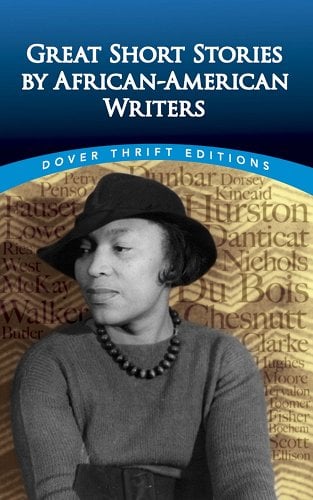
Today’s post for the Year Club is one of those rare occasions when I am not posting on an Australian short story. The simple reason is that I could not find one in my anthologies, and I am keen to read from my physical TBR. Happily, I found one in Great short stories by African-American writers, and it was by a writer I have read before, though it could be a bit of a cheat … read on …
Langston Hughes
Wikipedia tells us that James Mercer Langston Hughes (1901-1967) was born in Joplin, Missouri, and was “best known as a leader of the Harlem Renaissance (about which I have written before). He was also “an American poet, social activist, novelist, playwright, and columnist” as well as “an early innovator of jazz poetry“. My anthology editors, Rudisel and Bob Blaisdell, describe him in their biographical note, as “one of the most famous African-American writers of the [twentieth] century [who] continually published poems, plays, novels, short stories, essays, translations, children’s books, and edited anthologies”. They say that “knowing first-hand the financial difficulties and discouragement of being a writer of colour, he helped numerous African Americans get noticed and published”. Poet Kwame Alexander, writing in the Beltway poetry quarterly, adds “operas, librettos, television and film scripts” and “lyrics, essays, [and] reference manuals” to his writing credentials. He was prolific.
Wikipedia explains that like many African Americans, he was of mixed ancestry, with both of his paternal great-grandmothers being enslaved Africans, and both paternal great-grandfathers being white slave owners in Kentucky. The old story! He spent most of his childhood in Lawrence, Kansas, but also lived in other Midwestern cities. His parents separated soon after his birth. Apparently, his father, who “wanted to escape the racial intolerance of the United States”, moved to Cuba and then Mexico. The critical point for us, however, is that, because his mother travelled a lot for work, he was raised primarily by his maternal grandmother. “Through stories of Black resistance, dignity, and perseverance, [she] shaped his understanding of racial responsibility” and imbued him “with a duty to help his race”. Consequently, continues Wikipedia, he “identified with neglected and downtrodden black people all his life, and centered their lives honestly in his work”.
I’ll leave his biography here, but if you are interested, start at Wikipedia which has an extensive, well-referenced article.
I mentioned that I have read him before – and I have, but in poetry anthologies, some of them for children. He captured my attention, not just because he was new to me but because his subject matter – social justice and civil rights – interests me. I have not read his prose before.
“Feet live their own life”
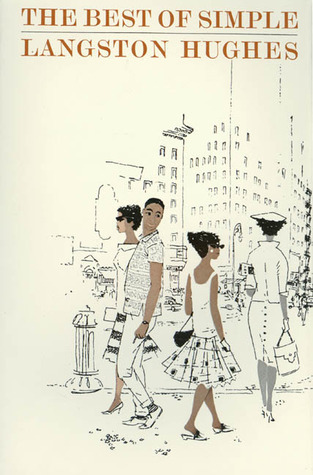
I said in my opening paragraph that this selection for the Year Club could be a bit of a cheat. This is because this story was originally published in the Chicago Defender in 1943. However, my anthologists selected the story from a book published in 1961, and say that the version there is “an expansion and revision” of that original column. I think this makes it valid for the 1961 Year Club!
So, the story. Wikipedia pointed me to The Chicago Literary Hall of Fame, which says that soon after inaugurating a theatre group in Chicago in 1941, Hughes went to work for the Chicago Defender, an African American newspaper founded in 1905. It was here that Hughes introduced readers to his character Jesse B. Semple, aka Simple. The Hall of Fame says that
Hughes combined powerful rhetoric with down-home humor to attack or reflect the conditions of African-Americans at the time. He was eloquent and clear – and no injustice escaped his literary wrath. To some, this column was Hughes’ most powerful and relevant work. He became the voice of a people who were beginning to secure their place in society. Hughes wrote his column for the Defender for 20 years.
“Feet live their own life” is, in fact, based on Hughes’ first column in the Defender, making it an excellent introduction to the character. Being a column, it is a very short short story, running to just three pages in the anthology. It is set in a bar, as I think are all the Simple stories, and comprises a conversation between an unnamed, somewhat serious narrator, a foil in other words, and Simple. It starts:
“If you want to know about my life,” said Simple as he blew the foam from the top of the newly filled glass the bartender put before him, “don’t look at my face, don’t look at my hands. Look at my feet and see if you can tell how long I been standing on them.”
It is a humorous character study with a political edge and a lacing of wisdom. Simple is – as his name suggests – an ordinary man, a black everyman. In this story, he introduces his readers to the travails of his life, to which those like him, the people Hughes wanted to reach and represent, could relate:
These feet have supported everything from a cotton bale to a hongry woman. These feet have walked ten thousand miles working for white folks and another ten thousand keeping up with coloured. These feet have stood at altars, crap tables, free lunches, bars, graves, kitchen doors, betting windows, hospital clinics, WPA desks, social security railings, and in all kinds of lines from soup lines to the draft …
These are life events his readers knew. When our narrator counters that all this is general, and asks for something specific that his feet have done, Simple tells him how his right foot had broken the window of a white man’s shop and his left foot had set him off running from the cops. But why, asks our narrator, would he “go around kicking out windows”. Simple says
“You have to ask my great-great-grandpa why. He must of been simple – else why did he let them capture him in Africa and sell him for a slave to breed my great-grandpa in slavery to breed my grandpa in slavery to breed my pa to breed me to look at that window and say, ‘It ain’t mine! Bam-mmm-mm-m!’ and kick it out?”
When our logical narrator suggests that the bar glass he is drinking from is also not his, but he’s not smashing that, Simple responds, logically
“It’s got my beer in it”
I think you get the gist. Simple is a comic character who is able to say the outrageous and the human things and bring his point home. He is humorous and wise, silly and pointed at the same time. I enjoy writing like this, writing that tells the truth with warmth and humour.
I am sure many of you will know Langston Hughes. I’d love to hear your thoughts about reading him – in whatever form you have.
* Read for the 1961 reading week run by Karen (Kaggsy’s Bookish Ramblings) and Simon (Stuck in a Book).
Langston Hughes
“Feet live their own life” (first published in The best of Simple, 1961)
in Christine Rudisel and Bob Blaisdell (ed.), Great short stories by African-American writers
Garden City: Dover Publications, 2015
pp. 181-183
ISBN: 9780486471396
Available online in audio version at archive.org and


My goodness, I’ve not heard that name in a very long time. So interesting.
I’m glad I refreshed your memory Pam.
Lol.
Fabulous post and I was really interested to hear all about Hughes. I’ve been aware of him for a long time but have just never got to reading him. I know him mainly as a poet but he was obviously a polymath and I’ll have to explore further. Thanks so much for sharing this!
Thanks Karen. I was really pleased when I found this short story because I love getting writers onto my blog that I’ve known of before. He is a really interesting man isn’t he? And I love the influence of his grandmother. She reminds me of my own who was such a strong influence on my values.
I’ve actually never read Hughes’s fiction, but I should based on the sample I see here! I loved that he and Hurston were best friends…that is, until they had an irreparable falling out. I tried reading Hughes’s collection of letters to get his side of things, but they were impossible for me to follow. He’s constantly replying to letters and not giving us context (which makes sense—they’re letters), so I couldn’t tell what he was writing about. On the other hand, Hurston’s collection of letters are very clear, and she felt Hughes contributed nothing to their play, Mule Bone, but he wanted to claim it as his own.
Thanks Melanie … I vaguely remember reading about their relationship but had forgotten. Fascinating. He is generally lauded for his support for other African American writers.
In general, he was huge in the Harlem Renaissance movement and a great writer. I don’t know that there was much evidence that he tried to steal Mule Bone from Hurston, but I am not sure.
Thanks Melanie. It’s sad when people with so much to offer fall out.
Lovely to get reacquainted with all this and to see many commenters enjoying the level of detail. A few years back, I spent some time with Hughes for a series on BIP and still only scratched the surface: such a pivotal figure. But I did read and enjoy some of the Simple stories (which have been collected into a single volume, posthumously I believe, although I don’t know how readily available that would be overseas). Previously I had only read the poems included in children’s anthologies too. Given how unseriously writers for children are treated in the literary landscape (unfairly, too), one has to question the decision to include him consistently and specifically there,and not in anthologies for grown-up readers as well.
Thanks Marcie … notwithstanding your point re the anthologies I also like that I first heard of him in kids’ anthologies because it felt like the editors were not dumbing down to the kids and only including kid-targeted poems/verse (many of which are great so I’m not anti them at al, but it’s just good to look beyond.) I don’t have many non Australian poetry anthologies in my collection – so I wasn’t aware that he doesn’t appear as frequently in general anthologies.
I think the book cover I’ve included in this post is for a collection of the Simple stories? I don’t know if there’s a more recent perhaps more comprehensive one?
That’s a good point, and his poetry is often included in poetry athologies (especially American ones, which are omnipresent in Canada) but in my mind I had crossed into thinking about how often only white writers are included in a literary anthology more generally and how I didn’t even know that he wrote prose (let alone so many varied forms) and had dismissed him for years cuz I didn’t seek out poets.
So I guess, what I’m saying is that I don’t think the breadth of his work/talent is evident from the way he’s anthologised? And, also, I’m saying, inadvertently, that only prose collections matter? lol My bias coming out: you know I read poetry, but it’s like I read non-fiction: something I make a point of doing, cuz it doesn’t naturally happen.