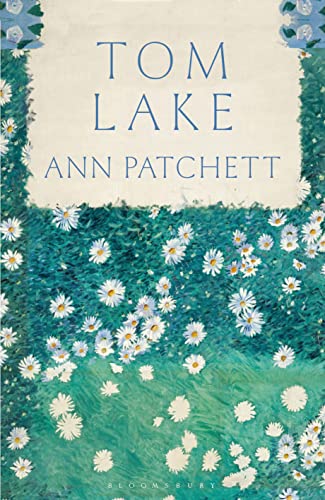
I have not read Ann Patchett for a long time. In fact, I’ve only read one novel, Bel Canto, way before blogging, and one nonfiction piece, “The bookshop strikes back” (my review). So, when I saw all the love her latest novel, Tom Lake, was getting in 2023’s end-of-year lists (including Kate‘s annual compilation), I thought it might be time to read her again, and added it my reading group’s suggestions list. With others having read and enjoyed various of her books, we reached consensus and scheduled it for March.
For those who haven’t caught up with it, Tom Lake is set on a family cherry orchard in Michigan during the COVID pandemic. It is a dual timeline story in which the narrator, 57-year-old Lara, tells her three twenty-something daughters, about her past, specifically about the summer she played Emily in Thornton Wilder’s classic play, Our town, and the romance she had with Duke, a co-actor who later became a huge star. Lara was just 24-years-old, and these were the golden days of youth when all seemed possible. As we flip between past and present, while the family picks the sweet cherries and the tart, feelings are explored and insights about life, love, and the decisions we make are revealed and turned over. The girls come to know their parents better, and see perhaps why fame is not necessarily all it appears, while Lara gets the monkey of her past off her back. This does not mean Tom Lake is one of those angsty books about the past coming back to haunt you. It’s a quieter, more subtle story about children’s fascination with their parents’ pasts, and what parents choose to tell – and when. It is also about the way in which revisiting the past can bring new insights (just as re-reading a great novel can produce new thoughts and ideas). Lara thinks, near the end:
“The beauty and the suffering are equally true. Our Town taught me that. I had memorized the lessons before I understood what they meant.” (Ch. 18)
All this would normally appeal to me, and I did enjoy reading the novel. I was fascinated by the whole summer stock theatre business because it has frequently popped up in my reading and viewing over the years. And, I loved her characterisation. The differentiation of the three sisters – Emily, Maisie and Nell – and Lara’s understanding of their separate personalities was well done and engaged me from the start.
This is not surprising. Tom Lake is Patchett’s 9th novel, so she knows how to construct and tell a story. Her metier seems to be interpersonal relationships within small groups of people. This novel’s focus is two such groups – the Tom Lake theatre group in 1988 and the family on the farm in 2020. These groups are well characterised. You feel you are there rehearsing in the theatre or swimming in the lake, or at the farm chatting over dinner or picking cherries. The voyeur in me loves being in places outside my experience, so I loved these beautifully depicted places.
But, it is a quiet novel and, as much as I enjoyed the read, I also found it somewhat unsatisfying. It’s not that it was completely predictable because, although we know from the start where Lara ended up, the journey does have some interest. It’s more that it’s a sweet, warm-hearted story, while I like a bit more edge or bite in my reading, a bit more meat.
And, there was potential for meat. Tom Lake is an intergenerational story which explores that mystery between children and their parents’ lives. It reminded me how my brother and I learnt things that surprised us about our parents’ courtship right in the last months of their lives. This story is a bit about that, about how, when and what you tell your children and why. When Lara’s husband Joe had, sometime in the past, inadvertently let drop that Lara had dated the now celebrity actor Duke, he is surprised by how much the children care. So, with the family isolated together due to the pandemic, Lara embarks on telling her story, “knowing full well that the parts they’re waiting to hear are the parts I’m never going to tell them”. This is warmly and skilfully done, so that by the end the girls accept the story they are given.
The interactions reveal other intergenerational issues too. The girls challenge Lara when she uses what is to them “politically incorrect” language. When she introduces her understudy, Pallace, who is also a dancer, Lara describes her “preposterous” legs, but is quickly criticised for “objectifying” her. And, when she describes Duke’s “craziness”, she is interrupted again and told she can’t use words like “crazy” or “nuts” or “insane”. They’re “pejorative”. She should only use his “diagnosis” and only if he didn’t mind. She should just say “what happened … Just the facts, without attaching any judgment to it”. These are gorgeous interactions that mirror the sort of conversations many of us are having as we navigate modern sensibilities. Patchett handles them with grace and generosity – not to mention a lovely touch of humour.
Indeed, one of the book’s strengths is the learning between generations, and the gentle wisdom imparted. When the girls jump onto an event involving Duke, calling it “the happiest day” in her life, Lara reminds them that it was “not by a long shot”. It was simply “the happiest day of the summer of 1988”.
So far so good … I can see why people (including me) enjoyed it. It is warm-hearted, and nicely reflective about youth and the perspectives of age. But, it also disappointed. Tom Lake crosses some genres that interest me – pandemic literature, farm literature, climate change literature (cli-fi), coming of age stories, and the sliding-door trope, and I wanted these explored more. I wanted her to tackle the questions left hanging, such as climate change and Emily’s decision not to have children.
However, Tom Lake is not that book, and I shouldn’t expect it to be, so I won’t. But, even without that, it just felt a bit saccharine (including the farm cemetery with its “benevolent” shade), a little too neatly tied up. Difficulties are hinted at, but in the end the sweet cherries win out over the tart. I, though, like my desserts just that little bit tart.
Ann Patchett
Tom Lake
London: Bloomsbury, 2023
310pp.
ISBN: 9781526664235 (eBook)


I loved Bel Canto and I enjoyed The Dutch House. I like the theatre backdrop to this one so may check it out.
Thanks Cathy. Of course, if you do, I’d love to see your thoughts. She is a good storyteller isn’t she.
I didn’t much like Bel Canto and I disliked The Dutch House, while I really love State of Wonder. I did enjoy the gentleness of Lara’s narration in Tom Lake but shared some of your dissatisfaction with the tameness of it–what I said in my own review (August 9, 2023) is “the way Lara’s perspective influences the story she is telling shows her tendency—the human tendency—to simplify.”
Thanks Jeanne. That’s an interesting assessment of Lara. I’ll have to think about the word simplify … but I think I understand your point. I’ll come read your review.
I hear different responses to her novels. I enjoyed Bel canto more than I expected to but not in a memorable way, if that makes sense.
It’s been three years since I read Tom Lake, and reading your review brought back all the reasons I enjoyed it. Although your experience was different, I found the book’s quietness to be comforting and satisfying. When I think back on the pandemic in the U.S., I recall a time filled with anxiety, social and civil unrest, so instead of finding the novel overly sentimental or cloying I experienced it as wistful, and at times bittersweet.
Thanks Carolyn … you certainly didn’t get much anxiety from them did you? I did enjoy reading the novel … I like warm-heartedness. Perhaps everything felt just a bit too easily resolved though we do know it wasn’t quite that.
I read Patchett from time to time if she comes up as a library audiobook. From memory, Commonwealth was the one I liked most. I guess she’s found her niche in quiet, complicated family stories.
Dad in particular made sure us kids knew nothing about the 2 years or so before he and mum married. He was 5 years older, at least to some extent her teacher, and they ran away together almost as soon as she turned 18. I still feel betrayed that this was kept from us, though mum talks about it a little if she is asked (and she certainly doesn’t regret it).
Thanks Bill. I can imagine her books would be great audiobooks. I remember some people really liking that book when it came out.
Is there something in particular you feel betrayed about?
I don’t know why I feel betrayed. I don’t know why kids think they have a right to their parents’ stories, but they clearly do.
Thanks Bill – I think this is one of the points in this book though perhaps I didn’t make enough of that in my post. I love that you have raised it.
I have meant to read this but heard so much about it I lost a bit of interest. I grew up in Grand Ledge Michigan. About 10 miles from the capital Lansing. Itwas known for Fitzgerald Park where we used to bile to to play and climb the rock,ledges. There is a great big old red barn there that ks a playhouse and summer stock was big. There were plays all summer then it closed down for the rest of the year. My home town was too far south for the cherry crop but my grandparents had a cottage up north and summer meant tons of cherries, all of them sweet. I really loved the black cherries. There were also a lot of oil wells there and one could smell it. I remember the first play I ever saw was at that playhouse in that barn . Uncle Tom’s Cabin. Of course the part I remember was when Little Eva died an went to heaven. She was in a harness and they had her ascend i to the top of the stage with her angel wings. Being about 8 yrs old I didn’t get the whole story but never forgot Little Eva going to heaven. As far as I know that playhouse is still going and there were big stars who performed there over the years. I wonder if Ann Patchett was basing her tale on that summer stock theatre as it was an important place in the scheme of things. Maybe I’ll listen to the book just for the memories.
Thanks for sharing all this Pam. Sounds like it might be one you’d enjoy listening to.
I did enjoy this though I think that reaction was largely influenced by some personal connections with elements of the plot. Friends of mine run a theatre group which staged Our Town – and my husband had one of the roles. Plus, for many years I travelled to Michigan for work and always loved it when that co-incided with cherry harvest and I could go out to one of the farms and pick up some supplies.
It was a good enough story and well handled though didn’t have the same pull as Bel Canto.
Thanks Karen. I love those connections. And certainly this book would not spoil any of them but would enhance those feelings of warmth. I just don’t remember Bel canto enough so perhaps it didn’t have the same pull for me. I do remember enjoying reading it.
While some ablest language is pretty obvious, and we all grew up knowing better (the r-word comes to mind), I do find it interesting and challenging that younger folks are calling out really old words as ableist, racist, etc. when we don’t even use the words as it was originally intended. For example, I’ve read we should stop using the phrase “master bedroom” because it comes from slavery and plantation houses. But no one uses it that way. Same thing with “crazy.” We use it to mean “wild” or “nearly unbelievable,” but now it’s considered ableist. A word popular in the 90s was “lame” to mean you don’t like something. Oddly, we don’t call physically disabled people “lame,” so I didn’t even realize until it was pointed out to me. I do my best to get rid of unnecessarily derogatory language, but I don’t always succeed.
At first, this sounded just like the right book for me. The cherry-growing areas in Michigan are gorgeous (Traverse City cherry wine, anyone?), and I love when I know a setting well, but I’m not up for anything overly sentimental right now, and it sounds like Tom Lake is just a bit too squishy.
I love this comment on language Melanie. You are so right. I like the way Patchett left the two generations sit for us to think about. “Master” bedroom is a good one. I guess the issue is not so much what the word literally “means” but how it comes across. A friend of mine years ago called it her “mistress” bedroom. I don’t think so much in terms of slavery as the patriarchal “master of the house”. These days real estate here calls it “main” bedroom.
Anyhow I agree about trying to avoid derogatory language but there are so many traps aren’t there.
I’m not sure whether it’s too squishy in that sense, but if there are other books to read I’d probably go with them!
I grew up thinking a master bedroom was the one that had an attached bathroom, and that was it.
Ah, that’s interesting. Ensuites, as we call those bathrooms, came way way after the idea of master bedrooms over here. I don’t think I knew of anyone having ensuites when I grew up. Out first house, built in 2966 and bought in 1978, had no ensuite until we added one in 1985. Not one of the houses we looked at in 1978 had ensuites though they were probably starting to appear in new houses in the outer suburbs.
What defined a master bedroom here was that it was bigger and could fit a double bed whereas other bedrooms didn’t always. When my family bought a house in a good established middle class suburb Sydney in 1966, parents gave my sister and me the master bedroom because it could fit two single beds. They took the second bedroom which could fit a double bed but it wasn’t spacious.
I really loved this as a long-term Patchett fan underwhelmed by Commonwealth and The Dutch House. I can see the critique that it’s too sweet and soft, but for me Patchett writes well enough to just fall on the right side of that line.
Thanks Laura … I certainly wasn’t sorry I read it because it was enjoyable to read. And that was because of the writing and characterisation. The daughters were well drawn in particular I thought.
Such an interesting review, Sue. I too remember all the raves this novel received when it came out a couple of years ago, but somehow it didn’t appeal to me at the time. And now that I’ve read your reservations about the sweetness, coupled with your desire for some more bite, I can see that it wouldn’t be for me.
I always get Ann Patchett confused with Anne Tyler, which probably doesn’t help matters, but I do recall my old book group having a lively discussion about Bel Canto many years ago. Everyone seemed to be it reading at that time!
Thanks Jacqui … I always do a double take about those two though only briefly. Anne Tyler has a bit more bite or edge more that bite … she’s also warm-hearted but there’s a quirkiness that gets to the nub of things in a different way. I wonder how she’d set a novel during the pandemic.
My reading group hadn’t done Patchett before though several had read her. In the end I missed the meeting but I gather the responses were mixed.
Hunh, that’s interesting. I started with Bel Canto but then went back and read everything else. (But as I think I mentioned when you announced this would be on your schedule for this year, I’ve missed a few of her newer ones, including this.) For awhile, she was a dependable Must-Read for me, like Kingsolver and Smiley, (but then that category got crowded and my selections diversified). There were some APs that I didn’t enjoy quite so much as others, but when I took a closer look, I found more connections than I had noticed when I read through the first time. (State of Wonder was like that for me, although I see someone else has mentioned it as a favourite: I liked it more when I reread sections.) When I get to Tom Lake, I wonder if I’ll feel a little disappointed too…
Thanks Marcie, I’ve been fascinated here – and among my friends who have read her – that there is a great diversity in which books people really loved and which the felt quite so-so about. I suppose people are the same with Kingsolver, Smiley – and I would add someone like Tyler to this list too. Actually, I suppose it’s true of any author who has a few books under their belt, but somehow, I’m still surprised by the strength of people’s feelings here.
I can see, especially in way this novel settled with you, that Tyler would feel like a natural comparison but, for me, Tyler is more like Elizabeth Strout. Mainly because a political angle does emerge via character in Tyler and Strout, but it’s so subtle that one needn’t even recognise it; whereas in the others, I think there is an overt polical view (and often a resulting moral conundrum of sorts which is a prominent part of the story).
However, that might say more about me as a reader than it says about Tyler… because I have read her from the beginning and wasn’t reading much literary fiction at all back then? (And haven’t read her recent novels either, just due to timing.) Now I wonder, if I went back and read AT’s earliest books (which I still have), would I assess that differently? Or if I catch up with the latest?
Yes, it’s the fact that so many people respond so heartfully to entirely different novels that says to me that it’s not her talent that varies but the readers’ willingness (mine too) to respond to a certain story (theme mightn’t appeal, mood mightn’t fit etc.). But, of course writers’ priorities can change over time too, and maybe she just wants to tell different kinds of stories now? I dunno.
I can see, especially in way this novel settled with you, that Tyler would feel like a natural comparison but, for me, Tyler is more like Elizabeth Strout. Mainly because a political angle does emerge via character in Tyler and Strout, but it’s so subtle that one needn’t even recognise it; whereas in the others, I think there is an overt polical view (and often a resulting moral conundrum of sorts which is a prominent part of the story).
However, that might say more about me as a reader than it says about Tyler… because I have read her from the beginning and wasn’t reading much literary fiction at all back then? (And haven’t read her recent novels either, just due to timing.) Now I wonder, if I went back and read AT’s earliest books (which I still have), would I assess that differently? Or if I catch up with the latest?
Yes, it’s the fact that so many people respond so heartfully to entirely different novels that says to me that it’s not her talent that varies but the readers’ willingness (mine too) to respond to a certain story (theme mightn’t appeal, mood mightn’t fit etc.). But, of course writers’ priorities can change over time too, and maybe she just wants to tell different kinds of stories now? I dunno.