Last week, one of our grand old men of Australian letters, David Malouf, died. He has been such a presence in our literary landscape since the mid-1970s, that, despite all that has been written and said over the last few days, it would feel disrespectful to let the occasion of his death pass. And, anyhow, I don’t want to – let it pass, I mean.
Ten years ago, I wrote one of my Spotlight posts on him. It justifies, I think, my “grand old man” epithet, so I will repeat what I said there – and then some! Malouf wrote in multiple forms – novels, short stories, poetry, essays and criticism, memoir, even libretti – and was critically acclaimed in all. This is no mean feat. There is an extensive list of his national and international accolades at Wikipedia. They include the Neustadt International Prize for Literature, an International IMPAC Dublin Literary Award, a Miles Franklin Award, the Australia-Asia Literary Award, a Commonwealth Writers Prize, a Pascall Prize for critical writing, and the Australia Council Award for Lifetime Achievement in Literature. He also gave the annual Boyer Lectures in 1998 (with the topic “A Spirit of Play: The Making of Australian Consciousness”). Sian Cain, in his obituary for The Guardian, added that Malouf was a passionate supporter of Opera Australia, Adelaide Writers Week, and the Indigenous Literacy Foundation. I always saw him as a serious contender for a Nobel Prize, but that book has closed.
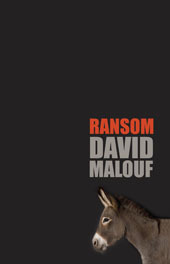
Although Malouf published his last novel, Ransom (my review), in 2009, he continued producing poetry, essays and short stories. His last published book was his 2018 poetry collection, An open book. However, because I mostly review novels, and because I only started my blog in 2009, I have not reviewed him as much as I’d have liked. But, I have mentioned him often. This tag link captures my main mentions, but there are many others.
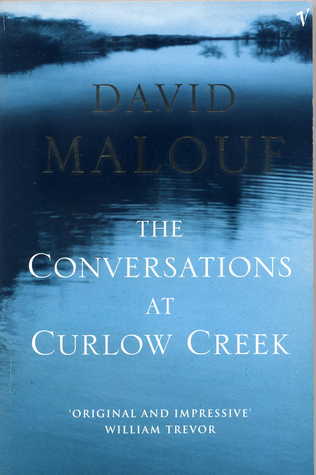
I have read six of his nine novels: his semi-autobiographical novel, Johnno (1975), An imaginary life (1978, the favourite of many), Fly away Peter (1982, one of my all-time favourite novellas), Remembering Babylon (1993), The conversations at Curlow Creek (1996, one of his least popular, but another favourite of mine), and, of course, Ransom. In other words, I’ve read his first three novels and his last three, but not the three in the middle!
These works, as I remember them, reflect a calm, measured intensity. In my Spotlight post, which drew on an interview Malouf had with Annette Marfording, I shared some of his thoughts about Patrick White. He believed that White achieved two things which paved the way for writers after him. These were that White showed that “an Australian life could be of significance” and not just in Australia but more generally, and that
he made it possible for you to write a novel in which the major interest was the interior, not really on action, but on what was going on in people’s heads.
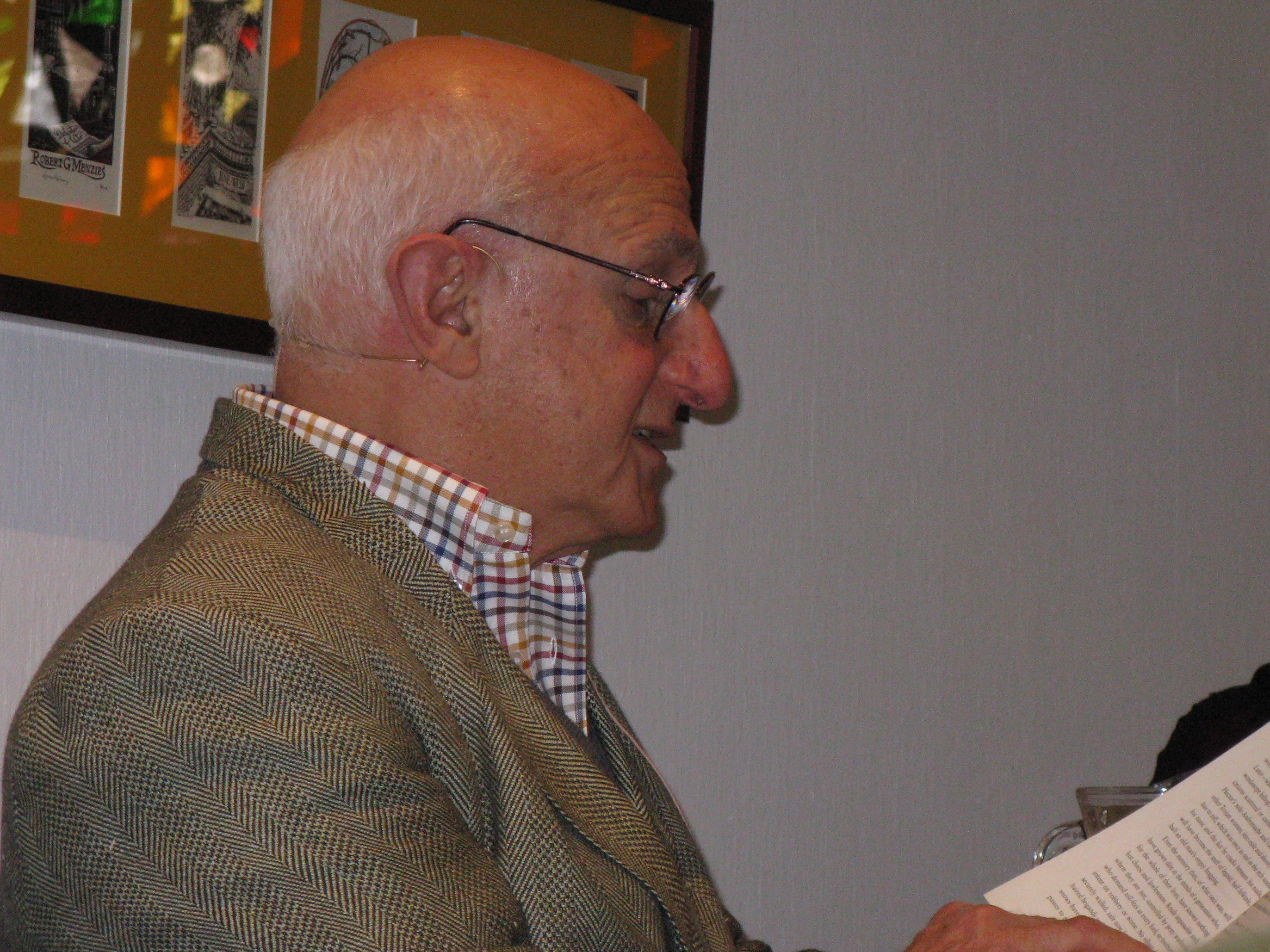
I have “seen” Malouf three times – twice for launches of books (The great world, in 1990 before blogging, and Ransom, see my post) and once when he was sitting in the foyer of the National Library of Australia. I had one of those fan-girl moments, as in, should I or shouldn’t I go over and say something. Then, I remembered that Kate Grenville had once told me that authors love to hear readers say they enjoy their books. So, I went over to him, and told him how much I loved his writing – I can’t recollect exactly what I said – and left him alone. He was gracious, but I have no idea whether he did like being approached.
Selected thoughts from others …
So much has been written, or published about Malouf since his death, but I will just point you to a few. Two were particularly personal and help explain the man. One is a blog post, Remembering David Malouf, by Jonathan at Me fail? I fly! He was taught by Malouf at university and had various encounters with him over the years. I loved Jonathan’s anecdotes for the delightful insights they give into the human being behind the writer. I could share some of them, but really, you should just read the post yourselves and enjoy Jonathan’s telling.
The other was an article written around his 90th birthday in March 2024 by author Susan Johnson, for The Monthly (This might be paywalled, but I think there are ways of accessing it without subscribing.) She visited him in his apartment in one of the most incongruous places you could think of for David Malouf, Surfers Paradise. It’s partly one of those cosy artist-at-home articles, but it also contains some little jewels, such as this on what drives him:
It’s opera and art – and above all, literature and the imagination – that sustains David Malouf. It is his great, over-arching enthusiasm for everything between heaven and earth that a man or a woman can create from the stuff of life that propels him.
Other pieces I have read about him in the last few days include one from literary editor, Jason Steger, in his weekly Herald Booklist email (24/4/2026). He offers more insights into Malouf, but again I’ll just choose one. It concerns “the novel to which he was most devoted”, which I think interests us readers, doesn’t it? That novel is Herman Melville’s Moby-Dick, which he apparently tried to read almost every year. Steger shares some comments Malouf made about Moby-Dick some years ago in The Age, when talking about his “cultural turning points”. Malouf described Moby-Dick as
an anthology, in short, of man’s meeting with man, with the animal kingdom; of nature and its use (or misuse) in what was then America’s largest industry; of man’s meeting with the divine. All in a language of the highest eloquence and at times of the most mischievous, sometimes erotic, sometimes blasphemous play.
I started my post by referring to Malouf as a “man of letters”. Brigid Rooney also described him that way in her article in The Conversation a couple of days ago. She explained it thus:
He was in every sense a man of letters. He was a great reader and profoundly erudite. He was a sociable, assured and generous contributor to literary and public conversation. These same qualities imbue his writerly voice, his regular invocation of a communal “us” or “we”. His intimacy of address marks his poetry and prose, inviting trust and drawing in readers.
This is how he came across to those of us who only knew him through his books. He was a reassuring presence in the best meaning of that phrase, someone you felt was oh so intelligent but generous and compassionate in his world-view. We will miss him.
Vale David Malouf.


Oh how sad! I had not heard t his. Such a great voice. He will be missed.
Thanks Stefanie. It’s lovely to hear that someone not Australian knows and appreciates him!
Lovely tribute! He is an amazing author, I just need to get round to reading more of his work!
Thanks Rach, glad you liked my tribute. I want to read more of his short stories and poetry.
Whenever I meet an author in person, I try to ask them some niche question that I actually want the answer to, but that no one else has probably asked. For example, when I went to a comic convention and Denise Crosby was there, I was aware she had been invited because she was a character on Star Trek: The Next Generation. Well, I’ve never seen Star Trek, but I have seen Pet Sematary and Dolly Dearest, and in both, she plays a hysterical mother. I asked her, “Since you’ve already nailed playing Hysterical Mother in horror films, can you tell me what villain you would play if given the opportunity?” And without missing a beat, she replied, “Satan.” What a treat!
Oh well done Melanie. That’s good advice. It’s probably easier if you know in advance that you are likely to meet them? For me it would be, anyhow!
Nicely done! I’ve only read Fly Away, Peter, which I remember as being beautiful and painful. I was thinking I would add his name to my remembrance reading at the end of this year, and saw this lovely sounding one at the local branch, and was so happy to see anything of his at all, that I thought I might even try to read it in French…L’Infinie patience des oiseaux… but I think it’s Fly Away, Peter after all! What a lovely title though.
FAP’s title in the US is apparently The Bread of Time to Come.
I wish I’d read it recently enough to make sense of these different titles, Bill.
How curious! I wonder if these are pulled from phrases in the novel, even if they were phrases that didn’t make the final edit possibly. There are lots of his books available via ILL, so I’ll keep comments in mind when it comes to choosing one.
Love it Marcie … and yes, what a lovely title that French one is. I love your remembrance reading idea.
I went off Malouf, especially The conversations at Curlow Creek. But I think Fly Away Peter was important in that it marked the beginning of it being common to regard WWI as a tragedy for the common soldier (compared with 1915 say).
That’s a lovely point re Fly away Peter, Bill. I haven’t read 1915, but I know I should.
As for Conversations, I think we have discussed it before. I read it 23 years ago, in a different state of awareness/consciousness to where I am now. But I’m still not sure I would agree with your dislike which, as I recollect, has something to do with his not addressing the colonialism issue? If this is memory is correct, I don’t think every book set in Australia has to do this. I remember being mesmerised by the – well – conversations, and their intensity. For me, it was about those two men and the paths they had chosen for themselves. BUT I would need to read it again to really be sure I still feel the same. I probably won’t though, as there are books of his that I haven’t read and really want to read.
A lovely tribute, Sue. I’ve seen quite a lot of online tributes since news broke and the thing that seems to shine through is the fact he was a really kind and lovely man, generous with his time and encouragement of other writers.
The Great World is a particular favourite of mine. I also adored Fly Away Peter and Harland’s Half Acre. I read Remembering Babylon when it first came out but can’t recall anything about it. I really ought to read some of his other stuff.
Thanks kimbofo. Yes, I see the same things coming through about him. They reflect the way he has always seemed to me to be, without any real direct evidence beyond his writing but which we are now getting.
I remember The Great World was one of his more divisive ones in terms of critical and reader response to it. And I think Remembering Babylon was a bit the same because it deals with a man’s experience of living for years with a group of First Nations people. I would like to read it again sometime, but as I said to Bill there are others I really want to read. Harland’s half acre is my top priority of the three novels I haven’t read. Most people seem positive about it.
Harland’s Half Acre is a wonderful book… I sometimes still think about it. It’s a lovely evocation of the difficulties associated with pursuing an artistic life.
Must read it!
I wasn;t here in the 70s during his heyday and I’ve not read him but I have certainly heard much about him. It’s sad when a country;s icons pass away.
Thanks Pam … I think his heyday was probably more in the 80s and 90s, but we can’t be across every book and author can we. It is sad, I agree, when our icons die, but the lovely thing about Malouf is that at least we can’t feel cheated that he died out of time.
A lovely tribute Sue.
David was a regular in our city shop in Glebe when he lived in Chippendale and my boss has lots of lovely memories of this ‘gentle’ man. He also reminded us that David was a lifetime ambassador of the ILF.
Pingback: David Malouf (1934-2026) | thinking about poetry
Pingback: The Complete Stories | David Malouf – This Reading Life