Monday musings on Australian literature: Capital women poets

Since Australia’s capital, Canberra, is celebrating its centenary in 2013, it seems timely to devote a few Monday Musings posts – scattered throughout the year – to its literature. Comparatively speaking, Canberra is a small city, but it is rich in poets, past and present, female and male, so I’ve decided to make my first topic Canberra’s women poets. I’ll write, as I usually do in these sorts of posts, about a representative few. They all appear in The invisible thread, Canberra’s centenary anthology about which I’ve written before.

Judith Wright (1915-2000)

Australian high country (Mt Stilwell)

Australian high country (Mt Stilwell)

Wright spent the last 28 years of her life in the wider Canberra region, and is arguably Canberra’s best known woman poet. She was a prolific writer, and a committed environmentalist and Aboriginal rights activist. Her poetry ranges over a huge range of subjects from the bush, birds and nature, through life and relationships, to all sorts of social justice and political issues. Like her contemporary Patrick White, she was not afraid to speak out about the issues that concerned her. As pretty well every biography reports, she took part in an Aboriginal Reconciliation March in Canberra not long before she died at the age of 85.  Several of her poems, including “Bullocky”, “Woman to man”, and “South of my days”,  are anthology standards. A self-confessed lover of our bush, I adore this from “South of my days”:

low trees, blue-leaved and olive, outcropping granite-
clean, lean, hungry country. …

I also like the lesser known (to me, anyhow) poem selected for The invisible thread, “Counting in sevens”, in which she counts off her years in, yes, sevens:

Seven threes are twenty-one.
I was sailing my own sea,
first in love, the knots undone.

Rosemary Dobson (1920-2012)

Another grand dame of Australian poetry, and also a prolific one, Dobson moved to Canberra in 1971 with her husband Alec Bolton. I’ve written about them before in my Literary Couples post. Like Wright, she turned her hand to many forms of writing and also worked as an editor. Both women knew that to make a career out of writing, you wrote … but in Dobson’s case she also translated – Russian poetry! I quoted a couple of her poems in the post I wrote after her death, including the one she wrote to/for Christina Stead. The poem from which I’ll quote here, though, is the intriguing “Child with a Cockatoo” in which a child, sitting for a painting by Simon Verelst in a time before the discovery of Australia, is given a sulphur-crested cockatoo, presaging Europe’s future contact with the southern land:

That sulphur-crested bird with great white wings,
The wise, harsh bird – as old and wise as Time
Whose well-dark eyes the wonder kept and closed.

Susan Hampton (b. 1949)

I must say I know Susan Hampton more as the editor, with Kate Llewellyn, of The Penguin book of Australian women poets, than as a Canberra-based poet, but I’ve discovered that she’s lived in Canberra since 1993. Her poems, from what I’ve seen, tend to be personal with a witty, whimsical or poignant edge, such as this one about “Hands” which starts

for some reason are battered and speckled,
the claws of an old hen poke through the skin.
I stare at my hands the way Escher
makes you stare at his …

I know the feeling … and isn’t that partly what poetry is about?

Melinda Smith

Now Smith, who has been in Canberra, on and off apparently, since 1989, is new to me, but I do love her cheeky poem in The invisible thread. It’s titled “No bed” and here is its beginning:

When love is on the wrong side of the sheets
romance must give way to expedience
and, short of coupling in the public streets,
all places serve at love’s convenience.

Kerry Cue at Poem Pig quotes another of Smith’s poems, “Mother love”. It’s a beautifully structured poem but you’ll have to go to Poem Pig to see that, as I’m just going to quote a verse:

Heaving itself onto an empty beach,
the sea still finds the energy to give.
I start a task whose end I’ll never reach.
I give you life, not knowing how you’ll live.

And here are the first two lines of a poem called “Virginia Woolf” from Smith’s own blog, Mull and Fiddle:

Veiled in muslin,
intellect like a steel ribbon.

“Intellect like a steel ribbon”. Love the combination of strength and fragility, masculinity and femininity, solidity and fluidity, in that image.

Penelope Layland (b. 1962)

My last poet – but there are many more in Canberra, including one I’ll review soon – has spent pretty much all her life in Canberra. I’m most aware of her through her work as a journalist and columnist but she is also a poet. I’m rather tickled that the poem of hers included in The invisible thread speaks to an earlier Monday Musings, that about the “lost child” theme in Australian literature. The poem was published in 2005 and doesn’t feel dated. The “myth” clearly resonates still. The poem starts:

They search the stock dams first –
neighbours, solid men feigning nonchalance,
the self-righteous, the busy-bodies, the merely excited
and somewhere the father, whose looks keep going
to the bush beyond, gathering itself.

And there you have it … an all too brief introduction to some of our capital women poets.

Who are your favourite women poets?

Barbara Baynton, Scrammy ‘and (Review)

Barbara Baynton.

Presumed Public Domain: via Wikipedia

Back in November, Trevor at Mookse and the Gripes, decided that rather than write a single review of Alice Munro’s latest collection of short stories, Dear life, he would, over a period of time, read and review the individual stories.  Now, there’s something to be said for reviewing a collection of short stories as a collection because authors do put a lot of effort into the order of those stories. Reading them over a long period of time or, worse, out-of-order, could disrespect the author’s art. However, reviewing each story individually, enables us to give each one real recognition, and that has its value too methinks. Anyhow, this is what I’ve decided to do with Barbara Baynton‘s collection, Bush studies. I have, so far, reviewed the second story, “Squeaker’s mate”, and the sixth and last story, “The chosen vessel”. Today I’m going to review the third story, “Scrammy ‘and”, partly because Debbie of ExUrbanis likes it. Next, maybe, I’ll start at the beginning! I hope Baynton isn’t turning in her grave.

In her post on Australian classics for the Australian Women Writers Challenge 2012, Australian novelist Jennifer Mills wrote of discovering Barbara Baynton, saying that reading her was “an absolute pleasure”. She wrote:

Her work is distinguished by her rural character studies and a poignancy which verges on despair, and her stories are prototypes for the proliferation of outback gothic in our literature now. Baynton is part Henry Lawson, part Eudora Welty, and a master of the tension and texture of the short story form.

I couldn’t say it better myself! Mills’ comment that Baynton’s a master of “tension and texture” in the short story form is particularly true for “Scammy ‘and” because this story commences, quite deceptively as it turns out, with a fair dose of humour. It concerns an old shepherd and his dog Waderloo (Waterloo). The story starts with a flashback to a few weeks previously when the old man’s neighbours had headed into the nearest town to await the birth of their first baby (which, the old man thinks, “will be a gal too, sure to be! Women are orlways ‘avin’ gals. It’ll be a gal sure enough”.) The story then jumps forward to when the old man, having notched up the passing weeks, expects the young couple, who clearly provide some sense of security, to be back.

The humour in the first part of the story derives from Baynton’s description of the relationship between the man and his mate Waderloo as they go about their business. Here for example is the man talking to the dog about fixing a hat:

‘It’s all wrong, see!’ The dog said he did. ”Twon’t do!’ he shouted with the emphasis of deafness. The dog admitted it would not …

… and so on. The man and his dog resemble a Darby and Joan pair, dependent on each other, loyal to each other, but also having their little tiffs. However, underlying what seems like a light-hearted character study are intimations of something darker. First there’s the misogyny which features regularly in Baynton’s work. The old man is critical of the young woman despite her apparent attempts to help him, including fixing the hat. “‘The’re no good'” he says of women. This misogyny becomes more pointed in the parallel story of the man’s irritation with the ewe whose “blanky blind udder” means she can’t feed her “blanky bastard” of a lamb, and that he must feed it. Later on though the ewe is shown to be perfectly capable of teaching her lamb to drink.

But, there are intimations of other menace too.  Things are awry at the farm – including a tomahawk and an axe gone missing. Scrammy is mentioned in the second paragraph. The old man says:

”twarn’t Scrammy.’ But the gloom of fear settled on his wizened face as he shuffled stiffly towards the sheepyard.

As the story progresses, our disquiet increases, though for a while we are not quite sure where the problem is – is it an external threat or is it internal? The old man suspects “ther blacks”, “not poor ole Scrammy, ‘cos Scrammy wouldn’t ‘urt no-one”.  Baynton builds the tension slowly, but gradually, inexorably, it becomes clear – and halfway through the story the perspective shifts from the old man to the vagrant one-handed Scrammy, who’s seen the old man counting out his money. The menace grows. It’s melodramatic and almost a comedy of errors as Scrammy misreads clues … but I’ll leave the plot here.

Again, there’s none of Lawson’s pioneer romanticism here. Rather, this is a powerful story about refusing to see the truth –  or perhaps being scared of the truth. It’s not only the old man’s aloneness that makes him vulnerable but his prejudices. In the end, we see that wisdom is, in fact, more likely to be found in the ewe and the mother.

Barbara Baynton
“Scrammy ‘and”
in Bush studies
Sydney University Press, 2009
ISBN: 9781820898953

Available online: in Bush studies at Project Gutenberg

This review will count towards my Australian Women Writers Challenge 2013.

Fridays with Featherstone, Part 5: The wrap

Today’s post concludes my Fridays with Featherstone series. It comprises my follow-up interview with Nigel wherein I … well, you’ll see soon enough …

INTERVIEWER (C’est moi!)

I enjoyed reading your interview with Susan Errington of Wet Ink, Nigel, but of course that was prepared before the publication of your latest book, the novella I’m ready now. What intrigued me about this and your previous novella, Fall on me, is that the main characters in both are somehow stalled by their pasts. What is it about the past that draws you to write about it?

FEATHERSTONE

Milan Kundera wrote that the novel mustn’t be the writer’s confession, and I agree with his statement, but it does seem as though most writers find themselves exploring the same or similar ground over a series of works, perhaps it’s all they’ll ever write about; whether this is a confession or not I’m uncertain, but perhaps these patterns point to something important in the writer’s psyche.

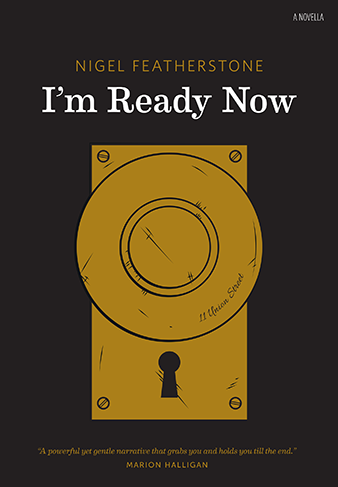
Nigel Featherstone, I'm ready now

Cover (Courtesy: Blemish Books)

In his illuminating On writing: a memoir of the craft (2000), Stephen King talks about how he has really only one theme – that it’s difficult to put everything back in Pandora’s box once it’s opened.  Tim Winton, of course, has his lifelong infatuation with the south-west coast of Western Australia and the men who people the place, especially the men who are trying to work out their masculinity and what role they can play in the family environment.

In terms of my own writing, you’re spot-on that both I’m ready now and Fall on me are about people – men and women – who are trying to work through something from their pasts.  What are these things we all have that might hold us back or anchor us down?  What stops us from becoming the people we want to be?  What if we pretend that there’s something in our past that seems fine but really isn’t?

In Fall on me, Lou Bard has had to survive the murder of his wife, and he’s done this with considerable focus and tenacity, but it’s meant that he’s never found anyone to share his life with in a romantic way – though by story’s end things are looking much more hopeful.  In I’m ready now, mother Lynne finds herself remembering a great but fraught love from her late-teen years, while son Gordon believes that a year of running amok will ameliorate the impact of what happened to him at the very beginning of his life.

Novellas/novels are always about time, and the past is an endlessly fascinating element of time. The past is also about the present and the future, so it’s the foundation of all of us.  Done well, the exploration of a character’s past can be analogous to a country’s past.  If a character’s past is difficult then their country’s past may well be difficult too.  Australia’s past is difficult.  Perhaps all its fictional characters must be difficult?

INTERVIEWER

In the third part of your Wet Ink interview, you say, ‘That’s my mission as a writer: to gently lead people into the darkness and show that there’s not a lot to be scared about’. As a reader, I’m intrigued by writers’ intentions and would love you to tell us what’s behind this mission of yours.

FEATHERSTONE

Featherstone, Fall on me

Fall on me bookcover (Courtesy: Blemish Books)

This is something that I’ve only recently started to think about, primarily with the publication of my novellas.  I try to write in a very accessible way – I want to be read and I also want to be read by a diversity of people.  That’s not to say that I’m disinterested in the musicality of prose, or that I’m not fond of the odd literary firework or two.  It’s just that I don’t aim to be difficult.  However, I do write about things that some readers may feel is difficult, and indeed correspondence I’ve received seems to indicate this.  As mentioned, Fall on me is about a man struggling to come to terms with the senseless end of his wife’s life almost two decades ago, and how their son, who’s now a teenager, persists in doing bravely creative – if not ridiculously dangerous – things with his body and life.

I’m ready now is dark in other ways: just after her husband’s death of a heart-attack, Lynne Gleeson finds herself thinking about a love affair from her childhood, a love affair that gave her a son; meanwhile that son, now an adult, is papering over the fractured start to his life by conning himself that he’s happy and simply being playful.  Whilst I’m not a horror writer, nor do I read horror, in some ways these are horrible – as in ghastly, shocking, almost unspeakable – predicaments for these characters to be in, but my intention is to write about it all in a way that allows everyone inside.

In his profoundly moving collection of essays A way of being free (1997), Ben Okri says, ‘A true storyteller suffers the chaos and the madness, the nightmare – resolves it all, sees clearly, and guides you through the fragmentation and the shifting world.’

Whether or not I’m a true storyteller, I have no idea, but I do adore Okri’s words.

INTERVIEWER

Your novella Fall on me is told in third person, while I’m ready now is told in alternating first person voices. How do you decide what person/voice to tell a story in, and can it change during the writing process?

FEATHERSTONE

These are the choices a writer makes, and sometimes the choices are made at the very beginning of the writing process and they stick, other times there’s a change of mind (or heart) halfway through the writing, even during final editing, and things are altered.  However, with both these novellas I was clear from the first few marks of the pen what I wanted to do.  I’m ready now would be told in the first-person voice – I wanted the sense of intimacy that this brings – and also that the story would be told through both the mother’s and the son’s point of view, so we see their similarities and differences.  Even though Fall on me was published first, it was actually written after I’m ready now, and I made the decision that having just finished writing a first-person narrative I wanted to write a third-person narrative; thankfully this particular story works much better for the distance and perspective that the third-person mode brings; as the writer I was able to be less emotionally entangled.

It’s true that there can be changes through the writing/editing process.  My novel Remnants was drafted first-person but much later was changed to third-person.  I’ve heard that other novelists have done similar last-minute surgeries.  However, I do think that the point-of-view schema of a work is so important – so incredibly integral – that if there needs to be such a significant change then it’s quite possible that something at the core of the story’s construction isn’t working.

INTERVIEWER

Another comment you made in the third interview struck me. You said: ‘I’m interested in place as character’. Many years ago I was in an online reading group in which this topic caused much angst: some members argued that place can’t be a character, and others argued just as vociferously that it could. I’d love to know what you mean by “place as character” and the role you see it playing in your writing.

FEATHERSTONE

Oh yes, place can be character!

There’s a fantastic book that’s very relevant here called Place and placelessness (1976) by the urban geographer Edward Relph.  It’s as rare as hen’s teeth, but thankfully the National Library of Australia has a copy.  I’d like to offer two quotes:

A deep relationship with places is as necessary and perhaps as unavoidable as close relationships with people; without such relationships human existence, while possible, is bereft of much of its significant. (p41)

A deep human need exists for associations with significant places.  If we choose to ignore that need, and to allow the forces of placelessness to continue, then the future can only hold an environment in which places simply do not matter. (p147)

So, houses and farms and towns and cities, even whole countries, can be places that we connect with as though they are living and breathing entities, and this notion is such a great thing for writers to explore.  A fiction writer’s job is to make all the elements of a narrative come truly alive for the reader, and we do this through drawing connections and relationships that matter to the people of the work.  As mentioned earlier, Tim Winton writes about the closeness but almost unknowable vastness of Western Australia, and Randolph Stow did something similar, particularly in The merry-go-round in the seaMarion Halligan often writes about her relationship with Canberra, and, of course, Kate Grenville has a long-time fascination with the Hawkesbury – I have no doubt that the river is as alive to her as the characters.

INTERVIEWER

Can you let us in on your next writing project?

FEATHERSTONE

For some years now I’ve not discussed works-in-progress, primarily because I believe that I’ll jinx it, and jinx it in a negative way (as I hinted with Susan Errington).  It’s as though the work is unravelled as soon as it’s discussed publicly.  It’s not a superstitious thing.  All the effort and energy and intelligence one can muster should be focussed on the writing of the work.  If I tell someone the story of what I’m working on, then the telling is done and there’s no need to finish the thing.  So I’ve always found that it’s best to leave the discussion until the work is properly primed for the world, as in it is published, or very soon about to be.  Then I’m happy to talk about it until the cows come home!

Having said all that, I’ve always believed that Fall on me and I’m ready now are two novellas in a set of three, each of them explorations of modern Australian family life.  So we’ll see what happens with that.

INTERVIEWER

You are the founder of the online literary magazine Verity La. What inspired you to start it, and what are your aims for it?

FEATHERSTONE

One night back in mid-2010 I was watching High fidelity, the fine movie adaptation of the excellent novel by Nick Hornby.  In it, the main character owns and runs a record shop but he also has a record-label, which impressed me.  I thought, I’d love to make a contribution in a similar way but to writing.  I’d been running a personal blog, Under the counter or a flutter in the dovecot, for a year or so, and even though I enjoyed writing for the thing it did seem a little self-focussed.  What if I created a blog that other people wrote, and all the writing was fiction or poetry?

As soon as the movie finished, I poured myself a glass of wine, fired up the laptop, and started work on Verity La – by the time I went to bed the guts of it was more or less ready to go.  The mission statement I wrote that night remains the same: ‘Bravery is essential in the Verity La neck of the woods, which means creative risk-taking, freedom, and – above all else – being no one but yourself.  We are interested in new voices, different voices, progressive voices; we like writing that gets you in the head as well as the gut, that has a point, that isn’t afraid.’

Realising that it would be difficult to run a literary site by myself, I contacted Melbourne writer Alec Patric, who whole-heartedly embraced the idea.  Alec left Verity La at the beginning of 2012, and since then the site’s been considerably redeveloped so it’s now as much a fully-fledged journal as possible.

My aims for Verity La haven’t changed – I still want it to be one of the edgiest Australian literary journals.  In some ways I’m inspired by Oz from the 1960s, but I’m also inspired by the little photocopied and hand-stapled zines that sometimes you find at markets.  I don’t want Verity La to be polite or precious or pretentious; there’s enough of these things in literature already.  I continue to want the journal to provide maximum opportunities and exposure for the writers it publishes, but for it also to be light-weight infrastructure – by this I mean that I don’t want it to be administratively burdensome.  My main game is being a writer, not an editor, so I have to keep this in perspective otherwise Verity La could end up occupying the majority of each week.

Having said that, even though there’s no money in the Verity La universe and everyone involved volunteers their time, I’ve always wanted it to be as professional as possible.  Despite the sometimes hand-made aesthetic of the journal, if we are going to publish writing then we’re going to do it to the highest possible standard in terms of editorial practices.  At the end of last year, Verity La received a Canberra Critics Circle Award, which recognises all those who’ve contributed to the journal, either as writers, readers, editors, or web-developers, but it’s a sign that we’re doing something worthwhile.

As is, it must be said, Whispering Gums.

INTERVIEWER

Given the recent demise of Wet Ink, how does the future look for literary magazines?

FEATHERSTONE

It was very sad to see Wet Ink disappear towards the end of last year – in a relatively short period of time it became one of the most eminent journals in Australia.  However, and I apologise if this next comment appears a little callous, I’ve been writing for twenty years now and journals have always come and gone during this time, and this continual evolution is important to a healthy literary community, even though the changes can be difficult to swallow.

The online environment provides many opportunities for new and exciting journals – there used to be the problem of design and production and distribution, but the internet, to a certain extent at least, has solutions for these things.  Verity La has proven that free blogging software can be used to start up a journal within a matter of hours (though it should be noted that more recently we’ve had professional assistance from the very generous Canberra-based graphic design/web-development firm New Best Friend).  Social media together with smart phones and tablet-computers offers extraordinary opportunities – in the past, we had to physically search out a journal, but these days once we’ve subscribed to a site then the literature comes to us and we can read it wherever we are.  Poetry in particular will thrive in this environment.

That’s not so say that everything’s peachy.  It continues to be a challenge to build an audience around literary writing, and I have no idea how an economy can develop in this context where writers can be paid.  Will readers pay to subscribe to an online literary journal?  If newspapers can’t make it work, then what hope do we have!  There are the other challenges of professionalism, standards and quality control.  It might be very easy to establish an online journal, but I’m a firm believer in the importance of excellence at all levels of the operation.

Here’s a thing.  There are approximately 30 tertiary creative writing course in Australia, and enrolment numbers for each are somewhere between a dozen and two hundred.  So that’s potentially a couple of thousand creative-writing graduates each year.  If only 1% started up a literary journal, then we’d be all better off!  So I’m a practical optimist and on the whole am excited about all the opportunities that we have now or will have very soon for writers and readers.

Despite all this, it’d be wrong if I misrepresented myself: I do read short works on-line, but I much prefer a hardcopy book, a cup of coffee, and a long afternoon spent on the couch.

INTERVIEWER

You are also involved in an arts advocacy group, the Childers Group. Given there are many groups advocating on behalf of the arts, what particular role do you see this group playing?

FEATHERSTONE

This is an interesting question because whilst there are organisations that have been established to develop various art forms – the ACT Writers Centre, for example – there are very few whose sole mission is to be an advocate for the arts in general.  In fact, up until the Childers Group was established in late 2011, there was no arts advocacy body in the ACT region, and there’d been only one or two in the last couple of decades.  Nationally, there’s Arts Peak, which is made up of the various art form associations, like the National Association for the Visual Artists as well as Ausdance, but regionally-based advocacy bodies around the nation are very rare indeed.  So, for the ACT and surrounding area, the Childers Group certainly fills a gap; it may well be that this model and style of operation is actually a first for the arts in Australia.

The Childers Group was originally inspired by the Wentworth Group of Concerned Scientists, which brings cool, calm, considered thinking to environmental conservation matters, so we aim to bring cool, calm, considered thinking to the arts.  The arts are too important for there not to be a unified voice based on logic, research and thoughtful conclusions.  The ACT is very lucky to have, generally speaking, bipartisan support for the arts and at approximately $15M per year is by far the most important ongoing investor into the creative life of the region.  However, step over the border – I’m a Goulburn resident – and things are a bit different, so much so that the NSW Government will no longer be subsidising a range of fine-arts courses.  There’s poverty and substantial social and economic hardship in the regions and involvement in the arts provides many people with a way of building their skills and self-esteem.  This decision is short-sighted and, for want of a better word, ugly.

Going back to Ben Okri and his way of being free, he says two things: ‘Creativity of any valuable kind is one of the fullest expressions of the human and the godlike within us’ and ‘The imagination is one of the highest gifts we have’.

He’s right.

INTERVIEWER

And now, for fun.  What is your favourite gum tree (because, of course, as an Aussie, you must have one)?

FEATHERSTONE

Angophora Costata

Angophora Costata (Courtesy: Eug, using CC-BY-SA 2.5, via Wikipedia)

Ah, you know I love this and when I first scanned the list of questions I thought, well, that last one is easy – the Angophora costata, that’s my tree.  But then I realised that it’s not technically a gum, because it’s not a eucalypt.  Except I just can’t change my mind.  So, the Angophora costata it is.

I grew up on the North Shore of Sydney, right on the edge of the Kuringai Chase National Park.  The angophora, or Smooth-barked Apple, loves that hot and dry sandstone country, and we had a very large one in our front yard.  They’re magnificent trees with great, smooth, orange-red trunks and twisted, gnarly, sculptural canopies.  My mother must have been worried that our tree was getting too big and maybe one day would drop something on me or my two older brothers, so she got around a tree surgeon to take out the odd precarious branch.  She must also have been worried about its health in general – being a keen gardener she didn’t want the tree gotten rid of – so, using screwdrivers, we dug little holes in the ground and filled them with a fertiliser called Poplar Special and the tree continued healthily.

One year when I was about fifteen or sixteen – I’m not making this up at all – I was mowing the front yard, which was never a task I enjoyed, and still don’t, to the point that I have next to no lawn, when a sugar-glider floated down out of the angophora and landed on the handle-bar of the mower.  The animal was so small and delicate and cute, it’s little white-tipped ‘wings’ folded up on each side.  I was utterly entranced, enthralled.  Not wanting to frighten the thing, I carefully turned off the mower’s engine.  The sugar-glider stayed there on the handle-bar, and I thought that maybe he’d come for a cuddle, maybe even some love.  So, extra gingerly, I went in to pick him up.  My hands got closer and closer.  Just as my fingers reached his fur, he turned his head and bit me badly on the finger, drawing blood.  He leapt off the mower, and sprinted to the angophora’s trunk and made his way back to the faraway crown.

This was such a magical event that maybe, in old age, when I’m about to draw my last breath, it’ll be this story that’ll dart through my mind.

INTERVIEWER

Thanks Nigel for these wonderfully thoughtful – though I’d expect no less – responses to my questions. I can see myself coming back to them a few times to digest the ideas you’ve shared with us. I love your favourite gum, by the way. Eucalypt or not, it’s still a gum, and what a pretty one.

Finally, thanks again to you and Susan for offering the Wet Ink interview to me. I’m thrilled to have this record on my blog.

Delicious descriptions from Down under: Patrick White on men and sheep

A few months ago I wrote a Monday Musings on the representation of sheep – well, people who work with sheep anyhow – in Australian literature. I was therefore tickled when early in Patrick White’s Happy Valley, which I reviewed last week, he talks of men who work with sheep, as follows:

Men who work a lot in the open, especially men who work with sheep, have a habit of repeating things, even trivial things, several times, perhaps because conversation is scarce and it gives them a sense of company to have  a phrase coming out of their mouths, even if the phrase is already stated. Clem Hagan was like this. He repeated a remark ponderously, sometimes with different intonation just for variety’s sake. He stared out in front of him with an expression that might have been interesting if you didn’t know it was due to his having spent most of his life looking into the distance for sheep. Anyone who stares long enough into the distance is bound to be mistaken for a philosopher or mystic in the end. But Hagan was no philosopher, that is, he searched no farther than the immediate, sensual reality, and this translated into simpler terms meant a good steak with juice running out at the sides, and blonde girls with comfortable busts.

White then goes on to describe a man who thinks he’s God’s gift to women – and whom many women, though it beats me why they do, let think so.

Monday musings on Australian literature: Coming up in 2013

In a first for Whispering Gums, I have decided to post about coming attractions. It seemed an appropriate first Monday Musings for the year. But, how to do it? As I can’t possibly list them all, I’m going to make a selection and group them in sets that make sense to me. So here, as you’ve heard me say before, goes. Remember, this is just a selection reflecting the sorts of books I’d like to read. Whether or not I actually manage to read them all is another thing entirely.

John Maxwell Coetzee

Coetzee, 2006 (Courtesy: Mariusz Kubik, via Wikipedia)

Fiction from authors I’ve read before

  • J.M. Coetzee, The childhood of Jesus (March 2013 from Text Publishing): It’s been over 5 years since Coetzee’s last piece of fiction, Diary of a bad year (my review). I look forward to seeing whether Coetzee plays further with the novelistic form, as he has in recent outings, in this new offering.
  • Richard Flanagan, The narrow road to the deep north (August 2013 from Random House): Similarly it’s been over 4 years since Flanagan’s Wanting (which I read before starting this blog). This new novel, I gather, moves from Australia where his previous novels have been set to the Burma-Siam death camps.
  • Andrea Goldsmith, The memory trap (May 2013 from Fourth Estate): Goldsmith’s last novel Reunion (my review) was not my favourite Goldsmith, but she’s well worth watching.
  • Joan London (November 2013 from Random House): I don’t know the title of London’s next book, but I can’t wait to see it, as her Gilgamesh (which I virtually gifted to Stu) is one of my favourite Australian novels. My review of her most recent novel, The good parents (2008), was one of my first reviews on this blog.
  • Alexis Wright, The swan book (August 2013 from Giramondo): It’s been nearly 7 years since Indigenous author Wright’s last novel, Carpentaria (my review). It won the Miles Franklin award in 2007 so a new one from her is long-awaited.

Fiction from authors I’ve been meaning to read

  • Georgia Blain, The secret lives of men (April 2013 from Scribe): A collection of short stories and you know how I like short stories.
  • Fiona Capp, Gotland (July 2013 from Fourth Estate): Apparently about a reluctant Prime Minister’s wife, but this article written by Capp in 2009 might throw some light on the title.
  • Steven Carroll, A world of other people (May 2013 Fourth Estate): A Miles Franklin Award winning author I haven’t read. Boo me!
  • Robert Gott, The holiday murders (February 2013 from Scribe): OK, I’m lying with this one. Gott is not an author I’ve been meaning to read. In fact, I’d never heard of him. He has written children’s books, crime (not my genre), and a newspaper cartoon. Why then you are probably asking am I including him? Well, he, like PL Travers of Mary Poppins fame, was born in the same not-well-known town that I was, Maryborough in Queensland. And that’s good enough in my mind to give him a nod!
  • Chris Womersley, Cairo (September 2013 from Scribe): I’m still hoping to find time to read Womersley’s second and well-reviewed novel, Bereft, but if I don’t, this might well be my introduction to him.

Debut fiction

  • Balli Kaur Jaswal, Inheritance (February 2013 from Sleepers)
  • Lesley Jørgensen, Cat & fiddle (February 2013 from Scribe)
  • Maurilia Meehan, Madame Bovary’s haberdashery (April 2013 from Transit Lounge): Described as quirky crime novel, so I might just be interested.

Non-fiction

  • Anna Goldsworthy, Quarterly Essay (June 2013 from Black Inc): I’ve reviewed a couple of Quarterly Essays (by Krien and Flannery) and am interested in this one which will apparently be on misogyny/feminism in Australian politics.
  • Anna Krien, Night games (May 2013 from Back Inc): I’ve reviewed Krien’s Into the woods about forestry in Tasmania (my review) and her Quarterly Essay (see above). I enjoy her style and perspective. This book is apparently about the rape trial of a footballer.
  • John Safran, Murder in Mississippi (July 2013 from Penguin): This intrigues me – an Australian writing about the murder of a white supremacist in the American south – but then Safran has made somewhat of a career of investigating religion and related issues around the world.
  • Helen Trinca, Madeleine (April 2013 from Text): I’ve reviewed one of Madeleine St John’s novels, The women in black (my review), and know a little of her life. She was apparently the first Australian women to be shortlisted for the Booker Prize. She’s also a peer of Australian expat intellectuals, Germaine Greer, Robert Hughes, Clive James and filmmaker Bruce Beresford who, many years ago, optioned The women in black for film. I’d love to read this biography.

For more information about these or other books coming out in 2013, you might like to check the publishers’ websites:

Patrick White, Happy Valley (Review)

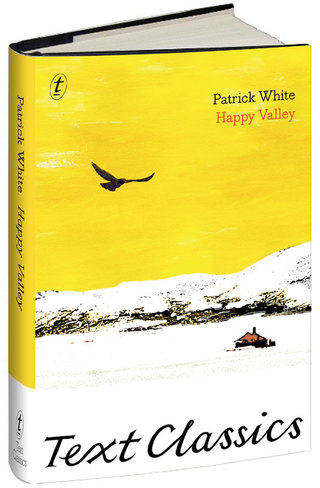
Patrick White, Happy Valley

Book cover (Courtesy: Text Publishing)

My love affair with Patrick White, figuratively speaking, began in my last year of high school when I studied Voss. Always partial to Aussie literature, I was, at 17 or 18, bowled over by White’s writing, passion and vision – and by his rather acerbic, though mostly compassionate, view of the way people submerge their “selves” in exterior trappings. I was consequently thrilled when Text decided to publish his first novel as part of its Text Classics series because this book, first published in 1939, was not published again in White’s lifetime. His decision, not his fans, I might add!

Why White refused its republication is a matter of some conjecture. He describes it in his autobiography, Flaws in the glass (1981), as “my first published, best forgotten novel”. Whatever the facts, being published in England and New York in 1939 probably made it easy to “lose”. All I can say is that it’s a great shame, because this is one helluva novel.

But let’s not conjecture, and get on with the book. It’s hard though to know where to start. As a newly released but first Patrick White, it’s going to be (and probably already has, but I’ve kept my eyes averted) the subject of much critical and literary analysis. How, this amateur blogger thinks, can I add to that? By, I suppose, just picking a few things that interested me.

There were several things that interested me in this novel, besides the fact that it is a good read. Perhaps I’d better explain that, the plot, first. It’s set in, yes, a town called Happy Valley, in the Snowy Mountains-Monaro region of New South Wales, just south of where I live and where Patrick White was a jackeroo for a year. If you know Patrick White, you’ll know the town’s name is ironic because White’s people are rarely happy. Life tends to be, for them, disappointing at best, sterile, depressing and/or meaningless at worst. In this book we have a large number of people and families, representing a cross-section of a typical country town: the doctor (Holliday), the teacher (Moriarty), the squatter (Furlow), the storekeepers (Quongs), the banker (Belper), the piano teacher (Alys Browne), the farm worker and “stud” (Clem Hagan), the “simpleton” (Chuffy Chambers). The novel begins and ends with the doctor, but its subject matter is the desire to escape. Many of the town’s residents don’t want to be there, and dream of ways out. Alys dreams of California, Hilda Holliday of Queensland, Sidney Furlow of anywhere-but-here, and so on. For the most part the novel chronicles the relationships between the people, explores the sources of their discontent, and teases them with future possibilities. It seems, until near the end, that nothing particularly dramatic will happen but then a shocking event occurs which precipitates decisions – some big, some small – that will change the lives of those concerned. For the better? Well, that’s a question for us readers to consider, but it’s important to recognise that for White the important decisions/shifts that have to be made are internal. Here is Alys near the end, seeing her escape dream for what it was:

I shall not hurry, she said, I shall shape time with what I have already got.

It’s a good story – and it’s clearly White.  There are a lot of characters, which can be the downfall of first novels, but White handles them well. The connections are clear and he keeps them all moving along so that we readers rarely, if ever, feel lost – once we have them in our heads.

What bowled me over most about the novel though is its style. It’s big – it’s inventive, expressive, rhythmic. As I was reading it, I was reminded of DH Lawrence (and his intense sensuality) and James Joyce (and his “stream of consciousness”). Peter Craven, who wrote the introduction to Text’s edition, agrees, and adds Gertrude Stein (whom I don’t know well enough) and Virginia Woolf (whom I should have picked too!). However, despite these pretty clear influences, the novel doesn’t feel slavish. Although this is (obviously) early in his career, his mature style is already evident. I was impressed by how he moves pretty seamlessly between description, dialogue and interior monologue, by how he shifts point-of-view, even within paragraphs, and by how, almost imperceptibly at times, he changes voice from third to second to first person. It’s spirited, gutsy writing. You feel, sometimes, that’s he’s strutting his stuff, but he rarely loses us and, while he may occasionally push a little too far, it doesn’t feel like showing-off but more like a writer with ideas bubbling out of him.

Earlier in the review, I mentioned writers that I felt influenced White, but now I want to mention one that I think was influenced by him, and that’s Thea Astley. She also had a pretty acerbic view of the world, and could skewer characters for their superficiality while maintaining, unless they really didn’t deserve it, compassion for them. White and Astley also use humour, usually wry or satiric rather than belly-laugh. I loved this description of a person in a bar early in the novel:

But another was an old man, one of those static old men you see in country bars, who seem to have no significance at all, except as recipients of drinks that they pour in through the meshes of a yellowish moustache, just standing and nodding, willing to listen to a story, but never giving much in return. They are generally called Abe or Joe. Though this one was called Barney, as a matter of fact.

That made me laugh; it’s the sort of writing that made me keep reading. But it’s not all quite this benign, because Happy Valley is a town where there “never was co-operation”, where “people existed in spite of each other”, where town “stud” Clem would like to “take a lump of wood, treat her almost like a snake”.

One of the threads running through the novel concerns the limits of language to express true feeling:

Both of them wanting to say something and then it only came in words.

White, I understand, would love to have been an artist, calling himself a “painter manque”, but oh dear, what words we would have missed had he done so.

Lisa of ANZ Litlovers, also a Patrick White fan, loved the book too.

Patrick White
Happy Valley
Melbourne: Text Publishing, 2012 (orig. published 1939)
407pp
ISBN: 9781921922916

(Review copy courtesy Text Publishing)

Fridays with Featherstone, Part 4: On writing and admired writers

Today, I bring you the final part of Susan Errington’s Wet Ink interview with Nigel Featherstone. In this part Nigel talks primarily about some of the writers he admires or who have inspired him – and how they relate to his writing. I love the fact that many of the writers Nigel admires are also favourites of mine, such as … but no, if I tell you now that will spoil the interview. Read on …

INTERVIEWER

You seem interested in troubled or fractured families, especially in Remnants. Is the family dynamic something you want to expand on in future writing and perhaps bring to the forefront?

FEATHERSTONE 

Families are both fascinating and frightening.  As a writer I’m asking, what makes up a family?  It’s not just husband and wife and two children.  A family can be a group of people living in a share-house.  It can be a rock band.  It can be three kids on a road-trip.  It can be an old woman and her twenty cats; Eva Hornung explored human-animal relationships as family in her extraordinary novel Dog Boy.  Families can be forces for good, and forces for evil; more often than not, they are both at once – this is what Anne Enright was doing in her Man Booker prize-winning The Gathering.  Whenever I hear someone say that family is ‘the bedrock’ of society I want to reach for my pen and get to writing.  Family might be the traditional bedrock in terms of procreation, but it certainly isn’t the emotional bedrock for many individuals.

INTERVIEWER

Your Australian families lack the hysteria of Patrick White’s and remind me more of the quiet honesty of Randolf Stow’s. What’s important to you in creating a family in your work?

FEATHERSTONE

You’re not the first person to mention Randolf Stow in relation to my stories, and it always fills me with a warm inner glow.  I read The Merry-Go-Round in the Sea back in high-school and I was rapt, and that rapture has continued after all these years – and I haven’t read it since, although recently I bought another copy and it’s on the bedside-table pile.  Quiet honesty.  I like that.  Is that what attracted me to Stow?  Who can tell?  In terms of technics, what’s important in creating a fictional family is life, depth of character, and conflict.  It’s also important, I think, for the family to want something, resolution, revelation, salvation, disintegration, even if they don’t know it.

INTERVIEWER

Who are the important novelists for you?

FEATHERSTONE

J.M. CoetzeeDisgrace is the perfect contemporary novel.  Colm ToibinThe Blackwater Lightship, a story about three generations of Irish women, is told in the simplest, most direct voice, but it dives so confidently into the depths.  Alan Hollinghurst – the language in The Line of Beauty never ceases to amaze me, and the author is invariably hilarious.  Kazuo IshiguroA Pale View of Hills and The Remains of the Day are two gorgeous novels, both being vast wells of intimacy.  Graham SwiftLast Orders is a novel I return to regularly.  Morris WestEminence is built around a terrific what if (what if the next Pope was agnostic?).  Truman CapoteIn Cold Blood is a book that has had a huge impact on me because it’s the portrait of friendship and family and landscape.  Harper Lee – the burning desire for justice in To Kill A Mockingbird.  The verse-novelist Dorothy Porter – what she could conjure on the page!  Helen Garner – although not fiction, Joe Cinque’s Consolation shows all the hallmarks of what makes a novel.  It may appear odd in this company, but Flann O’Brien’s The Third Policeman is the most audacious of stories.  The names Tolstoy and Chekhov have to appear in this paragraph.  As does Flaubert’s; Madame Bovary is the truly great novel.

INTERVIEWER

Writing is a tough and often lonely gig.  Where do you draw your inspiration?

FEATHERSTONE 

From the things that happen around me, or happen around other people.  That makes it sound easy.  You’re right: it’s not.  There are days when I’d like to chuck it all away, but my life would be dreary without writing and reading.  And music.

INTERVIEWER

What are you working on at present?

FEATHERSTONE

Nigel Featherstone, I'm ready now

Cover (Courtesy: Blemish Books)

Going back to where we started, the second of those Launceston novellas is being published by Blemish Books in November this year*, so over the coming months I’ll be working on the nips and tucks required by the publisher (it’s already been through quite a few rounds of these), getting the story as perfect as humanly possible.  What can I tell you about it?  Perhaps, after all this talk about men and their trials and tribulations of forming relationships and trying to have meaningful lives, it might be a surprise to tell you that this second novella, which is called I’m Ready Now, is a story about a mother and son.  The mother has reached a fork in her life, and so has the son, and both are in the midst of making decisions that will change the course of their lives and their relationship(s).  It’s told from both points of view, and I enjoyed writing the mother as much as the son, perhaps even more so.  And I’m always working on short stories, and creative journalism.  And, yes, there’s a bigger project but I can’t talk about that because I’ll jinx it.  But for the next few months, much of whatever brain-power I have will be occupied with bringing I’m Ready Now into the world.

* This interview was prepared many months ago for publication in Wet Ink during 2012. Readers of this blog will know that I’m ready now was indeed published in November and reviewed by me that month.

If you missed Part 1, click here, for Part 2 here, and for Part 3 here.

Thanks again to Susan Errington for supporting my running this interview after the demise of Wet Ink. I’m sorry that Wet Ink no longer exists, but it’s been a pleasure to share this great interview with readers here.

Fridays with Featherstone will finish next Friday with my follow-up interview with Nigel…

Highlights of 2012: Notable reads for 2012

To complete my 2012 round-up triumvirate, which started with my blogging highlights and was followed by my Australian Women Writers challenge wrap-up, this post documents my notable reads of the year. If you are sick of me and my round-ups, I won’t be offended if you click away now!

Like last year, I’m not doing a top 10, because I find defining “top” reads such a movable feast. I would really like to list almost everything I read! So, again, I’m listing my notable reads under categories to give a flavour of this year’s reading life. Last year’s categories were based on review clichés and jargon, but this year I’m going to just make up my own, as whim takes me. Here goes, in no particular order:

Most disappointing read: PD James’ Death comes to Pemberley. It’s not that it was a bad book, exactly, but I’m not much of a crime reader and I don’t tend to read Jane Austen sequels/spin-offs, and I just felt this didn’t cut it, mainly because Elizabeth and Darcy didn’t ring true. They were flat, there was no chemistry. Without that, it was lost.

Most surprising read: Fergus Hume’s The mystery of a hansom cab. What did I say about not reading crime? Well, that’s partly why this was my most surprising read, because it is a late nineteenth century Australian crime novel and I loved it. It provided such a great social history of Melbourne of the period – and was a rollicking good read as well. Quite coincidentally a new telemovie adaptation was broadcast late in the year, and I enjoyed that too.

Francesa Rendle-Short book cover Bite your tongue

Bite your tongue Bookcover (Courtesy: Spinifex Press)

Bravest book: Francesca Rendle-Short’s Bite your tongue. I loved the creative way Rendle-Short went about telling her uncomfortable story via a fictional-memoir. This book is an example of what Rebecca Giggs meant when she talked about writers finding new modes of authority by which they can describe (and we can find valid) how the world “actually” is.

Most inspiring book: Izzeldin Abuelaish’s I shall not hate. What can I say? Abuelaish’s ability to rise above a pain that no parent should face, the death of his daughters in a targeted terrorist attack, and continue to argue for peace and reconciliation between Palestinians and Israelis should be a lesson to us all. I have never liked the idea of revenge, but also have never had my philosophy seriously tested. He has and shows that it is possible to see things a different way.

Favourite e-Book: Willa Cather’s My Antonia. I didn’t read many e-Books this year, but this e-notated version of an American classic was special. While I had some reservations about a couple of the features, overall the e-notation enhanced my reading and, anyhow, it’s a great novel. A re-read for me, and I’d read it again (if I had the time!)

Book scoring most “hits”: Julian Barnes’ The sense of an ending. This popularity was quite a surprise. I was fairly late – given its 2011 Man Booker Prize win – to read and review it, and yet my post seems to score high in Google searches. Why, I have no idea, but there you go! I’m happy to list it in my “notable reads” because, besides its being popular with the search engines, I liked it.

Favourite classic: Elizabeth Harrower’s The watch tower. I read a few “classics” this year – novels and short stories – and enjoyed them all. There’s something about reading good writers from the past – for learning about the world they were writing in, and for providing a different perspective on our own world (if that makes sense). Harrower’s novel is so of its time and place and yet is absolutely universal in its study of power and control in intimate relationships.

Favourite translated novel: Yan Lianke’s Dream of Ding Village. This was one of the books I read for the Shadow Man Asian prize earlier in the year. I also liked the winning book Kyung-Sook Shin’s Please look after mother and several others but, as time has gone on, it’s Ding Village that most often comes back to me. A great study of power and greed, with personal and political implications.

Favourite recent Australian book: Gillian Mears’ Foals’ bread. What can I say? This is one of those books that hits you in the guts. It’s about character, passion (of all sorts), and the ambiguities in human relationships – and Mears nails it.

Favourite short story: Paddy O’Reilly’s “The salesman”. This was very hard, so much so that I nearly decided not to create a category for it. I read several great short stories in 2012 but I had not read O’Reilly before and I was impressed by her control of the form. It’s a powerful story about deprivation, racism and the violence that lies just, only just, below the surface. It’s both subtle and unsubtle at the same time.

That’s 10. I could go on with more categories but I won’t bore you any further. Before I go, though, I’ll just, because I can, give a special mention to those writers who are published by the little presses and who deserve wider notice: Nigel Featherstone (Blemish Books), Catherine McNamara (Indigo Dreams) who has a collection of literary short stories coming out in 2013 to follow her 2012 commercial novel, and Michael Sala (Affirm Press).

Monday musings on Australian literature: Australian Women Writers’ Challenge 2012 Round-up

Australian Women Writers Challenge 2012 Badge

(Design: Book’dout – Shelleyrae)

It seems fitting that my last Monday musings for 2012 be devoted to the Australian Women Writers Challenge, partly because it turned out to be quite a significant event in Australia’s literary calendar for the year, and partly because I introduced it in my first Monday musings of the year. The challenge was instigated by Elizabeth Lhuede in response to growing concern in Australian literary circles about lack of recognition* for women writers here. This concern resulted in several tangible actions, besides this challenge, including the creation of the Stella Prize and the first Meanjin Tournament of Books being dedicated to novels by Australian women.

Elizabeth, I know, had no comprehension when she started the challenge of just how successful it would be. Not only did it end the year with around 350 participants, who wrote around 1500 reviews for over 550 authors, but it received significant recognition from multiple quarters, including:

  • Huffington Post, for which Elizabeth was asked to write an article
  • ABC Radio National, on which the challenge was mentioned at least once
  • The National Year of Reading, 2012, which recognised it as an activity in their program
  • Many bookshops, libraries and authors (too many to list), who got behind the challenge and promoted it on their blogs/sites

The challenge has infiltrated social media. It can be found on Facebook, Twitter (@auswomenwriters), and GoodReads, as well as on its dedicated website and blog. It has built up such momentum that it will continue in 2013, with a team to help Elizabeth manage it. I have agreed to be part of that team, with responsibility for the “Literary” area. If it sounds like the sort of challenge for you, please sign up here: Australian Women Writers Challenge 2013.

As I explained in yesterday’s highlights post, this is my first ever challenge. I’ve discovered that it is normal to do a round-up post at the end of a challenge, so here’s mine. I signed up for the Franklin-fantastic Dabbler level, that is, that I’d read (and review) at least 10 books by Australian women writers in more than one genre. I’m therefore listing them by category/genre (but please understand that the groupings are very loose and pretty arbitrary! They are indicative only).

CONTEMPORARY FICTION

HISTORICAL FICTION

CLASSIC FICTION

NON-FICTION

ESSAYS

SHORT STORIES AND POETRY

What did I learn from the challenge? Principally that there’s a whole world of Aussie women writers out there that I knew little or nothing about. They are beavering away in genres I tend not to read and they have big followings, many of whom posted their reviews on the challenge site. The existence of this band of writers was one of the reasons Elizabeth started the challenge, because she knew they were scarcely known outside their specialised fields. I suppose this is the case with all reading categories: we tend not to know what’s going on outside our sphere of interest. But, I’m glad to have had my eyes opened, even if I’m unlikely to greatly change my reading habits. So much to read … and all that, eh?

* Somewhat ironically, this year two books by Australian women – Anna Funder’s All that I am and Gillian Mears’ Foal’s bread – pretty well scooped our top literary awards. While I like to see awards spread around a bit because there’s a lot of quality out there, it was good to see these two wonderful writers receive such clear recognition.

Finally …

A big thanks to all you readers who add so much to my blogging experience. I truly appreciate the encouragement you give me by visiting, by “liking”, and best of all by commenting. I hope you have all had a satisfying 2012 and wish you every good thing, bookish and otherwise, for 2013.

Highlights of 2012: Blogging and the Reading Life

It’s been a busy year chez Gums and so I’ve decided to write two highlight posts – one listing some favourite reads, and this one for other blogging and reading highlights. Here, in no particular order, they are …

The challenge to do when you don’t do challenges

I decided when I started blogging that I wouldn’t take part in challenges, much as some intrigued me. I wanted to be mistress of my own reading choices and not get drawn into “having” to read something to comply with a challenge. But then, along came the Australian Women Writers Challenge, and I couldn’t say no. It’s a bit of a cheat, really, to say I’ve engaged in a challenge because reading Australian women writers is not a challenge for me. It’s what I do anyhow, it’s my reading preference. And so, readers, I completed the challenge – and will take part again next year. Look for tomorrow’s Monday Musings for my challenge wrap-up …

Other blogging activities

This year I took part in two other blogger-initiated literary activities. One was the Shadow Man Asian Literary Prize team (which actually started in late 2011 but ran through the first quarter of 2012). With a team of 6 (Lisa, Fay , Matt, Stu and Mark), we reviewed the full longlist and chose our winning book, Kyung-Sook Shin’s Please look after mother, which was also chosen by the official judges. It was a great experience, and some of the books I read will be among this year’s reading highlights. However, I have not joined the team this year because I knew I wouldn’t be able to keep up. I’m missing reading some great books though, I know.

The other activity was the Bah-Humbook virtual gift exchange instigated by Guy Savage and Emma. My exchange partner was Stu (see Shadow Man Asian team above!). Stu chose two fascinating sounding books for me, so you can expect reviews of these in the coming months!

Blogging highlights

It has been a pretty exciting year for Whispering Gums blog. Firstly, I finally decided in October to buy my own domain name so that I’m now the proud owner of “whisperinggums.com”. It doesn’t mean much really – except that Google “lost” me for a few months – but it somehow feels more authentic. I’m still hosted by WordPress, giving me, for my needs, the best of both worlds.

Around the same time, an excerpt of my review of Gillian Mears‘ wonderful novel Foals’ bread was included, along with those from another blog (Reading Matters) and several newspaper/magazine reviewers, in the front pages of the “C” paperback edition of the novel.

And then, in December, my blog was added to the Pandora web archive by the National Library of Australia, meaning that, if I ever disappear, my blog will be available online in perpetuity (or until a librarian decides to deselect it!).

Literary events

I attended a number of literary events this year … though never as many as I’d like to! The highlight was probably the inaugural Canberra Readers’ Festival. With writers like Kate Grenville, Anita Heiss and Frank Moorhouse speaking, it had to be a winner, and it was. We Canberrans hope it continues next year.

I also attended the Prime Ministers’ Literary Prize post-announcement panel, and the launches of The invisible thread anthology, Nigel Featherstone’s novella I’m ready now and Suzanne Edgar’s poetry collection Love procession.

Reading goals

This heading is a bit of a misnomer, as I don’t set formal reading goals. However, I do have in my mind works and authors I’d like to read, and this year I achieved an important one, Gerald Murnane. He’s been on the Australian literary scene for a few decades but I had never managed to read him until now. And why now? Because of Text Publishing’s new Text Classics series – the publication of which is another highlight of my reading year. Text has made available, at a good price, a wonderful and diverse collection of Australian classics. I’m glad I finally met this goal, and look forward to more Murnane in my reading future.

Red Dog

I wrote a post in September about the number of ways people were reaching my blog by asking about the film Red Dog, particularly by asking whether Red Dog dies in the movie. Three months later – and some sixteen months after my review – my Red Dog post is still in my top five posts for the year. That movie seems to have really hit a chord. This doesn’t mean I am now going to tell you the answer, but I’m sorry to tell you that Koko, who played Red Dog in the movie, died this month. He was only 7 and had, apparently, won awards for his role. I didn’t even know there were awards for animal stars but apparently there are. All I can say is, Vale Red Dog, oops, I mean Vale Koko!

And that’s about it from me for my blogging/reading life highlights of the year. I’d love to hear if you have any highlights of the literary or blogging kind that you’d like to share …