Monday musings on Australian literature: Indigenous Australian literacy

I feel a little uncomfortable being a white person writing on indigenous issues. It’s difficult in situations of such immense power imbalance as currently exists between indigenous and non-indigenous Australians not to come across as patronising or a self-congratulatory do-gooder. However, I’m also aware that consciousness needs to be raised and good programs promoted, so here I am. I just hope I don’t offend those who really know what they are talking about.

I’ve been aware of a number of initiatives for some time now – such as the Indigenous Literacy Foundation – but this post was inspired by a small article I saw in my city’s newspaper about an initiative called the Indigenous Reading Project. So, I thought it might be time to talk about some of the things that have been happening in recent times. Indigenous literacy rates in Australia are at scandalous levels, which I find incredibly embarrassing for a so-called first-world nation. The situation is particularly bad in remote areas. According to a National Indigenous Literacy Day press release, “only one in five children living in a remote Indigenous community can read or write to the accepted minimum level”. One in five and only to the minimum level! This really isn’t acceptable.

Here are some activities/organisations that I’m aware of, but there are more, many at local community levels:

  • Indigenous Literacy Foundation: A not-for-profit charity established, I believe, with the support of the Australian Book Industry and other private sponsors. It doesn’t receive government funding. Its aim is “to make a positive difference in the lives of Australian Indigenous children by focusing on ways to improve their literacy levels”. It is a broad ranging organisation that sponsors or supports a wide variety of events and activities. According to its website, it raised $600,000 in 2012, and over the course of its existence has supplied some 85,000 books to over 230 remote communities.
  • Indigenous Reading Project: The project that finally inspired me to write about this issue. The article I read – here – describes a project developed by a Canberra-based public servant. It aims to “improve indigenous reading standards by giving students a Kindle in an effort to boost their interest in reading”. The project, very new still, has had significant success, in terms of the measures they’ve devised. It is geared to 10-15 year olds who are independent readers but “at or below national benchmarks in literacy”.
  • Australian Literacy and Numeracy Foundation: Describes itself as “the first independent charity in Australia dedicated to raising national language, literacy and numeracy standards, especially in remote and marginalised communities.” Its tagline is, simply, “being able to read and write is a basic human right”. It targets literacy and numeracy throughout the Australian population, but indigenous people clearly form a major part of its constituency. It supports a variety of literacy projects at the individual, family and community level.
  • National Indigenous Literacy Day: Organised by the Indigenous Literacy Foundation, and now 6 years old, the Day has two main aims: to encourage Aboriginal and Torres Strait Islander children to read; and to raise money to buy books for children living in remote Australia. A wide range of organisations are gradually getting behind this initiative including literary organisations like the Wheeler Centre, public libraries, schools, broadcasters like the ABC. I hope it becomes a universally recognised event on the Australian literary calendar.

There are also indigenous writers who are working hard to support literacy programs. Two whom I’ve heard speak (live) are Anita Heiss and Boori Monty Pryor. They are (of course!) both passionate about their cause, and are effective (and entertaining) public speakers.

Anita Heiss is an Indigenous Literary Foundation ambassador. She is actively involved in all sorts of literacy initiatives, from grass roots activities like writing books collaboratively with school children to lobbying and working at organisational levels. Boori Monty Pryor is one of Australia’s first two inaugural Children’s Laureates. He has made sharing and promoting indigenous culture his life’s work, with his main focus being, as I understand him, to encourage cultural pride and literacy skills in indigenous Australians and awareness of and respect for indigenous culture in non-indigenous Australians.

I’ll close with a statement by Heiss, taken from the ILF website:

Literacy is essential to Aboriginal people’s self-determination. If we cannot read we cannot make the decisions that inevitably impact on our lives …

Reading, as we all know, is that important!

If you believe in the cause of indigenous literacy, and have some money to spare, please click on the organisational links above and consider donating.

Oh, and if you know of successful literacy organisations, programs and/or campaigns, I’d love to hear about them.

Meanjin’s Tournament of Books 2012 (2013), Semi-finals

And so Meanjin’s Tournament of Books rolls on – during a hot Australian summer that has been characterised by terrible fires and floods. “I love a sunburnt country” but this is ridiculous.

Anyhow, the tournament’s semi-finals have been played and the best short stories (sorta) have won. Here they are:

Semi-final 1: Thea Astley’s ‘Hunting the wild pineapple’ defeated Nam Le’s ‘Love and honour and pity and pride and compassion and sacrifice’

This match was judged by one Ronnie Scott, who is apparently a reviewer, writer, and PhD graduate among other literary-artsy things. His discussion of the two pieces is pretty thorough. He makes a few references to Nam Le’s creative writing school background – which is in fact the setting/background of this short story. He suggests, for example, that the story “invokes the fearsomely competent, ‘polished’ writing current writing schools produce”. He seems to admire Nam Le’s writing, arguing that while Nam Le uses “the (valuable) Creative Writing class trope that smell is the only unmediated route to memory”, he “does the impossible and makes the result break your heart”. However, Astley’s writing he says “feels dangerous, unruly, charged”. I think that’s it – that’s Astley in a nutshell, and you either like her or you don’t. This match was a hard call and I’d have been happy either way but, Astley has to be my sentimental favourite because of who she is, and because of the way she skewers the heart of people’s superficiality, self-centredness and intolerance.

Oh, and why did Scott give the award to Astley? Because, he argues quite logically really, that “the weirder work is the one deserving of the imaginary prize”! Can’t argue with that …

Semi-final 2: Tom Cho’s ‘Today on Dr Phil’ defeated Jennifer Rowe’s ‘In the mornings we would sometimes hear him singing’

Now this match is between two stories I hadn’t read, so after the Round 2 I decided to track them down. I did manage to obtain Josephine Rowe’s, which is in her collection Tarcutta Wake, but not Tom Cho’s. Oh dear! I really will have to find it now. Anyhow, this match was judged by book critic and Monash University academic, Melinda Harvey. I enjoyed her adjudication which she framed through tennis match metaphors, asking at one point “Will it drive you wild if I keep these tennis metaphors going a bit longer?” Not me, Melinda! “Like a Federer-Nadal match”, she writes, “this semi-final is a study in contrasts. Rowe’s story is nostalgic, lyrical, earnest, an evocation of a particular time and place […] Cho’s story is contemporary, colloquial, playful, a flight of fantasy about identity”. The metaphors continue in her comparing Rowe’s writing to “groundstrokes” and Cho’s to “the drop shot and the lob”. I’ve read the Rowe now – a lovely, somewhat nostalgic but not sentimental piece about the way art (in this case music) can help us transcend the daily grind – and from Harvey’s description can guess a little about the style of Cho’s story. The match could almost be a replay of Nam Le versus Thea Astley, methinks, from the sound of it. But, Harvey is less definitive than Scott and lets Hawk-eye decide … it’s close, but it’s Cho. Not having read the Cho*, as I’ve already said, I have no comment.

Recap

And so it’s down to the final round and it’s between an older story and a recent one, a long story and a short one, a female writer and a male one, but also, it seems, between two writers who are a little more “out there” in style and thinking than many of their opponents have been. It’s gonna be interesting!

Who will the winner be? Ideas anyone?

  • Thea Astley’s “Hunting the wild pineapple” (1979) OR
  • Tom Cho’s “Today on Dr Phil” (c. 2006)

* It’s in his collection Look who’s morphing which is available for the Kindle. I used my 1-click purchase option and lo and behold, I have it! I’m ready …

David Foster Wallace, Federer as religious experience (Review)

David Foster Wallace‘s essay “Federer as religious experience” is several years old now. I did plan to read it a couple of years ago when I first came across it but, somehow, I didn’t. However, this week, Lisa at ANZLitLovers reviewed a David Foster Wallace essay collection which includes this essay*. She decided not to read it because tennis “is just running around on a court hitting a ball with a racquet”. I suggested in my comments that there’s some congruence, affinity perhaps, between sports and the arts in that sport is (can be) about drama, beauty and character. She dared me to review the essay on my blog, so here I am! Never let it be said I’m a wuss!

Roger Federer, Master Series Monte Carlo 2007

Roger Federer, Master Series Monte Carlo 2007 (Photo credit: Lijan Zhang, using CC-BY-SA 2.0, Wikipedia)

Unlike Lisa, I have read David Foster Wallace. Hmm, I’m cheating a little when I say this – something Roger Federer, the god of modern tennis, would be above I’m sure – because I’ve only read one short story, “All that”, which I reviewed two years ago. A couple of commenters on that post suggested that Wallace’s essays and magazine articles are a good place to start. I enjoy essays, so liked the sound of that.

Wallace does not specifically discuss the “drama” and “character” aspects of tennis, although drama is implied at times such as in his description of the 2006 Nadal-Federer Wimbledon final as a “revenge-narrative” and he does touch on some players’ personalities. However, I was thrilled to find the following discussion of “beauty” on page 2 of my printed out version:

Beauty is not the goal of competitive sports, but high-level sports are a prime venue for the expression of human beauty. The relation is roughly that of courage to war.

[ …]

Of course, in men’s sports no one ever talks about beauty or grace of the body. Men may profess their “love” of sports, but that love must always be cast and enacted in the symbology of war: elimination vs. advance, hierarchy of rank and standing, obsessive statistics, technical analysis, tribal and/or nationalist fervor, uniforms, mass noise, chest-thumping, face-painting, etc. For reasons that are not well understood, war’s codes are safer for most of us than love’s…

Beauty is not, really, the goal of literature either, but those of us who love reading love it best when the writing is “beautiful”. That beauty can take many forms, but we all know it when we see it – not, of course, that we all agree, but that’s partly the fun and challenge of it all. I’d say that Wallace’s writing in this essay is beautiful. It’s there in the way his language slides between the formal, the journalistic and the colloquial; in the way he slips in appropriate classical, literary and pop culture allusions expecting us to get them all even though he’s writing about something as pedestrian (!) as sport. It’s there in the touches of satire, the slices of tongue-in-cheek wit, and the sly digs at some of the hallowed aspects of the sport. (“Wimbledon is strange”, he writes. “Verily it is the game’s Mecca, the cathedral of tennis; but it would be easier to sustain the appropriate level of on-site veneration if the tournament weren’t so intent on reminding you over and over that it’s the cathedral of tennis”.) And it’s also there in the essay’s very structure and its shifts in tone. Despite all this beauty, though, I did get a little lost in the blow-by-blow description of an actual point played between Roger Federer and the hunky Rafael Nadal. Wallace is clearly a connoisseur of tennis.

Robert Atwan, the man behind Best American essays, defines the best essays:

To my mind, the best essays are deeply personal (that doesn’t necessarily mean autobiographical) and deeply engaged with issues and ideas. And the best essays show that the name of the genre is also a verb, so they demonstrate a mind in process–reflecting, trying-out, essaying.

Wallace’s essay embodies all of these. Wallace clearly loves the sport and knows his stuff. Not only can he identify all the tennis strokes, from cross-court backhands to forehands with topspins, but he knows the history of the game and has his own views on who was the progenitor of the power-baseline game. I particularly enjoyed his analysis of the game’s trajectory in the modern era and his assessment of Federer’s impact on it. There is also a sense, as Atwan likes, of his working out as he goes along what makes Federer Federer.

I would, though, add to Atwan’s definition, that the best essays have to be interesting (durr) and, I think, they need to surprise the reader with some new angles or fresh ways of seeing. Wallace does this too. He doesn’t knock Federer-worship – in fact he’s a worshipper himself – but he explores Federer from what he calls metaphysical and technical points of view. And he entertains us while doing so. That to me is a good essay.

David Foster Wallace
“Federer as religious experience”
Published in The New York Times’ Play Magazine, August 20, 2006
Available: Online nytimes.com

* The essay is apparently retitled “Federer Both Flesh and Not” in this collection.

Frank Moorhouse, Cold light (Review)

As I reached around the two-thirds point in Frank Moorhouse‘s Cold light, the third tome in his Edith trilogy, I wanted to cry out “Enough already”! It’s not that I wasn’t enjoying (most of) it, and it’s not that it’s a bad book, but it does go on – and on. It’s a book, I think, that could do with a severe prune. But perhaps that’s just li’l ol’ novella loving me talking!

For those not familiar with Frank Moorhouse’s Edith Trilogy, a little summation. The first book, Grand days (1993) sees Edith Campbell Berry join the League of Nations as an enthusiastic, idealistic ingénue. She’s “plucky”, as most reviewers point out, which she needs to be because she wants to change the world. It was, as I recollect, a thoroughly engrossing  a thoughtful insight into Europe at that time. The second book, Dark palace (2000), I haven’t read, though it is in the TBR. Embarrassing eh? It won the Miles Franklin Award after Grand days had been controversially rejected for not being, according to the judges’ interpretation of the award conditions, “Australian enough”. Dark palace chronicles the failure of the League and, with it, of the ideal of internationalism. This ideal, or at least her desire to make the world better, is something that Edith still hankers for at the start of Cold light. Unlike the first two novels, which are set in Europe, Cold light is, until the last few chapters, set in Canberra. That of course gave it added interest for me.

The three novels cover the middle half of the twentieth century – from the early 1920s to the early 1970s – with Cold light “doing” 1950 to 1973. Edith must be in her 40s when the novel opens and is well into her 60s by its close. This can be a challenging time of life for a woman and Frank Moorhouse’s exploration of the issues women face – biologically, socially, and intellectually – is sensitively and authentically done. Edith’s challenges are compounded by the fact that she wants to work – in the public sphere – but in 1950s Australia married women, as she was, were not entitled to work for the government. Edith does manage to get around this in various ways, mostly by being employed under honorariums and the like. Not very satisfactory, but better than nothing.

What I most enjoyed about the novel was its coverage of some of the big issues of its time, particularly in relation to Australia: the planning of Canberra which was still in its infancy, the Cold War and the attempts to ban the Communist Party of Australia, and nuclear energy. One way or another, Edith becomes involved in each of these issues and serves as our guide. I particularly liked the discussions about Canberra and what sort of city it should be. Early in the novel it is described as a “toy city”, a “make-believe city”, an “unfinished city”, “a city that is not a city”. Some of those criticisms still hang over it now, though less so I hope. Certainly, Edith begins to warm to it and enthusiastically works for a few years with the Town Planning section. She initially envisions it as a place of “communal memory”, as “the living memory of the nation”. Fifteen years on, as the will-we-won’t-we-will-we-won’t-we artificial lake is finally “opened”, her thinking has moved on. She would like to see Canberra as a “social laboratory”, which would “try out all sorts of ideas for good living”, and as a “place for citizens to ask questions”. Moorhouse’s thorough research into Canberra’s planning shows through here, as it does in the other topics he covers in the book.

I also enjoyed much of his characterisation. The novel has a large cast of characters, so his list of “Who is who in the book” at the end, with the “real” people asterisked, is very useful. But, beware, because if you read Edith’s entry, you’ll find a potential spoiler. The best drawn characters are the fictional ones: Edith, her cross-dressing “lavender husband” Ambrose, and to a less extent her brother and Communist Party official Frederick, and his girl-friend-partner, Janice, for whom Edith has some confused feelings.

Edith is, of course, the focal character. The novel’s voice is third person subjective, that is, it is told through Edith’s eyes, her perspective. And Moorhouse does it well. Edith’s a living, breathing, believable human being – but there’s just too much of her. We spend too long with her questioning and ruminating on just about everything she confronts. She ponders, and wonders, she asks herself multiple questions – and it is all just too much. And yet, and I know I’m being contradictory, she’s an engaging character. But not “plucky”. Surely that’s a bit twee for a professional woman? I’d use the words resourceful and confident. Even when she doesn’t feel confident, she knows how to put on a show. Despite this, by the book’s end, she wonders if she’s “bungled” her life. She wonders, in fact, for many pages, and asks many questions (have I said that before?) in the process. She tries to recast her life as “a journey” rather than as a failure to achieve goals, which seems fair enough to me. She’s most concerned, at this point, with her personal rather than her professional life, and the fact that she’s had three husbands. Alluding to Othello, she concludes:

She had loved not too wisely, nor too well. But she had tried with all her might.

She sure had.

I also enjoyed the themes of the novel. There are many of them, in fact, but the two that interested me most are the failure of idealism and the challenges of aging. As the book draws to a close she wonders:

Perhaps she was wrong to assume that evolution was moving towards some humanistic paradise.

But she still believes that

Safety lay in candour – the open personality in an open society.

And I love her for it.

Finally, I liked the fact that this novel of uncertainties has a very certain end. Moorhouse was clearly determined to end with a bang, not a whimper. Overall though, I would have like some zing, some wit, or alternatively, something to wrench my guts. Instead, it was just a little too laboured for me to feel the “wow” that I’d hoped for. A good read? Yes. An interesting read? Definitely. But a great read? Not quite.

For a thorough and totally positive review, check out Lisa’s at ANZLitLovers.

Frank Moorhouse
Cold light
North Sydney: Vintage Books, 2011
719pp.
ISBN: 9781741661262

Happy 200th birthday to Pride and prejudice

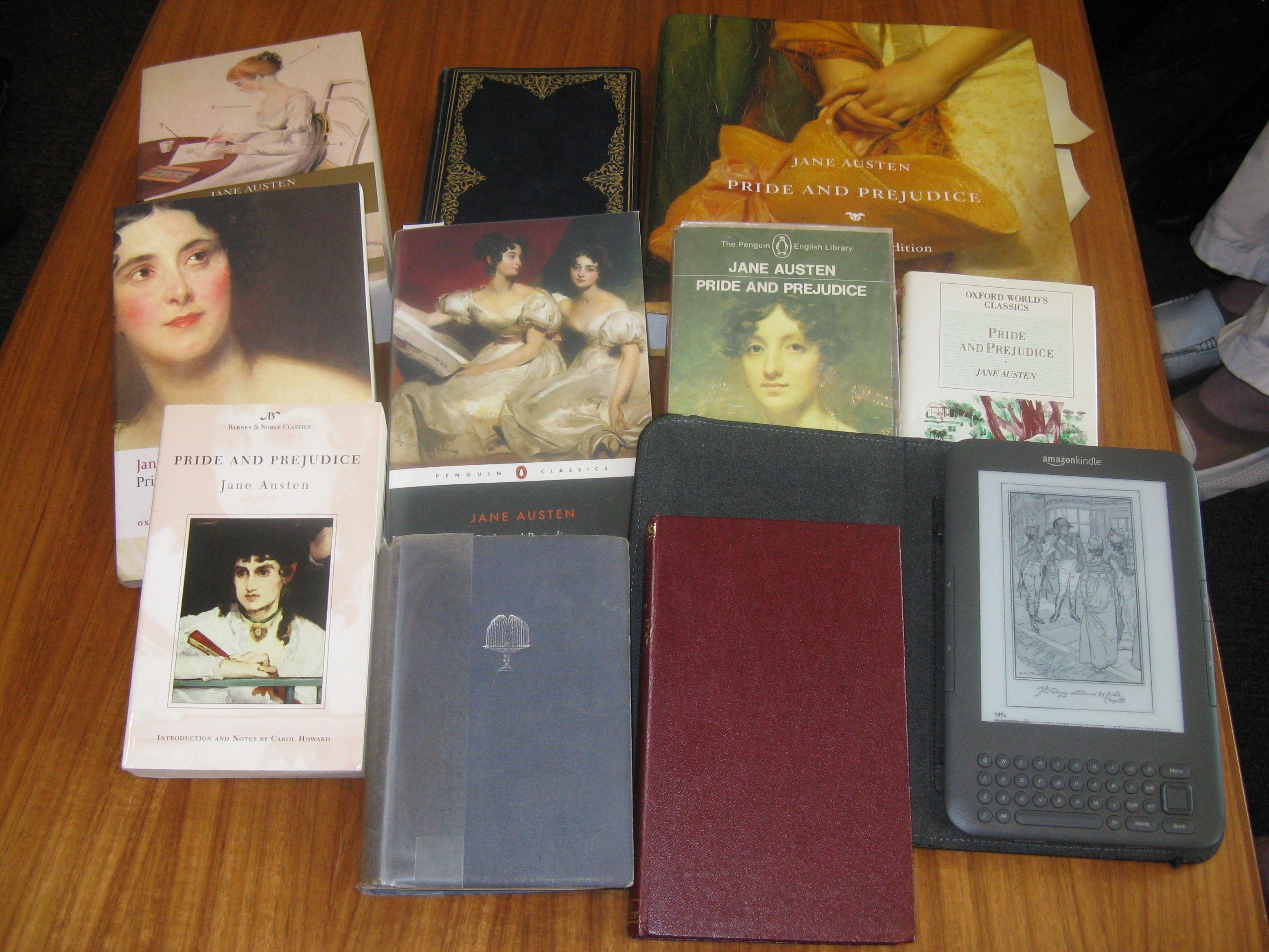
Pride and prejudice book covers

Just a few editions of Pride and Prejudice

It is a truth … no, I can’t go there but, just in case you haven’t caught up with the news, I’m here to tell you that today, January 28, is the 200th anniversary of Jane Austen’s most popular novel, Pride and prejudice.  And so I’ve decided to give Monday Musings a break this week and talk a little about this book. But where to start? What can I say that hasn’t already been said?

How about what the book means to me. It is the book that turned me from being a book reader to a literature lover. I hope that doesn’t sound snooty but what I mean is that Pride and prejudice is the first book to teach me that there can be more to reading books than quick page-turning to find out what happens in the story. There’s nothing wrong with page-turners – they serve a very important purpose in helping us to escape the daily grind – but books can offer a lot more if we want something else from the time we spend reading. They help us better understand the human condition, they can challenge our intellect, and they can appeal aesthetically.

Pride and prejudice, like all of Jane Austen’s novels, satisfies the first of these in spades. Through her characters, Austen demonstrates an in-depth knowledge of human nature. She shows us kindness, compassion, envy, selfishness, stupidity, thoughtlessness, integrity, anger, pride, prejudice and more, including, though Charlotte Bronte (who once wrote that “she ruffles her reader by nothing vehement”) would not agree, passion. Mr Darcy’s ghastly “in vain have I struggled” proposal is nothing if not passionate. I for one don’t need ripped bodices to feel the passion!

Regarding challenging our intellect, one of the delights of reading Austen is the mind games she plays with us – the irony, the wit, keep us on our toes, encouraging us to see the meanings beneath the surface. And, if you read for plot, try reading an Austen novel a second time and you will see how perfectly she plots. Rereading books like Pride and prejudice brings so many pleasures. It’s like meeting an old friend and learning new things about her that enrich your relationship and remind you why she became your friend in the first place.

The aesthetic pleasures are something else – and I fear I’m on thin ground here because I’m probably using the term quite differently to the way philosophers and literary theorists might use it, but it’s the best I can come up with. What I mean is appreciating the novel as a work of art, regardless of its content. Readers from the 20th and 21st centuries can, I think, find Austen’s “art” a little quaint, if not downright dated, but in fact she was innovative. Susannah Fullerton in her latest book, Happily ever after: Celebrating Jane Austen’s ‘Pride and prejudice’, spends a few pages on this. Austen’s main innovation lies in her use of “free indirect discourse” (FID) or “free indirect speech”. She was not the first writer to use it, but was, says Fullerton, “the first English novelist to use FID consistently and extensively”. It is used in third person narratives and involves “hearing” what a character feels or thinks without the use of dialog and not via authorial interaction or the omnipotent narrator. We feel, in other words, that we are in the character’s head rather than being “told” what s/he feels. Austen slips between third-person and this interior mode regularly in her novels. It allows us, in Pride and prejudice, for example, to feel right along with Elizabeth – but the advantage of this technique is that it can shift from character to character in between omnipotent third-person narration. These and the rest of Jane Austen’s grab bag of literary techniques are another reason why she’s such a pleasure to read – and why her books are just plain beautiful.

In other words, Pride and prejudice is the real deal – great story and characters, along with food for the mind, the intellect and the heart. No wonder it has never been out of print.

Suzanne Edgar, The love procession (Review)

Amongst the madness of last year’s silly season was a little oasis, namely the launch of local poet Suzanne Edgar‘s latest collection, The love procession. It was an oasis not only because the launch was for a book of poetry, but also because it took place in the peace of a garden. Poetry and gardens – a match made in heaven don’t you think?

And in fact, there are gardens in this collection of poems, but before I write about the poems, I’d like to mention the title and cover. As Edgar explained at the launch, the title comes from a painting she loved in the Renaissance Exhibition held at the National Gallery of Australia a year ago. The painting, “Love procession”, is attributed to Marco del Buono and Giovanni di Apollonio, from the 1440s. Apparently it took many months for Edgar and the publishers to negotiate the rights to use the painting, but it was worth it because the end result is a simple, yet rich and stylish cover.

It’s a good title because the collection is about love – romantic and other – and about procession. About the procession of our lives – about love, life and death, about work and the things that keep us going, about friends and family, about nature that travels with us. The subject matter reflects the poet’s stage of life, someone who’s lived more than a few decades, who’s travelled, worked, lost friends and family, managed homes, experienced passion and peace. Well, you know what I mean. I could mention for example a poem about clutter, which conveys the melancholy of time passing:

Wilting hats from our salad days
match skirts too small at the waist.
(from “Silt”)

Or one about the real ravages of age:

A patch of muddy clay could well betray
unwary folk who have a metal hip
and hope to play again another day.
(from “Winter Sports”)

The collection’s first poem is – as you might expect – titled “‘Corteo d’amore’ (Love procession)” and is Edgar’s response to the painting. She imagines the groom waiting at the other end of the procession, reflecting. It’s a cheeky poem that contains both a sense of excitement and uncertainty, setting just the right tone for the rest of the collection:

To bed the girl had always been his goal
but laughing in the square, she’d seemed less grand.

I particularly like the way Edgar varies her tone throughout the collection. There are wry poems, and downright funny ones, and there are the passionate, the sorrowing, and the resigned ones. The style varies too. There are poems that rhyme and poems that don’t. There are three-line poems, a four-page poem, and even a bunch of sonnets. There are story poems and there are ones I’d describe as reflections. The imagery is generally accessible – at least it is to those of us who have lived (are living) similar lives in similar places. She invests the places and objects of our lives with meaning. There’s the woman, for example, who upsizes –

She tries a sea change, a tree change,
an elevated view change
(from “The Leavings”)

– losing, in the process, “her ghosts/ghosts of her children’s cries”. The doggerel-like rhyme and rhythm here are perfect for what Edgar clearly sees as the woman’s silly decision. Other poems speak of chairs that know our lives (“The Life of Chairs”), roll-top desks that trace a family’s history (“A Family Servant”), and of course the gardens that provide “refuge from summer’s sultry hours” (“Two Gardens”).

The poems are unmistakeably Australian with their references to the bush and of course gums, to wattlebirds and magpies, to drought and the pleasures of rain that only dry places know.

My favourite poems, though, are those scattered throughout that chronicle her relationship, at least they feel autobiographical, with her husband/lover/partner/significant other. They are often addressed to “you”. These poems speak of a long and deep love, but one also peppered, as real love is, with differences and squabbles. These poems made me smile, even where they spoke of loss, because they are honest.

Nearly halfway through the collection is a poem that starts:

I wonder where the poems went,
I used to think them heaven-sent.
Life is cluttered with noise and news
(from “Turn Off the Noise”)

Well, the poems are still here and I’d happily recommend Edgar’s collection as the perfect one to dip into whenever you want a respite from “noise and news”. These aren’t difficult poems, but that doesn’t mean they are trivial. Try them, if you can, and you’ll see what I mean.

Suzanne Edgar
The love procession
Port Adelaide: Ginninderra Press, 2012
107pp.
ISBN: 9781740277754

Barbara Baynton, A dreamer (Review)

Finally, having reviewed three stories in Barbara Baynton’s collection Bush studies, I start at the beginning with the story “A dreamer”.

This story is a little different to the three* I’ve reviewed to date, primarily because men do not play a significant role in the action or denouement of the plot. The plot is a simple one: a young pregnant woman arrives at a remote railway station, at night, expecting to be met by someone with a buggy. When that proves not to be the case, she decides to walk “the three bush miles” despite the windy, rainy night because it was “the home of her girlhood, and she knew every inch of the way”. Except …

… as it turns out, on a dark rainy night, she doesn’t. Baynton recounts the drama of the young woman’s walk – a wrong choice at a fork, near drowning on a creek crossing – and in the process idealises the mother-child relationship against hostile nature:

Her mother had planted these willows, and she herself had watched them grow. How could they be so hostile to her?

How indeed? This story is another example of Baynton’s gothic, of her non-romantic view of the Australian bush which is, for her, alienating and forbidding, particularly for women. If the language of the opening paragraph is unsettling – “night-hidden trees”, “closed doors”, “blear-eyed lantern” – it only gets worse as nature seems to conspire against the woman. The wind fights her “malignantly” and the water is “athletic furious”, but the woman sees “atonement in these difficulties and dangers”. Atonement for what is not made quite clear but it might simply be that the young woman has been away for some time: “Long ago she should have come to her old mother”. Visions of her mother and memories of her childhood keep her going: “soft, strong arms carried her on”. To avoid spoilers, I’ll leave the plot here. You can read the story at the link below.

In my last post on Baynton, I wrote briefly on reading short story collections in the order they are presented, rather than in the ad hoc way I’ve done with this collection. Mostly, I do read collections from beginning to end. Had I done so with this collection, I would have had, with this story, an effective introduction to Baynton’s style and themes without being confronted with her full fury. In other words, “A dreamer” is the perfect first story in a collection which ends with “The chosen vessel”*.

Barbara Baynton
“A dreamer”
in Bush studies
Sydney University Press, 2009
ISBN: 9781820898953

Available online: in Bush studies at Project Gutenberg.

This review will count towards my Australian Women Writers Challenge 2013.

*For my first three reviews of stories in this book, click the appropriate title: Scrammy ‘and, Squeaker’s mate, The chosen vessel.

Monday musings on Australian literature: Patrick White and those Blue Poles by Jackson Pollock

A change of pace for this week’s Monday Musings to give you a bit of a rest after my few rather lengthy posts of late. Enjoy!

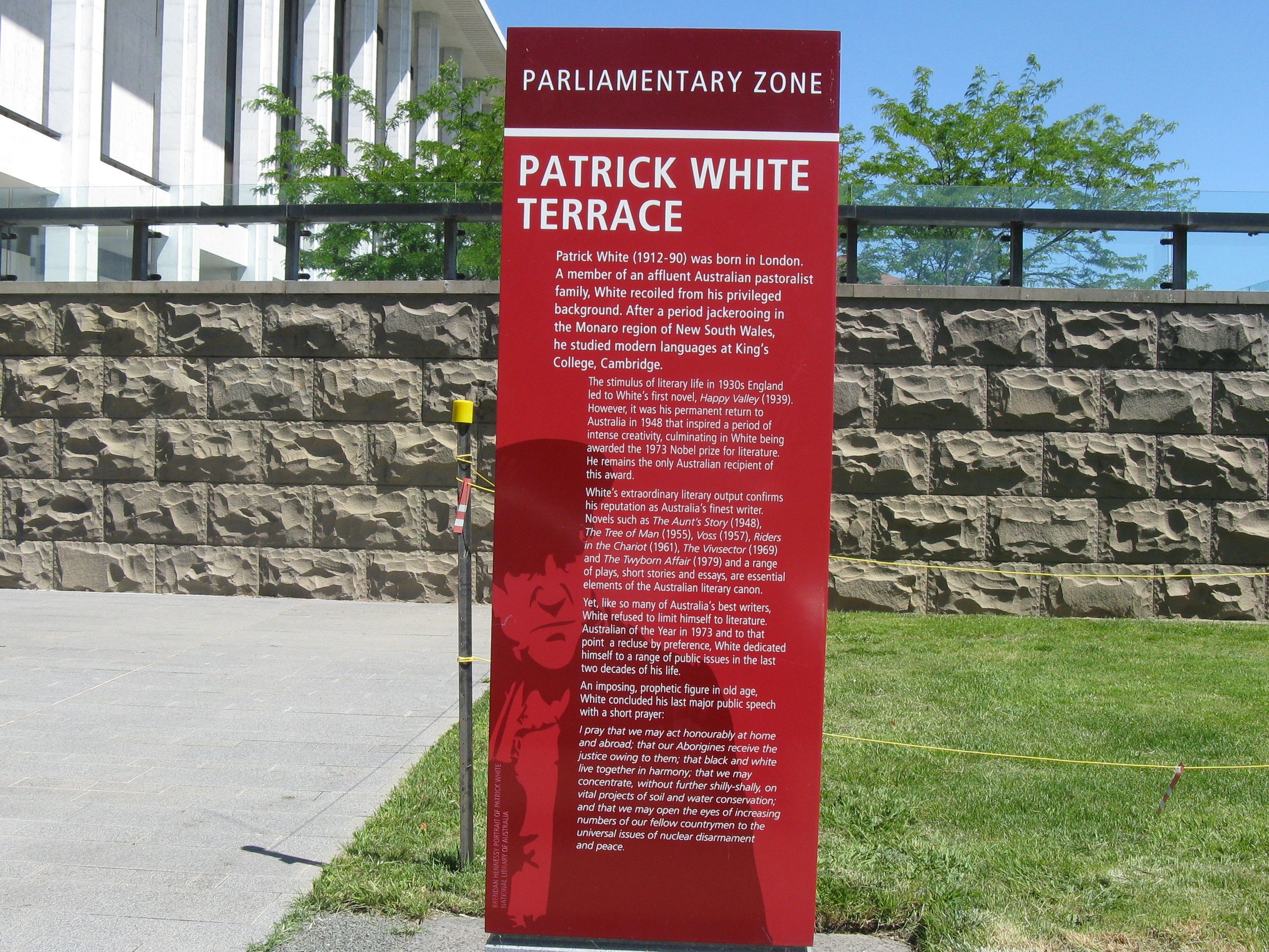
I have already mentioned Patrick White a few times this month. One was my reference to his calling himself a “painter manque” in my review of his debut novel, Happy Valley. Another was mentioning his willingness to stand up for issues important to him, in last week’s Monday Musings on Australian women poets. Today’s post takes up both these points … You see …

In 1973 the Australian Government bought Jackson Pollock‘s painting Blue Poles. With a price exceeding $1 million, the painting’s purchase could not be approved by the then director of National Gallery of Australia, James Mollison, but had to be signed off by the Government. It just so happened that this Government was the new Labor Government which had won power the previous December after 23 years of conservative rule. Australia was ripe for change – and for philosophical and intellectual debate if not downright conflict between the conservatives and the progressives. And so, with announcement of the purchase, all hell broke loose, so to speak. Here is where our “painter manque”, Patrick White, enters the picture.

Campaigns were mounted to prevent the acquisition. One of these was a petition which Patrick White was invited to sign by a Canberra resident. Now Patrick White, as those who know him would expect, wasn’t having any of it. Here are some words from his letter, which you can view in full on the Leski Auction Site (where it was advertised for auction in 2012):

I am not signing the petition because I think you are wrong. You are the kind of person any creative Australian has been fighting against as long as I can remember, the aggressive philistine, often in disguise, who has held us back.

After a couple more paragraphs, he concludes

I regret to say, Mrs English, you are the (perhaps) well-meaning, but destructive, Australian busy-body, we must continue fighting against in the arts.

Don’t you love those parentheses around “perhaps”? How very White!

Patrick White Terrace

Patrick White Terrace, National Library of Australia

Rod Howard, A forger’s tale: The extraordinary story of Henry Savery, Australia’s first novelist (Review)

Rod Howard, A forger's tale

Cover: courtesy Arcade Publications

“Name Australia’s first published novelist” is, I think, a question that would trick most Australians at a trivia night. Rod Howard, who wrote the biography, A forger’s tale, about this writer would agree, as would the writer in the West Australian in 1950 to whom I referred a couple of months ago. Henry Savery, in other words, is not a household name in Australia though, as Howard says in his Author’s Note, there are a couple of minor streets and a biennial short story competition named for him which prevent his complete slide into obscurity.

Why is this? Besides describing Savery as “a son of fortune undone by folly and fate”, Howard argues that the book, Quintus Servinton, received little attention during or in the years after his lifetime, partly because “it had neither the ghoulish titillation of a Newgate novel nor the fashionable allure of a society saga”. Moreover, its publication year, 1830, was a time he says “when public debate was dominated by Arthur’s Black Line* – a brutal but farcical attempt to corral the island’s remaining native inhabitants into the island’s southwestern corner”. Howard concludes, in the Author’s Note, that  “once you have become obscure it can be terribly difficult to enter the limelight”.

And so, as was also characteristic of the author’s life, the book’s poor “fate” was the result of a combination of factors – Henry’s own history (about which I’ll talk more next), the work itself, and external issues like the political and social situation of the day.

Who, then, was Henry Savery and how did he come to write the first “Australian-made novel”? He was born in England in 1791, the son of a generally respected country squire and magistrate. His father, Henry claimed, believed his son’s future had been foretold by a gypsy. Unfortunately, much of what the gypsy foretold did eventuate. Henry was three times “in danger of sudden or violent death”, by his own hand it must be said, and he did, at least three times, “undergo great reverses of fortune”, as much by his own poor decisionmaking, particularly regarding money, as by bad luck or the actions of others.

It’s a rather tortuous story characterised by politics, naiveté, poor decisionmaking, loyalty and betrayal. Howard manages to keep the narrative clear, though you do have to concentrate to keep all the characters straight. The Savery Howard presents is intelligent, hardworking, often foolish or imprudent rather than dishonest (though dishonest he was), and sometimes just plain unlucky. Right until near the end, he had influential friends who somehow managed to soften the legal impact again and again of his failures and misdemeanours. Howard’s book, in fact, provides an interesting and useful insight into the often grubby workings of 1820s-1840s colonial Tasmania, albeit through the specific lens of Henry’s life.

Fortunately (for us anyhow), Henry’s life was a colourful one. When young, he apprenticed himself as a gardener, but he was also interested in literature and demonstrated a capacity for business. However, it was the failure of an early business venture and a conviction for forgery that resulted in his being transported to Van Dieman’s Land in 1825 where his career, as it had been in England, continued its eclectic path and encompassed, among other things, various business enterprises alongside newspaper writing and editing.

Henry was, apparently, a good satirist. The columns he wrote anonymously for The Colonial Times while he was in prison in the late 1820s, and which were later published as The Hermit in Van Dieman’s Land, resulted in his employer being tried and imprisoned for libel. Although protected to the end by his employer, Henry of course lost the job. He couldn’t, it seems, take a trick. As soon as he got himself up, something would bring him down. Nonetheless, there were successes, one being that he established the colony’s first vegetable market. That gardening apprenticeship clearly came in handy. Howard writes at one point that “more lyrebird than magpie his situation provided ample scope for reinvention”. How, one wonders, could such a creative, hard-working man come to the ignominious end that he did? I suggest you read the book to find out more!

But now, the novel, Quintus Servinton (available at Project Gutenberg Australia) which was written in 1830 after a stint in gaol for debt. It is an autobiographical novel in which, Howard writes,

Henry had taken the Hermit’s merciless gun, and turned it, with deadeye aim, upon himself.

Henry, himself, writes in his Preface:

Although it appears under this shape,—or, as some may perhaps call it, novel,—it is no fiction, or the work of imagination, either in its characters or incidents. Not by this, however, is it pretended to be said that all the occurrences it details, happened precisely in their order of narration, nor that it is the mere recital of the events of a man’s life—but it is a biography, true in its general features, and in its portraiture of individuals; and all the documents, letters and other papers contained in its pages are transcripts, or nearly so, of originals, copied from the manuscript, which came into the author’s hands ….

In his Author’s Note, Howard writes of the challenges he faced in researching the book due to the paucity of primary source material. He recognises the dangers in mining fiction for fact but he discovered that “many important aspects of Quintus Servinton (subtitled A tale founded upon incidents of real occurrence) could actually be verified as fact”. Fact in fiction, fiction in fact. It was ever thus, eh?

I would love to report that after writing this – our first – novel, Henry went on to have the happy, successful life that he envisaged for himself in his book and as had in fact been foretold by the gypsy, but that’s not quite how it turned out. Henry, described as “a man of talent” by the last judge to try him, ended his days in the notorious Port Arthur gaol.

Despite being published in an unusual, diminutive format, A forger’s tale is a traditional biography. I appreciated the Author’s Note and list of sources at the end, but would have liked an index. This though is a minor quibble. Howard has an engaging style making the book an enjoyable read for anyone interested in Australian literature, colonial Australia, convict stories or Tasmanian history. Thanks Brother Gums for a great Christmas gift!

Rod Howard
A forger’s tale: The extraordinary story of Henry Savery, Australia’s first novelist
Melbourne: Arcade Publications, 2011
197pp.
ISBN: 9780987171481

* The Black Line has been the subject of some recent Tasmanian fiction, including Richard Flanagan’s Wanting and Rohan Wilson’s The roving party.

Meanjin’s Tournament of Books 2012 (2013), Round 2

Methinks our Meanjin Tournament of Books judges partied a little too much over the silly season because it has taken a few weeks for the second round to be judged. However, the judging has now concluded and the eight stories have been reduced to four, as follows:

Round 2 Match 1: Thea Astley’s ‘Hunting the wild pineapple’ defeated Barbara Baynton’s ‘Squeaker’s mate’

From my point of view this was a hard one because I admire both these stories (which I have reviewed here and here). I would like to have seen them both go through to the next round. The good thing however is that I was not going to be disappointed with the winner. Judge, Australian crime writer Jennifer Rowe, starts her judgement by commenting that both stories “harbour a certain grotesqueness” and she’s right, what with Astley’s stabbing pineapples and Baynton’s oppressive poverty. She said she started by thinking ‘Squeaker’s mate’ would have an “easy victory” because it is “an impressive, unflinching work of Australian gothic” but, despite admitting getting lost at times in Astley (as I also admitted in my review), writes that “Astley’s verve for language is ultimately endearing (and possibly contagious) and despite the initial frustration I was won over …”. As I keep saying, there’s something about Astley.

Round 2 Match 2: Nam Le’s ‘Love and honour and pity and pride and compassion and sacrifice’ defeated Henry Lawson’s ‘The drover’s wife’

Another match-up of two stories I’ve read, and an interesting one that pits a much-anthologised Australian classic against a new kid on the block. The judge, Andre Dao, writes that “if Lawson is iconic of a certain type of Australian literature, then Nam Le’s ‘Love and honour and pity and pride and compassion and sacrifice’ is emblematic of something at the very other end of Aussie lit’. Le grapples he says with ‘intergenerational trauma, ethnic literature and appalling crimes against humanity’. Dao appreciates the complexity, as do I, of the story commenting on “the layers of metafictionality and murky autobiography” in it. In the end he gives it to Le because Lawson “represents our literary past” while Le’s “writing augurs well for our literary future”. I think that’s a good enough reason as any, though I do wish that Le had given some thought to we poor reviewers and given his story a shorter, easier to remember title! Oh, and, it would be good to see something new from Le …

Round 2 Match 3: Jennifer Rowe’s ‘In the mornings we would sometimes hear him singing’ defeated Peter Carey’s ‘American dreams’

Oh no, another long short story title! This match is harder for me to comment on as I have only read the Carey. Looks like I’ll have to seek Rowe’s story out now that it’s won through to the next round. Judge, editor Melissa Cranenburgh, says that she’s always rather liked Carey’s story “for its classic fairytale structure” and says that it is “deceptively simple – both charming and barbed”. She writes that Rowe’s story also has “a fairytale quality, but of a more transportative, mystical kind than Carey’s traditionally told tale.” She gives it to, as she says, “the new kid on the block”. Interesting … because, look what happens in Match 4 …

Round 2 Match 4: Tom Cho’s ‘Today on Dr Phil’ defeated Elizabeth Jolley’s ‘Five acre virgin’

Now this one did make me sad as the Jolley was, as I’ve said in previous post, one of my nominations for the tournament. I love this story, which was one of the first Jolleys I read. Of course, I haven’t read the Cho so I should reserve judgment. Then again, the judge was a dog (aka First Dog on the Moon) so is a bit suss wouldn’t you think! Seriously though … well, can I be serious about a judge who says the winner is Tom Cho’s “because it had the Hulk in it and anyway Elizabeth Jolley is dead so I’m not likely to run into here anywhere am I?” Hmm …

Recap

Now, have you noticed something? In every match it was the newer story of the two that won. A changing of the guard? A bias on the part of judges towards the new? Coincidence or conspiracy? (Just joking). Meanwhile …

… we are left with 4 stories to go into the next round:

  • Thea Astley’s “Hunting the wild pineapple”
  • Tom Cho’s “Today on Dr Phil”
  • Nam Le’s “Love and honour and pity and pride and compassion and sacrifice”
  • Josephine Rowe’s “‘In the mornings we would sometimes hear him singing”

OK, so I’ve read two of these – the Astley and the Le. I will try to track down (the rhyming pair) Cho and Rowe, before the next round. Watch this space, but don’t hold your breath …