Author interview with “word hustler” Catherine McNamara

Catherine McNamara

Catherine McNamara

I haven’t made a practice of doing author interviews on my blog. In fact, the only other interview I’ve presented was one the now defunct magazine Wet Ink did with Nigel Featherstone. However, when Catherine McNamara asked whether I’d be happy to host her as part of her blog tour, I was more than happy to oblige. Authors published by independent publishers work hard to get their name and books out into the public domain – and Catherine is no exception.

As I wrote in my review of her first book of literary fiction, Pelt and other stories, Catherine is an Australian expat currently living in Italy. She’s led a rather peripatetic life since she went to Paris as a student a couple of decades ago, including working in an embassy in Somalia, and co-running a bar and traditional art gallery in Ghana. Clearly she’s seen much and thought a lot about people and how they relate to each other – and loves to hustle* words in the service of her stories. Catherine has been a regular commenter on this blog for a couple of years now. I’m sure that’s partly about getting her name out there, but it’s also obvious that she loves talking about books and reading. I’ve thoroughly enjoyed getting to “know” her. Promotion may be part of her game – and who could blame her – but she comes across as genuine, thoughtful and a lot of fun.

Anyhow, enough from me. You can decide for yourself when you hear what she has to say …

You clearly love writing short stories. What attracted you to this literary form? Can you tell us your favourite short story writers?

I do love writing stories and fortunately they seem to be appreciated a little more these days, with more and more collections receiving positive coverage, lots of competitions and a rise in small publishers less averse to this “risky” form. I think it’s a wonderful moment to be a short story devotee.

When I was young I fell in love with Katherine Mansfield’s stories – as many do. I also loved Joseph Conrad’s long stories set in the south seas. I published quite a few pieces with Australian Short Stories initially, received encouragement, and found it quite easy. My first published piece was called ‘Elton John’s Mother’ and  was about welfare mums living in a caravan park on the Central Coast who gave their kids pop stars’ names and lived rather desperate lives.

My favourite short story writers include Cate Kennedy, Grace Paley, James Salter, Flannery O’Connor, Simon Van Booy, Nam Le, Kevin Barry, Emma Donoghue, Alison MacLeod, Sarah Hall, Junot Diaz, Amy Hempel, Robin Black, T.C. Boyle, Kevin Barry. I even read a wistful D.H. Lawrence short story recently, and O. Henry for the very first time. One can never read enough!

In your collection, Pelt and other stories, you have written in 1st and 3rd person, and in diverse voices including a gay male. How do you choose the voice to use? Are there any stories in which you changed the voice because it wasn’t working?
Catherine McNamara, PeltI think that when a story or a story springboard presents itself you immediately feel whether it is a 1st or 3rd person piece. You already know if you want the incisive and selective view of an onsite narrator, or a little more distance from the story crux through a third person character, where more description is allowed. For me it’s as clear as the very gist/illumination/transformation you’re heading for, or hope you are.

I’m very attached to first lines and for me they set a tone I rarely veer away from. But if the story feels fumbling, or as though it doesn’t really need to be written, I’ll bin it and wait for something else. I don’t think I’ve ever tried shifting voice. I think if my doubts were that substantial then something in the mix of the story wasn’t going to work anyway.  Perhaps if you were working on a novel where there were larger themes and plot devices to move around, changing person might enhance the work.

You’ve clearly thought about the order of the stories in Pelt and other stories. What factors did you consider when ordering the stories?

I did have great difficulty putting the stories in order. Initially I tried to vary first or third person pieces, then I didn’t want too many African stories in a line, and I wanted an even progression between male and female protagonists, and short and longer pieces. Then there was also the chronology or backwards chronology of the some of the interlinked pieces! Eventually, I worked through all of this and focused on beginnings and endings that seemed to match up. I had first and last sentences and a key chart on bits of paper on the floor, and tried to make them move along. The frightening thing is that I might even change the order again if I went back to revisions.

You have spent most of your adult life as an expat, which is reflected in the diverse settings for your stories. How has expat life has affected your writing?

When I was first living in Somalia I wrote several stories with traditional expat characters reckoning with their place in an exotic, exploited world. I think I saw things as any Westerner would – even though I had studied modern African independence movements at university and thought I knew something – I didn’t know a thing. “Expat life”, so removed from thrumming everyday life and, at its base, an us-and-them construction, was quite shocking. It nearly drove me crazy! Somehow I stepped through a barrier and found a way to live a more valid life. As I went deeper into my own experiences in West Africa I was largely living, earning a living, surviving. Not writing much at all. After nine years in Ghana I wasn’t so much an expat as someone who remained visible, but just lived there. That way when I came to write some of these stories I had a great variety of voices inside.

Pelt and other stories is subtitled “tales of lust and dirt” – and many of the stories deal with the darker side of sexuality, such as incest, sexual violence, sexual jealousy and infidelity. Yet humour is also clearly important to you. How do you reconcile the dark and the light in your writing?

I’m trying to think of incidences of humour in the stories! “Pelt”, the first story: I remember thinking it quite humorous and was floored when an early reader called it a complete tragedy. For me the African mistress was powerful and sassy and knew her game; she made the Westerners look as though their agonies were clumsy and inarticulate, whereas she “would have pulled his hair out by now” and ends up in the kitchen with a pan of hot oil. I think she was great. I wanted to show the contrast between African pragmatism and Western dithering and diplomacy, often so spineless like Rolfe, who can’t even bring some photos back to show his bird the snow in Germany. But I don’t think I consciously set out to meld dark and light, that’s just voice.

Photographers appear in several of your stories, often as a secondary or supporting character, such as Reece in “Stromboli” and Seth in “Nathalie”. They tend to be passive or even negative forces. How does this fit into your world view, at least as you present it in your stories?

When I was much younger I was torn between image and word and took a while to favour writing. I began a graphic arts course and loved photography and film-making – in fact in Ghana it cropped up again when I co-ran a graphic design agency and art gallery. One of the factors that probably made me sway towards the written word was that photography seemed so arbitrary, almost accidental, however I do realise it involves skill, vision and patience!

In the African context I saw that image is often manipulated to show what the West wants to see of the continent – power remains with the photographer. This can seem like the colonial process all over again.  In “Gorgeous Eyes” I wanted to express my irritation at the way the contemporary African condition is often trivialised, glamorised or showed partially to suit the Western palate. There are some brilliant African photographers out there whose work is more real.

You maintain two blogs, one for each of your recently published books. How important is it for you to engage in social media activities such as blogging and what do you see as the pros and cons for authors of engaging in social media?

As you know the blogs are hard work and time-consuming, and yet I feel they can be very rewarding. As a writer, a weekly blog post (that’s all I can manage) can keep you on your toes and remind you that apart from your creative task, you have an audience at hand whose interest you must sustain, perhaps with a topic that has a soft connection to your book. The rub is having to voyage the internet to attract possible new followers, while being sincere and perceptive in your blog comments. I like to engage with my blog readers, and have met quite a few over the past few years (anyone for a drink in Venice?). We have exchanged guest posts, interviews and reviews – something that kills the isolation of the job and makes you feel knitted into a community (even if it’s to share the various difficult aspects of the task). That can renew energy and ideas, and provide useful contacts (festival and reading invites) in a much faster way than letter-writing or serendipity!

The pitfalls are becoming hooked on your platform and social presence at the expense of your development as a writer. I think it’s unwise to dilute your creative energies, and essential to remember that social media time must serve a purpose – contacts, exchange or potential sales, or just light relief. As it can become very draining, it’s important to keep it in its box.

I’m finding it challenging to maintain two blogs but at the moment my two books have quite different audiences – although many readers have bought both books. Eventually I guess I’ll have to merge everything together. The DLC blog veers towards life in modern Italy and speaks of my writing pursuits, racism, politics and also handbags. The Pelt blog stays strictly with short story info, interviews, festivals and musing.

Both your books are also available in electronic format. Are your readers embracing e-books? What impact, if any, do you think electronic publishing will have on the nature of fiction writing in the future?

I’m still very old-school and like to stumble upon a physical book – mostly through recommendation or random browsing or reviews. I don’t think I’m putting enough time into pushing e-book sales, though I noticed when my publisher placed the book on sale just before Christmas that quite a few blog readers made immediate purchases. Also my Facebook friends who are nearly all work-related gave great support.

I’ve had quite a few stories on a smartphone application called Ether, which is at the forefront of the short story download movement in the UK – they have done a lot of groundwork to stir interest in the short story. E-readers have also opened doors for flash fiction writers over the past few years and there has been a surge of competitions. Trends like these do change what is being written – flash fiction seems to make more noise than poetry currently. Also, with many literary magazines failing to survive I think greater respectability has been given to e-zines, some of which are dynamic hives of writing activity and sharing – interesting both for the reader and writer. And downloads mean that the often-neglected novella form has received fresh attention.

Self-published e-books have of course changed the shape of publishing and I worry that this is a sales-driven sphere – there are endless websites devoted to how to improve your Amazon rankings and broaden your fan base. I imagine this is less applicable to literary fiction which has a smaller readership anyway. What seems positive is that there are more books of every type out there, and it seems as though more people are reading – I don’t know if this is true. I’m just glad that short stories are mentioned more often, and with passion.

As this is a blog written primarily for readers, would you tell us some of your top reads over the last year?

Though I love to write I am very much a reader. However I do have to be careful when reading while I am working on a story or novel – I think that subconsciously the tone or cadences of another writer’s language can easily seep in. This year I read several books I’d read about on this blog – Gilgamesh, Everyman’s Rules for Scientific Living, Five Bells and Tall Man, also Tête à Tête – all books I savoured. I am particularly pleased that I picked up an early novel This Side Jordan by Canadian Margaret Laurence set in pre-Independence Ghana, a favourite era of mine. I also discovered Simon Van Booy’s short stories and philosophy books, and even met Simon by chance at my reading in December. (This was one of the most thrilling moments of my year.) I read Iris Murdoch for the first time – The Sea, The Sea – which as soon as I finished I wanted to begin again. I also read James Salter’s Dusk and Other Stories for the first time – I read each story three times over and wished they would not end. I read some contemporary short story writers – Tom Vowler and Alison Lock – and I’m now reading The Devil that Dances on the Water by Aminatta Forna. That’s all I can see on my book shelf from here!

Thanks very much for having me WG!

… and thank you, Catherine, for sharing your thoughts with us. I, and I’m sure Catherine, would love to hear any comments you have on what she has shared with us.

If you would like to read Pelt and other stories, you can order it from the publisher, Indigo Dreams Bookshop or The Book Depository. It is available in e-version from Amazon (Australia, UK or USA). You might also like to chase up her first novel, The divorced lady’s companion to living in Italy, which I reviewed back in 2012.

* Catherine called herself a “word hustler” in a comment on this blog some months ago. A wonderful description, I thought, of someone who is passionate about words and writing.

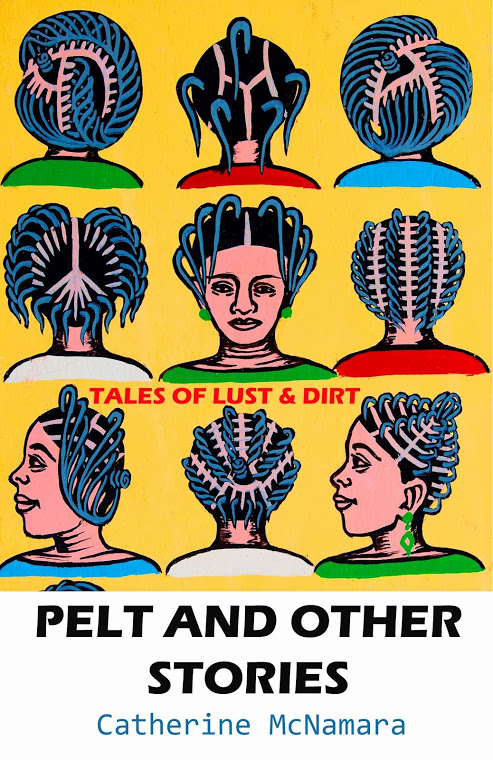
Catherine McNamara, Pelt and other stories (Review)

Catherine McNamara, PeltIt seems fitting that my first review of the year be for a book of short stories by one of this blog’s regular commenters, Catherine McNamara. I have reviewed McNamara before, her first published novel, The divorced lady’s companion to living in Italy. McNamara  describes that book as commercial fiction. It is, to describe it differently, chicklit for the mature woman – and is a fun read. However, Pelt and other stories is a different thing altogether. It represents, McNamara has said, where her real writing love is – literary short stories.

You will hear from Catherine herself soon in the form of an author interview on the blog, but by way of introduction now, she is an Aussie expat who left Australia as a student a couple of decades ago. She now lives in Italy but has lived in other parts of Europe and for several years Africa. All this is reflected in her stories which have Australian, European and African settings. As with many short story collections, several of the stories have been published elsewhere, on-line and in print. Her story “Coptic Bride” was published in Giramondo‘s now-defunct, but admired, literary magazine Heat.

The first thing to say about McNamara’s writing is that it is not spare. Her exuberant use of imagery reminds me at times of  the early writings of Thea Astley and another expat, Janette Turner Hospital, both writers who have reveled in colourful, figurative language, albeit to different purposes. Occasionally the imagery can feel a little overdone, but I love their freshness, love the risks McNamara takes. The next thing to say is that her subject matter tends to revolve around sex. The book is, after all, subtitled “tales of lust and dirt”. In McNamara’s work, sexual passion represents the best and worst of what life has to offer. And, given that there’s more drama in the worst or the problematic, it is this – in the form of violence, incest, jealousy and infidelity – that we mostly find in Pelt and other stories. Thirdly, McNamara mixes up her narrative voice. She uses first and third person, and she writes in a variety of voices, including, for example, a white gay male and a black female. This keeps you on your toes. You never know who the next characters will be, and where they’ll be from. I like that.

While Pelt and other stories is a collection, several stories are connected, which makes the order of the stories particularly interesting. I suspect ordering stories in a collection, which I discussed briefly in my review of Knitting and other stories, is one of the trials of preparing a short story collection (or anthology). Do you match or contrast tone or themes? Do you put related stories together? The truth is that it probably matters less to the reader than the writer/editor thinks, as readers will often pick and choose. However, with single-author collections, my practice is to read, from the beginning, in the order presented. And this is where the fun started with Pelt and other stories. There are, for example, sly connections in which a character – Nathalie for example – is an important subject in one story (“Nathalie”), but then appears as a passing reference elsewhere. Other stories have stronger connections. I was particularly intrigued by McNamara’s presentation of three of these – “Opaque”, “Where the wounded go” and “Volta”. They don’t appear consecutively, and when they do appear it is not chronological. I’m not sure what McNamara’s intention was in this, but for me it replicates the way we get to know people. We meet them at a point in time, getting to know their current lives, while gradually learning their back story. In a collection that ranges widely in character and location, the connections can be grounding.

What I particularly like about the stories is their honesty. McNamara doesn’t flinch from letting her characters express their (our) meanest, least generous thoughts. Love, McNamara shows, can make us selfish, desperate, and sometimes cruel. In the first story, “Pelt”, the animality of lust is palpable as a pregnant black mistress stands her ground, fighting for her rather weak, German lover against his barren wife. Many of her stories are about compromised relationships and the accommodations made, by one or both parties, to keep them going. “The Coptic Bride” is one of these, as is “Opaque” in which a woman’s love for her man is tested against her sense of morality, of what is right:

But if she called, it would perforate all that she held close to her. It would cost her her life.

Do you think she made that call?

awwchallenge2014These are unsettling stories about characters struggling to survive in a precarious world. Europe’s colonisation of Africa shadows the book. Many of the relationships are mixed, and in most stories there is power imbalance, and hints of exploitation. It’s there in “Pelt”. In “Janet and the Angry Trees” a sex-worker is taken to her Italian lover’s family home to look after his parents, and seems to accept the pittance of attention she gets from her still-married lover. It’s in the little piece “Innocent” about a taxi driver, his white employer and his pregnant teenage girlfriend, and in “Infection” in which a brother receives a western education while his sister “received no education, cursory love, much admonishment”. There’s a suggestion in some stories of stereotyping – you know, the lusty, sensual black woman and the unfaithful white man looking for “a bit” on the side – but the relationships are more complex than that. Overall, I’d say that the stories are more about humanity than about politics, while recognising that politics has contributed to the uncertainty of the world the characters inhabit.

A recurring motif in the book is the photographer. McNamara seems to view photographers with suspicion. At least they tend not to be the most admirable characters in the stories in which they appear. They represent the disconnect between appearance and reality, and perhaps also the idea of exploitation. In “Gorgeous Eyes”, the narrator views photographs by the visiting famous photographer, Nina Cooke, seeing the truth behind the idealised images of “Dinka men – erotic in beaded body corsets”. He reflects that those in the know see something else, “a crucible of sadness”, in these images and concludes:

If Nina Cooke’s gift ever needed an honest name it would be the invasive branding of humble detail. It appears she is at the vanguard of a vulgar world trait.

These stories are not comfortable reading. Some make more sense to me than others. But McNamara’s voice is strong, her writing lively and her characters real. Pelt and other stories will linger with me for some time.

Catherine McNamara
Pelt and other stories: Tales of lust and dirt
Beaworthy: Indigo Dreams Publishing, 2013
204pp.
ISBN: 9781909357099

(Review copy courtesy the author)

Notable reads and highlights from 2013

Last year I wrote two highlights posts – a general one on blogging and reading, and a specific one targeting books. This year, I think I’ll revert to one post and combine the two. (I’ll provide links to my posts where relevant – not to promote myself, but to make it easy for those of you who’d like to check out anything I refer to that you missed first time around).

Literary event highlights

Sara Dowse text

Sara Dowse (Courtesy: NewActon.Com)

I managed to get to a few literary events this year – including some great book launches – but the three that most stood out for me were:

  • Woven Words: an inspired and inspiring night, associated with The invisible thread anthology, that blended words with music chosen by the guest authors.
  • Writing the Australian Landscape Seminar: a wonderful weekend of speakers organised by and held at the National Library of Australia. Not only was it wonderful to hear some favourite writers in person but the content gave me much to think about. Two ideas that have remained with me are Murray Bail’s suggestion that Australians rely too much on the strangeness of our landscape to construct our identity, and the wider issue regarding reconciling settler Australians’ experience of landscape with indigenous Australians’ relationship to country.
  • Childers Group’s forum on The role of the public arts critic. I particularly loved the idea that the critic is “a trader in ideas”, It takes away the notion of assessment and judgement and focuses us on what the arts are really about – which for me is to provide us with an opportunity to reflect on who we are, what we think, where we’ve come from and/or where we are going.

Aussie reading highlights

I don’t like to list my “top [name your number] books of the year” because it is such a subjective and moveable thing. I prefer instead to name some highlights:
  • The classics: I read a few Aussie classics this year and all were well worthwhile reading, but the two highlights were being able to read Patrick White’s first (buried) novel Happy Valley, which was published by Text Australian Classics, and finally reading a Christina Stead, For love alone.
  • A debut: I haven’t yet read this year’s most touted debut, Hannah Kent’s Burial rites. That pleasure, as I’m assured it will be, is coming this year. But I did read a few debut novels. Courtney Collins’ The burial was a standout for me. I loved the unusual and confronting narrative voice, the strong descriptions, and the fact that it was inspired by the story of a little-known Australian woman bushranger.
  • Awards: While I couldn’t tell you who won all the major literary awards in Australia this year – and have been slack about maintaining my sidebar awards list – two winners were standout novels for me this year: Carrie Tiffany’s Mateship with birds which won the inaugural Stella Prize and Michelle de Kretser’s Questions of travel which won the Miles Franklin award (among others).
  • Canberra Centenary anthologies: Canberra’s centenary year has ended but we have two wonderful books – The invisible thread edited by Irma Gold and Meanjin’s The Canberra issue – to dip into again and again when we want to think about what Canberra means to us, its residents, and the wider us, Australians.
  • Small presses: I’ve read so many excellent books from small presses, books that just don’t get the exposure they deserve. Dorothy Johnston’s e-book Eight pieces on prostitution published via the Australian Society of Authors website, Lesley Lebkowicz’s The Petrov poems (Pitt Street Poetry), Rachel Hennessy’s The heaven I swallowed (Wakefield Press), Gabrielle Gouch’s Once, only the swallows were free (Hybrid) and Susan Hawthorne’s Limen (Spinifex Press) are just a few of this year’s small press treasures.
I feel badly about limiting my list to just these few – I read so many good books this year. Just because they are not listed here doesn’t mean I’ve forgotten them!

Other reading highlights

This year really was a year of Australian reading. However, I did read some excellent books from foreign lands. The highlights were – and I swear I didn’t choose them for the initial of the author’s last name:
  • Hilary Mantel’s Bring up the bodies. What can I say? I loved how Mantel continued Cromwell’s story but with a different theme to the first novel in the trilogy. Can’t wait for the third book. What will she explore in it?
  • Diego Marani’s The last of the Vostyachs which was not only a great read but synchronised well with what turned out to be a major theme of my reading this year – the relationship between language and culture.
  • Bill McKibben’s Oil and honey: the education of an unlikely activist. McKibben does a great job of chronicling his transition from writer on activist issues to an activist who also writes, and he beautifully articulates the development of his activist strategies, making this book work both as memoir and how-to.

Blogging highlights

  • Australian Women Writers’ Challenge: this is such a positive project to be part of, and I am proud of what we as a team are achieving in terms of promoting Australian women writers. I’d love to know whether those writers who are living are seeing any increase in sales or, even, wider recognition, since the challenge started in 2011.
  • Commenters: I’d love to name you all because you have made blogging this year such a positive experience for me. I’ve enjoyed all the thoughtful and honest comments you’ve posted – asking questions, posing different ways of looking at issues, adding your experiences to the conversation. Thank you so much.

Short stories rule: Top posts for 2013

WordPress consistently tells me that the most popular topics I write about – according to my tags and categories – are Australian literature, Australian writers, Women writers, 21st century literature and Review-Novels. However, my most “hit” post last year was a short story by an English woman: Virginia Woolf’s “The mark on the wall (reviewed in March 2012). I presume, partly because of the sorts of searches that find it, that this is because it’s a set text for schools/universities, but still, it’s great seeing short stories being read.

Interestingly, my top “hit” Australian post (and third on my Top Posts for 2013) is also for a short story: Barbara Baynton’s The chosen vessel (reviewed in November 2012). This one I find more intriguing. Is this a set text too? If you can throw light on this, I’d love to know.

Searches that reached my blog in 2013

Every now and then I take a look at what people who come to my blog have searched on. As Google is now offering encrypted  searching, less information about search terms can now be captured by WordPress, but some still are. Here are some of my favourites from this year:
  • non living elements that help a echidna (I have no idea what post this one found as I can’t replicate the search to find me)
  • what significance does “whitaker’s table of precedency” have in “the mark on the wall”? (From the very specific wording of this one, I’m guessing this was a test/essay question?)
  • my sporty.com in sex gum girl (I can’t help thinking he/she was disappointed to find me!)
  • what page of midnight empire does drone attacks start (From someone else reviewing Croome’s book?)

And finally …

Thanks to everyone who has read, commented on and/or “liked” my blog over the last year. I may not know you all, in person, but I really do appreciate your visiting me here. I wish you all happy reading in 2014 … and, meanwhile, would love to hear of your blog or literary or reading highlights of the year.

Monday musings on Australian literature: Australian Women Writers’ Challenge 2013


Australian Women Writers Challenge
As last year, I’m devoting my last Monday Musings for 2013 to the Australian Women Writers Challenge. This challenge, instigated by Elizabeth Lhuede in response to growing concern in Australian literary circles about lack of recognition for women writers, was so successful in 2012 that Elizabeth, with the help of a team of volunteers, decided to continue the challenge in 2013. I am one of those volunteers – responsible for the Literary and Classics area – and, of course, am also a challenge participant. It was a quieter year for the challenge as we settled into a routine, but that doesn’t mean nothing memorable happened. So, before I round-up my own challenge I’d like to comment on a few of the highlights for me.

The main excitement was, I think, the announcement of the inaugural Stella Prize. The prize was not created by our Challenge, but it grew out of the same concerns that inspired the Challenge. Marg (Adventures of an Intrepid Reader) attended the award ceremony on behalf of the Challenge and wrote a post on the experience. The winner, Carrie Tiffany (for her novel Mateship with birds), impressed us all by sharing a portion of her prize with the shortlisted authors. A lovely gesture recognising the complex and uncomfortable nature of literary competition.

In October, as a special “event”, the Challenge focused on women writers of diverse heritage, and asked four authors to write guest posts. If you’d like to read these posts, they are:

  • Tseen Khoo: on her frustration about “narrow interpretations of writing by Asian-Australian women writers”
  • Alice Pung: on, interestingly, “Ruth Park, class, and marginalisation”
  • Malla Nunn: on her experience as an African migrant turned Australian writer
  • Merlinda Bobis: on “the necessity of creating and defining ‘home’ both for herself, as a writer, and for her readers”.

Finally, one of the features I particularly enjoy about the challenge is seeing Australian women writers support it (and each other) by reviewing books by other women writers. Annabel Smith, Amanda Curtin and Jessica White are three who have been particularly active this year.

If you are interested in the challenge, you can check it out at the link above, and, if you’d like to join up for 2014, you can fill out the form on this page.  This year, it is possible to join up as a reader or as a reviewer. The challenge can also be found on Facebook, Twitter (@auswomenwriters), GoodReads and Google+.

As I explained in last year’s highlights post, the Australian Women Writers’ Challenge is my only challenge. Once again, I signed up for the Franklin-fantastic Dabbler level, which is that I’d read (and review) at least 10 books by Australian women writers in more than one genre/category. Here is my list (with links to my reviews) for this year.

FICTION

SHORT STORIES

POETRY

NON-FICTION

ESSAYS

ANTHOLOGIES

awwchallenge2014CHILDREN’S LITERATURE

I have enjoyed taking part in the challenge – for being part of a team of committed people keen to spread the word about the breadth of Australian women’s writing, and for being introduced to that breadth. I am learning a lot more about Australian women’s literature than I could possible have learnt by beavering away here on my own. Roll on the 2014 challenge.

Meanjin’s Tournament of Books 2013, Final, or the Winner is announced

One of the best things about blogging is the conversation it can engender. I was consequently pleased then when my last post on the Meanjin Tournament got some conversation going about the tournament itself – some thoughtful, respectful conversation. So, before I report on the final round, I thought I’d discuss this a little …

This year is the third time Meanjin has run the Tournament of Books. The first, in 2011, focussed on books by women writers, while last year’s focused on short stories. This year, they chose a, I guess you could call it, topic, the sea. The tournament was inspired by the American Morning News Tournament of Books, which is now 9 years old. Blogger Kerry of Hungry Like the Wolf has, for a few years, shadowed the tournament. That was my first introduction to the concept, so when Meanjin decided to emulate the idea – including the comic commentary – I decided to report on it.

However, some commenters – commenters I respect like blogger Lisa (ANZLItLovers) and novelist/artist Sara Dowse – are uncomfortable about the tournament. Similar concerns were expressed during my reporting on the first round. I wrote a post then on my understanding of the tournament, which is that I:

  • don’t take literary competition seriously. (Australian writer Christos Tsiolkas has said that “he envied the surety of the outcome in most sport – unlike with books, when prize judging is largely subjective”. Winning an award, or having great sales, does not necessarily reassure you as a definition of success, he has said. This, I think, says it all.)
  • think that literary competitions can promote literature, can get a conversation going.

The thing about the Tournament of Books is that it has a tongue-in-cheek aspect. It recognises, I believe, that literary competitions are fundamentally questionable as identifiers of “best”. But, humour is difficult to get right, and we don’t all see humour as appropriate in all situations. I’d be very sorry, as I responded to Sara on my last post, if this competition caused distress to the writers involved or worked in any way to undermine their achievements or sense of self.

In response to these concerns, I posted a question on one of the judge’s blogs – Belinda Rule’s barking dogmouth – regarding her understanding of the tournament. Here is part of her response:

it’s an organised series of comparative book reviews, with the intention of being light-hearted and entertaining (or so the judging brief tells us!), and starting a conversation about the books involved. I guess the high-level objective is to promote Australian fiction in an entertaining way.

I’d be interested to know what you think. I’d also love to know what Meanjin thinks it is doing and what if any evaluation it is doing of the “event”.

But now, the last round between Tim Winton’s Breath and Margo Lanagan’s Sea hearts. As for last year, the final adjudications involved three judges:

Judge 1: David Mence, a Melbourne based writer and playwright, saw it as a battle between David (Margo Lanagan) and Goliath (Tim Winton). He opted for Margo Lanagan’s Sea hearts because: Winton

is without a doubt the jaeger (or MechWarrior) of Australian literature, the champion defender of all that we stand for. But then again, I have always loved monsters from the deep—I would not want to live in a world without monsters—and it seems to me that Lanagan’s book is, among other things, a homage to that which is strange, difficult and monstrous in our world.

Judge 2: Bethanie Blanchard, a Melbourne based freelance writer and literary critic, who decided on the basis of which book was most about the sea. She gave it to Winton:

In Lanagan’s work the sea is an abiding presence in the background, but the tale is less about the ocean than the inhabitants who spring from and long to return to it. It is Breaththat is more truly steeped in the ocean, in its changeable hardness and lure. Winton writes powerfully of the beauty of the water when riding high upon it, ‘for a moment—just a brief second of enchantment—I felt weightless, a moth riding light,’ as well as the danger and impossibility of its conflict between the fear of not breathing and the desire to stay immersed.

And so it came down to the deciding vote of:

Judge 3: Belinda Rule, who describes herself on her blog as “a Melbourne writer of fiction and poetry”, says she loves and defends Tim Winton. However, like Sara Dowse who commented on my previous Meanjin post, she’s bothered by the “mean sexy lady” in Winton’s fiction. She gives her vote to Lanagan:

It’s Lanagan for me! I love Winton’s miscellany of things to do with breath, but I don’t want it nearly as badly as I want Lanagan to get me on the ground and kick me in the heart again.

There is, as yet, no commentary from Melbourne comedians Ben and Jess on this final round, but I believe it is coming …

However, just to confirm, the winner of the 2013 sea-themed Meanjin Tournament of Books is Margo Lanagan’s Sea hearts. I wasn’t expecting that at the beginning, but there you go. Serious or not, this tournament can raise readers’ awareness of works they may or may not have heard of, or may have heard of but decided wasn’t for them.

You can read the full judgements for 2013 here.

Meanjin’s Tournament of Books 2013, Round 2

Round two of this year’s Meanjin Tournament of Books has now been played – as of a couple of days before Christmas. Here are the winners

Round 2 Match 1: Tim Winton’s Breath defeated Kim Scott’s That deadman dance

Well, I must say I’m surprised. Much as I love both these books – both of which won the Miles Franklin Award in their year – I thought That deadman dance would be the eventual winner. But, as in all exciting competitions, it was not to be – and who am I to argue with the judge Maxine Benebe Clarke. I don’t know her but she’s apparently “a widely published Australian writer and slam poetry champion”. Interestingly, she, a poet, found Winton’s Breath easy to read but “early on in the reading of this book [That deadman dance], I confessed to a fellow poet and voracious reader that I’d re-read the first sixty or so pages three times, because I felt them so inaccessible”. I understand how that might happen, though I didn’t find it so myself. She did come to enjoy Scott’s novel, once she let go of her expectations of historical fiction which are that it should give her knowledge of the era or event without her being aware it’s happening. Hmm … sounds to me like her definition of historical fiction is a little narrow. She said she enjoyed the novel when she “stopped aching for this to happen”. However, as she chose another book that I love and that has stuck with me since I read it, I won’t complain. She chose Winton because:

I found myself, despite my lack of knowledge of surfing culture, fighting for air, caught in a crazed obsession, the book which almost suffocated me under the deep blue, before landing me back on shore, face-grazed, foamy and gasping for Breath.

I know exactly what she means. It’s a breath-taking (sorry!) book.

Round 2 Match 2: Margo Lanagan’s Sea hearts defeated Jaya Savidge’s Surface to air

This match was also judged by someone I don’t know. Clearly I’m not up on the Melbourne scene. Adolfo Aranjuez edited Award Winning Australian Writing, and is editor of Metro magazine, sub-editor of Screen Education, and deputy editor of Voiceworks. He found judging hard, particularly because he really was judging apples and oranges, that is, a collection of poems versus a novel. Moreover, he says that:

Thematically, Savige’s poems aren’t all about the ocean, either, handicapping it slightly. And then there was the pre-existing problem of bias: I’ve adored Lanagan for years, though I tried to summon as much impartiality as my Lanagan-fan heart could muster.

I haven’t read either of these books so can’t comment. Our judge discovered why Savidge is recognised as a great poet, but for him the selkie myth won out. His reasoning makes sense:

Lanagan’s nods to miscegenation and multiculturalism highlight the issues that I and those like me face as ‘mongrels’, unable to explain to largely-monocultural Australians where we ‘come from’. These intercultural themes raise questions that are increasingly relevant in our society, where arranged marriages aren’t uncommon, some are forced by circumstance to leave their homes, and the rhetoric of ‘assimilation’ continues to have currency.

I have been thinking for some time that I should read this book. Aranjuez’s adjudication has strengthened my resolve.

And so … we are left with a Final that will be between

  • Tim Winton‘s Breath; and
  • Margo Lanagan’s Sea hearts

I’ll be very surprised if Tim Winton doesn’t win at this point, but I’ve been known to be wrong before. As they say, it isn’t over until … as usual, watch this space, soon!

Monday musings on Australian literature: Translated fiction, Australian-style

Having just read and reviewed Linda Jaivin’s Quarterly essay, Lost in translation: In praise of a plural world, I thought I’d research the state of translated fiction in Australia. Jaivin doesn’t spend a lot of time of this particular issue, but in her concluding plea she says:

Publishers need to consider how to prise open their lists in order to let more translation in.

In other words, while she argues that students should learn foreign language/s, she also recognises that we can’t be across all languages. We should therefore have easy access to translated literature. However, in my experience and I’m sure that of Australian blogger Tony, who specialises in translated fiction, it is not easy to find material here and so, all too often, we turn to overseas publishers and distributors.

That said, there are some local sources of translated fiction. And there are – and have been – Australian translators of foreign fiction (besides, of course, Linda Jaivin). I have written before on this blog about poets Rosemary Dobson and David Campbell who translated Russian poetry into English.

The easiest type of translated fiction to find in Australia is of course the classics. It is not hard to find Russian, French and other classics in English in most decent bookshops. It is also relatively easy to find translated works by the better-known contemporary writers from non-English cultures. Random House Australia, for example, has published Japanese writers like Haruki Murakami and Yoko Ogawa. But they do not make it easy to find their translated books. They categorise fiction by genre/form, so if you search under crime, say, you will find translated works by, for instance, the Norwegian crime writer Jo Nesbø. It should be easy enough for them to add a category for translated works to help those of us who’d like to seek out non-English-centric works.

Many of Australia’s smaller independent publishers also publish translated fiction. For example, Text Publishing, probably the largest of the small presses, is currently publishing Diego Marani (whose The last of the Vostyachs I reviewed recently). On Text’s Fiction page is the category Translated, which takes readers to a list of around 60 titles.

Other small presses publishing translated works include:

  • Brandl + Schlesinger lists translated works as one of its focuses. Its list includes Russian author Igor Gelbach, and Hungarians István Örkény and György Dalos.
  • Giramondo specialises in “innovative fiction” and, while it is one of the smaller publishing houses, it includes translated fiction in its list including a work by French-Australian Catherine Rey.
  • Scribe, which has won the Small Publisher of the Year award four times since 2006, publishes foreign language authors such as Dutch writer Gerbrand Bakker. Bakker won the 2010 International IMPAC Dublin Literary Award for his novel The Twin, which is one of his books published by Scribe.

I have to admit that I don’t know all these authors, but it’s great to know they are here!

As I was researching for this post, I came across the website for the Australian bookseller, Booktopia. Of course, as an Australian reader, I’ve known about them for some time, but I was pleasantly surprised when they popped up in my Google search for “translated fiction Australia”. Booktopia, I discovered, do, like Text Publishing, include translated fiction in their side-bar categories though, intriguingly, the click-through categorisation goes like this:

Books
|- Fiction
|- – Fiction in Translation and Short Stories (in a box labelled Subjects)
|- – – Fiction in Translation

Odd, that, the grouping of “Fiction in Translation” and “Short Stories” but at least Booktopia provides a path for readers to find translated works. Go Booktopia I say! They currently have 1862 titles in their list. There’s a lot of crime there, but they also carry classics, popular contemporary fiction (by such writers as Allende and Zafón), and books from independent publishers like Peirene Press, which is well regarded as a publisher of European literature in translation.

It’s probably a bit late for Christmas shopping, but why not include some translated works in your summer (or holiday) reading plan? Meanwhile, I’d love to hear your thoughts on the topic of sourcing and reading translated literature.

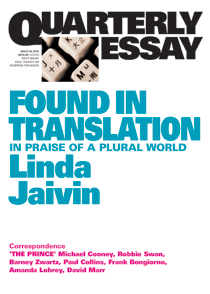
Linda Jaivin, Found in translation: In praise of a plural world (Review)

Linda Jaivin, Found in translation Book cover

Courtesy: Black Inc

Reading synchronicity strikes again! In the last couple of months, the issue of language, translation and culture has been crossing my path – in Diego Marani‘s The last of the Vostyachs, in Gabrielle Gouch’s Once, only the swallows were free, and on Lisa’s blog post about the AALITRA Symposium on Translation. I was consequently more than happy to accept a review copy of the latest Quarterly Essay, Linda Jaivin’s Found in translation.

Now, as some of you know, I have mixed feelings about reading books in translation. I want to read them because I want to read not just about but from other cultures. Not being fluent in all the languages of the world, the only way I can do this is to read works in translation, but when I read a translated work I am very conscious that there is a mediator between me and the work. This bothers me. Linda Jaivin, herself a translator, knows exactly what I mean:

… it is absurd to speak of issues of literary style, rhythm – or any aspect of a translated work aside from its structure, characters and plot – without acknowledging that the language of the text is at once a creation of the translator and an interpretation of the author …

And she gives good examples to support her statement. I was pleased to see her acknowledge this, because she knows of what she speaks! But, this little point is only a very small part of Jaivin’s wide-ranging, entertaining but also passionate essay. Jaivin, if you haven’t heard of her, is a multi-skilled woman: she subtitles Chinese film and television and translates Chinese text; she has worked as an interpreter; and she has written novels, stories, plays and essays.

As a reader and lover of words, I enjoyed Jaivin’s discussion of the technical and philosophical challenges faced by translators. She peppers her discussion with an eclectic but fascinating array of examples. And she quotes other translators, such as Edith Grossman who wrote that

a translation is not made with tracing paper. It is an act of critical interpretation … no two languages, with all their accretions of tradition and culture, ever dovetail perfectly.

Take swearing for example. How we swear is highly cultural. Swear words, Jaivin writes, “expose what is forbidden, what is permitted and what is held sacred” in a culture, and consequently “can  throw differences in worldviews into sharp relief”. However, you’ll have to read the essay, if you want to see her examples!

I was intrigued by her argument that translations of classics go out of date! So, this means that the Spanish will always read the same Don Quixote but English speakers are very likely to read a different translation depending on which one is currently in vogue.

“… a culture doesn’t grow just by talking to itself …”

But, the critical point of her essay is not the act of translation. As the title of her essay implies, Jaivin is passionate about pluralism, and more, about cosmopolitanism. By this, she means not just living side by side, not just accepting each other, but “sharing a common vision”.

Australian Women Writers ChallengeFor Jaivin, “translation” is not a narrow concept. Its implications extend far beyond the “simple” translation of words from one language to another, because attached to language are meanings and ideas. When ideas are translated – via words – from one culture to another those ideas change. Jaivin describes how concepts such as Confucianism and yes, even democracy, change when they cross cultures. This can lead, she says, to misunderstanding but it can also provide “room for the kind of creative interpretation that allows cultures and the conversations between them to grow and evolve”.

She argues that, because of Australia’s particular history and geography, and because Mandarin is the most commonly spoken language in Australia after English, “Australia is … in a unique position to translate the shift from the ‘American century’ to the ‘Asian one’ …”.

Building successful international relationships, she believes, requires genuine communication, which includes knowing, recognising and respecting other languages. It

does not require the weak to adopt the language of the strong – as reliance on English threatens to do, given its global and frequently imperial reach.

Jaivin argues that learning a foreign language should be a compulsory part of year 12 and university education, because “we need to have every possible line of communication open to us” if we are to successfully traverse the changes coming.  Not everyone agrees. What do you think?

Linda Jaivin
“Found in translation: In praise of a plural world”
in Quarterly Essay, No. 52
Collingwood: Black Inc, November 2013
103pp.
ISBN: 9781863956307

(Review copy supplied by Black Inc.)

Monday musings on Australian literature: Australian migration literature

Last week I reviewed Gabrielle Gouch’s memoir, Once, only the swallows were free, in which she tells of her family’s migration from Hungary to Romania to Israel, and then her own on to Australia. While Gouch focuses more on the brother left behind, she does touch on the challenges of migration – the dislocation and loneliness that often ensues. One of the commenters on that post, Ian Darling, suggested that “Australia must have produced some particularly fascinating emigrant accounts in its literature”. We have, and way too many to list here.

It would be worth some time exploring the changes in that literature over the two or so centuries since white settlement – from the early days of British confidence, through to the changes that came as different nationalities started to appear (such as the Chinese on the goldfields in the nineteenth century and the Italian and Greek migrants after the Second World War), to the Asian migration of the later 20th century. But, that’s not what I’m going to do here. It’s nearly Christmas, so I’m going to take it easy and just list a few  I’ve read in recent years that I found interesting. Migrant literature, as you’d expect, crosses genres, particularly literary fiction and memoir.

Yasmine Gooneratne’s A change of skies (1991)

Gooneratne emigrated to Australia from Sri Lanka. I first knew of her as a Jane Austen fan and English literature lecturer at Macquarie University, but then my reading group read her novel, A change of skies, about the experience of migration. She writes about educated middle class migrants – like herself I presume – who work to find a balance between fitting into the new culture while at the same time preserving their Sri Lankan identity.

Melina Marchetta‘s Looking for Alibrandi (1992)

Marchetta’s book is a young adult novel about the daughter of an Italian family and her desire to fit into an Australian world against the family pressure to live the old Italian way. She’s young, bright, and in the last year of high school. She wants to meet boys – and not just Italian ones. She wants to live as her friends do. Gradually, she learns to make peace with her family, to recognise the rich heritage she belongs to while at the same time showing them that she can walk two worlds. It was a hugely popular book when it was published and was later adapted into a successful movie. It is I believe taught in high schools.

Arnold Zable‘s Cafe Scheherezade (2001)

I read this novel a few years before I started blogging. It was inspired by the eponymous cafe in Melbourne at which Jewish immigrants – survivors mostly of the Second World War – would meet, talk and provide support for each other. It is a gorgeous novel, about the power of stories to provide support and aid survival. Zable is a warm, generous writer. I remember the book for that, but I also remember it for  teaching me about the various ways Jewish people came to Australia. I didn’t know, for example, how many had transitioned through Shanghai. Zable’s The sea of many returns, which I reviewed early in this blog, is also about migration and yearning for home – and about the power of stories. Stories, we know, are a powerful mechanism for preserving culture – whether it be our national identity or the micro-culture of our families!

Nam Le‘s The boat (2008)

Le’s book is a collection of short stories, many of which are not about migration, not specifically anyhow. However, two of the stories – ““Love and honour and pity and pride and compassion and sacrifice” and the title story “The boat” which closes the collection – are autobiographical, and draw directly on his life and on family’s experience of migrating to Australia from Vietnam as boat refugees when he was just one. The interesting this is that, while most of the stories aren’t specifically about migration, they do tend to all be about survival, which suggests, to me anyhow, that the experience of migration has strongly informed Nam Le’s world view.

Alice Pung‘s Unpolished gem (2007) and Her father’s daughter (2011)

As with most of the books in this list, I read Pung’s memoir, Unpolished gem, before I started blogging. It tells the story of her growing up in an immigrant household. She focuses particularly on the challenges of being a child growing up in a culture that her parents are unfamiliar with, of being caught between two worlds. While I loved the book, it bothered me a little that she didn’t empathise with, or try to understand her parents as much as I would have liked. I guess she was just young! However, she rectifies this in her next memoir, Her father’s daughter, which I reviewed a couple of years ago. She starts to understand two things – what their lives were like and what they’d lost/sacrificed, and why they had worried about her and tried to protect her the way they did. I loved this recognition in the book:

She started to see her mother and father in a new light. They had a sense of humour! They knew their private lives were completely separate from the world their daughter had described in another language.

Hats off, I say, to all those families who traverse this tricky ground.

Kim Scott‘s That deadman dance (2010)

Up to this point, I’ve presenting this list chronologically, but I wanted to end with this one, because it is, for Australia, the ultimate migration story. Written by an indigenous Australian, it explores the first meeting in Western Australia between British migrants and the indigenous inhabitants. Drawing from documentary evidence, Scott tells a story in which arrogance reigns over good will, setting Australia down a path from which we haven’t yet recovered. Bobby, the main indigenous character, says at one point in the novel:

We thought making friends was the best thing, and never knew that when we took your flour and sugar and tea and blankets that we’d lose everything of ours. We learned your words and songs and stories, and never knew you didn’t want to hear ours.

I think I’ll leave it there …

Meanjin’s Tournament of Books 2013, Round 1

Hmm, when I announced this year’s Meanjin Tournament of Books over three weeks ago, I thought I’d be back before now with an update. However, the last match in Round 1 was only posted a couple of days ago, and I wanted to wait until the Round was finished before reporting back. So, here I am now, with Round 1’s results …

Round 1 Match 1: Margo Lanagan’s Sea hearts defeated Favel Parrett’s Past the shallows

Now this is a round between books I haven’t read, so I have no vested interest here. The judge Laura Jean McKay is a writer-performer who has been published in places like Best Australian stories and The Big Issue. She had a hard job – though what Meanjin Tournament judging isn’t hard, do I hear you say? – as both books have received significant critical acclaim since their publication. Sea hearts was shortlisted for this year’s inaugural Stella Prize, while Past the shallows was shortlisted for the 2012 Miles Franklin Award. Meanjin showed their strategic hand when pitting these two against each other! McKay observes that both “are told through very similar landscapes and lifestyles—though the first is Australian and the latter presumably Scottish. As well as the motifs of island and fishing life, both books are a comment on effects of these lives on women and their sons”. Parrett’s book she says is a “desperately sad and realist story of a rural Tasmanian fishing family torn apart by jealousy and death” while Lanagan draws on the selkie myth to tell her story of women, men and fishing. McKay doesn’t want to make a decision but, she says, “our relationship with the sea is unfair” and so she makes a choice. Lanagan wins by a seal’s whisker for coaxing McKay under to a place from which she never wants to emerge. Hmm!

Round 1 Match 2: Kim Scott’s That deadman dance defeated Kathryn Heynman’s Floodline

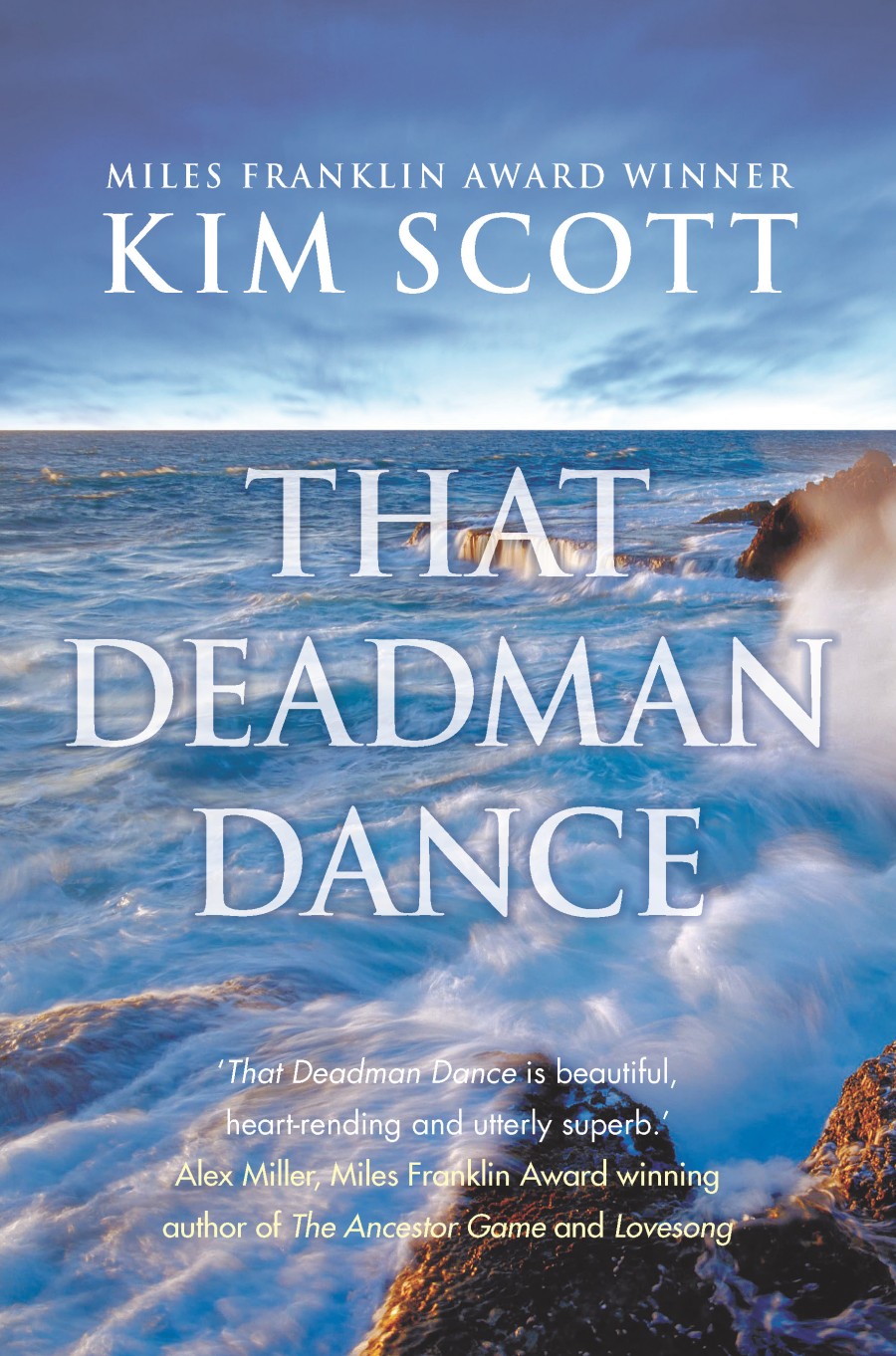
Kim Scott That Deadman Dance

Now, I admit that I don’t know Heynman or Floodline, but I reckon it would have taken a super-extraordinary book to beat Kim Scott. Heynman should take comfort from that. She could have lost to way lesser mortals! Judge Peter Taggart is a Queensland-based writer and theatre critic. Unlike McKay, he is very clear about which book is the winner and why. He appreciates much of what Heynman does but says that Floodline, a novel that explores the hypocrisy of Christina morality, recedes from memory while That deadman dance, with its powerful protagonist in Bobby, “lingers, which is why That Deadman Dance must take out this round”. Can’t argue with that. Scott’s wonderful book (my review) is not easy to forget, and will, I suspect, be a hard one to beat.

Round 1 Match 3: Jaya Savige’s Surface to air defeated Nevil Shute’s On the beach

I must say that, while I haven’t read Savige’s book and I loved Nevil Shute as a teen, I’m not surprised by this result. The mysterious judge, First Dog on the Moon, and I are in agreement. However, why First Dog chose Savige is not exactly clear – you can read the adjudication yourself at the link above – so I will just say that while I loved Shute’s dystopian novel when I was 15, I was disappointed when I read it a decade or so ago. Shute is a good story-teller – his books make great movies – but the characters were too stereotyped and the writing a little too prosaic to engage me beyond the basic story. Enough said. So, I must check out Surface to air which is, apparently, a collection of poetry.

(PS First Dog on the Moon is Walkley award-winning cartoonist Andrew Marlton)

Round 1 Match 4: Tim Winton’s Breath defeated Kate Grenville’s The secret river

Tim Winton, Breath

What a shame that these two books met in the first round – particularly since they are two of the four books I’ve read! Judge Tseen Khoo, a senior adviser in Research Development at RMIT University, had a hard job having to choose between these two great books, but I think, given the “sea” theme, that Tim Winton had to win. How could we not have Winton, our most famous chronicler of things oceanic, in the next round? Seriously, though, Khoo goes into some detail to explain her adjudication. Her decision, rightly or wrongly, comes down to the fact that she’s uncertain whether The secret river “changes conversations in Australia’s present about its past” – and she’d like it to. On the other hand, while she feels that Winton’s protagonist “never grows into measures of self-confidence and joy in life”, the book “left me haunted in an enduring way”. Grenville’s book, she said, felt like a book she’d read before, while Winton’s was unfamiliar and “not comfortable”. Much as I love both books, I think that’s a very good reason for choosing one work of art over another.

Recap

And so, we have 4 books – three novels and one book of poetry – going into Round 2:

  • Margo Lanagan’s Sea hearts
  • Kim Scott’s That deadman dance
  • Jaya Savige’s Surface to air
  • Tim Winton’s Breath

OK, so I’ve read two of these – Scott and Winton. Watch this space, to find out which two books will be in the finals …