Some readers do not like non-human narrators, full stop, but I am not one of them. Indeed, I have read some wonderful non-human narrators, including most recently, those created by Carmel Bird and Chris Flynn. What these narrators offer, when done well, is a different, unexpected perspective, and I find that exciting. So, I was open to the one I found in Angela O’Keeffe’s Phantom days.
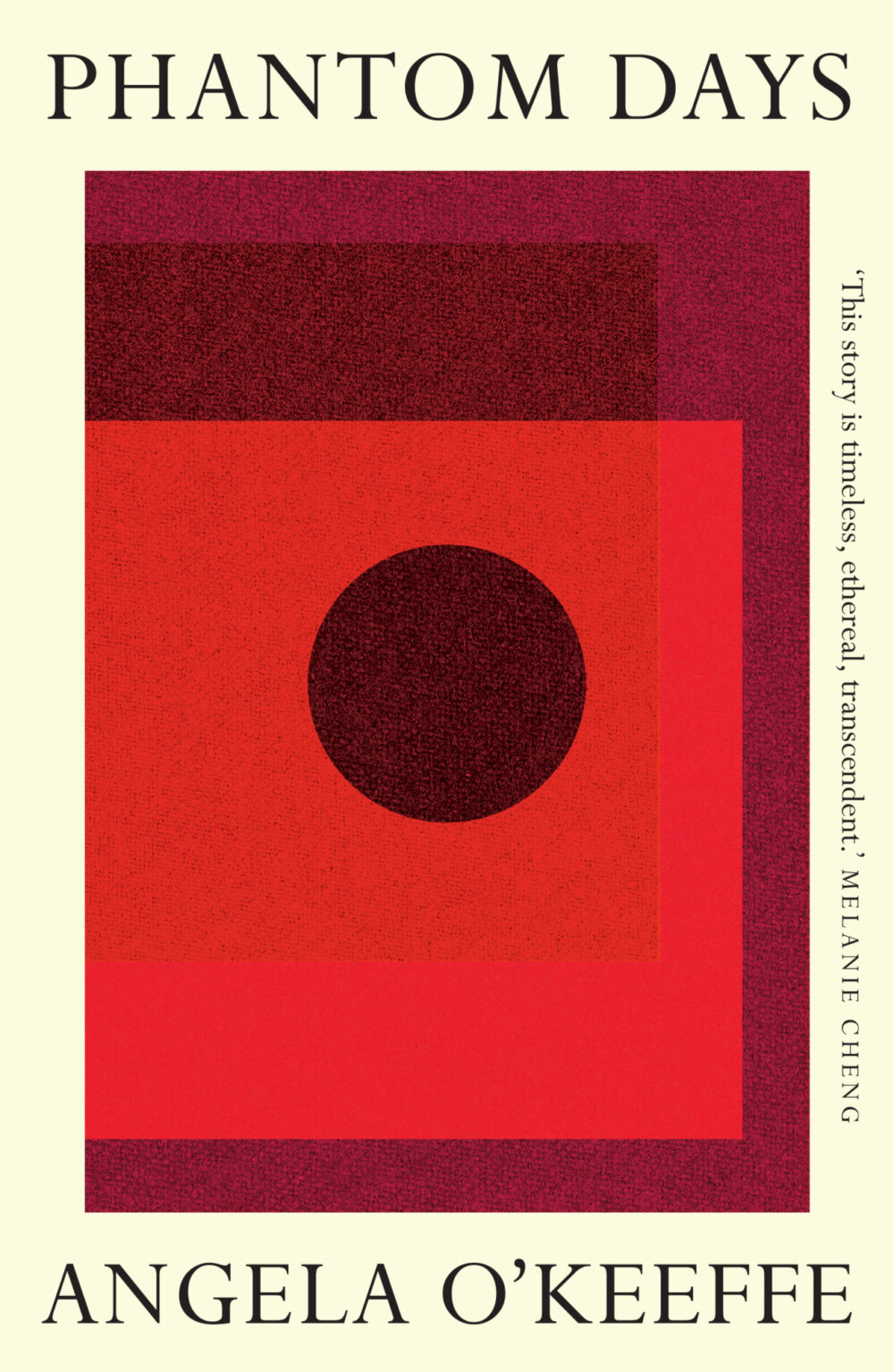
Phantom days is not the first book O’Keeffe has written in the voice of a non-human narrator. Her debut novel, Night blue, was written largely in the voice of the painting Blue Poles. Then, two years later, in 2023, came The sitter, which is partly narrated by the ghost or spirit of Marie-Hortense Fiquet, wife of the French artist Paul Cézanne. Art is clearly a passion for O’Keeffe, as you can tell by the Rothko-inspired cover of Phantom days. But this novel is not about art, though Rothko does feature. It has three narrators – a Book, its owner Isabel, and, a few chapters in, Isabel’s mother, Maggie – but, we also hear stories from the ashes of another mother. If this is sounding too weird, please don’t run away until I’ve told you a bit more …
I don’t know what themes or ideas drove O’Keeffe’s first two books, but Phantom days has its roots, or, a root, in the power of books. It opens in Book’s voice:
There are those who claim that their life was saved by a book. I don’t know anyone who has claimed this, but I am aware of the sentiment. It is part of the collective memory of books. A book comes into the world as a saviour of sorts.
Book, we can see from these four short sentences, has a sense of its potential, but is not going to make claims it can’t stand by. We can, therefore, trust that it will not lead us astray but simply tell us what it sees or knows. In the opening chapter we meet it and Isabel at its launch, which is where Isabel buys it.
But, what has prompted Book to mention the idea of saving out of all the possible claims for the value of books – like offering comfort and escape, or building empathy, or improving our vocabulary, or helping ward off dementia? Gradually, a darker story emerges, one that Book is witness to but can only observe because, after all, a book can’t really save anyone, or, can it?
So, is Phantom days partly questioning the idea that the pen is mightier than the sword, that literature (or art in general) can bring about change, or make things happen. We learn partway that Book’s title is A new step, but we never know what it is about. Book, itself, feels impotent, “but I could do nothing”, while Isabel, early on, opens Book to read it, but doesn’t continue, “I had the impression that something was being thwarted – in me or in you, it was hard to say”. In other words, there are limits to what literature can do – or, perhaps it’s that literature, art, must wait until you are ready.
This a curiously mesmerising book. Through multiple threads supported by strong recurrent imagery – Rothko’s reds suggesting violence and the physical body, and Book’s yellow offering something more open and light-filled – O’Keeffe examines human nature and our relationships. Leaving aside Book itself, there are three significant relationships – an unhealthy one between Isabel and her lover Lewis, a loving but prickly one between Isabel and her mother Maggie, and a supportive one between Isabel and her friend Donita. Isabel breaks with Lewis early in the novel, because of his lying about a rude “shove”. Around the same time Isabel senses “a new thing forming” in her, “a weightless presence”, “a light”. It turns out to be a phantom pregnancy that continues through the narrative, and that could be interpreted as reflecting 30-something Isabel’s apparent stagnation. She’s been in the same job in arts administration for over a decade, during which she’d only had one small promotion. Her mother, a lecturer in literature, wonders what Isabel is “creating in her life”, how “satisfying her life is.
So, is Phantom days also about creation? Isabel’s reflection of Rothko’s pronouncement that “A painting is not a picture of an experience; it is an experience” provides a clue to our reading of this novel. Isabel’s “experience” of seeing Rothko’s Seagram Murals at the Tate, which is entwined with her knowledge of their relationship to his death, reverberates through the novel, and is related to my next thread…
Violence. I have already mentioned the “shove” which resulted in Isabel ending her relationship with Lewis. A little before that event, Isabel closes Book, and Book comments, simply, “To be shut is violence”. Violence is a constant presence in the book. It is part of the ashes’ story. They belong to Lewis’ mother, who tells her story of domestic violence through to its shocking, yet surprising, conclusion. Rothko’s death, to which Isabel often returns, was violent; Rothko the artist who “didn’t trust words”. And an act of violence is the founding event in Crime and punishment, which Maggie reads near the end of the novel, and which propels the resolution.
Then, there’s the idea of truth. Isabel learns early on that she can’t trust Lewis to tell the truth, but she and the ashes have a deep sense of their own truths. The ashes tell their truth over and over “for no other reason than the telling”, while for Isabel the truth seems to be bound up with the light growing inside her:
The light in me would never amount to anything, I knew. Yet it existed. This was the truth upon which I stood. (p. 50)
And yet, the light does – as you have probably guessed – kickstart something for Isabel. The novel’s conclusion is both dramatic and yet calm. There is violence but not in the way we expected, and there is irony, at least for the book and that initial question concerning saving a life.
Phantom days is a quiet, rich read that covers much in its novella-length. It explores complex ideas about how books and art affect or shape our individual realities, within a narrative that encompasses love and connection, misogyny and violence, trust and truth. Ultimately, though, it is surely a love letter to books and reading. Watching Maggie read Crime and punishment, Book tells us that “She read, as if to read was to live”. Ain’t that the truth!
Angela O’Keeffe
Phantom days
St Lucia: UQP, 2026
168pp.
ISBN: 9780702271151
Review copy courtesy UQP


I adored this novel, as I did Night Blue and The Sitter. Lovely review.
Thanks Amanda. I really must read those others. I’m glad you liked the book and my review.
I love the sound of this book, but then I have tons of questions about how the book knows things. Does it only know what it hears, and does that imply that books listen? Does it know what all books know? As if they share some sort of ecosystem, like trees? Perhaps I am reading your blog post too early in the morning and my brain is firing too hard, lol.
I’m in Europe as you know Melanie so can’t answer these questions closely. The book makes some comments about what it knows and doesn’t, but it does also require some suspension of disbelief.
I’m ok with a non human narrator as long as it’s not an animal. Lol. Ghosts, robots, etc. i haven’t read a lot of them though. Interesting sounding books.
What about an animal fossil Pam? (Chris Flynn) Or Carmel Bird’s Spix’s macaw?
I wonder if you’d like this?
Who knows? I’d have to try it. Lol😂
In theory this shouldn’t work, but it does, doesn’t it?
Glad you enjoyed it too.
It does!
This sounds completely intriguing – I love your description of it as ‘curiously mesmerising’.