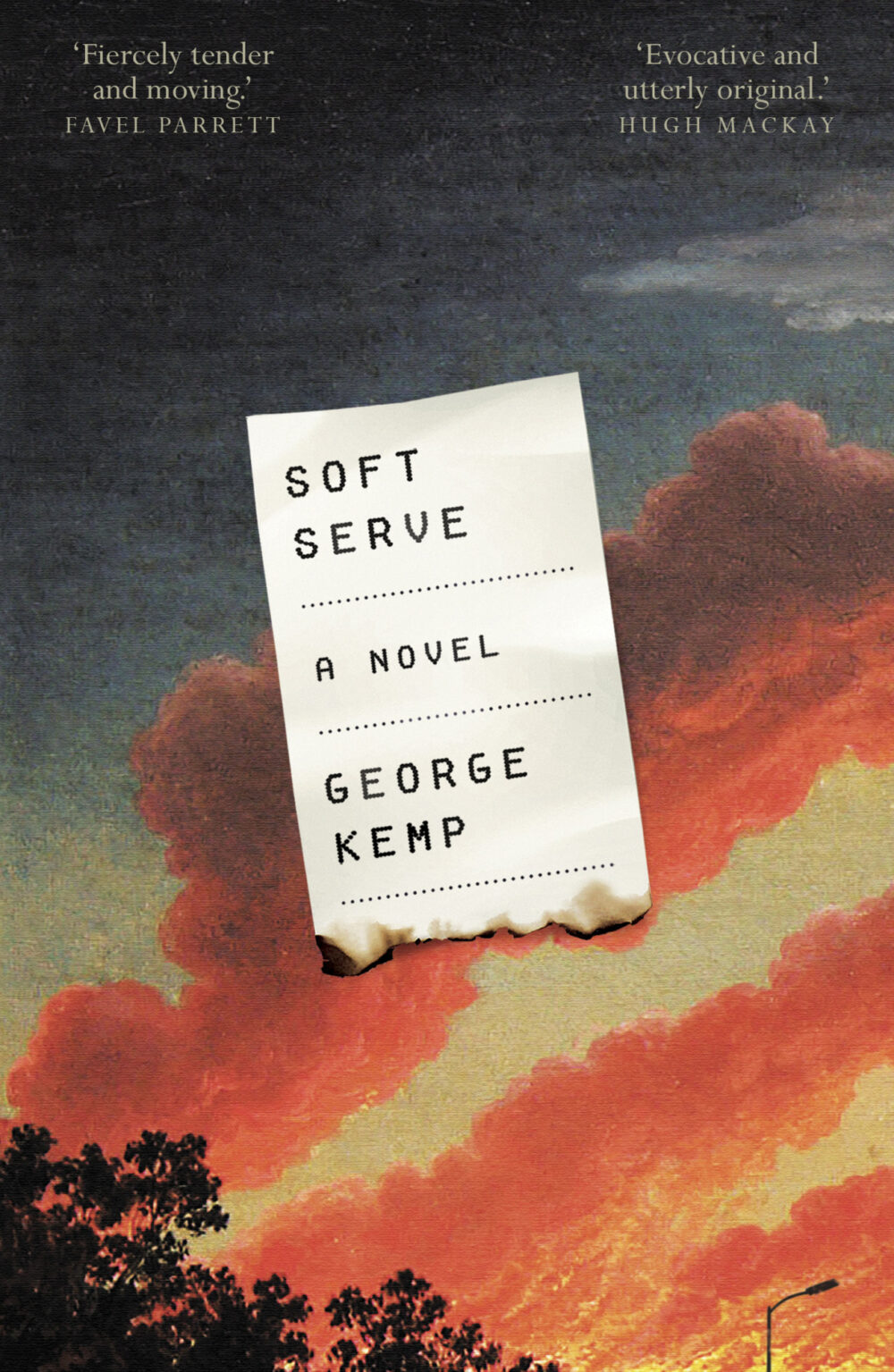
George Kemp’s debut novel, Soft serve, explores big themes in a quiet, compassionate little package. Coming-of-age is tough enough, but when young people are confronted with the devastating loss of one of their own, it becomes an almost insurmountable challenge. Put this terrible grief against a backdrop of climate-change-fuelled bushfire and you might expect something melodramatic. But, while there is drama, Soft serve‘s focus is the internal, with the developing – and very real – external threat acting like a metaphor for what is going on inside.
Soft serve centres around six characters. There’s Taz, who had died in a freak accident two years earlier, his two school friends, Fern and Ethan, who were 18 at the time, and Fern’s two-years-older brother, Jacob. These are the young people. The other two characters are older women, Taz’s desperately grieving mother, Pat, and warm-hearted Lotte, a volunteer firefighter with the Rural Fire Service. The novel is set in a small fictional town named Yinabil in rural New South Wales, and takes place over one day. This day is the second anniversary of Taz’s death, and a bushfire is threatening the town.
The story is told through three alternating storylines. Two are set in the present: one, in the local Maccas*, chronicles the day through Pat’s shifts (starting with Part one: Morning shift), and the other, titled Fire, concerns Lotte working on the firefront. The third, Party, is set a little over two years ago. It is in Taz’s voice as he talks about the 50th birthday party he’d organised for his mum as a farewell gift, before he left home for Sydney and adventure. The title refers to the “Ceremony” involving Taz’s three friends’ tradition of toasting him with Maccas’ soft serve ice creams on the anniversary of his death.
The story is straightforward. Taz has died, four people – his mother and three friends – are grieving two years later, and a fire is encroaching on the town. Pat, as the older, experienced person, finds herself having to deal with the emotions of the three young people who have come to Maccas for their Ceremony, when all she wants is to nurse her grief and survive the day. Meanwhile Lotte just wants to save as much of the town as she can.
As the day unfolds, conflicting emotions come to the surface. For the older women, some sacrifice is called for as they put their own needs on hold – Pat to help the young and Lotte to help the town. There’s a subtle emotional and physical parallel here that plays out right through to the end. For the young people, there’s the struggle to find themselves, to be honest about who they are and what they want. For Ethan, from a well-to-do but emotionally distant family, it’s his sexuality, while for Fern, from a struggling single-parent background, it’s her dreams of a better future and her assumption that Ethan, “kind” but with the “wild threat-wary eyes of a chihuahua”, will be central to that. Jacob, on the other hand, with his “constant shoot-’em-up game energy”, is at loose ends, with no idea where he is heading.
“Life isn’t folded laundry”
Kemp’s writing is truly delicious. It’s funny at times, generous to its subjects, and vivid. Fern, who retreats to TikTok at some point “to scatter the intensity of her pain”, suddenly sees its shallowness, and is “exhausted from being constantly bamboozled by the impossible algorithm of happiness”. Pat sees that Jacob is “languishing, tossing and turning in the great unmade bed of the world”, but also recognises “a magic” in him.
These aren’t new stories, new challenges, new emotions, but Kemp has a way of telling them that makes them fresh and, in doing so, reminds us of our humanity, encourages us in our compassion, and conveys some truths about contemporary life. There’s a wonderful wisdom in the writing, in, for example, Jacob waiting for Ethan to explain his plans:
He waits for Ethan to respond, and wonders if this is the kind of silence where the words aren’t yet known, or the kind where they are, but aren’t quite ready to be spoken. (p. 77)
Or, in Pat’s thoughts on Fern,
planted in the wrong garden, like a gerbera ill-equipped against the wind – a life grown sideways as she seeks out the warmth of the sun. (p. 99)
Pat, who had resigned her job as school careers counsellor after Taz’s death, because she had needed “something mindless”, finds her “protective instincts … begin to murmur and cautiously turn their focus outwards”. By the end of the day, she has made some difference in the lives of the three, though how lasting that will be, who knows. After all,
How often is there resolution in life? Once? Twice, if someone’s really looking for it. The rest is just one long suspension. Life isn’t folded laundry; it’s the clothes chucked into the washing basket waiting to be cleaned. (p. 190)
Soft serve is, as I opened with, a debut novel. I had not heard of George Kemp, but he is a successful playwright, actor and arts educator. His award-winning play Shack, says publisher UQP, has been performed frequently around Australia and internationally, and is included on the new NSW Drama Curriculum. This experience shows. Soft serve is tightly structured, with a wonderful grasp of character, and tells a story that would surely speak to any Australian. Kemp introduces contemporary issues, including sexuality, race, climate change, social inequity, and rural life without labouring or preaching.
Indeed, Soft serve tells a tough story with intelligence and grace, offering insight into modern life without pretending to know the answers. Well worth reading – for young and old.
George Kemp
Soft serve: A novel
St Lucia: UQP, 2026
196pp.
ISBN: 9780702269134
(Review copy courtesy UQP)
* What Australians call McDonald’s Fast Food Chain


I like the sound of this, Sue. I don’t know how true this is, but I don’t think there are many modern novels that explore bushfire threats in contemporary times???
Thanks Kimbofo … it is a very good read. I felt for all the characters. But, good question. I can’t think of many contemporary novels with “actual” bushfire threat either, as against theoretical threat or a post-apocalyptic landscape.
The only 2019 bushfire book that springs to mind right now is The Performance | Claire Thomas.
One of my colleagues liked this a lot too, so I must check it out.
Oh thanks Brona. I think I have that book on my TBR but have never got to it.
I think I’d enjoy this book too. Though fires always make for a tense read.
They do Pam, though for much of this novel they are the backdrop. The fire does, though, play a significant role in the denouement.
It was a great, though unsettling, book—and I also learned that “Macca” is an abbreviation for McDonald’s in Australia.
Haha Carolyn, I put the footnote precisely because you had told me you didn’t know the abbreviation, so thankyou for that. It is an unsettling book, I agree, but he does it so warm-heartedly, with such sympathy for his characters. I like that.
Someone else reviewed this novel, possibly Karissa from Canada, and I added it to my TR then. You’ve only further encouraged me to read it. I do find that folks who have a background in writing plays or TV tend to write excellent first novels. They really have the practice of nailing pacing and characterization.
Oh, you think someone from Canada did! I’ll see if I can find that. That would be great. Anyhow, yes, I think you are probably right about play and screenwriters and their particular skills translating well to prose fiction.
As I read along, I was starting to wonder (because of the cover) if maybe “soft serve” was not ice-cream-related there, just as you have explained you have different nicknames for McDonalds. But, nope, it’s ice-cream after all! There is a collection of stories by Allison Graves published by Breakwater Books in eastern Canada with the same title (and I just loved it) and I imagine there are all sorts of characters who really should be meeting up at McDonalds. Which BTW, every country apparently has a nickname for (check Wikipedia…. which I did, to see how one would spell what it’s called in the U.S. which is Mickey Dee’s (Wikipedia identifies the usage as Canadian and American, but I rarely hear Canadians use the term, unless they also spend time in or have family in the States). I like it when writers are able to maintain a light touch on heavy subjects: tough to do.
Thanks Marcie. I didn’t think of looking up Wikipedia for McDonald’s nicknames. I will do that later. I loved that you used the cover for a potential clue re Soft Serve, but probably most of Maccas menu items (even if not its nickname) are fairly universal? I was thinking of you as I wrote this post, because this is a quiet, gentle – but also powerful book – that I think you would appreciate.
I never would have thought to look for it either, only needed to check the spelling and thought it might be on the McDonalds page, but you’ll be as shocked as I was, I’m sure! Yes, I imagine if soft serve sells in Canada, it’ll be anywhere (especially hotter places). It really does seem to be my cuppa, and of course just being stories is already a mark in its favour!
I never would have thought to look for it either, only needed to check the spelling and thought it might be on the McDonalds page, but you’ll be as shocked as I was, I’m sure! Yes, I imagine if soft serve sells in Canada, it’ll be anywhere (especially hotter places). It really does seem to be my cuppa, and of course just being stories is already a mark in its favour!
It is fascinating too about menu differences. Ice cream is probably almost a universal food, but so many other local flavours and styles are incorporated, like beetroot in an Australian burger!