Robert Frost, The question of a feather (Review)

Well I never! Never knew, that is, that Robert Frost wrote prose as well as poetry. I suppose I didn’t know that he didn’t do it, either, but now I know that he did! And how do I know? Through the Library of America of course! This week’s story is “The question of a feather” by Robert Frost.

LOA’s notes, as usual, provide some interesting background. It appears that in 1899 Frost was chronically ill with, the doctor thought, tuberculosis which had caused his father’s death. The doctor’s advice? Go work outdoors, young man! And so Frost, “a born-and-bred city boy”, and his wife, decided to take up poultry farming, first on a rented farm and then on a farm bought for them by Frost’s grandfather. Robert and Elinor farmed for around nine years at the beginning of the 20th century.

Still wanting to write, Frost wrote poems which were, apparently, regularly rejected for publication so, LOA says, “he eventually lit upon the idea of writing pieces for the regional poultry-farming papers”. “The question of a feather” was one of these pieces. Frost scholar, Mark Richardson, amusingly wrote of these pieces:

In regards to Frost’s writing for poultry journals, it must be acknowledged first that they are certainly the best poultry-stories written by a modern American poet.

I bet they are!

Now, I have to be honest here and say that I really only know a couple of Frost’s famous poems – “the road not taken” and so on – so this is not going to be an analysis of how this sketch illuminates or represents his work. Rather I’m just going to introduce it a little, and hope you decide to read it yourselves using the link below. It’s a short piece. (LOA’s notes say that there are hints of this story in his poem “A Blue Ribbon at Amesbury”).

It is subtitled “How an editor got out of the frying pan and into the fire” and concerns the editor of the poultry journal, Hendom, who receives a letter from a reader stating that their poultry farm

is the result of following your instructions to the letter … You have been our only teacher, and we want you to be the judge whether it has been to our advantage.

Now, our editor is not thrilled about this. He tells his readers not to follow him exactly, but to “use judgment in keeping hens”. However, he’s been stuck in his office all day “and he was tired of it” so decides to visit the two sisters “though he did not feel he was to blame”. He fancies the result will be “bad” or “amusing”. He assumes he will be confronted by “a failure to make money in hens”. There’s a mock-heroic sense to all this, which I liked:

He considered himself as having one of the good times incident to his calling. He liked nothing better than visiting a farm, and visiting this one had a spice of real adventure.

Of course, what he finds is not what he – the superior male editor – assumes. And he is confronted with an ethical question regarding poultry showing:

“… you are just in time, Mr Fulton, to help us with that feather on the leg of, I think, our best pullet.”
“Pull it?”
“Yes, pullet.”
“Help you pull it, I mean.”
“Tell us whether it is right to pull it,” she answered, flushed and serious.

There is quite a bit of sly humour in the piece … and a lovely description of character. You know exactly what sort of man the editor is – pompous and patronising towards women, particularly spinsters, and yet his unwillingness to be definite about anything gives away a degree of wishy-washiness, a lack of confidence perhaps. And you know the sisters too, their conscientiousness, openness, and willingness to confront the difficult questions. It’s an odd little piece, really, but shows to me a Frost interested in the details of everyday life, in how people do or don’t communicate, and in describing character. It also provides a little picture of New England at the time.

Robert Frost
“The question of a feather”
First published: Farm-Poultry, July 15, 1903.
(Library of America’s text is from Mark Richardson, The Collected Prose of Robert Frost: A New Critical Edition, Rutgers University doctoral dissertation, 1993. Reprinted by permission)
Available: Online at the Library of America

Monday musings on Australian literature: The sheep’s back

As a baby-boomer, I grew up knowing that Australia “rode on the sheep’s back”, that our economy, in other words, was based on the wool trade. It’s not quite so now – though wool is still an important product – but I was reminded of the saying last weekend as we were introducing a young American to a little bit of country Australia. We were, in fact, focused on one of our wine regions, but it was the sheep that she particularly noticed.

Sheep among the vines at Stanton and Killeen

Sheep among the vines at Stanton and Killeen, Rutherglen

This made me think about sheep in Australian literature/culture. How do (did) they feature, given the role that they’ve played in our “wealth for toil”. Rather negatively, in fact. Horses and cattle-droving are romantic, and often feature in Australian outback novels and ballads, with a sense of heroism (as in “The man from Snowy River”). Sheep and shearing don’t quite cut it in the same way. They too can be romanticised, but more in the “rough diamond” category rather than the “heroic” one.

One of the best known Australian songs/ballads to feature sheep is “Click go the shears” which describes the hard work of the shearer, the various roles played in the shearing shed (the “boss”, the “tar-boy”, the “old shearer”, the inexperienced “snagger”) and the drinking at the pub when it’s all done. The other, more famous song featuring sheep is of course “Waltzing Matilda” about the swagman who steals a sheep (the “jolly jumbuck”) to eat. The song, written by Banjo Paterson, was probably inspired by the hardships endured by shearers during and after the Great Shearers’ Strike of 1891. It depicts the class division in Australian society between the “battler” (or working-class man) and the “squatter” (or, landowner).

And this reminds me of a novel I reviewed early in this blog’s history, William Lane’s The workingman’s paradise, a social realist novel which explored both urban poverty  (Sydney) and rural hardship (Queensland shearers). The novel is set in Sydney, but the plight of the shearers is a major theme. Another, much later novel, Jeremy Chambers’ The vintage and the gleaning, is set in the vineyards of northeast Victoria (where this post’s photo was taken) but is narrated by Smithy, who had been a shearer for 47 years before becoming a vineyard worker. Smithy rues his years of hard-drinking (see “Click go the shears” above!) and its impact on his health. A third Australian work to focus on the rough, hard side of the shearer’s lot (alongside its mateship aspects) is the movie Sunday Too Far Away. Hard drinking features here too, in a story about shearers fighting to retain their bonuses against the threat of non-union shearers.

There are other “takes” on sheep, however. One is the film Babe, that was filmed in Australia but based on English writer Dick King-Smith‘s children’s novel, The sheep-dog. It’s a romanticised pastoral story about a pig that herds sheep like a sheep-dog. King-Smith’s (English) sheep are intelligent and manipulative, quite different from the typical description of sheep in Australian literature. Another, more interesting depiction, though, comes from Jeanine Leane’s Purple threads which I reviewed earlier this month. In that review I commented on Leane’s use of sheep symbolism. Her book is set in a sheep farming area. The narrator sees her indigenous family’s practice of adopting the black sheep that are spurned by the farmers as reflecting Jesus’ teachings about charity and inclusiveness. It’s pretty obvious, I suppose, but I liked the way she makes her point by mixing Christian symbolism with something symbolising anglo-Australia’s encroachment on her people’s country.

But I can’t resist returning to Banjo Paterson, my favourite bush poet, to close today’s post. He wrote a piece called “The merino sheep”, which you can read online. He describes the sheep as a “dangerous monomaniac” whose “one idea is to ruin the man who owns him” and concludes with:

The hard, resentful look on the faces of all bushmen comes from a long course of dealing with merino sheep. The merino dominates the bush, and gives to Australian literature its melancholy tinge, its despairing pathos. The poems about dying boundary-riders, and lonely graves under mournful she-oaks, are the direct outcome of the poet’s too close association with that soul-destroying animal. A man who could write anything cheerful after a day in the drafting-yards would be a freak of nature.

Oh dear … and I thought it was caused by heat, aridity and remoteness!

Anyhow, if you are Australian, I’d love to hear of other references to sheep in our literary (or cultural) life that have struck you (as my discussion here is brief and limited). And, if you are not Australian, does this post inspire any thoughts about ongoing motifs in your own national literature?

My most unforgettable books, to date!

I was going to title this post “Life-changing reads” but decided that that wasn’t quite right. I’m not sure that any book has quite changed my life though many have opened my eyes to other ways of seeing and being in the world.

May marked my third year of blogging and I started this post then, thinking to mark the moment by reflecting on the books that have most impacted me (in some way or another). Somehow life got in the way, and I am only getting back to it now. I think it’s still worth doing – for my benefit, if not for anyone else’s. It’s going to be hard to keep my list short – as you litbloggers and litblog readers will surely understand. So here goes, in alphabetical order by author – it’s hard enough limiting the number (to a self-imposed arbitrary number of ten) without ranking them too!

Margaret Atwood‘s The handmaid’s tale: Such an astonishing evocation of what might happen should extremist fundamentalist views be taken to their, hmm, logical conclusion. The book functions as both a wake-up call – we can never rest on our laurels while injustice and inequality remain in our world – and a great read.

Jane Austen‘s Pride and prejudice: A great read on multiple levels that introduced me to Austen. I love all Austen’s novels and really can’t pick a favourite, but this is the one that started it all. I can read (and have read) her books multiple times – and every time I find something new. Can’t ask more than that from a writer I reckon.

Albert CamusThe plague: Oh, this one fed my youthful idealism, except I don’t think I’ve ever grown out of the belief that Camus’ Rieux is right when he says “that there are more things to admire in men than to despise”. I have read this three times, and will read it again. (My review)

Gabriel Garcia Marquez‘s Chronicle of a death foretold: It’s all about the tone. I love the way this story is told. I’ve read and enjoyed other books by Garcia Marquez but this is the one that stays in my brain.

Kazuo Ishiguro‘s The remains of the day: This one’s all about the tone too – and the unreliable narrator. There’s a wry humour to the butler’s narrow-minded focus on things that don’t matter while being completely oblivious to the things that do.  I have gone on to read all (but one, so far) of Ishiguro’s oeuvre.

Elizabeth Jolley‘s The newspaper of Claremont Street: I loved the black humour here. It reminded me of a (very) modern Jane Austen. I’m sure Austen would have loved Jolley. After all, I love them both.

Rohinton Mistry‘s A fine balance: This book showed me how a grim book can still offer hope (though not all readers agree with me). What else can I say? If you haven’t read it, I say do!

Toni Morrison‘s Beloved: This post was inspired by the “Getting started with Toni Morrison” post at Book Riot. It’s impossible to forget Sethe and the decision she makes.

Junichiro Tanizaki‘s The Makioka sisters: I didn’t know much about Japan when I read this in the early 1990s, but what I knew was that it was a pretty homogenous society. And, it is, but The Makioka sisters showed me a more diverse society than I had imagined. This is not the main subject of the book, but it was eye-opening for me. I also enjoyed it as a thoughtful analysis of Japan on the cusp of change from a traditional to a modern society , particularly in relation to the lives of women. Oh, and it is an engrossing story.

Patrick White‘s Voss: What can I say? Voss introduced me to Patrick White. It spoke to my teenage sense of the romance of grand ideas and of doomed love in language that was intense but accessible. I went on to read more Patrick White – and am still reading him. I’ve some still to read, and some I’ve read more than once. Such is the life of a reader…

Three of these books – Pride and prejudice, The plague and Voss – I read in my teens. I shall be forever grateful to them for the introduction they provided to the world of literature and what it can mean to one’s life.

I’d love to hear about the books that resonate most with you. (And I’m sure that, for some of your choices at least, I’ll say, “Oh yes, that too!”)

Monday musings on Australian literature: Who is Colin Roderick?

Regular readers here will know that a couple of recent Monday musings were based on two books written in the late 1940s surveying Australian literature. At the time of writing those posts, I’d never heard of the man behind those books, one Colin Roderick. I soon learnt, though, that he was a somewhat significant figure in 20th century Australian literature. In fact, according to Peter Pierce*, in his obituary for Roderick in 2000, “no other figure has been more influential in giving intellectual rigour and self-belief to Australian literature”. Wow … this is clearly someone I should know at least something about I thought. And so I did a little research and discovered some interesting things.

I didn’t know, for example, that there is a Colin Roderick Award. It was established in 1967 by James Cook University’s Foundation for Australian Literary Studies which Roderick founded. The award is presented annually, and has been won by many writers I’ve reviewed here, such as Deborah Robertson, Peter Temple, Tim Winton, Ruth Park, Peter Carey, Alan Gould and Thea Astley. It is not limited to fiction, so, for example, Don Watson has also won for his book on Paul Keating, Recollections of a Bleeding Heart: A Portrait of Paul Keating PM, and Peter Rose for his memoir, Rose boys.

This is great – I’m a believer in literary awards – but, what struck me was the award’s criterion: “the best book published in Australia which deals with any aspect of Australian life”. Now, if you are an Australian literary award watcher, this will ring a bell – and the bell is the criterion for our premier award, the Miles Franklin Award. Its criterion is “the best Australian published novel or play portraying Australian life in any of its phases”. It’s not totally surprising, I suppose, that awards created in Australia be targeted to Australian published books about Australia. But there is something particularly interesting about this case, because …

Colin Roderick was one of the original judges for the Miles Franklin Award. In fact, the terms of Miles Franklin’s will set out the first judging panel for the Award. According to the Miles Franklin Award website, the panel was to include “the then Mitchell Librarian at the State Library of New South Wales; two representatives of Angus & Robertson publishers, Beatrice Davis and Colin Roderick; the poet Ian Mudie and George Williams, Miles’ accountant.” Colin Roderick remained a judge from the first award in 1957 to 1991 when, according to Peter Pierce, “he resigned in acrimonious circumstances over the definition of what constituted a work of Australian fiction”. Ah, awards controversies! Don’t you love them? Patrick Allington wrote an article about the award, including a discussion of this affair, in the Australian Book Reviewof June 2011. I won’t go into details – you can find Allington’s article (a pdf) online – but apparently Roderick felt that Nicholas Jose’s The avenue of eternal peace, that was on the 1990 shortlist, should not have been eligible (though he apparently felt it was a better book than the winner).

This controversy aside, Roderick played a significant role during his life in promoting Australian literature through much of the mid to late 20th century. Allington describes his “career long commitment to Australian literature”, a commitment that can be demonstrated through his:

  • work as an editor (and later director) of Australia’s then premier publisher of Australian literature, Angus & Robertson, for around 20 years
  • role in the movement to establish a chair in Australian literature at Sydney University
  • creation of the Foundation of Australian Literary Studies (and the associated annual Colin Roderick Award and Colin Roderick Lecture) in 1966
  • role as a Miles Franklin judge
  • prolific, wide-ranging writings on Australian literature including critical and biographical works on Rosa Praed, Miles Franklin (whom he knew), and Henry Lawson.

This is not to say he was universally revered. Even Miles Franklin, who chose him for her first judging panel, wrote to Angus & Robertson’s most famous editor, Beatrice Davis:

You can measure how much I miss you when I say that Roderick seems the flower of the flock to me there now, and I’m glad of his friendly welcome till he spoils it by some literary obtusity.

Oh well, we all have our feet of clay. I’ll be returning to Colin Roderick’s books on Australian literature in future – and when I do, at least we’ll all know a bit about him.

* The obituary was published in the Sydney Morning Herald, 17 June 2000.

Djuna Barnes, Come into the roof garden, Maud (Review)

English: Djuna Barnes, writer

A stylish Djuna Barnes (Presumed Public Domain, via Wikipedia)

Okay, I’ll admit it, I’ve never heard of Djuna Barnes (1892-1982). However, I was intrigued when I saw her pop up in the Library of America‘s (LOA) Story of the Week program last month, and so decided to investigate. I discovered that, while I didn’t know her, many did, such as, oh, ee cummings, TS Eliot, Carson McCullers, and other contemporary literary luminaries. She even interviewed, apparently, James Joyce. She was a modernist writer, and, according to Wikipedia, a key figure in 1920s-30s Bohemian Paris.

LOA’s notes state that she wrote around 100 articles for various newspapers, and that these articles “straddle the line between fiction and journalism”. That’s certainly how I’d describe “Come into the roof garden, Maud”. I decided to categorise it, according to my minimal blog taxonomy, “Review – Essays”. It’s an uncomfortable fit, but it’ll do!

Anyhow, to the article I’m reviewing today. LOA’s notes describe it as “fictionalised, comic snapshots of the fashionable crowd chasing the latest craze of the 1910s: rooftop dancing”. I did enjoy it – partly because reading about New York in the early 20th century is a treat in itself, but mainly because it is so deliciously satirical and I do like a bit of satire.

I don’t usually do this, but I think I’ll quote the beginning paragraphs of the article:

First of all, enter the atmosphere.

And this, the atmosphere of a roof garden, is 10 per cent soft June air and 10 per cent gold June twilight, and a goodly per cent of high–hung lanterns and the music of hidden mechanical birds, swinging under the tangle of paper wistaria, fifty feet above, where, between guarding panes of glass, shine electric signs, plus a few stars, of Broadway.

A good deal of the grace of God is there, too. It is a majestic something that keeps a distance east of the champagne bucket, and goes out upon the dancing space not at all.

The thing that is really lacking is a sense of humour. There are not ten people with a really good laugh in their systems in a whole evening on a roof garden.

Doesn’t this – together with the clever title – want to make you read on? It did me …

She goes on to describe the “beautiful people” (though that’s my term, not hers of course) who frequent the roof gardens, skewering their superficiality and inability to have a good time because they are too “hung up” (oh, dear, another anachronistic 1960s term from me) on appearance and being seen. Her language and writing are delicious as she describes this one and that one attending roof garden events. Dancing is a big thing in (or is it “at” or “on”) roof gardens. I loved this description of a band conductor:

The conductor, a great, towering figure in white flannels, stands knee-deep in green foliage, which may or may not be false, but which looks extremely like asparagus gone to seed, fine and green and feathery – a soft accompaniment to a fearsome pair of legs.

And her description of those women “who can come in without looking interested – the very essence of refinement”. (Hmmm … Is this still the case? Are “refinement” and “enthusiasm” mutually exclusive? I fear they may be, at least in the eyes of those who define “refinement”.) There is, though, a couple who throw themselves into dancing … but they’re not American. Her criticism of refined New York is a little reminiscent of Edith Wharton – but reminiscent only. Wharton was three decades older, and her style rather different.

Do read the story: the link is below.

Meanwhile, my question to you is: Have any of you read Djuna Barnes, in particular, her novels? If so, I’d love to hear what you think.

Djuna Barnes
“Come into the roof garden, Maud”
First published: New York Press, July 14, 1914
Available: Online at the Library of America

Australian Women Writers 2012 Challenge completed

Australian Women Writers Challenge 2012 Badge

Australian Women Writers Challenge (Design: Book’dout – Shelleyrae)

I am not a blogger who takes part in challenges, until, that is, this year when Elizabeth Lhuede set up her Australian Women Writers 2012 Challenge. It didn’t take me long to break my non-challenge rule, because this challenge focuses on my two main reading passions: Australian Literature and Women Writers. This was the challenge for me!

And so I signed up for the top level: Franklin-fantastic. This required me to read 10 books and review (at some depth) at least 4 Of them. I decided that I would also attempt the criss-crossing Genre Challenge of Dabbler which required me to read “more than one genre”. I can’t pretend that I actively pursued the “top” Genre Challenge of Devoted Eclectic which required reading “as many genres as you can read”.

This week I posted my 10th review and became the 30th person to complete the challenge (at least, my name is the 30th on the Completed section of the challenge page). I will continue – of course – to read Australian women writers and will add those reviews to the Review section of the challenge page, but in the interests of formal closure, here are my 10 books (with links to the individual reviews):

See! More than one genre, but I’d be cheeky to claim Devoted Eclectic. I hope, however, that Elizabeth (a true devoted eclectic) is happy. I certainly thank her for this great initiative. It’s been fun and has certainly attracted a lot of interest. If you haven’t taken part, there’s time yet: Australian Women Writers 2012 Challenge.

Jeanine Leane, Purple threads (Review for Indigenous Literature Week)

What I especially like about Jeanine Leane’s book, Purple threads, is how well she draws the universal out of the particular. That she does this is not unusual in itself. After all, this is what our favourite books tend to do. The interesting thing about Purple threads, though, is that the particular is an Indigenous one. Even as I write this post my mind is flicking back-and-forth between thinking about the Indigenous Australian themes in the book and the more universal ones about family and relationships. More on that anon. First, I want to say a little about the book’s form, because ….

I’m not sure whether to call Purple threads a novel or a book of connected short stories, except I don’t think it matters much. What is significant is that the stories revolve around a mostly female-only Indigenous Australian family living on a small piece of land in the Gundagai area of New South Wales in the 1950s to 1960s. The main characters run through the whole book, and the stories are told pretty much chronologically. There could even be a plot line or two, but they are not strong and are not what drive us to read on. This form had an eerie familiarity as I was reading and I realised it was because it reminded me of another David Unaipon Award winning book I have reviewed here, Marie Munkara’s Every secret thing. Is this a coincidence – after all, there are similar books by non-Indigenous writers – or should I go out on a limb and wonder whether this form reflects an Indigenous Australian way of story-telling? In addition to this similarity in form, these two books share a particular style of humour. Munkara’s is probably more belly-laugh, and is definitely more gut-wrenching, but both have a self-deprecating element, a willingness and ability to laugh at themselves, to see the absurd. It’s a form of humour we also see in Alexis Wright‘s Carpentaria. Okay, enough of that, back to the book itself.

The stories are told first person by Sunny (Sunshine) who lives with her sister Star, and her grandmother, Nan, and aunts, Boo (Beulah) and Bubby (Lily). Her mother, father, grandfather, more aunts and uncles, and others in the community, also appear in the book, but these five named characters are the focus. They are well differentiated. Nan is the down-to-earth matriarch of the group who doesn’t know how to read but “sure as hell know[s] how ta think”. Boo is independent and feisty, the one who takes action when action is needed. She loves the ancient Romans, particularly Empress Livia “who knew how to work behind the scenes”. Bubby, on the other hand, is the gentle, romantic one, who loves Emily Bronte and Wuthering Heights. The stories chronicle the first two decades of Sunny’s life in this female-dominated household. There are anecdotes about walks with Aunty Boo, about spoilt Petal (Sunny and Star’s mother), and about interactions with neighbours, teachers and others in the community. Most of the stories are light, albeit with a good degree of bite, but some are dark, such as the story of the young white neighbour, Milli, who is regularly beaten by her husband. This story, in fact, forms a minor plot line in part of the book.

The universal themes are about the way families comprise different and sometimes conflicting personalities and yet manage to love and support each other to ensure their joint survival. The particularity, though, has to do with being Indigenous, with being lesser, in a rural community. Leane handles this cleverly, using, for example, the Christian symbol of “the black sheep” throughout the book to tease out the ironies and complexities packed into this idea when it is played out in a sheep-farming community. The symbol is explicitly introduced to us in “God’s flock” where Sunny talks about going to church and being taught the story of “the black sheep”:

‘ … But Jesus, if we pray to him [the priest says], will find all the lost sheep and return them to the fold, even the black sheep that no one  else wants or loves.’

At least this bit made sense to us. Apart from Jesus, we didn’t know any other sheep farmer who loved black sheep. Most hated them, in fact. That’s why every year my Aunties always ended up with a few black lambs to raise ….

Leane shows how Nan and the Aunties navigate life in a world where “black was not the ideal colour” and in which “women livin’ by themselves are always easy targets”. They navigate it with dignity, often by pretending to go along with white society’s ways while staying true to their own values, which involve respecting and caring for other people and creatures and for their little bit of land.

Purple threads, apparently drawn from Leane’s life, provides an engaging but uncompromising insight into a life most Australians know little about. I hope I’m not being too pompous when I say that we need more books like this, and they need to be read by more people, if we non-Indigenous Australians are to have a chance of truly comprehending the experience of being Indigenous in our nation.

Read for ANZLitLovers Indigenous Literature Week, for which Lisa has also reviewed it.

Jeanine Leane
Purple threads
St Lucia: University of Queensland Press, 2011
157pp
ISBN: 9780702238956

(Review copy supplied by University of Queensland Press via ANZLitLovers blog giveaway. Thanks Lisa. Thanks UQP)

* I have assumed copyright permission for this cover on the basis that the book was provided by UQP

Monday musings on Australian literature: Guest post from Christina of Memory and You

As with most of my guest posters here, I met Christina through blogging and thus discovered not only another Australian litblogger (there aren’t many of us) but one who is also a writer. Her special interest is memoir and her blog is titled Memory and You. I enjoy (a good) memoir but don’t get to read as many as I’d like, partly because it is not always easy to determine which are the “good” memoirs. And here is where Christina comes in. She has a PhD and a Masters degree in life writing, and is writing memoir herself. She also mentors and teaches other writers, and reviews books for a couple of newspapers. She has thought a lot about memoir and so I’m thrilled she agreed to write a guest post on it for my blog. Thanks Christina …

Memoir as an act of healing

Memoir is a multi-faceted art, and has become the people’s voice. There is even an Australian publisher’s prize for an unpublished memoir, The Finch Memoir Prize, awarded annually. For me, there are two sorts of memoir: the ‘good story’ that tells us how it is to experience life events that have shaped, perhaps damaged, a life; and the remarkable memoir, that fuses the personal with the universal, and takes us on a journey that we remember and want to revisit. Of the first type, there are many, and more being published each year. Of the second type, there are a few, bright stars that shine out in a crowded galaxy.

It is the bright stars that I want to focus on here, and share with you some that I think are, like a good wine, worth adding to your library (or cellar). The three Australian memoirs I want to talk about are: The Young Widow’s Book of Home Improvement, by Virginia Lloyd (2008); When it Rains, by Maggie Mackellar (2010) and Reaching One Thousand, by Rachel Robertson (2012). These are all memoirs that deal with loss, grief, disability, and with how the subject, the narrator, has been affected  and has survived. There are also some renowned memoirs by overseas writers on this theme, including Joan Didion’s Blue Nights and The Year of Magical Thinking, and Joyce Carole OatesA Widow’s Story.

Some critics say that grief should remain private, unspoken. But memoir can be an act of healing, not only for the writer, but for readers who have suffered and seek stories of others who have survived loss, abuse, betrayal. And even if we have not been so unfortunate, through empathy, we enter another’s pain and are strengthened and illuminated by their sharing. When the personal is fused with the universal, in a memoir that makes us pause, catch our breath, linger and want to return, we share what it means to be human, and finish the book feeling different, more alive.

The Young Widow’s Book of Home Improvement is, as the sub-title tells us, about love and renovation. The author, Virginia Lloyd, lives in an old inner city 19th century house that is attacked by rising damp. The story opens with the diagnosis, by an expert, that it needs extensive repair. The expert is incredulous that Virginia has let the problem get so bad. Her reason, which she does not tell him, is that when the problem surfaced, her husband was dying. She met John when she was 32 and single. He was 47, divorced, and had been diagnosed with a rare tumour at the base of his spine. She knows this, but he is not defined by his illness, and they fall mutually and deeply in love. She moves in with him, and within months, they are married. 11 months after the wedding, she buries him. Throughout the love story and the final, agonising ending, the theme of repair to the rising damp, and of her steps away from the grave, are woven into the narrative. It is impossible to summarise briefly how artfully and seamlessly this is done, and how, as a young widow, she is released from the self that briefly loved and lost into an undefined future, in a house that is both an ending and a beginning; her life as a wife is ended, and her life as a widow and a person who is not defined by her past is beginning, as she prepares to “take flight” for New York, with John’s blessing and desire that she should live “a rich and full life”.

When it Rains, by Maggie Mackellar, narrates how her life is shattered by the sudden descent of her husband into psychosis and suicide, closely followed by her mother’s diagnosis of aggressive cancer, and death within nine months. She and her husband have a five-year-old daughter, and she is six months pregnant with their son when she becomes a widow. After these terrible losses, which she had no time to prepare for, she struggles on for a year in the city, then moves with her children to the family farm in central western New South Wales. Heat and drought are constant themes, but the simple life, the horses and other livestock, the rhythms of the land and the seasons, slowly restore her and her children to a sense of worth and a reason for living. She takes the scary step of resigning from her academic job, and becomes a country woman and a full-time mother and writer. She struggles with two griefs, the grief for her beloved mother, which is “open and raw and honest”, and the intertwined, ambivalent grief for her husband, whom she had loved unreservedly and feels betrayed and abandoned by. He haunts her dreams, and “the question of why one death is so different from another, one grief so perplexing, so hidden, and another so obvious, so instinctively harrowing, keeps niggling me”. At last, she begins to release him, and when her daughter is nine, and agrees that it is time to let go, they go back to the sea, and the children throw his ashes into the air:

He mixes with salt and wind. He falls on rock and heath. He falls into beauty as the children scatter him like chicken feed. They laugh and chase each other on the high headland in the screaming wind. I say goodbye. At last, I say goodbye.

The epilogue: it’s Christmas Eve back at the farm, and a big rain is forecast, breaking the long and severe drought. She lies in bed, quiet and lonely. Then the rain starts to fall. “Tomorrow, I think, because of the rain, tomorrow will be different.”

Finally, a few words about Rachel Robertson’s memoir of her relationship with her autistic son, Reaching One Thousand. The story of Rachel’s awakening to her son’s difference, and her search for ways of relating to him that respect his difference and allow them to develop trust and intimacy is delicately told, with restraint and honesty. Theories about autism and the mind are lightly woven in and filtered through the narrator’s down-to-earth, ethical, questioning intelligence. Understanding and acceptance bring healing for disappointed expectations, and the joy of sharing a different way of being. One of the delights of this story is that Ben, a story-teller in his own right, has a strong voice, and is given the last word. I wrote a longer review of this memoir in my blog.

If you haven’t read these stories, I recommend them. They are shining examples of memoirs of healing.

Vale Rosemary Dobson (Australian poet)

Last time I wrote about poet Rosemary Dobson was in my post on Australian literary couples but my post today is a sadder one as Dobson died this week, just a week or so after her 92nd birthday. She had a long career as a poet, starting soon after World War 2. When she first came to recognition, winning awards in the 1940s, she was described as the granddaughter of English poet and essayist, Austin Dobson, who was well-known in his time.

Dobson moved to my city – well, she was here first, in fact – in 1971 when her husband Alec Bolton became the National Library of Australia’s first Director of Publications. I knew Alec, as his office was next to mine for a few years in the late 1970s. He was a charming, lovely man who, first as a hobby and then a retirement project, managed his own small press which printed, among other works, some of his wife’s poetry. It’s nicely fitting that the poem used in our newspaper’s front page article on her death is one she dedicated to him:

The kitchen vessels that sustained
Your printed books, my poems, our life,
Are fallen away. The words remain –
Not all – but those of style and worth.

(from “Divining Colander”)

The poem goes on to use the “colander” as a metaphor for sifting out the bad from the good.

Dobson was active in Canberra poetry circles and well-known to our poets, some of whom I’ve written about here, such as Geoff Page and Alan Gould. But, she was known more widely too, having won several significant literary (and other) awards, including:

  • Patrick White Award for Literature (1984)
  • Grace Leven Prize for Poetry (1984)
  • Order of Australia for Services to Literature (1987)
  • Australia Council’s Writers’ Emeritus Award (1996)
  • The Age Book of the Year Award for Untold lives (2001)
  • NSW Premier’s Special Award (2006)

In a review of a recently published collected edition of her work, titled, Collected, Australian writer David Malouf described her as “the last of a generation of Australian poets – Judith Wright, David Campbell, Gwen Harwood – who in the 1940s and ’50s remade Australian poetry, and then, by remaking themselves, helped remake it a second time in the ’70s.” He also refers to a poem of hers which appears in The Penguin Book of Australian Women Poets (1986) which I like to dip into every now and then. The poem is dedicated to Christina Stead, whom Dobson knew, and is about Stead’s dying:

I sit beside the bed where she lies dreaming
Of Pyrrhic victories and sharp words said

[…]

Suppose her smouldering thoughts break out in flame,
Not to consume bed, nightdress, flesh and hair
But the mind, the working and the making mind

That built these towers the world applauds

(from “The Nightmare”)

I reckon that effectively conveys Stead’s strength and feistiness – and Dobson’s affection and admiration for her. “The Nightmare” is one of five poems of hers, from her mid career I think, included in the anthology. They demonstrate some of Dobson’s variety, her seriousness and her humour, but there’s no way I can do justice to her career here, now. Before I conclude though, I must say that what I found interesting, when I researched her life a little a few years ago, was that she and poet David Campbell, also produced anthologies of Russian poetry that they had translated.

For a lovely, brief summary of her life and contribution to Australian poetry, check out the podcast from ABC Radio’s Books and Arts Daily.

Australian poetry will miss her …

Apostrophes amok

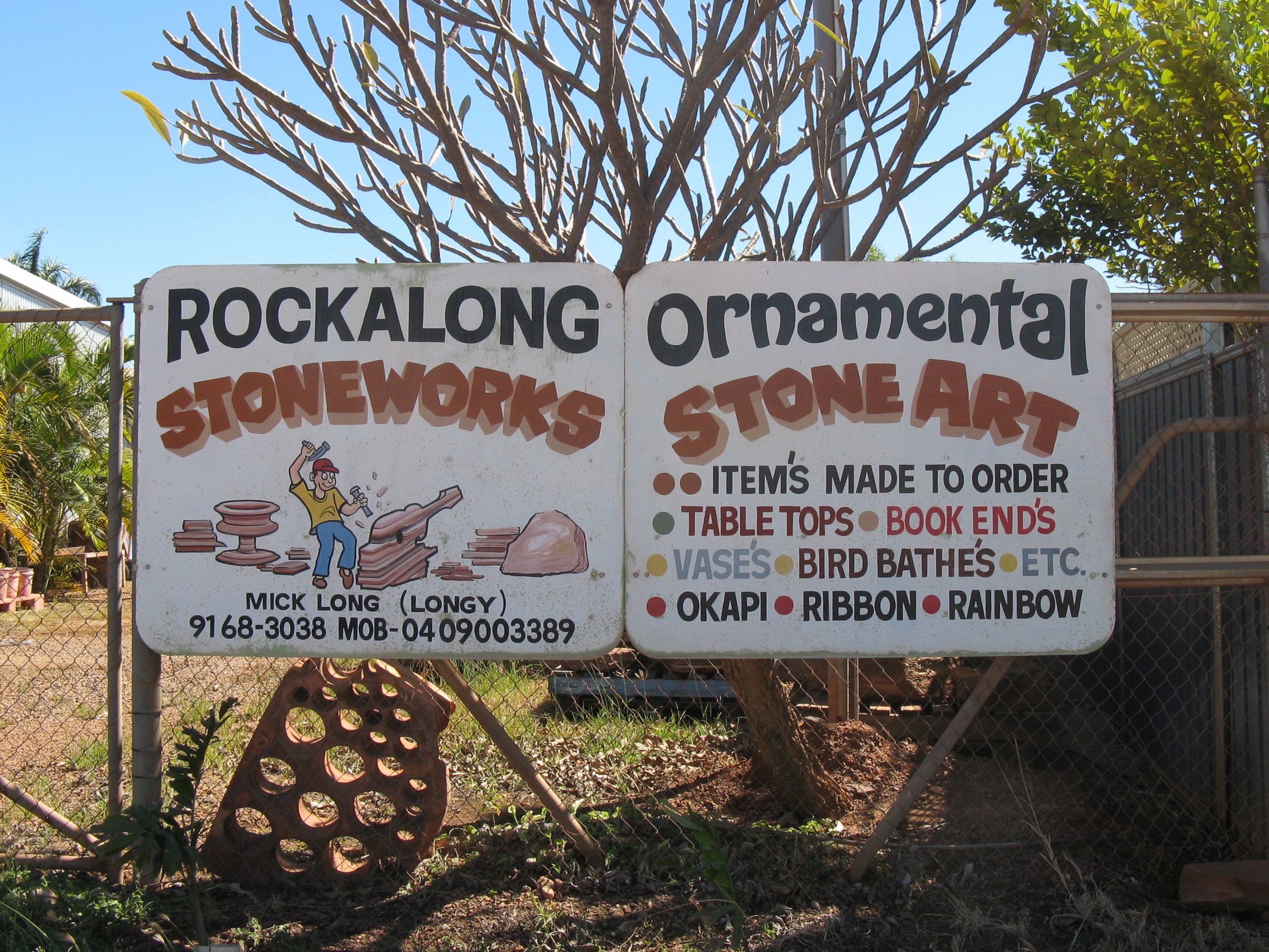
Seen on our recent holiday in Kununurra, in the Kimberleys:

Rocks. Apostrophes. They're all here for the taking.

Don’t you feel sorry for the “table tops”? They look rather lonely in there.

My philosophy regarding apostrophes is a simple one: When in doubt, leave them out. I find the odd missing apostrophe far less distracting than the opposite – but perhaps that’s just me. What say you?

(In lieu of Monday Musings which will return next week.)