Delicious descriptions from Down Under: Elizabeth Harrower on Circular Quay

When I reviewed Elizabeth Harrower‘s The watch tower the other day I wanted to fill it up with quotes from the book because her writing is so delicious. And that means, of course, that it is perfect for a Delicious Descriptions post. The one I’ve chosen occurs at the end of Part 2 (of three parts). I like it because it, albeit briefly, describes place – central Sydney in the mid 1950s – as well as one of the characters – Clare. It’s quite a long quote but here goes:

… The well-dressed, prosperous crowds pushed off the ferry, slipped coins into the ancient turnstiles and clanged through, out onto the concourse of the Quay.

Even as early as this, the small shops were busy – the bread kiosks, milk-bars, dry-cleaners and delicatessans. And he was at his usual post. He recognised her as she went towards him. Every week he looked smaller in his loose navy-blue uniform, and frailer and dustier; every week she thought he would be missing.

The morning breeze that lifted her hair and flapped the old man’s uniform was seaweedy and salty. Traffic rumbled. People ran. Clare stood before the old man and let some shillings drop into his box. The small Salvation Army soldier watched her and she watched his lips and weak blue eyes, waiting, determined. (Yet she might be rebuffed.)

‘God bless you,’ he said simply, looking at her like a child.

Oh! — Clare relaxed. ‘Thank you,’ she murmured. She was blessed, who was most in need of blessing. Blessed.

Having received what she had paid for, she moved on.

I love what this says about Clare’s desperation … and how Harrower conveys it through such a normally mundane scene. She shows how a typical, simple transaction becomes something way more while busy, purposeful Sydney life goes on around it, unaware, reflecting the world’s oblivion to what Laura and Clare are submitted to, day in and day out. I also like the sense of the giver being desperate to receive. Finally, it shows how Harrower can build up tension. Who is he? Why is she going towards him?

Elizabeth Harrower, The watch tower (Review)

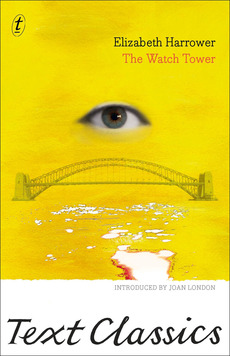
Elizabeth Harrower The watch tower
Cover for The watch tower (Courtesy: Text Publishing)

Elizabeth Harrower’s fourth and final novel, The watch tower, is a rather harrowing (couldn’t resist that) read. It is also an astonishing read, and I wonder why it has had such little recognition over the decades or so since its publication in 1966. Thanks to Text Classics, though, it now has a second chance. It deserves it. In fact, I’d say it is one of the best books I’ve read this year (to date, of course!)

What makes it so is the writing. It has a Patrick White-like intensity – and I can see her influence in writers like Joan London and Shirley Hazzard*. But first, a little about the content. It is set in Sydney and spans roughly the mid-1930s to around 1950. The plot is slim. It concerns two sisters, Laura and Clare, who are abandoned twice – first, albeit inadvertently, by their father (through his death when Laura is about 16 years old, and Clare, 9) and then a few years later by their selfish unloving mother who decides to return to her family in England, without them. What happens to them from this point is Harrower’s subject and it all centres on the ironically named Felix, Laura’s first and only boss, who comes to the rescue, or so it seems, when mother leaves the scene.

Laura had been a girl of dreams with the ability to achieve them. She aspired to be a doctor, but when tragedy strikes and she is taken from school, she’s not overly concerned. She “had read books” and in all but those with “circumstances ridiculously removed from hers, everything ended happily for young heroines.” And yet she also

had a sensation of having mislaid a vital pleasure that she could not remember, or a piece of herself.

Clare is younger and is less affected by having to leave boarding school, but life with their mother is no picnic. She expects her daughters to “take over”, to, in effect, run the house as well as go to school, for Clare, and business college then work for Laura. And so Laura’s life of servitude to one master or another begins, while Clare takes on the role of helper and watcher. Laura gets on with the job, generously and to her detriment, particularly when the misogynistic power-hungry Felix enters the scene. Clare sees what is going on, and expects more of life, but soon realises she

had really nowhere to go. Caught, not safe, cold – There were no reliable people.

From these premises, Harrower builds a story of psychological and physical entrapment in which both girls become caught in Felix’s malevolent net. Laura, ever the Pollyanna who believes noone would be consciously mean or vicious, becomes complicit in the destruction of her self while Clare, physically caught, maintains a vision of something better and does her darnedest to get Laura to see it too.

Harrower develops all this with a slow drip-drip, through language that is tightly pared to the essentials, through a simple but not even chronology that moves in fits and starts, and through a narrative voice characterised by subtle shifts in point of view. The focus is inwards  – on a small number of characters and their relationships with each other that rarely lets outsiders in. The result is a claustrophobic tone – and a slow build up of tension and suspense. Take this description, for example, of the women upon hearing Felix, drunk, coming down the path:

Breaking their poses like trees snapping branches, the women urgently regarded each other, cleared away all signs of work in an instant, examined their souls for defects, in a sense crossed themselves, and waited.

Acts of violence do occur, but are reported in retrospect. This seems to lessen our focus on the specific event and emphasises instead the response of the two young women. Will they decide to leave this time?

Late in the novel a fourth person, 19 year-old Dutch migrant, Bernard, is thrown into the mix, creating the catalyst for the denouement. For Laura, he provides a diversion for “poor Felix” and hopefully another chance for him to show a decent side. For Clare, he shows her that for all her suffering she can still be a useful person. For Felix, he of the “cold smile” and “deaf look”, well that would be telling… And as for Bernard himself, the question is whether he will survive his Felix experience intact.

And this brings me to my final point. While she doesn’t expressly say it, and in addition to her study of power and control, Harrower seems to be exploring ideas about the soul (a person’s essence) and character. Where does one end and the other begin? How do they act upon each other, and is change possible? This is a book I won’t quickly forget.

POST-SCRIPT, 2025: I wrote here about “power and control”, because the term “coercive control” by which it would now be known, was not in public parlance.

Elizabeth Harrower
The watch tower
(with a new introduction by Joan London)
Melbourne: Text Publishing, 2012
335pp.
ISBN: 9781921922428

(Review copy supplied by Text Publishing)

* Hazzard is only 3 years younger than Harrower but her first novel was published, I believe, in 1966, the year this, Harrower’s last, was published.

Monday musings on Australian literature: Kimberley dreaming

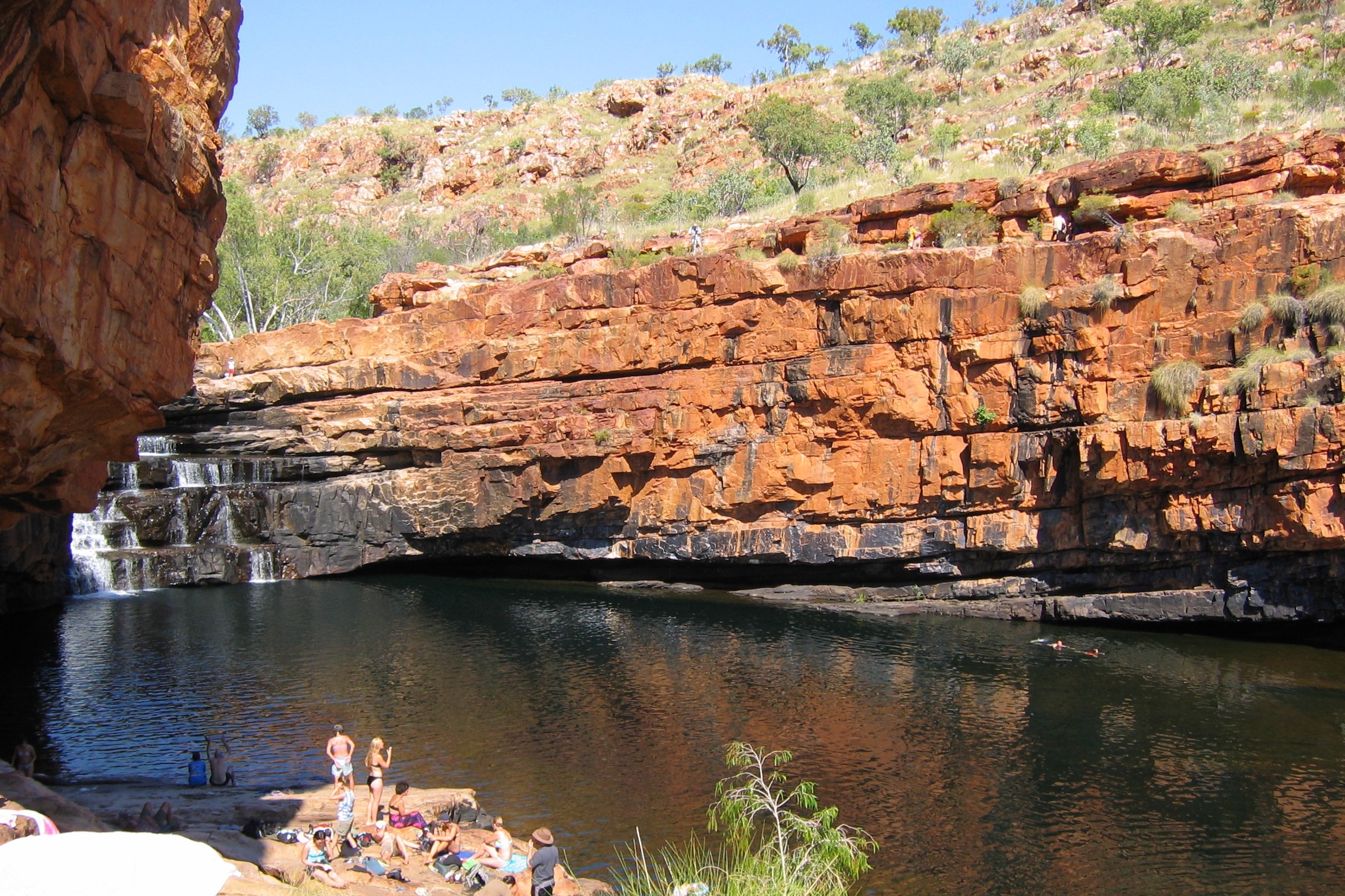
Waterhole in the Kimberleys

Waterhole in the Kimberleys

The Kimberley region of Australia is a place of dreams. The most enduring and significant of these are, of course, those belonging to its indigenous inhabitants who have been there, it is believed, for around 40,000 years. Jump forward to recent centuries and we find new dreamers – the pearlers, the gold prospectors, the pastoralists,, the farmers (with their ambitious Ord River Scheme), the miners and, most recently, the tourists.

It is a huge region occupying an area that is about three times the size of England and it is beautiful, with its beaches, gorges, waterfalls, rivers, lakes and stunning sandstone and limestone rock formations. It has a long and rich indigenous culture and a fascinating, if not always admirable, colonial history. In other words, it’s a region that is of much interest, historically, culturally, socially and geologically.

The most famous book about the region is, surprisingly, a history,  Mary Durack‘s Kings in grass castles (1959), which chronicles her family’s story from their migration from Ireland in the mid-19th century to their life as Kimberley pastoralists in the mid-20th century. Durack wrote other histories, as well as novels, children’s books, and articles. She wrote sympathetically about the indigenous inhabitants and provided practical help and support to indigenous writers and artists.

Many Australian writers, including some I’ve mentioned in recent Monday Musings like Ion Idriess and Henrietta Drake-Brockman, have set writings in the area. Novelist Dora Birtles describes the town of Wyndham:

Wyndham lay flat under the moonlight, its main street, its corrugated iron roofs, its mud flats by the mangrove edges, drawn into main relief, in highlight and dark shadow like the strong, rough contrast in a lino-cut, white and black. The salt pans glittered sharp as ice. It was not without beauty in its starkness…

Other writers who have written about the area include Leslie Rees and Randolph Stow, who worked at a mission for several months and used this experience in his novel To the islands.

A more recent Australian writer who has set writing here is Tim Winton, in Dirt Music. In an interview he said:

Lu gets to see something of the endurance and power of Aboriginal wisdom. For someone like him, a southerner if you like, with farming connections, he’s mostly been exposed to indigenes as victims, and being in the remote parts of the Kimberley he sees more power, more confidence, more evident, extant culture that resonates, educates him in an oblique way.

But I’ll conclude with a poet I don’t know, because his description conveys a wonderful sense of the region, some of which reflects my own, admittedly brief, experience:

Fire-red mountains, fissured and caverned,
lilac-hazed ranges, red-purple ravines,
have reared round, receded, and reappeared
all  day through my vision. This is the region
of baobab trees, of monstrous obese
baobabs squatting in chaos of sun-fired,
sun-blackened boulders in the ranges’ ravines.

— Ronald Robinson, “Kimberley Drovers”

Thanks to Peter Pierce’s The Oxford Literary Guide to Australia, Oxford: Oxford University Press, 1983, for the bulk of the literary background in this post.

unDISCLOSED, the second national indigenous art triennial

Indigenous Australian art has, over the last few decades, become big business in Australia and overseas, and for good reason. It is unique and it is beautiful. Most Australians, I suspect, only know of the “traditional” dot painting style of the Central Australian Desert and perhaps the wood carvings of the Torres Strait Islands. However, contemporary indigenous artists are producing works across the whole art spectrum from traditional painting to modern sculpture, from digital photography to video installations, and it is this variety that is currently on exhibition at the National Gallery of Australia in its second national indigenous art triennial titled unDisclosed. The first triennial was titled Culture Warriors and was, I understand also exhibited in Washington DC.

The exhibition is organised thematically, with the themes speaking to traditional relationships with country and people as well as to more modern concerns regarding identity and the ongoing effects of oppression. They are:

  • Family, Ritual and Country
  • Invisibility, Silence and Memory
  • Belonging
  • Manifesting Presence
  • Revelation

Twenty male and female artists spanning a wide age range are represented. While there wasn’t a piece of work I didn’t enjoy, the works that spoke most to me were those in which political comment was woven into gorgeously conceived art with an indigenous sensibility.

Particularly clever are two works about colonisation by Michael Cook, Broken Dreams featuring a woman and Undiscovered featuring a man. Each work comprises 10 photographs that comment on indigenous experience of colonisation in a surprising and mind-bending way. In Broken Dreams, a beautifully dressed indigenous women is pictured in England of the late 18th century. As the sequence progresses, moving across the sea to Australia, she is gradually undressed. In the second last photograph, she is bound by rope. The photos are simple – in their muted tones and uncluttered composition – and complex in their iconography. What, for example, is the role of the colourful lorikeet which accompanies the woman on her journey? This is the sort of work that invites conversation.

Another mesmerising work is Christian Thompson’s Heat which comprises a “large-scale three-channel projection of three young Aboriginal women, sisters, each on a separate screen”. We see only their heads and bare shoulders against a plain background. They stare into the camera – and therefore at us, the viewers – with only the occasional blink. Sometime during the projection, which runs for a little over 5 minutes, wind catches their hair which becomes alive and waves about their heads and faces, while they maintain their steady stares. (How they didn’t sneeze, I’ll never know!) The symbolism of the hair is complex and invites us to consider women’s hair, personally, historically and mythologically. It makes us think about the relationship between hair and wildness, beauty and, of course, the power held by and over women.

My third selection, for the purposes of giving you a flavour, is Nici Cumpston’s set of four large landscape works which were created by combining photography with inkjet printing, watercolour and pencil. The images all depict aspects of Nookamba Lake (aka Lake Bonney to “the interlopers”) which is part of the damaged Murray-Darling River System. The lake, now stagnant, was once part of a flourishing system supporting a rich indigenous life. Cumpston’s stark images – with their muted colours – contain evidence, if you know where to look, of that past life while also conveying the current degradation. And yet, paradoxically, the images are beautiful too. I sometimes wonder whether such beauty – though admittedly stark – can undermine the message?

The exhibition’s curators, on an the interpretive panel, describe Heat as saying:

 We are here; We are strong; We have survived.
And that is, indeed, what the whole exhibition says, loud and clear, and with a confidence that is inspiring. It is well worth seeing … I wonder if the triennial could turn into a biennial!

(Note: I have not included images of any of the artworks here for copyright reasons)

Monday musings on Australian literature: Literary hoaxes and identity scandals

Have you ever heard of the Ern Malley affair? Or of Helen Demidenko? Or what about Mudrooroo? These are just three of Australia’s literary controversies involving false identities. Why are Miles Franklin and Henry Handel Richardson perfectly acceptable pseudonyms, while Helen Demidenko, for example, is not? Aye, there’s the rub…

It seems to have something to do with a conscious attempt to defraud, to trick … and yet …

Let’s look at three recent Australian literary scandals. One is white male author Leon Cameron whose supposedly autobiographical novel, My own sweet time, was published in 1994 by indigenous publisher, Magabala Books. He presented himself as Wanda Koolmatrie, a Pitjantjatjara woman of the Stolen Generation, and he won the Dobbie Literary Award. The truth didn’t come out until he tried to sell his sequel and the publisher asked to meet him. And then all hell broke loose.

Another is Norma Khouri‘s Forbidden Love which was published by Random House in 2003 as a non-fiction account of the honour killing of her best friend in Jordan. It was a best-seller, but after being exposed by Sydney Morning Herald literary editor, Malcolm Knox, she admitted – eventually – that she had taken “literary licence”. For a work marketed as non-fiction, this was a bit of an understatement!

Then there’s Helen Demidenko, whom I mentioned in the opening paragraph. Her novel The hand that signed the paper won the Vogel award for unpublished manuscript in 1993 and then the prestigious Miles Franklin award in 1994. Helen Demidenko was a pseudonym for Helen Darville. On its own, that doesn’t seem like a huge crime, but the controversy came about because she presented her novel as being based on the experiences of her Ukrainian family. She said that the events that she wrote about in the book “actually happened”. Well, they may have, but not to her or her family. This book became the subject of a longstanding literary debate*.

What probably made people most angry about these hoaxes is that they involved authors appealing to our sympathies – by masquerading as minority writers (in the case of Cameron and Darville) and/or writing a “true” story about a devastating event (in the case of Khouri). And why did they do this? To get published, to rise above the crowd? Or, to make a point (as had been the case with the Ern Malley affair)?

In general, literary hoaxes tell us something we all know, that it is tough to get published and that prevailing cultural and social sensibilities can get in the way of  who and what gets published. They also suggest that for some people the ends just might justify the means. But, besides these, let’s say, more practical concerns, they raise some fundamental issues for readers and critics about the nature of literature, about what we mean by authenticity and how we define quality. Would Khouri’s book have packed the same punch if it was known to be fiction? Why or why not? We know honour killings occur and Khouri** reached a lot of people with her story. Is the message less valid because she based her story on research rather than telling the true story of a friend? Similarly, are Demidenko’s and Koolmatrie’s stories somehow less “authentic” and of less literary quality because the authors aren’t who they say they are?

The bottom line is, I suppose, is the work the thing? Always? It depends?

What is your experience of literary hoaxes – and what do you feel about them?

* An additional controversy regarding plagiarism came later, though she was I believe acquitted of this latter accusation.
** Khouri’s story is complicated by the discovery of other fakes or frauds in her life.

Catherine McNamara, The divorced lady’s companion to living in Italy (Review)

McNamara A divorced lady's guide to living in Italy

Bookcover courtesy Indigo Dreams Publishing

What would you say to a cross between chick lit, those mature-women-finding-themselves travel memoirs (like, say, Mary Moody’s Au revoir or Elizabeth Gilbert‘s Eat, Pray, Love), and Alice in Wonderland? Such a fusion is how I’d describe Catherine McNamara’s first novel, The divorced lady’s companion to living in Italy. Intrigued? Then read on …

The plot is simple. Marilyn Wade, a forty-something mother of two teenagers, is “dumped” in her kitchen by Peter, her husband of 17 years. After a period of disbelief and confusion, she decides to go to Milan where rumour has it that another neighbourhood “dumped” wife, Jean, is living a happy and glamorous life after finding true love at Machu Pichu. Jean, also, she believes, runs an English language school where she hopes she’ll find work. Enter Fiona, Federico, Brett, Arnaud, eventually Jean … and a whole new world, to put it mildly, for our Marilyn.

So, why do I describe it the way I did in the first paragraph? Well, to start with, it has elements of chick lit. Just look at the cover with its title in pink. But it’s not a pure chick lit cover is it? There’s no designer handbag or impossibly high heels, no tiny waisted 20-something young thing. Instead, with the exception of the title, there’s a rather classy black and white cover comprising half of a woman’s face that reminds us of more mature women, like, say, Sophia Loren. In fact, there are many references to Sophia Loren in the book. The cover, then, nicely sets up the content as having some thematic correspondence with chick lit but with a difference.

Because in fact, Marilyn’s search is not really chick-lit-like. She’s a mature woman who sees life a little more complexly, and this brings me to the second style of book I mentioned, the mature-woman-finding-herself-travel-memoir. Marilyn is not idealistic about true love and the desire to have it all that is common to chick lit. She’s been around the block, has been betrayed and hurt, and is more than a little jaded – but she has enough hope and energy to think she can still make something meaningful of her life and she leaves the comforts of home to do it. She takes risks – in all meanings of the word, if you catch my meaning – on her way to forging a new life for herself. (Fortunately, like chick lit heroines, she seems to have enough money to support her adventures into her self).

How then, you must be wondering, does Alice in Wonderland fit into all this? It’s not simply the adventures, because these would be covered by the travel-memoir genre I’ve described, but more to do with the rather fantastical world in which they occur. The world Marilyn finds herself in is characterised by somewhat bizarre people (or, at least, people who push our credulity) and by excessive coincidence. For some readers these may get in the way of their ability to suspend disbelief, since McNamara seems to take Chekhov’s gun theory seriously and pushes it to the limit. The first couple of coincidences had my antenna out, but then I got into the flow and actively looked for them. They made me laugh and feel part of Catherine’s fantasy (because, really, books in these genres are fantasy aren’t they? Or is it me who is jaded!?)

As for the writing itself, McNamara has clearly been honing her craft for some time. She has published a children’s book and several short stories. She has a lovely, original turn of phrase. And while at the beginning I felt she sometimes overused similes, as the novel wore on the writing tightened and became controlled and expressive without feeling overwritten. I liked, for example, the opening sentence:

An old friend of mine named Jean fell through a tear in her marriage and landed on her feet.

(Now, doesn’t that sound like Alice in Wonderland?). And I liked this description of Marilyn’s arrival in Milan:

Then, without waiting for my agreement, the woman who’d sold my husband the prize-winning beetle-eating show turned on her high heels and began to tug me into Milan.

Milan, the fashion capital of Italy where appearance is god, turns out to be quite a tricky place for mature-aged housewife Marilyn, but she’s ready for change and change is what she gets. She learns to smarten herself, without succumbing to the Italian fear of aging:

But this is awful [says her young lover Federico]. This woman she not know who she is anymore. She is like carnevale mask, very scary. But this is Italy now, everyone afraid to get old …

All up, The divorced lady’s companion to living in Italy is a fun and often funny read about friendship, love, risk-taking and changing direction.

Catherine McNamara describes this novel as commercial fiction. Her next book, which will be published by Indigo Dreams in 2013, is a short story collection titled Pelt and other stories and represents her foray into literary fiction. McNamara is serious about her career and is clear about her goals and her audience. From what I’ve read so far, I think we’ll be seeing more of her.

PS Elizabeth Lhuede of the Australian Women Writers Challenge will be proud of me. I have stepped out of my literary fiction comfort zone into genre, which will help me achieve my Franklin-fantastic Dabbler level of the challenge. Thanks Catherine for the incentive, and woo hoo!

Catherine McNamara
The divorced lady’s companion to living in Italy
Stoney Stanton: Indigo Dreams, 2012
284pp
ISBN: 9781907401732

Review copy courtesy Indigo Dreams Publishing via the author who has been, for several months now, a regular commenter on this blog.
Kate Chopin, After the winter (Review)

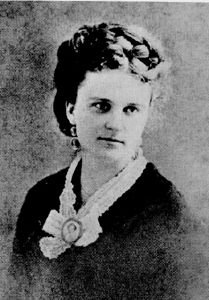
Kate Chopin

Kate Chopin (Public domain, via Wikipedia)

I am, as many of you know, a Kate Chopin fan and I therefore tend to keep an eye out for her in the Library of America‘s (LOA) Story of the Week program. “After the winter”, one of her earlier works, was an LOA story in April and so here I am for the fourth time writing about Kate Chopin.

According to LOA’s notes, “After the winter” was written in late 1891, expressly for Easter, and was bought by Youth’s Companion. However, they never published it. LOA writes:

Chopin’s story includes a mention on the very first page to [?] the calamity that had turned the main character into a misanthrope; while he was away fighting in the Civil War, his wife had grown “wanton with roaming” and had left him. It was Chopin’s first reference in her fiction to an unfaithful spouse, and it’s possible, one biographer [Emily Toth] suggests, that youth in the 1890s needed to be protected from even a passing reference to adultery – especially one that describes “women whose pulses are stirred by strange voices and eyes that woo”.

Chopin sold it again a few years later and it was finally published in 1896.

Despite the apparently risqué reference to “wanton” women, “After the winter” is a lighter story than most of her work that I’ve read. It is also a more straightforward read, but this doesn’t mean it’s not a good read. Chopin has a wonderful ability to engage readers with strong characters and effective imagery.

The story is set at Easter, which of course symbolises rebirth. As we read the story, we wonder whether this symbolism is going to play out literally or ironically, and Chopin manages to maintain our interest and suspense about this right to the end. The plot is fairly simple. Monsieur Michel had returned from the Civil War some 25 years prior to the time of the story to find his wife gone and his child dead

But that was no reason, some people thought, why he should have cursed men who found their blessings where they had left them

or, indeed, why he should have “cursed God”. However, he did and still does, so that by the time of the story he is living pretty much as a hermit, engaging with people as little as possible. Consequently, exaggerated stories had built up about things he’d done and was capable of doing. Enter a young girl, Trézanine, who has no flowers to contribute to the Easter church service. She ventures to the area around Monsieur Michel’s hut and picks all the flowers there, setting off a reaction in Michel that leads us to the story’s conclusion (which I’ll not divulge here).

What this story shows is Chopin’s writing skill and ability to develop a plot, maintain reader engagement, and use effective imagery to convey meaning and tone. The title, for example, is also both literal and metaphoric. Easter, of course, comes after winter, but our misanthrope’s life has, for 25 years, been a wintry one. Chopin makes a clever and ironic link between spring-affected Trézanine and winter-bound Michel. She needs to go hunting for flowers because none can grow in the “bleak, black yard” of her father’s blacksmith shop, while his “low, forbidding” “kennel” that seems to “scowl” is surrounded by “brilliant flowers”.

The story is told in three short acts. In the first we are introduced to Trézanine and Michel, and learn of Trézanine’s plan to go flowerpicking. In the second, Trézanine picks the flowers and Michel comes into town to confront the townspeople, whom he finds in church for the Easter service. The final act resolves the tension … but I won’t give that away except perhaps to say that it has biblical elements.

Another good story from Chopin that I’d happily recommend.

Note: My other Kate Chopin reviews are A respectable womanDésirée’s baby and Morning walk

Kate Chopin
“After the winter”
First published: New Orleans Times-Democrat, April 5, 1896
Reprinted in the story collection A night in Arcadie (1897)
Available: Online at the Library of America

Monday musings on Australian literature: Twenty Australian novelists in 1947

My Monday Musings of two weeks ago was about the first book in a series of four books on Australian fiction. The books were written by Colin Roderick and published by Angus and Robertson. The second book, which is today’s topic, was published in 1947, two years after the first, and was titled Twenty Australian novelists.

The novelists Roderick chose for this volume are:

Wow! While there were only two or three authors I didn’t know in the first post’s list, there are several I’ve never heard of in this one. Interestingly, the writer in the West Australian on 12 July 1947 commented that “perhaps Katherine Susannah Pritchard (sic), Henrietta Drake-Brockman and other well-known writers have been selected for discussion in one or other of the two remaining volumes which are to complete the series”. Certainly, these two writers, particularly Prichard, are better known today than many in the above list. They must be … They have Wikipedia links and I’m sure most of you have heard of Wikipedia’s notability requirement!

Despite my ignorance, I enjoy seeing which authors a previous generation deems important … and I did learn something interesting. Seaforth Mackenzie apparently died by downing in Goulburn, which is about an hour’s drive from where I live. I knew his name but not that he had a connection to my region. And I haven’t, I’m ashamed to say, read him.

Geoffrey Hutton, writing in the Argus in September 1947, critiqued the book. He started by arguing that Australia had yet to produce:

a figure of the type of Hemingway or Falkner*. You may say God forbid, but the point I want to make about these two writers is that they built a literary style out of the speech-habits and speech-rhythms of the American people, which is as distinct from the metropolitan English style as it is from Hardy’s slow-moving Wessex dialect. Even when they are not talking local slang or describing canyons or skyscrapers, their writing has an un-English, a specifically American taste.

I do love that “You may say God forbid”? It speaks volumes. Anyhow, he went on to state that “Australian-ness” was conveyed primarily through subject matter rather than in “style or method”, and, while he agreed that Colin Roderick was undertaking a job worth doing”, he concluded that:

Mr Roderick’s study of the trees has little reference to the wood, and although you may say that the wood is only the sum total of what grows in it, there is a great difference between a tree that grows on its own and one that grows in company. Specifically, Mr Roderick gives little or no indication of the development of the Australian novel out of the colonial novel; he does not place his novelists or satisfactorily estimate their relative significance. He has done useful work, but the growth of the Australian novel is another story.

I haven’t read Roderick’s book, but my reading of the various newspaper reports and reviews suggests it is more survey (or “panoramic view” as one journalist put it) and anthology than an analysis. Hutton clearly wanted more … I will explore this mid-twentieth century issue of the developing Australian novel a little more in coming weeks.

* What’s that they say about learning something new every day? Today, about to leap in with my proofreading pen, I discovered that William Faulkner was born Falkner. However, the name change was apparently made in 1918, so perhaps I should have used my red pen anyhow!

Acknowledgement: National Library of Australia’s Trove and Newspaper Digitisation Project.

Litblog reviews – What you said

Help Books Clker.com
Courtesy OCAL, clker.com

Two weeks ago I wrote a post about what readers look for in litblog reviews. There were some wonderful responses with a reasonable consensus, so I thought it would be worth reporting on that. Here goes …

Style and format

Most people prefer a “personal and quirky” (to use Stefanie’s description) style to a more formal academic one. They want to hear the blogger’s “voice”. Some suggested that the style can vary with the type of book reviewed.

Readers want analysis – that is, reasons, literary or otherwise, for the blogger’s opinions – over what Catherine, Laura and others described as unsupported gushiness, cursoriness and venom. DKS at Pykk said she was looking for “discussion” about books rather than reviews per se, and Stu welcomes comparison with other works.

Short reviews are preferred, though a couple of commenters like longer ones.  And everyone wants essay-style rather than dot-points.

Few commented on tags, categories and labels, though one did say “author” and “country” tags were useful. This makes me think that tags (or whatever, depending on the blog platform) may help people find a blog but, once there, readers tend not to use them to navigate around the blog. Then again, perhaps I asked too many questions and this one didn’t really engage the commenters.

In addition to my questions, other ideas were offered, including the need for white space to make reading easier on the eye.

As for the Oxford comma? It was a pretty resounding no – except to avoid ambiguity.

Content

Most of my questions were to do with content and so to keep it short I am going to use dot points. Shock! Horror! But, rules are made to be broken, aren’t they!

  • Plot summary and spoilers. There was an overwhelming “yes” for a plot summary – as long as it’s not too long – and “no” for spoilers (though one or two don’t mind spoilers, particularly with a warning).
  • Background information about the author, etc. Again, most people like the inclusion of some background. But there were qualifications. People only want information that adds context to the work being discussed, otherwise a link to another site (such as Wikipedia or an author site) is the way to go.
  • Quotes. Quotes are generally liked too, but not too many or too long, and accompanied by a reason for their inclusion.
  • Images. Not many seem to care about this but Kim did make a point about including picture credits. Ah, a woman after my own heart.
  • Awards won. Again, this was not a hotly contested issue. Some found awards information useful, some didn’t care, and one didn’t want it.
  • Well-known versus lesser-known or hard-to-get books. There wasn’t a lot of discussion on this topic, either, but those who did, such as Karen Lee and Judith, said they read blogs to discover new-to-them works. They didn’t seem to mind whether those books might turn out hard to get. After all, there are always libraries and on-line second-hand booksellers to help with this, aren’t there?
  • Reading challenges. Only one response to this, and it was a no. This suggests to me that challenges are fine for bloggers to take part in, but they are not important to those who read blogs.
  • Publication details: The few who responded on this were generally in favour but didn’t see it as essential.
  • Links to other reviews: Again, there was minimal response to this question.
  • Information about where to buy the reviewed book: There was minimal response here too, and the two who did respond said “no”.

Some other ideas were offered about content. Justine said she particularly wants to know whether a trusted blogger recommends the book being reviewed. Delia and Tracey like to know why the blogger chose that book to read. And John talked of developing a critical culture, part of which involves, he said, relating the reviewed book to other books and identifying its place in the wider culture.

SO, thanks everyone for responding to my post with such enthusiasm and thoughtfulness. You’ve given me much to think about …

Note: I haven’t named every commenter in my response here, but please know that every comment was read and did contribute to this follow-up post.

Susan Johnson, Life in seven mistakes (Review)

By coincidence, really, my local reading group finally got around to reading Susan Johnson’s Life in seven mistakes just as her next novel, My hundred lovers, is to be published. Johnson has written several novels now, though I’d only read one, The broken book based on the life of Charmian Clift, before this. I loved that book and I liked this one.

Life in seven mistakes is a book targeted squarely at middle-class, middle-aged Australian baby boomers – a bit like, perhaps, Jonathan Franzen‘s The corrections was for Americans. It’s about a family – parents Nance and Bob who have retired to Australia’s answer to Miami, Surfers Paradise, and their three middle-aged children, Elizabeth, Robbo and Nick. They are not a particularly well-functioning family (says she, in an understatement). Johnson sets out to analyse how such families come to be … and how, or if, they can be rectified.

There’s not, as is common in books like this, a strong plot.  The main story is set over a few days encompassing Christmas. Robbo and Elizabeth, with their families, have come up to Surfers Paradise from their respective big southern cities to celebrate Christmas and their parents’ 50th wedding anniversary. Nick is absent, being in prison for a minor drug related offence, but his life has been off the rails for some time. The atmosphere is charged with long-unspoken tensions – and a crisis, of course, occurs – but I won’t spoil that main plot point.

Like The corrections, this book chronicles the family’s past while also telling a story about the present gathering. Johnson does this by using alternating the chapters to tell two chronological stories. The present one starts a couple of days before Christmas with the family already gathered, while the past story starts at the time Nancy meets Bobby, and progresses until it pretty much meets the present. This structure works well. It is easy to follow and enhances our understanding of the characters without interrupting the flow of what’s happening now. The chapters have pointed titles like “On top of the mountain” in which Elizabeth sees Australia’s Great Dividing Range in symbolic terms:

As she drives, Elizabeth fancifully pictures the mountain range as forming the backdrop to their lives, and for one fantastical moment she imagines time strung end-to-end along it, her father in his working boots, aged twenty-five, at one end of the mountains, and his son Nick, aged forty-five, at the other. She sees her father at the very top of the mountain, moving trees with his bare hands, and her brother at its very base. Did her father want to remain forever elevated, was that it?

Johnson has a keen eye for family dynamics and most readers (at least from the target group I described) would have moments of recognition here even if, hopefully, the whole is not their experience. It is this, together with Johnson’s sharply observed language, that makes this book somewhat of a page turner. You can’t help wanting to know how this motley crew came to be and what they are going to do next. Will Elizabeth, the successful ceramicist about to have her first one-woman show in New York, grow up and finally stop feeling “infantilised” around her family? Will Nancy relax her drive for perfection and let her family in? Will Bob engage with his family rather than stick to his position as “star of the story”?

I must say I loved the language. Almost every page contains something that makes you stop and think, yes, she’s got it. But – there is a but – somehow the book didn’t work for me quite as well as The broken book did. I’m not quite sure why because, really, it’s the sort of book that is normally right up my alley – and by this I mean the subject matter, the setting (much of which was very familiar to me) and the language.  And yet, it didn’t totally sing for me. One reason may be that the novel is billed as “funny” and “ironic”. Whilst there is humour here, I didn’t find it a funny novel, and I didn’t really see it as ironic. It read more like a serious, straight drama to me. This can’t be my main concern though, because a novel shouldn’t be judged by how it is described by others.

My bigger issue is probably more to do with the “voice”. The novel is told third person – mainly third person, limited.  And this limited point of view is predominantly Elizabeth’s. It’s her pain, her inner conflict, that we are mostly privy to. But the point of view does shift at times. It has to, for example, in the chapters about Bob and Nancy’s marriage because Elizabeth can’t know their story. And so, there are subtle shifts between Elizabeth’s, Bob’s, Nancy’s and sometimes an omniscient viewpoint. This, I think, spreads our engagement a little thin. The book feels like it’s meant to be Elizabeth’s, but it isn’t totally, and so when the resolution comes it feels a little, well, limited.

It was nonetheless a good read … and I would certainly read more Johnson. Can’t say  better than that!

Lisa at ANZLitLovers loved it. Resident Judge enjoyed it too, and like me, saw some similarity to The corrections.

Susan Johnson
Life in seven mistakes
Sydney: Bantam, 2008
346pp
ISBN: 9781741669190