Eudora Welty, A curtain of green (Review)

This week I received the Library of America’s annual email in which they list their “Top 10 Story of the Week selections of 2016″. I’ve only read eleven of their selections this year, but two – Kate Chopin’s “A pair of silk stockings” (my review) and Willa Cather’s “Enchanted bluff” (my review) – are in their Top Ten. More interesting to me though is that it contains another writer I like, Eudora Welty. I read her book One writer’s beginnings and what is probably her most famous short story, “Why I live at the P.O.”, before I started blogging, so I decided to read this Top Ten story, “A curtain of green”.
weltycurtainofgreenWelty was a short story writer and novelist who wrote mostly about the South. She won the Pulitzer Prize in 1973 with her novel The optimist’s daughter and, according to Wikipedia, was the first living writer to be published by the Library of America (LOA)! “A curtain of green” was one of her early stories. It provided the title for (and was included in of course) her first published collection of short stories (1941), which also includes “Why I live at the P.O.”

However, before I get to the story, I want to share a little from One writer’s beginnings. This book originated in a series of lectures, the inaugural ones apparently, she gave in 1983 at Harvard University, the William E Massey Sr. Lectures in the History of American Civilisation. The cover of my 1984 edition claims that it was on the New York Times Bestseller List for 46 weeks! Pretty impressive for a series of essays I think. She was born in 1909 in Jackson Mississippi, the eldest of three. From the opening pages of the book she tells us how her growing up contributed to her writing.

For example, in the first paragraph she mentions growing up “to the striking of clocks”. She’s not sure whether it’s because of her father’s Ohio family “having been Swiss back in the 1700s” but her family were all “time-minded” all of their lives:

This was good at least for a fiction writer, being able to learn so penetratingly and first of all, about chronology. It was one of a good many things I learned, almost without knowing it; it would be there when I needed it.

Surely there’s a little bit of the tongue-in-cheek in her reference to the Swiss origins? Anyhow, two pages in, and she’s talking about her parents’ respective reactions to the weather, her father’s caution regarding storms for example and her mother’s rejection of that “as a character failing”:

So I developed a strong meteorological sensibility. In years ahead, when I wrote stories, atmosphere took its influential role from the start. Commotion in the weather and inner feelings aroused by such a hovering disturbance emerged in dramatic form.

And so the book continues in this delightful manner, sharing her childhood with affection, perception and a wonderful sly wit … but now to “A curtain of green” in which meteorological conditions do, in fact, feature!

“A curtain of green” is about grief, but it starts

Every day one summer in Larkin’s Hill, it rained a little. The rain was a regular thing, and would come about two o’clock in the afternoon.

One day, almost as late as five o’clock, the sun was still shining …

It tells the story of Mrs Larkin whose husband had died the previous summer in a terrible accident – a tree, “a fragrant chinaberry”, had come crashing down on his car as he was arriving home. She had seen it happening, had believed her love would keep him safe. And so now, while the other women of the town sit inside “fanning and sighing, waiting for the rain”, Mrs Larkin is out in her garden, where she is now all the time, because “since the accident in which her husband had been killed, she had never once been seen anywhere else”. It’s a fertile garden, needs “cutting, separating, thinning and tying back” to keep the plants from “overreaching their boundaries and multiplying out of all reason”. But, Mrs Larkin is deranged with grief. She does none of this, just works incessantly, obsessively, planting

thickly and hastily, without stopping to think, without any regard for the ideas that her neighbours might elect in their club as to what constituted an appropriate vista, or an effect of restfulness, or even harmony of colour. Just to what end Mrs Larkin worked so strenuously in her garden, her neighbours could not see …

She doesn’t offer flowers when they’re sick or die, for example. I love how the language in this story just piles on, driving us forward this way and that, just like Mrs Larkin’s grief does to her. The garden, to the neighbours who had initially tried to support her, “had the appearance of a sort of jungle, in which the slight, heedless form of the owner daily lost itself”. It’s oppressive to us, but Mrs Larkin has isolated herself behind her “curtain of green”. The only person she tolerates in this garden, and then only occasionally, is Jamey, “the coloured boy who worked in the neighbourhood”.

At this point in the story, which is told third person, the perspective shifts from omniscient to subjective, to Mrs Larkin’s point-of-view, that is. We are now in the garden with her as her memory returns her to the day of the accident. Suddenly all is still, “everything had stopped again, stillness had mesmerised the plants …” Jamey infuriates her, with his “look of docility”, of being “lost in some impossible dream of his own”. She watches him – her hunger for his innocence suddenly overtaken by a fury at his youthfulness, at his being able to be lost in this, to her, “impossible dream”. She’s overwhelmed by the unaccountability of accident, of life and death, by the meaningless of it all, and wants to smash his innocent absorption – but then comes the rain. There are two more pages in the story after this, but I’ll finish here.

This story was written in 1938 – quickly written and easily published, according to LOA. LOA also tells us that in 1931, Welty and her mother had been present when her father died of leukaemia, and they quote Welty’s biographer Suzanne Marrs as saying that her mother “discovered solace in gardening”. She spent hours in her garden, most days, often with Eudora by her side. Welty, says Marrs, wrote in an unpublished essay that “its [the garden’s] peace and fragrance are soothing to frayed nerves when we are weary from contact or perhaps conflict with the everyday world.” This memory clearly informed her story of the grieving Mrs Larkin.

“A curtain of green” is a great read, for its exploration of how grief can derail you, making you, temporarily at least, a little mad; for its evocative writing which captures that sense of derailment, taking you right into that garden with Mrs Larkin; and for its resolution which offers hope without being simplistic about it. After such a year as this has been, it seems just the right story to end on. Happy New Year everyone!

Eudora Welty
“A curtain of green”
First published in: Southern Review (Autumn 1938).
Available: Online at the Library of America

Georgia Blain: Births deaths marriages: True tales (Review)

Georgia Blain, Births deaths marriagesPoignant is a word I actively avoid in my review posts, as it’s such a review cliché, but sometimes a book really does call for it, and the late Georgia Blain’s essay-collection-cum-memoir, Births deaths marriages, is such a book. In the last essay, she talks of her mother, broadcaster, activist and non-fiction writer, Anne Deveson, trying her hand at fiction just as she, Blain, was trying non-fiction. She writes:

We had switched places, my mother and I. And we looked at each other. Both mothers. Both writers. Both trying on each other’s shoes, taking a few steps back, eyes on our feet, before we glanced across once again, curious as to how this had happened (“A room of one’s own (2)”)

The poignant thing, of course, is that these two who were so closely entwined in life, not just as mother-and-daughter but as writers, died within a few days of each other – with the sadly ironic twist that the daughter died first. It makes my heart break a little, something I wouldn’t have felt had I read it before these deaths. Such is the impact of context on our reading, eh?

Anyhow, onto the book. Births deaths marriages (the title has no separating commas) is the second memoir-in-essay-form that I’ve read this year, the first being Fiona Wright’s Small acts of disappearance. Both books follow a general chronological arc but the essay form makes it easy for this not to be strict, allowing the writers to follow tangential yet relevant threads. From here, though, the two “memoirs” depart, because the respective writers’ lives are very different. Wright, the younger writer, was writing primarily about her twenties and focused particularly on her experience of an eating disorder, while Blain was in her mid forties when writing hers. She was a published novelist and, significantly, had experienced a much more public life, not only because both her parents were public figures but also because of her mother’s own memoir, Tell me I’m here, about life with her schizophrenic son.

This book – with its intensely personal subject matter and its unusual form – offers rich opportunity for discussion. To do it justice, I’m going to have to narrow it, so I’m going to focus on form and style, but some content will push through along the way. The way I see it, there are two broad types of memoir, those which tell about lives most of us know little or nothing about (such as Frank McCourt’s Angela’s ashes, or, more obviously, celebrity memoirs) and those which are about lives much like ours. Georgia Blain’s falls into this latter category. For these ones to engage readers, they need to offer something illuminating about the lives we lead.

“the truth was a little more complex” (from “Getting in the boat”)

The first essay in Blain’s memoir is titled “A room of one’s own”. In it she reflects on her childhood, on how her mother would write about their family for newspaper columns and how reading these columns later, with their bland pictures that “did not accurately reflect who we were”, brought back the child she was, the child who wanted her family to be like the one in the columns, who thought all other families were like that and not like the messy reality she was experiencing. These bland columns are the antithesis of what Blain shares in her essays (and indeed of what Deveson herself shared in her memoir). It’s all about purpose I suppose. Newspaper columns tend to be more about entertainment – with perhaps some subtle messages about life – whilst memoirs, good ones anyhow, are about “truth”. If we don’t feel the memoirist is sharing the “truth” of her (or his) experience we are going to lose interest pretty quickly.

Blain convinces me that she is sharing her truths when, for example, she describes, in “The story my mother tells me” and “The outside country”, her fears about childbirth and her struggle to cope with the demands of motherhood. She exposes herself with soul-baring honesty when she shares her sense of disconnect, of being alone, of being “shattered” when her baby is born. She writes that she wanted to give her daughter “the place in my life that she needed and deserved, one that was without my terror and anxiety about loss of self” but it took several months for this to happen. She writes with similar honesty about her relationship with her husband Andrew. It takes some guts to write what she does.

In “Close to the bone”, Blain addresses more directly her writing life, and the difference between writing fiction, which she’d done until this book, and writing about herself, which she was now doing. Reflecting on her brother’s death, she says:

The complexity and rawness of an immediate response to pain is not easy to understand and recognise, let alone pin down in writing, in a photograph or in a film. The very act of capturing distorts. Once neatly contained, all that we felt is no longer unruly, unreasoned, immediate and wild. Perhaps this is why we hold these moments as truth. They cannot be replicated. Each time we try, we dilute their intensity, we confuse, holding up false images of this so-called truth that leave us reeling as we try to reconcile what we see encapsulated with what we have experienced.

Even her “truth”, the one she is writing, she sees, is not easy to grasp. She goes on:

I believed, and still do, that if I wrote about my own life and the lives of those I love, I had to tell the truth. But foolishly, I believed the truth lay only in the immediate…

These two excerpts reminded me of that David Hockney comment about happiness being a retrospective thing I wrote about recently, because I read them as her recognition that there are different truths – those immediate reactions and feelings, and those that come later. It’s this sort of reflection on “how” we live and interpret our lives which makes Births deaths marriages such a meaningful read.

I said that this memoir exemplifies the second type of my two simple categories, but I meant it when I defined them as being about “lives much like ours” because no life is the same. And so, Blain, like all of us, had her own set of challenges, including her control-freak, sometimes-violent father, and the tragic loss of her schizophrenic brother. One of the joys of her book lies in watching her explore and expose her own development, her learning not only to come to terms with these experiences in her life, but to use them to come to a more open, flexible way of understanding. She writes of “chasing absolutes”, of believing that “there was one truthful answer to every question” which she had to pin down, when in fact, as she learns, the truth lies in the “layers”.

In the end, there are no resolutions, she realises, but there are momentary happy endings along the way. She also realises that “writing about oneself” can “amount to more than a purely personal exercise”. It sure can, as she has proven here. This memoir is special – and not just because of the context in which I am reading it – but because it’s honest, because it doesn’t pretend to have it all sorted, because, in fact, it’s true – to her life and experience, and also to ours.

AWW Logo 2016Georgia Blain
Births deaths marriages: True tales
North Sydney: Vintage Books, 2008
ISBN: 9781742743981 (eBook)

Books given and received for Christmas, in 2016

I did a “books given and received post” last Boxing Day, and decided to do it again, but after Boxing Day because this year Boxing Day coincided with Monday Musings, and I have another tradition for the last Monday Musings of the year. Anyhow, here goes with the books I gave and received this Christmas. There are not so many of them this year, for some reason.

  • Robyn Cadwallader, The anchoressFor Ma Gums, who has worked as a lexicographer, yet another word-oriented book: John Simpson, The word detective: Searching for the meaning of it all at the Oxford English Dictionary, which I bought on spec when I saw it in the National Library’s bookshop (I think). Simpson was once chief editor of the OED. Next year I really will have to get her something different.
  • For Brother Gums, an historian who loves walking: Rebecca Solnit’s Wanderlust, as the result of Stefanie’s (So Many Books) review. It even mentions Lizzie Bennet apparently.
  • For Sister-in-law Gums, who likes to think about things: The best Australian science writing of 2016 . I loved (my review) the 2015 edition so I’m hoping she will like this. (I was tempted to keep it for myself!) And SNAP, in one of those wonderful readerly coincidences, Brother and Sister-in-law Gums gave this book to Mr Gums – so I will now have an opportunity to read it after all!
  • For Gums’ Californian friend, who showed interest when I told her about this book in a letter: Robyn Cadwallader’s The anchoress (my review).
  • For Gums’ Californian friend’s daughter, who’s just finished her law degree and might be interested in some Aussie crime: Peter Temple’s The broken shore.
  • For Gums’ Californian friend’s other daughter, who is interested in things factual and, I think, scientific: The best Australian science writing of 2016. (This book did well this Christmas in our neck of the woods.)

I did do a little shopping to help out Ma Gums, and bought on her behalf for her grand-daughter, aka Daughter Gums, Maxine Beneba Clarke’s The hate race. (I’m hoping that I might get to read it too!)

As for what I received, a varied but much appreciated bunch:

  • From Parents Gum: Grahame Greene’s Travels with my aunt, because they knew that it’s on my reading group list for next year. They’re not silly: they know this is one book they’ve given me which they can be confident will get read within a reasonable time of their giving it to me.
  • From Brother and Sister-in-law Gums, who know my interest in indigenous Australian culture: Kanalaritja: An unbroken string: Honouring the tradition of Tasmanian Aboriginal shell stringing, supporting a touring exhibition (and, to go with it, an original, authentic – and gorgeous – shell string necklace.) A beautiful gift.
  • From my Californian friend, who reads my blog and with whom I correspond regularly by snail mail, and who, therefore, knows my reading taste well: Viet Thanh Nguyen’s Pulitzer prize-winning The sympathizer. A commenter on my review of Josephine Rowe’s A loving, faithful animal recommended this book, as did the present-giver in a letter, so I’m very pleased to have it.
  • From a Jane Austen group member (a lovely out-of-the-blue present): Helena Kelly’s Jane Austen: The secret radical. This sounds intriguing, and I can see that the first couple of chapters on Northanger Abbey will come in useful when my group discusses this, Austen’s first novel, in 2017.

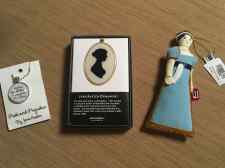
Jane Austen ornament and pendantsAnd I also received a couple of other book related gifts from friends who know me too well: a pendant necklace with a quote from Jane Austen’s Pride and prejudice,”I declare after all there is no enjoyment like reading”; and two gorgeous Jane Austen tree ornaments (a silhouette and a little figure). It pays, sometimes, to have obsessive interests!!

What about you? Any Christmas book news you care to report?

Monday musings on Australian literature: Australian Women Writers’ Challenge 2016

AWW Logo 2016For the fifth year in a row, I’m devoting my last Monday Musings of the year to the Australian Women Writers Challenge*.

This year has been one of consolidation rather than of huge change for the Challenge, as we got used to our self-hosted site to which we moved in 2015. The big advantage of this move was that it enabled us to produce a single searchable database of all reviews logged since the challenge started. It now contains reviews for nearly 3,600 books across all forms and genres of Australian women’s writing, an increase of 20% on last year’s total. A good achievement n’est-ce pas?

Once again the Challenge ran some special events during the year, achieved some milestones, and introduced some new initiatives. These include:

A big thanks to author/researcher Jessica White for her special posts on diversity – the Migrant heritage, Aboriginal and Torres Strait Islander Heritage, and writers with a disability  posts – and to Kelly (Orange Pekoe Reviews) for creating the Bingo Challenge, which we hope to run again in 2017. And a shout out too to Brona, Debbie Robson and Elizabeth who often commented on my AWW round-up posts.

The Australian Women Writers’ Challenge is the only challenge I do (or have ever done). This year I posted 30 reviews for the challenge, three more than last year. I managed a similar variety in my reading, but only dipped once into my TBR pile (to read part of Christina Stead’s Ocean of story for Lisa’s ANZLitLovers’ Christina Stead Week). Last year, I challenged myself to tackle my TBR pile and I failed, miserably. I also let the ball drop this year in one of my favourite areas, classic Australian women’s fiction. I’m therefore making no promises, setting no goals (at least publicly!) for next year.

Anyhow, here’s my list of works read for this year (with links to the reviews):

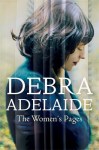
Debra Adelaide, The women's pagesFICTION

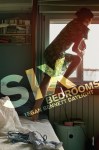
Tegan Bennett Daylight, Six bedroomsSHORT STORIES

POETRY and VERSE NOVELS

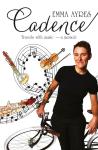
Emma Ayres, CadenceNON-FICTION

As in each year, there are subtle differences in this year’s list, though none are big enough to suggest my reading tastes have changed! For example, last year 48% of the reviews were for novels, while this year only 40% were. Half of these were debut novels. This year saw a return to 2014’s heavy emphasis on Memoir in my non-fiction reading, though there was some interesting playing with form. Not only were a couple of memoirs told through essays, but I also read three mother-daughter stories which combined elements of memoir with biography.

aww2017-badgeAnyhow, if you are interested in the challenge, you can check it out here. The 2017 sign up form is ready so do consider joining up, as we welcome all – women and men – to join us. I’ll be there again. The challenge is also on Facebook, Twitter (@auswomenwriters), GoodReads and Google+.

Finally, a big thanks to Elizabeth and the rest of the team – including Lewis, our wonderful database developer – for making it all such a cooperative, and enjoyable experience. I look forward to seeing what 2017 brings.

* This challenge was instigated by Elizabeth Lhuede in 2012 in response to concerns in Australian literary circles about the lack of recognition for women writers. I am one of the challenge’s volunteers – with responsibility for the Literary and Classics area.

David Hockney at the National Gallery of Victoria

David Hockney

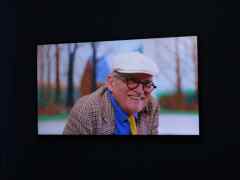
David Hockney (from video at NGV)

It’s a while since I wrote about an art exhibition, not because I haven’t been to any but because this is a litblog (and I’m even less of an art critic than I am a literary one). However, I did feel the urge to write about the David Hockney Current exhibition, which is now showing at Melbourne’s National Gallery of Victoria (NGV), because I have a long-standing – if rather rudimentary – interest in him.

It all started when, early in my film librarian career, I selected for the library a documentary about Hockney. That would have been the late 1970s or early 1980s. I hadn’t heard of him before that, but I was attracted to his larger than life, big, bold, art. This film featured, among other works, his famous 1967 painting, “A Bigger Splash“. My next memorable encounter came about twenty years later when, in 1999, the National Gallery of Australia acquired Hockney’s immense work, “A Bigger Grand Canyon”, and we hot-footed it to the Gallery to see it (having seen the Canyon itself several times in the preceding two decades). Looking at it again now, I can see that the issues Hockney was exploring then, including point-of-view in place and time or, as the NGV describes it, “multi-point perspective”, are still fascinations for him now – even more so, in fact, given the way visual media has developed in our digital age. And so, this current exhibition, which focuses on his work of the last decade, includes not only canvas paintings, but digital prints, videos and iPad/iPhone drawings.

Bigger Trees on Water detail

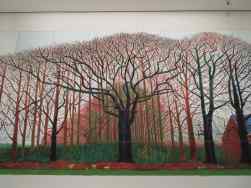
“Bigger Trees Near Warter” (large detail)

I’m not going to write a comprehensive report of the exhibition, but just share a few thoughts and highlights, starting with his work “Bigger Trees Near Warter ou Peinture en Plein Air pour l’age Post-Photographique“. (Are you seeing an ongoing “bigger” theme here!!) Like the Grand Canyon painting, it’s a multi-canvas work. Its dominant image is, by definition (not that painting titles are always so easily defined), trees. In the delightful 9-minute video interview with Hockney, which was created especially for this exhibition, he says that he has “always liked trees”. (A man after my own heart, obviously). The painting occupies the whole wall of one gallery room, with the other three walls containing digital same-size-as-the-original prints of the work. Beautiful – and rather mind-bending to be in a room surrounded by the original and its copies.

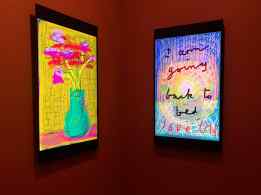
Enlarge iPad artBut, the exhibition comprised other works as well. The first thing that confronts attendees is a wall containing a row of iPhones, each containing drawings by Hockney. These little works are whimsical and fun, but have a serious edge too, reflecting, for example, on how new media can be used to create – and share – art. There are also bigger (ha!) screens displaying iPhone and iPad art in a larger easier-to-see format. These digital drawings include still lifes, portraits and landscapes, including some stunning, very large ones of Yosemite National Park (which, like the Grand Canyon in our gallery, had increased appeal for Mr Gums and me because of our familiarity with the park).

Some of the digital drawings are animated to show Hockney’s drawing process. Made me think – almost – that I could do it too but, funnily, whenever I put finger or stylus to a screen the result never looks quite as it does in my mind’s eye. The curators’ label suggests that these works “demonstrate that for Hockney art-making is a daily activity.” Hockney suggested in the interview that drawing had been dying until these little devices started bringing it back. He was amazed, he said, that the telephone could bring drawing back! Anyhow, these digital works, whether tiny or large, made for fascinating viewing, but there were so many of them it was impossible to take them all in. If I lived in Melbourne I’d happily go back.

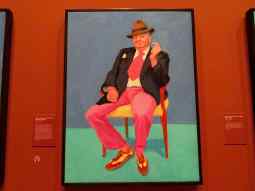
Barry Humphries portraitThe last work I want to mention is a little different from the landscapes and still lifes. It occupied a long narrow hall/gallery and contained 82 (I think) recently painted acrylic portraits of Hockney’s family, friends, colleagues and other artists. I didn’t recognise any by face, except for Barry Humphries. In the interview, Hockney mentioned these portraits, each of which was painted in just 2 to 3 days, and said that he sees them as one work. He then quipped – partly seriously – that at his age he now sees all his life as one work. I love portraits and could have spent hours pondering each one – the poses, the expressions. Why did this one sit that way, but that one sit this way, for example. What did their choice of clothes tell us about them? (So many men seemed to wear blue and cream/beige. Not Humphries though!)

Finally, I want to share another comment Hockney made in his interview. He said that “happiness is a retrospective thing”. Interesting, we thought. Of course, as life is happening we feel things – happy, sad, proud, and so on – but I think his point is that it’s only in retrospect that we can obtain a “real” perspective on the sense of those times. That is, at the time it is experienced, happiness, for example, is usually an ephemeral thing, or so it seems to me. In that sense it could be described as superficial? But later, we can look back, reflect and perhaps comprehend a more mature, lasting form of the feeling? I’m not sure what he meant, but this is the meaning I came away with!

It’s a great exhibition. It can be easily enjoyed on the surface, but if you spend time with it, you can see things going on underneath. Hockney comes across as whimsical, charming, engaging but also alert, ever-curious, always-thinking, and above all excited by new ideas (or perhaps, by new ways of exploring old ideas). We came away on a little high.

NB: In previous art posts I have not included images of the art for copyright reasons, but I’m now thinking that using a small number of low-resolution pics will not infringe copyright.

Monday musings on Australian literature: Spotlight on Georgia Blain

Courtesy: Annette Marfording

Courtesy: Annette Marfording

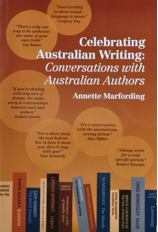
This is the fifth in my occasional series of Spotlight posts inspired by Annette Marfording’s Celebrating Australian Writing: Conversations with Australian Authors, and this time I’m featuring Georgia Blain who died just over a week ago, three days before her mother Anne Deveson also died. In a comment on my Vale post, Annette Marfording reminded me that she’d interviewed Georgia Blain for her book and so, with her support, I decided to make Blain the subject of this week’s Monday Musings.

Marfording’s interview took place in 2010, at which time Blain had published 4 novels, one of which had been shortlisted for the NSW Premier’s Literary Award; plus a memoir, which was shortlisted for the Nita B Kibble Life Writing Award, and a young adult novel. She had also been named in 1998 as one of the Sydney Morning Herald’s Best Young Novelists. At the time of her death, her eighth novel, Between a wolf and a dog had won the Queensland Literary Award for Fiction and been shortlisted for the Victorian Premier’s Literary Award. In addition, her first novel, Closed for winter, had been made into a film, and her second novel, Candelo, had been optioned for a film. Not a bad record for a writer who wasn’t, really, on everyone’s lips!

Marfording asked her, as she asked many writers, what awards meant to her. Blain simply said it “was incredibly pleasing” to be shortlisted and also to have one’s work made into a film, although on the latter she commented on the work required from others and that she “applauded” them more than herself for that. Sounds pretty humble to me. Later in the interview, when asked about her role as a judge, she comments on the degree of serendipity involved.

Anyhow, Marfording then moved on to talk about her most recent book, the young adult novel Darkwater which was published in 2010. She asked the question that I often want to ask writers who set novels in the recent past, which is why she’d set her novel in the 1970s rather than the present. This question is particularly pertinent when you are talking about a young adult novel because, as Marfording commented, “the young adults for whom the book is written weren’t alive then”. The simple – and probably obvious – answer which Blain gave is that it was the time of her own youth. She was writing what she knew, in other words. However, she also said she wanted the challenge of writing about a time when there was no technological communications – no mobile phones or texting or emailing, etc. And it was also a fascinating time she said that encompassed both “great conservatism and great liberation”.

Marfording then notes that her adult novels were also set in this period, and wondered, given Blain was only a child then, how she’d managed to evoke the mood so well. Blain replied that, being the period she grew up in, it “soaked” into her.

Moving onto subject matter, Marfording asked Blain about her focus on darkness, on pain and the loss of a major character. Blain responds not only that loss and pain are part of life but that they can lead to positive things.  I wonder whether she remembered this when six years later she wrote in The Saturday Paper about her initial hope that there’d been a mistake, followed by attempts to rationalise and intellectualise her prognosis, and finally her realisation that she needed to try

to live alongside this unwelcome guest, a guest whose presence cannot be ignored, and must be accommodated in the best way I am able.

Can we see this realisation – and her later understanding of what it means “to truly love” – as some of those positive things? It’s a hard – tragic – way to learn these lessons, isn’t it?

Interestingly, particularly given their deaths, Marfording comments on what she saw as “the autobiographical base” to Blain’s novels and whether there was “an element” of her trying to understand her mother and their relationship. Blain said that she didn’t see it this way, and that she didn’t believe in writing for catharsis. In fact, she said, that this can be self-indulgent and that she writes when she has some measure of resolution. But she followed this up with

of course I constantly draw on my life when I write and I think any writer who says to you that they don’t is lying to you.

I like her calm reason, I must say. Later in the interview, Marfording returns to her relationship with her mother, from a different angle, that of being the child of writers. Blain’s response is interesting, and perhaps a little guarded, when she says she “thought Why bother hiding it? It’s part of who I am and it doesn’t bother me that much”. My understanding, I should add here, is that Blain had a good relationship with her mother but that the family did suffer under a physically violent father, Ellis Blain.

Here is an excerpt from her autobiographical essays, Births, deaths, marriages:

Detailing his extreme physical outbursts was also an easy way of making people understand why I had so little love for him. But there was so much I could not describe in neat episodes. His presence alone created tension; it was the threat of what he might do that kept us tiptoeing, scared, around him. Each night we ate dinner in silence, knowing that the wrong word, a dropped piece of cutlery, even the scrape of a chair could set him off. He would slam his fist down…

I’m not going to summarise the whole interview, of course, but I do want to share a few more things. One of these is in relation to researching her various settings. Blain responded that

I’m quite a lazy researcher [laughs] but I write about places that have had a strong impact on me, and I work from memory … “Candelo” was set in a town where we had holidays when we were young, and again, I did not go back and research there. I actually got the geography of the town completely wrong – I did a reading in Candelo once and readers almost chased me out of town – but that actually doesn’t matter to me because what I’m doing is drawing on the impact that the place had on me.

I hear you, Georgia! I am one of those readers who doesn’t care about this sort of factual detail in a novel. I care about emotional truths, about whether they make sense to and move me, not about whether that hill is really here or over there. But, I often feel I’m in the minority. Anyhow, I wouldn’t have driven her out of town!

Marfording asked her about the impact of bad reviews, commenting on her reference to self-doubts, but once again Blain responds with a calm reason. She admits they can “knock you for a six” but then says that her main concerns are commercial. Will the bad review affect sales and/or the ability to find a publisher for the next book?

Finally, Marfording asked her about her favourite writers. Like Annette, like me, I’m guessing you’re interested in the answer? Well, they are Alice Munro and Richard Ford (his short stories specifically). In a 2008 article in The Australian, she also mentions Alice Munro, but this time alongside WG Sebald. Interesting choices don’t you think?

It’s an interesting interview. Blain says at one stage that maths was her best subject at school. I think you can see the clear, logical, mathematical brain at work here, a brain that, given what we know of the challenges she faced in her life, probably stood her in good stead – or, am I generalising too much?

Previous Spotlight posts:

Annette Marfording
Celebrating Australian Writing: Conversations with Australian Authors
Self published, 2015
273pp.
ISBN: 9781329142473

Note: All profits from the sale go to the Indigenous Literacy Foundation. To find out where you can purchase this book, please check Marfording’s website.


Elizabeth Jolley, An innocent gentleman (Mini-Review)

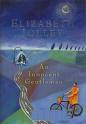
Elizabeth Jolley, An innocent gentlemanNote: this is a mini-review compiled from the notes I made when I read Elizabeth Jolley’s An innocent gentleman before blogging. I found them on some scrappy pieces of paper while decluttering and figured my blog is the best place to keep them … not floating in some drawer somewhere!

Most if not all of Elizabeth Jolley’s books that I’ve read deal with the difficulties in forming and maintaining meaningful human relationships. Of course, a lot of writers do this – after all people and their relationships are the stuff of life. But Elizabeth Jolley tends to deal with the disturbing or unsettling sides of our relationships. She explores the ‘feelings’ people have but often don’t admit to, such as feelings for a person of the same sex or for a person for whom they should not have feelings. This might be because of age or power differences or infidelity. She shows how difficult it is – though we desire it so – to maintain a long-term intimate or deep relationship that is equal on all levels (physical, intellectual, social, material, etc). And she usually does it with a deep sense of irony. In this, she is, to me, a contemporary Jane Austen.

And so, in An innocent gentleman, Jolley’s last novel, we have three main characters – Henry, Muriel and Mr Hawthorne – who have a complicated set of relationships with each other based on wishes and desires for something deeper, happier. The setting is World War 2, and the woman, Muriel, has married ‘down’ according to her mother. Henry is her husband, and Mr Hawthorne is the ‘classy’ man they meet. If you suspect the “eternal triangle” you’d be right, sort of, but in Jolley’s hands it doesn’t play out to script. The relationships that develop are complex … and play, for one thing, on the notion of innocence.

There is an autobiographical element to this too. In her essay collection, Central Mischief, Jolley writes about her mother’s long-running adulterous relationship, which her husband, Jolley writes, “grudgingly accepted”. He was an older, more well-off man. It’s not surprising, really, that Jolley explored complex, odd-to-many-of-us relationships.

Anyhow, besides these three, there are some secondary characters – Muriel’s mother, their neighbours the Tonkinsons, the two little daughters, and Victor and Miss Morton – who circle around these characters, being affected by or affecting the central relationships. This is very Jane Austenish too, in fact, this focus on a small range of characters operating in a small sphere, which comprises, in this case, a town in the midlands and a trip to London. In Jolley’s hands, though, there’s often a suffocating sense of lives too well controlled, too small, and of a desire, sometimes, to break out.

Jolley quotes Wordsworth: ‘…There is a dark/Invisible workmanship that reconciles/Discordant elements, and makes them move/In one society’. And so, as in most of her books, there is not a final resolution where the characters find their place, resolve their issues. There is just a point in time where they have learnt something about themselves and resolve to keep on going, doing the best they can ‘in one society’, but what that best entails is another thing.

Lisa at ANZLitLovers is also an Elizabeth Jolley fan, and has reviewed this book.

AWW Logo 2016Elizabeth Jolley
An innocent gentleman
Ringwood: Viking, 2001
258pp.
ISBN: 9780670912155

Vale Anne Deveson (1930-2016) and Georgia Blain (1964-2016)

Anne Deveson 2013

Anne Deveson, 2013 (Photo: Courtesy Mosman Library, using CC BY 2.0, via Wikimedia Commons)

If you are a person of a certain age in Australia you will know Anne Deveson. She was a radio broadcaster first, then filmmaker, activist and writer. Her death this week after suffering for some years with Alzheimer’s Disease is the saddest thing. She was 86, but sadder still is that just three days before she died, her daughter, novelist Georgia Blain, died of brain cancer, aged 52. We knew it was coming, she’d written about it, but she ended up with less time than the general prognosis she’d been given. These are big losses.

I’m going to focus here on Anne Deveson, partly because Lisa (ANZLitLovers) has written on Georgia Blain and partly because I so admired Deveson. She was one of those people you could rely on to be honest but warm, to fight for the people who needed fighting for – though her own life was not an easy one.

She popped up in the most interesting places, including, controversially, advertisements for Omo laundry powder in the 1970s!

We all knew her face from these ads – I wonder why she did them? Money, I suppose, but we soon came to realise that social justice and the well-being of humans were her real passions. She was a member of the inspiringly conceived (by one of our most visionary prime ministers, Gough Whitlam) Royal Commission on Human Relationships, from 1974 to 1977. This Commission was charged with gathering “a wide range of information about the private lives of Australians in order to better inform public and social policy”. An obituary for Deveson in the Sydney Morning Herald described the Commission as being instrumental in areas like “the legalisation of homosexuality, the decriminalisation of abortion and the establishment of women’s refuges”.

I became aware of her, though, through other means, such as discovering her work in film when I was working as a film librarian. The main films I remember were Who Killed Jenny Langby? , a 1974 docudrama about a woman/mother/wife who commits suicide; Do I Have to Kill My Child?, a 1976 documentary about child abuse and desperate mothers who need help; and then  Spinning Out, her 1991 documentary about schizophrenia. You are probably getting a sense now of where her heart was.

Anne Deveson, Tell me I'm hereAnd then there were her books. Her memoir, Tell Me I’m Here (1991), about life with her schizophrenic son, was the first book I read with my reading group upon my return from a posting in the USA. It is imprinted on my mind – and not just because it was so lovely to be back with my reading group! It’s, dare I be clichéd, a raw book. We need people like Deveson who are prepared to not sugarcoat the darker sides of human experience. She speaks of the love, the desperation to find a solution, but also of the shame, the violence and the fear. Best, I think, if I share an excerpt with you, from the first page I randomly opened today:

10 November. Georgia [Blain, of course] was to have her first exam, English, the following day. English was her best subject and she was expected to do extremely well; she had studied hard against big odds. Poor child, I thought as I looked at her taut face.

We went to bed early. At about ten thirty I heard a banging sound downstairs. Jonathan had forced himself in through the cellar door and was climbing the stairs. I sat bolt upright. At all costs he must not wake Georgia. I put on a dressing gown and ran downstairs. Keep calm. Make some tea. ‘No thank you,’ he said, he didn’t want any tea. His eyes followed me as I moved around the room, and even now as I write this I feel you might be thinking I am being melodramatic. But madness is sometimes the stuff of melodrama, and if you don’t take it seriously it can become tragedy. Jonathan had one of the kitchen knives in his hands and he waved it at me and ordered me to sit down …

And so she continues to describe the horror – his terrible appearance “three safety pins dangling from one ear” and wearing jeans that were “dirty, tattered and at half mast”,  as he continued to wave the knife and threatening “I’m going to get you before you get me”. She manages to give him tea and cake, and says she’s going to let the dog out. She goes to the GP who lives up the road, but whom she doesn’t know, to ask his help to get Jonathan to hospital. The GP clearly doesn’t want to get involved, but does come back with her. Deveson continues:

I introduced him to Jonathan and told Jonathan I thought he needed to go to hospital.

‘No sir, no sir, I am not sick,’ Jonathan said in a whining voice. He continued to spin the knife. ‘My mother only thinks I am sick and she’s got the army trained against me.’

Dr W said he couldn’t see any army and suggested that Jonathan might feel safer in hospital.

Jonathan disagreed, ‘I’ve got the PLO on my side.’

At this point the doctor draws Deveson into the hallway and tells her, confidentially, tgat she has a “dangerous young man there”! Deveson, relieved, assumes this means he’ll help get Jonathan to hospital. What does Dr W say but “He doesn’t want to go.” Helpful, huh? After further discussion, the doctor decides to call the police:

Dr W looked relieved and rang the police. He said that I seemed to be an educated sort of woman, even though he didn’t know me. What was the implication from this? Ignore all women if they don’t have an education?

Ckear-eyed about the bigger picture, while describing an intensely personal experience. The book won the Human Rights Non-fiction Award in 1991, just one of several awards Deveson won over the years for services to media and the community. She wrote other books too, including Coming of age: Twenty-one interviews about growing older (1994) and Resilience (2003). Both of these, as was her wont, blended the personal with the political, with the social implications. She was a tenacious and influential Australian about whom we can truly say she left the world a better place.

The tributes have started appearing, including one from Wendy McCarthy, ten years Deveson’s junior and for whom Deveson had been an early role model. There will be many more over the coming days, so I’m going to leave it here, having paid my little tribute to a woman I admired. Vale Anne Deveson – and vale, too, Georgia Blain. Brave women both.

Monday musings on Australian literature: ABC RN presenters name their best reads of 2016

Now, here’s my conundrum. We (at least I think I can speak for a general “we”) want Australians to read widely, because it’s important for us to understand cultures that are different to our own. But, given how small the Australian market is, we also want people to read Australian literature (and see, for that matter, Australian films which struggle for recognition and box office).  To achieve more people reading Aussie writing requires promotion, and there’s nothing like people of influence (like those I reported last Monday) naming and talking about Australian books to help this process.

Helen Garner, Everywhere I lookSo, what happened when ABC’s RN (Radio National) presenters named their picks for 2016? Well, there are 18 presenters on this list, and only two named Aussie books:

  • Paul Barclay (presenter, Big Ideas): Stan Grant’s Talking to my country. Stan Grant is a journalist who has an indigenous background, and his book, says Barclay “might not be quite the best thing I’ve read this year” but he says that its message about “growing up feeling excluded and subjected to bigotry in your own country” has stayed with him. Great choice. It’s on my TBR pile and everyone who’s read it says it’s a book all Aussies should read.
  • Sarah Kanowski (co-presenter of Books and Arts Daily): Helen Garner’s Everywhere I look. Oh, lookee you here, another Aussie, and what a lovely one it is. (See my review.) Kanowski – I always knew I liked her (haha) – described it as the book that gave her the “most delight — and most wisdom” this year.

So, what did the others choose? Eight chose British writers – mostly novelists:

  • Richard Fidler (presenter, Conversations): Peter Frankopan’s The silk roads: (non-fiction)
  • Andrew Ford (presenter, The Music Show): Alan Bennett’s Keeping on keeping on. (non-fiction)
  • Ann Jones (presenter, Off Track): Max Porter’s Grief is the thing with feathers. (novel)
  • Patricia Karvelas (presenter, RN Drive): Deborah Levy’s Hot milk. (novel)
  • Lynne Malcolm (presenter, All in the Mind): Ian McEwan’s Nutshell. (novel)
  • Rachael Kohn (presenter, The Spirit of Things): Andrew O’Hagan’s The Illuminations. (novel)
  • Amanda Smith (presenter, Sports Factor): Graham Swift’s Mothering Sunday. (novel)
  • Robyn Williams (presenter of The Science Show): Julian Barnes’ The noise of time. (novel)

And six chose American writers:

  • Kate Evans (presenter, Ear Shot): Colson Whitehead’s The Underground Railroad. (novel)
  • Antony Funnell (presenter, Future Tense): Amanda Foreman’s A world on fire. (non-fiction, that Funnell called “a nice, big fat book for summer reading”. I do like his definition of summer reading, I must say.
  • Cassie McCullagh (co-presenter, Life Matters): Noah Hawley’s Before the fall. (novel, which McCullagh decribed as “perfect holiday reading”)
  • Annabelle Quince (co-presenter, Rear Vision): Anthony Doerr’s All the light we cannot see. (novel, which Quince described as “perfect summer reading”.)
  • Scott Stephens (Online Editor for the ABC on Religion and Ethics): Martha Nussbaum’s Anger and forgiveness. (non-fiction)
  • Tom Switzer (presenter, Between the Lines): John B Judis’ The populist explosion. (non-fiction)

That leaves two more presenters:

  • Michael Cathcart (co-presenter, Books and Arts Daily) who chose a memoir by a Libyan-born novelist, Hisham Matar’s The Return.
  • Natasha Mitchell (science journalist and presenter) who managed to sneak in two choices, both memoirs, one English and one American: Jeanette Winterson’s Why be happy when you could be normal? and Gloria Steinem’s My life on the road.

These are all, I’m sure, worthy reads but is it wrong for me to be disappointed to see so few Aussie books here – just two works of non-fiction and no fiction? And, is it wrong for me to be further surprised that, of the preponderance of non-Aussie books, only one is not British or American? How ethnocentric we are! I appreciate that the presenters were asked to give only one pick (albeit Natasha Mitchell managed to squeeze in two). If they’d been asked to name three, say, we may have seen more variety, including more Aussie books.

However, I do see making these lists as a political act and therefore an oportunity for them to give a little boost to local writers. Perhaps, though, they didn’t want to show favouritism to one author over another and so went off-shore? Whatever the reason, I would love to have seen more Aussies here.

What do you think about this, particularly if you’re an Aussie? And if you’re not, what do you think about their choices?

Ted Chiang, Story of your life (or, Arrival) (Review)

Image for Story of your life

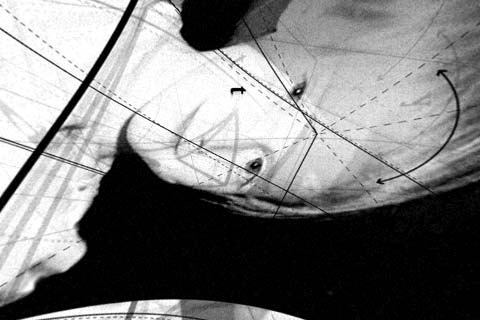
Illustration for “Story of your Life”, by Hidenori Watanave for Hayakawa’s S-F Magazine. [Permission from the artist: CC BY 2.0, via Wikimedia Commons]

Whenever I see a film, I go to Arti’s Ripple Effects blog to see whether she’s reviewed it. Sometimes she has, sometimes she hasn’t. As with books, I don’t read reviews before I see films, so I can never remember whether I’ve seen a review post pass through my inbox. Consequently, when we saw the intriguing, mind-bending sci-fi film Arrival, recently, I had to see whether she’d reviewed it, and she had. She had also provided a link to the long short story from which the film was adapted. The story, Ted Chiang’s “Story of your life”, won the Nebula Award in 2000. Having enjoyed the film, but having questions about its meaning, of course I had to read it. What a fascinating story it is …

But here’s the thing … I usually prefer to read a book or story before I see its adaptation. I don’t hold fast to this rule, particularly if it’s something I probably wouldn’t have read anyhow, like, say, Girl on a train, but if I have an interest in it, reading-before-seeing is my preference. This didn’t happen – obviously – with Arrival, mainly because I hadn’t realised it was an adaptation. So, when I set off reading “Story of your life”, I had the movie freshly in my head. Not ideal and a little distracting at first, but in fact, as I kept reading, I realised that the movie was a “true” adaptation, and I relaxed into the story.

The set up is simple enough. A bunch of aliens – dubbed “heptapods” by the humans because of their octopus-like tentacles – have landed in various spots around the world, including nine locations in the US. They do not appear to be aggressive, but why are they here. The world’s governments naturally wish to discover their purpose, and so they send physicists and linguists to try to find out.

Now, here’s the challenge, as Arti also says in her post: how do we talk about this story without giving some critical things away, because this is one of those stories where much of the meaning is in the telling, even if you don’t know it at the beginning. Arti handles this challenge by talking more about the adaptation, which was indeed well done. I, however, will take a different tack and talk more generally about why I liked the story.

I said at the beginning that I’m not really into sci-fi. I’m not keen on quest films or invasion battle scenarios, but there are sci-fi stories I’ve enjoyed, and they tend to be ones which focus closely on human concerns and issues rather than on fantasy or adventure. I’m talking John Wyndham whom I enjoyed in my teens, and Kurt Vonnegut’s Cat cradle which I read in my twenties. “Story of your life” fits loosely into this sort of sci-fi (in my mind anyhow).

The story is narrated by linguist Dr. Louise Banks, but in two threads. One is the chronological (sequential) story of her work with the heptapods, told in a traditional first person voice, while the other, which jumps around in time, comprises her memories of her daughter who we learn early on dies in her 20s. It’s also told first person, but addresses “you” as if telling this daughter about her life. There are, as you’d expect, connections between the threads, so that the transitions reflect or expand on ideas developed in the other thread.

It’s an intelligent story that demands intelligence of its readers. Chiang uses words and concepts from physics and linguistics and expects us to keep up. The discussions of Fermat’s Principle, for example, and of causal and teleological ways of understanding the world, not to mention of various linguistic forms, demand concentration of the reader, concentration that I might not, in another situation, have been bothered with – but the writing is so clear, and the story so intriguing, that I stuck with it. Here, for example, is Louise’s description of heptapod writing (which was beautifully depicted in the film):

When a Heptapod B sentence grew fairly sizable, its visual impact was remarkable. If I wasn’t trying to decipher it, the writing looked like fanciful praying mantids drawn in a cursive style, all clinging to each other to form an Escheresque lattice, each slightly different in its stance. And the biggest sentences had an effect similar to that of psychedelic posters: sometimes eye-watering, sometimes hypnotic.

One of the things I particularly enjoyed was the exploration of the idea that the language we use correlates closely with how we think. (Not a new idea I know but the implications are interesting here.) So, as Louise starts to learn the aliens’ language, dubbed Heptapod B, she finds herself starting to think differently. Instead of thinking in the traditional human “sequential” (cause-and-effect or linear) mode of awareness, she starts to appreciate the heptapods’ “simultaneous” mode of awareness in which they “experienced all events at once, and perceived a purpose underlying them”.

I found myself in a meditative state, contemplating the way in which premises and conclusions were interchangeable. There was no direction inherent in the way propositions were connected, no “train of thought” moving along a particular route; all the components in an act of reasoning were equally powerful, all having identical precedence.

It’s the idea that you have to know the effects before you can know the causes, that all the components of an action or event, in other words, are simultaneously there. I did say mind-bending didn’t I?

Anyhow, I expect the non-linear/non-chronological second thread of her narrative is meant, in part anyhow, to reflect or illustrate this more holistic or teleological way of thinking.

Ultimately, “Story of your life” is a philosophical story that gets to the nub of how we understand time, of what we know, of what we can (or would change) if we could. And that’s about as close as I’m going to get to giving it away. I do recommend you read the story and see the film.