Monday musings on Australian literature: Reading indigenous literature

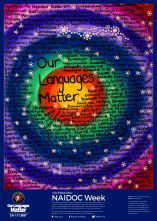
2017 National NAIDOC Poster (used under Creative Commons licence, CC BY-NC-N4 4.0)

Each July, as well as contributing at least one review to Lisa’s ANZLitLovers Indigenous Literature Week, I try to write a Monday Musings post related in some way to NAIDOC week which, as Aussies will know, is a week, usually the first full week in July, during which activities are planned to “to celebrate the history, culture and achievements of Aboriginal and Torres Strait Islander peoples”. Each year there is a theme, and this year it’s a good one, Our languages matter.

I have for as long as I can remember – since high school anyhow – been interested in social justice and civil rights (as we called it in the 1960s & 1970s). I read a lot back then about indigenous Australians and African-Americans in particular, such books as Douglas Lockwood’s I, the Aboriginal and Katharine Susannah Prichard’s Coonardoo. These books helped fire my feelings about injustice: they showed me some of the impacts of the inequities stemming from racism and of course they touched my emotions.

However, the only indigenous Australian writer I remember reading was Kath Walker as she was known then (or Oodgeroo Noonuccal as she became), until I read Sally Morgan’s My place in 1988. These writers started to help me see and feel, under the skin, the experience of being indigenous in Australia.

Now, if you keep up with discussions about the value of reading, you are sure to have read the various arguments for, or theories about, how reading can improve empathy. There was a Scientific American article in 2013 which reported that “Researchers [Emanuele Castano, a social psychologist, and PhD candidate David Kidd] in New York City have found evidence that literary fiction improves a reader’s capacity to understand what others are thinking and feeling.” Another article in The Washington Post in 2016 reported on cognitive psychologist Robert Oatley’s research of over a decade and his conclusion “that engaging with stories about other people can improve empathy and theory of mind”, resulting in improved “social ability”.

There are the naysayers to these arguments, of course, and I don’t know if reading fiction has increased my ability to empathise or not, but I can’t help agreeing with novelist Joyce Carol Oates’ statement that “Reading is the sole means by which we slip, involuntarily, often helplessly, into another’s skin.” “Sole” may be pushing it too far, but otherwise here’s my experience … and I fear I’m a bit clumsy in putting it but hope it makes sense!

I have become aware in recent years that my understanding and awareness of indigenous lives has deepened beyond the intellect and simple empathy, to a level of “knowing”.  In other words, I knew about – and could empathise with – the sense of loss, anger, disempowerment that those earlier, mostly non-indigenous writers described, but now that empathy is increasingly underpinned by knowledge of how dispossession plays out. I can never know what such historic dispossession does to a person’s psyche from personal experience but reading writers like Kim Scott, Alexis Wright, Jeanine Leane, Marie Munkara and many others, has given me the next best thing.

To labour it a little more: because I “know” my white anglo culture, I can can more quickly understand the context for a story about a gay man or an abused wife even though I’m neither of these. The leap to real empathy, which I’m arguing requires a thorough understanding of the underlying culture, is not a big one when people come from my own world. When they don’t, I can empathise at a human level – at the level any of us can when we see someone else in pain, struggling, angry, triumphant, and so on – but I sense that it’s a shallow empathy that doesn’t comprehend the forces behind that pain (etc). How do you get to comprehend those forces?

Well, Jeanine Leane, as I wrote in a recent post, says you need to immerse yourself in the “other’s” culture, in her case, indigenous Australian culture. For most of us, however, this is very difficult, if not impossible, but Leane argues that reading indigenous literature, that is writings by indigenous people about indigenous people’s lives, is a way in which we can engage with the culture. In her book, Position doubtful, which I reviewed recently, Mahood talks about the moments she waits for when, in a sense, a lightbulb turns on, when she experiences “a cognitive shift”. It’s that cognitive shift that I feel happening as I read more and more indigenous authors (of both fiction and non-fiction, particularly memoirs). It manifests in the fact that I don’t have to recalibrate my bearings so much when I open a book by an indigenous author. Certain things are givens – such as the original dispossession, the stolen generations, relationship to country. I don’t have to work to understand these, as I read, they’re there.

I hope this doesn’t repeat too much what I’ve written before, and I hope that it doesn’t sound arrogant, because it’s not meant to. I certainly know that I have much more to learn and understand. However, while I read and listen to commentaries in papers, on television, via the radio, it is through the indigenous writers I’ve read that what once felt more like information is now becoming a truth. I think that’s a powerful thing – and is why I’d argue that more Australians need to read more indigenous authors.
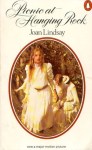
Six degrees of separation, FROM Picnic at Hanging Rock TO A few days in the country

Joan Lindsay, Picnic at Hanging RockWoo hoo, it’s Six Degrees of Separation day again, and for this month our host Kate (booksaremyfavouriteandbest) has selected a special book, Joan Lindsay’s Picnic at Hanging Rock, which is 50 years old this year. This meme, as you probably know by now, requires we players to create a chain of six more books, linking one from the other on whatever basis, flimsy or otherwise, we can justify. I have read Picnic, albeit nearly 40 years ago, and of course as always, I have read all the books I select for my chain.

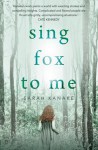
Sarah Kanake, Sing Fox to meBut, here’s where the problem started. I could think of so many ways to link from this book that I was stalled for a while. Would I link to another novel that readers thought was a real story, or a novel starting with a picnic, or a novel adapted to a popular movie, or, perhaps to another Gothic novel about mysterious disappearances. I decided on the last, and so my first link is to Sarah Kanake’s Sing fox to me (my review). Set in Tasmania, which is a favourite location for Australian Gothic novels, Kanake’s book is about a young 14-year-old girl, River Snow Fox, who disappears into the bush on a rainy night.

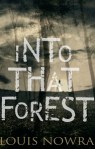
Louis Nowra, Into that forest

From here, given the prevalence of the lost child motif in Australian literature, I couldn’t not go to another book about lost young girls in the bush, Louis Nowra’s Into that forest (my review). Also set in Tasmania, it’s about two young girls, Hannah and Becky, who find themselves lost in the bush after their boat capsizes in a storm and Hannah’s parents drown. They are taken in by a Tasmanian Tiger pair, and live with them for four years until they are found – by Becky’s father. And then comes the problem, how to reintegrate into human society.

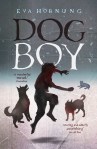
Eva Hornung, DogboyAnd now, if you know recent Aussie literature, you might guess my next link. Yes, Eva Hornung’s Dog boy (my review). It too is about a feral or wild child, this time a young 4-year-old boy who is taken in by a dog pack. In it, too, like Nowra’s, the boy returns to human society and again, reintegration proves a serious challenge. However, Hornung’s book explores the issue from a different, more scientific angle, and, although she is an Australian author, the book is set in Moscow. This gives me the opportunity to change my linking pattern from lost children to …

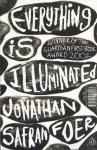
Jonathan Safran Foer, Everything is illuminatedSetting, sort of. I have reviewed other books set in Russia, but we’re now going to Russia’s neighbour, Ukraine, and Jonathan Safran Foer’s Everything is illuminated (my review). Coincidentally, it also involves the search for a lost person, though in this case it’s the protagonist’s search for the woman who, he believes, saved his grandfather from the Nazis during World War 2. It’s a Holocaust novel, but it is also a rather wild, postmodern novel that plays within itself and with the reader. None of these factors, though, generate my next link. Instead I’m going whimsical, and am linking to …

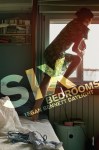
Tegan Bennett Daylight, Six bedroomsAnother three-name author. I was surprised when I thought of going this way, just how many such-named authors I’ve read, like Gabriel Garcia Marquez, Tara June Winch, Ali Cobby Eckermann and Tegan Bennett Daylight. I love these names, they have such a wonderful ring when you say them. Anyhow, of these, I’m choosing Tegan Bennett Daylight’s collection of short stories, Six bedrooms (my review). This is not one of those linked collections, but most do share a theme, coming-of-age.

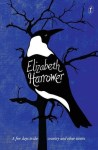
Elizabeth Harrower, A few days in the country and other stories

And now, I bet you thought I was going to link on the coming-of-age theme, didn’t you? But, I’m not. In 2016, Bennett’s book was shortlisted for the Stella Prize. It was a very interesting list, as its six books included two short story collections and an essay collection. For my final link, because I loved it so much, I’m choosing the other short story collection, Elizabeth Harrower’s A few days in the country, and other stories (my review). If you like short stories and you haven’t read it, then you have a thrill in store (is all I can say).

So, there you have it for another month. I’ve managed to include two male authors, and one non-Australian. We spent a lot of time in the bush with lost children, then ventured to the Ukraine and into bedrooms and other domestic spaces, before, guess what, somehow returning to the country (albeit not to lost children.)

Have you read Picnic at Hanging Rock? And whether or not you have, what would you link to? 

Kim Mahood, Position doubtful (#BookReview)

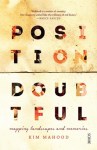
Kim Mahood, Position doubtfulKim Mahood’s memoir Position doubtful is a such a stimulating read. That might sound weird for a book whose subtitle is Mapping, landscapes and memories, but the thing is that it hits the spot in so many ways that are central to the issues confronting Australians right now. In other words, it’s about our relationship to place. Specifically, it’s about how kartiya* (non-indigenous Australians) comprehend our love for place, how we reconcile that vis-à-vis that of indigenous Australians, and how we go about respecting each other’s relationship with our land. Mahood may not explicitly generalise it like this, as for her it’s a personal journey – one exploring her experience of place and her reckoning of that with the indigenous owners – but I believe we can extrapolate her thinking to encompass something more universally Australian.

So, let me describe this personal aspect of the journey first, because this is, essentially, a memoir. It primarily covers the twenty years or so, from the mid 1990s, during which Mahood, chasing “unfinished business”, made annual trips back, from her Canberra region base, to the Tanami Desert region where she’d spent her childhood on a cattle station run by her parents, but which is now owned by the local Warlpiri people. She chronicles her desert art trips with Pam Lofts, the mapmaking she does to document country and stories, her various itinerant jobs, and most of all her relationships in the communities in which she stays, particularly Mulan (a Walmajarri community) and Balgo (where she works early on in the art centre).

Maps underpin her way of viewing and understanding place, and have become, also, the basis of her art practice. Early in the book, she writes:

In recent years I have made a number of maps with Aboriginal people, designed to reveal common ground between white and Aboriginal ways of representing and understanding country … The information marked on them is a mixture of Aboriginal knowledge – traditional camp sites, the birthplaces of individuals, the tracks of ancestors – scientific information about ancient shorelines and archaeological investigations, and the template of bores and paddocks and tracks and boundaries that represent the cattle stations and stock routes of white settlement. They serve different purposes – aboriginal, scientific, testimonial, environmental – depending on when and where they are used. Often there is a mismatch between my interpretation and the Aboriginal interpretation of their purpose.

So, this is a story about communication and negotiation, about sharing knowledge and understanding, about layers and multiple meanings, and above all, about respect for other while standing one’s own ground. The way Mahood navigates all this – the accommodations and understandings she works through, socially, personally, intellectually, scientifically, artistically and philosophically – is, really, what the book’s about. And it’s what makes it such a relevant read.

Now it’s my turn, I’m going to tell my side of the story

But of course, to write this story, she had to confront that issue I’ve raised here several times before of kartiya speaking for and/or about indigenous people. She addresses this in the last chapter (without specifically discussing the issue itself), when she describes visiting Mulan in September 2015 to tell them about her book. She organises several meetings, and reads “everything” that she thinks “might offend or upset people”. She is particularly anxious about her suggestion that the “popular version” of a massacre story she’s been told could be “a compilation of several distinct events” but she needn’t have worried. Her listeners nodded in agreement and pointed her to other people she could talk to.

This massacre “story” reminded me of another ongoing thread of mine – that one about “fact” versus “truth”. The truth is that massacres occurred – that’s not denied – but the evidence is now so murky that the various “facts” presented don’t always align. Does this mean the history, the recording of massacres, is wrong? I don’t think so.

a template of country infused with multiple meanings

The book is structured more or less chronologically following her trips, but she does move backwards and forwards occasionally – to finish an experience or flesh out a story. In between the more chronological, narrative chapters, are specifically reflective ones where she pauses to explore an idea. One is titled “Mapping Common Ground”. In it she articulates her ideas about language, maps, and being human. She says that “mapmaking was the common ground” on which she and her “Aboriginal companions put together our different conceptions of country”. She describes how maps “captured the imagination of the local mob”. They provided

concrete evidence of the knowledge that existed in the country, and they represented country in a way that everyone could understand, including the kartiya upon whom so much of the negotiations about land depended. … But the maps also aggravated the simmering arguments about who came from where, who owned which place.

And there, you see, is the politics. Politics is not Mahood’s focus but it is there, and the more you know about indigenous history, past and present, in Australia, the more you see it in the book. It’s there in the implications of changing a word from “custodians” to “ownership”, in the absence of middle-aged men resulting in matriarchies, in the “unintended consequences” of the 1968 equal wages bill, in the high prevalence of disease like diabetes, in who has or controls the money, and so on. It’s rather a mess, but “fixing” is not Mahood’s aim here, so she notes and moves on.

The title itself subtly references the underlying politics. Literally it means “of uncertain position” and is often used, for example, to indicate shipwrecks. However, when her father used the term, while navigating in the Tanami Desert, Mahood writes:

The term lodged in my mind as a metaphor for the way in which white Australians move through and occupy the country, especially the less accessible parts of it. And while the advent of satellite technology has given us the tools to find and map geographic locations with great accuracy, it seems to me that our position in relation to the remote parts of the country is more doubtful than it ever has been.

Metaphor, in fact, underpins much of how Mahood sees and explains the world, and I enjoyed that aspect of her writing, the way she finds some term or experience or object to reference bigger meanings.

Position doubtful is not exactly an easy read, but it’s a thoroughly engaging one. As memoirs go, it’s a strange hybrid, combining wonderfully warm and sometimes funny anecdotes about the people she meets and travels with, oral histories, indigenous creation stories, poetic insets, travel writing containing beautiful descriptions of landscapes, and of course her introspective reflections on who she is and what she’s doing. She allows herself to be vulnerable, and yet there’s a strong sense of self there too.

Kim Mahood, Gia Metherell

Bessie’s map, from the book and shown at CBR Writers Festival, 2016

I’ll close with some comments she makes regarding a trip to Lake Gregory with local owners and kartiya, including the palaeontologist Jim Bowler. It’s aim was to create “a cross-cultural document” showing “the interplay between  Aboriginal knowledge and western scientific knowledge in a form … easily accessible to both Walmajarri and kartiya“. She writes:

To have the ancient geography interpreted simultaneously through modern science and the Waljirri or dreaming, lays down a template of country infused with multiple meanings. While I don’t believe the creation stories in a literal way, they breathe animate life into the landscape in a form as potent and awe-provoking as the deep-time story Jim’s science tells. They complement rather than contradict each other.

And then, she talks of a discussion with Bessie, premier traditional owner for the area, in which they look at Bessie’s painting (see my image above) and the big painted map created during the project. As they talk, Mahood writes:

In putting together these two ways of conceptualising the same place, I experience a cognitive shift from which I will never entirely cover.

It’s a cognitive shift that is gradually happening throughout Australia – I hope – as we all come to terms with our different ways of seeing our history and our relationship to place and each other. This book makes an excellent contribution to this process.

Lisa (ANZLitLovers) appreciated this book too. Her write-up fills in some of the gaps I couldn’t cover without writing a tome.

aww2017 badgeKim Mahood
Position doubtful: Mapping, landscapes and memories
Brunswick: Scribe, 2016
320pp.
ISBN: 9781925321685

* Kartiya: white people (there is no one indigenous word for white people)

Monday musings on Australian literature: Changing literary tastes (2)

My last Monday Musings post was on Changing literary tastes from the 1920s to 1940s, using newspaper articles I’d found in the National Library of Australia’s Trove. Today’s post draws on just one article from the 1950s. I’m choosing just one because it, unusually in my experience, has a by-line – for a person worth introducing – and because the article is so delightful.

Leon Gellert, 1920s, by May Moore (Presumed public domain, nla.gov.au/nla.pic-an11253492, via Wikipedia)

So, the by-line. It is Leon Gellert (1892-1977), but I can’t resist telling you that when I first heard his name all I could think of was a tragic epic poem I read as a child about the dog Gelert (sometimes Gellert). Being a dog lover, that tale of a faithful dog has dogged me (sorry!) so powerfully ever since that whenever I heard the name Leon Gellert I couldn’t get past the dog – until now.

Why now? Because the article I found in Trove titled “The decline of the bookcase” was so entertaining that I decided to shake off my childish memory and check the man out. I found him in the Australian Dictionary of Biography (ADB). Biographer Gavin Souter describes him as “soldier, poet and journalist”. Gellert was born in South Australia, and taught briefly before he enlisted with the AIF. He ended up at Gallipoli on 25 April 1915, was injured, and repatriated home in 1916 after which he returned to teaching. He wrote poetry during and after the war. Souter describes him as “Australia’s closest approximation to a Brooke or Sassoon”. His short, powerful poem, “The jester in the trench”, appears in Jamie Grant’s 100 Australian poems you need to know.

According to Souter his early promise was not sustained and he turned to journalism. In 1942 he became The Sydney Morning Herald‘s literary editor “and wrote a graceful column, ‘Something Personal’, for the Saturday book pages”. The article I found is one of these, so let’s look at it.

Published on 16 June 1951, it captured my attention because it starts off talking about bookcases, and what reader isn’t interested in them! He starts

RECENTLY I roamed the city in search of some ready-made bookshelves. It was an almost fruitless search. The few that came within the bounds of my requirements were pitifully stunted little things obviously designed by craftsmen who had never read a book in their lives. The top-most compartment reached no higher than a man’s waist and the lowest could be approached only by crawling on all fours.

I was confident I would enjoy reading this. He then talks about

glass-fronted book-cupboards; ungainly remnants from late Victorian days now raised to the peerage with the dubious rank of “antique.” These, doubtless, once held their stern leather-bound arrays of Scott and Thackeray and Carlyle, close-corseted in the gloom against casual and curious hands. But they were too prohibitive in price for my pocket and too full of shadows for my purpose. There is so much unlatching and probing to be undertaken that the extraction of a volume is like an obstetrical operation.

Hmm, we Gums rather like glass-fronted bookcases because of the dust factor – but we only have a couple (recently inherited), and he is right about the “unlatching and probing”. He continues in a similarly entertaining vein, pronouncing his preference for bookcases “of open countenance that smile their invitation across the whole length of a room.” This is the type we mostly have – floor to (nearly) ceiling, most double-stacked. Very convenient, but pretty dusty too! What are your favourite types of bookcases?

He progresses from describing various bookcases to discussing their dearth in contemporary homes. He says where once they had a place in every small home, now they are viewed with suspicion:

How often have I admitted a guest to hear him exclaim, with a tincture of mistrust, as he crossed the threshold for the first time, “Ah, I see you are a reader,” and that mark you, with no more evidence to guide him than a meagre rack of books in what is referred to with sweeping hyperbole, as the entrance hall!

Hands up if, like Gellert and us, your first of many bookcases is in your entrance “hall”.

And then he gets on to WHAT people are reading …

He says that in the past people all read the same sort of material – a wide mix encompassing the likes of Henry James, H. G. Wells, Thomas Hardy, Eden Phillpots and Stanley Weyman (who was also known, says Wikipedia, as “the Prince of Romance”). “Those beyond the pale”, he writes, “read Mr. Garvice“. I had to look him up too! He was a very popular writer of romance in the early twentieth century.

However, now, he says, readers are dividing into two groups, “those who read, let us say, Virginia Woolf, E. M. Forster, Graham Greene and Joyce Cary, and the vast mass who read what I believe are called ‘Westerners’.” What’s more, he suggests, these groups are contemptuous of each other. This is interesting. Is he right that this divide, one that still largely exists today, only started around the 1950s?

Anyhow, then, having mentioned “westerners”, which, according to the writers in my first post, were their way out, he moves on to detective novels. He wonders if they are the cause of the impermanence he’s identified. The detective fiction craze has been going for forty years he says. When will it stop? One of their attractions, he thinks, is that they are a game that can be played in private, like patience, and they have “something in common with the crossword puzzle”. He quite likes detective novels himself, but is concerned that, having lasted more than thirty years – his marker for “the most obstinate vogue in history” –  detective fiction will “establish itself as a durable department of literature.”

He trots out, too, a concern about what it means to love detective fiction. We deride melodrama, he says, but “the most outrageous complexity of treachery, murder, torture and rape is regarded, by the intellectual and the illiterate, as legitimate fun”. Is it really the harmless game people think, he asks? He then tells us that detective fiction is popular with world leaders. Hitler loved them, as do “the most distinguished statesmen in the English-speaking” world and “the most scholarly writers and the most immaculate ministers of religion”. They all “squander countless hours in company with M. Poirot and Lord Peter Wimsy”. And yet, he says, when people worry about child delinquency, it’s cinema and radio they blame!

He concludes by wondering whether the time could come when detective fiction is banned. He doesn’t really want to see that, but at least it could “help to reestablish our pride in the permanent companionship of good books”.

We now know that detective fiction has indeed become “a durable department of literature”, but I’d argue that we have also reestablished our “pride in the permanent companionship of good books” (if he was right that it had been lost). Putting aside for a moment economic issues, the interesting question here is how important to literary culture is “the permanent companionship of good books” – meaning ownership and storage in personal bookcases – versus the fact that people are reading (as he says people were in his time).

Emily Maguire, An isolated incident (#BookReview)

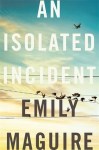
Emily Maguire, An isolated incidentEmily Maguire’s novel, An isolated incident, reminded me of Charlotte Wood’s The natural way of things (my review). Sure, An isolated incident is a crime novel, albeit a genre-bending one, while The natural way of things is a dystopian novel, but both deal with the same fundamental issue, misogyny. Wood exposes the scapegoating of women for their sexuality, while Maguire tackles violence against women (and in doing so, also traverses some of the same ground regarding attitudes to women’s sexuality).

That Maguire is going to confront the issue head-on is implicit in the irony of her title. Twenty-five-year-old Bella’s murder may have happened in an isolated place, and such murders may be rare in her small country town, but as we all know in our media-fuelled times, violence against women is not isolated. Indeed, it happens with terrible frequency. Maguire makes sure that not only do we not forget this, but that we see it in its entirety.

I started by saying that An isolated incident is a genre-bending crime novel. Now, I’m no expert in crime fiction but I know enough to recognise that this book inverts our expectations. In a nod to the genre, the novel is told chronologically with the chapters named by the date, such as “Monday, 6 April”. However, it is not told from the point-of-view of the police or detectives, and it does not focus on the whodunnit aspect, though the investigation does provide an ongoing thread. Instead, the story is told through two voices – the first person voice of Chris, Bella’s grieving big sister, and the third person voice of journalist May who has come to town with her own demons regarding a married lover. This narrative approach enables Maguire to broaden her reach, to focus on things other than catching the criminal, because that is the least relevant – I almost said least important except of course we do want these perpetrators off our streets – part of the story. The most relevant is why does this violence happen, and how does it affect those involved.

Maguire does not, however, provide any answers to these questions. Who knows why it happens? But Maguire does show some of the ways misogyny plays out in everyday life, from the “all piss and wind … harmless” pest who follows women in his car, through men who won’t take no, the men in the pub who know about violent men but do nothing, the schoolboy who enacts his sexual attraction by creating ugly pictures, to actual domestic violence resulting in a wife’s death. It’s powerful because it’s all so real – and true. And, definitely not isolated.

In a telling exchange between May and Chris, May says:

‘… You don’t realise how much most men dislike women. And knowing that, most women can’t relax around men the way you do. Can’t let ourselves show that we like them even if we really do.’

‘Ah. That’s a different thing, though. I like ’em fine, but I’m never relaxed, not fully. It’s like with dogs. All the joy in the world, but once you’ve seen a labrador rip the face off a kid, you can’t ever forget what they’re capable of.’

Late in the novel, Chris ponders this whole issue of the things men do and don’t do, and, heartbreakingly, decides:

… and there are men … who are pure and good of heart and intent and who only want to be our friends and brothers and lovers but we have no way of telling those from the others until it’s too late, and that, perhaps, is the most unbearable thing of all.

Similarly powerful is the way Maguire captures bereaved sister Chris’ grief. Chris is a down-to-earth, small-town barmaid who’s not above taking the odd man home for a little necessary money on the side. Her grief, her loss, is overwhelming, threatening to upset her sanity, and Maguire captures it well, including showing the impact of requiring a relative to identify a body when that body has been horrifically disfigured. The memory of how Bella looked, and imagining how the disfigurement occurred, add significantly to Chris’s grief.

An intriguing thread in the novel concerns the role of writing. Through May being a writer, Maguire explores, initially, the exploitative behaviour of journalists. They sweep into town en masse, intrude on people’s lives, trot out their jargon-laden reports about “close-knit” communities, and when the excitement is over, breeze out again to the next drama. May is one of these, until something about this story, and about Chris, results in her quitting her job to stay.

She explains to her brother why. It’s because she wants her writing to help overcome “the fear, the injustice”, whether by helping to catch the killers or just writing about Bella in a real way rather than simply as a victim. A little later, she tries to convince Chris to talk to her, arguing that her writing may help bring justice. As she argues with Chris, we wonder how much of what she is saying is sincere and how much is desperation to get a story, now that she’s freelance. Maguire writes:

May had started speaking in desperation but as the words came she realised she had once believed all of this about the power of a well-written story. The quaver in her voice told her that maybe she still did.

Hmm, is this Maguire, too, arguing for the value of writing her novel – and for writing in general?

So, did I like the novel? I did enjoy reading it. Maguire’s writing is compelling: it was easy to engage with Chris particularly, and to be interested in journalist May. Maguire’s picture of Strathdee is convincing, and she successfully imbues the story with a complexity that offers no easy answers. If it has a failing, it’s that it’s spread a little thin across the issues – male violence, media intrusion, grief and closure – resulting in an ending that didn’t quite punch an emotional or intellectual point home.

Quite coincidentally, just as I finished this book, Mr Gums and I watched the 2008 miniseries of Sense and sensibility, whose script was written by Andrew Davies. Towards the end comes a line from Marianne, albeit not Austen’s. Having been “burnt” by the dastardly Willoughby, she asks Elinor,  “What do men want from us – perhaps they don’t see us as people but as playthings”. Fortunately, many (most, perhaps) men do see women as people, but these novels, together with books like Anna Krien’s Night games (my review), remind us that we still have a long way to go before there is true equality, true respect, between the sexes.

This book has been reviewed by several of my blogging friends, including Michelle (Adventures in Biography), Bill (The Australian Legend), Lisa (ANZLitLovers), Kate (booksaremyfavouriteandbest), and Kim (Reading Matters). Two didn’t like it much, the others were more positive!

aww2017 badgeEmily Maguire
An isolated incident
Sydney: Picador, 2016
343pp.
ISBN: 9781743538579

Emily Midorikawa and Emma Claire Sweeney, A secret sisterhood (Pt 1) (#Review)

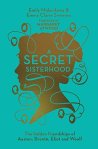
Emily Midorikawa and Emma Claire Sweeney, A secret sisterhoodMidorikawa and Sweeney’s book, A secret sisterhood, published this month, is subtitled The hidden friendships of Austen, Brontë, Eliot and Woolf, by which you might guess why a copy came my way! And so, as homework for my Jane Austen group meeting this month, I’ve just read the first part, which is about Jane Austen and Anne Sharp. If this part is representative of the whole, then I’m going to enjoy the book – but will probably read (and post on it) part-by-part. Not only will that spread my enjoyment, but it will enable me to slip the reading of it in between other books.

The impetus for the book, as Midorikawa and Sweeney (M&S from now on) explain in their Introduction, was to suss out literary friendships among female writers. They argue that literary male friendships, such as between Byron and Shelley, and Hemingway and Fitzgerald, are well-known and documented, but not so much those of women writers. They say, in fact, that “the world’s most celebrated female authors are mythologised as solitary eccentrics or isolated geniuses.” Jane Austen, for example, is seen as “a genteel spinster”, but there is more to her story than that – and M&S set about researching it.

Now, Anne Sharp is not unknown in Austen scholarship, so after reading M&S’s section, I decided to remind myself of what I already knew about this woman. She appears in several of Austen’s extant letters (Deirdre Le Faye’s Jane Austen’s letters) and in many biographies, such as those by Claire Tomalin and Carol Shields. Where she doesn’t appear, however, is in the first official Memoir of Austen written by her nephew, James Edward Austen Leigh in 1869. Why is this?

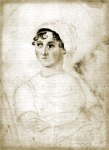
Jane Austen by sister Cassandra (surely public domain!)

Well, as Austen scholars and aficionados know, the Austen family worked hard to create what they thought was a suitable image of their famous relation. Letters were destroyed, for a start, and Jane Austen’s romances were not mentioned in the first edition. M&S argue that the family wanted to emphasise her neat handwriting, the precise way “she dropped sealing wax on her letters”, her matchless needlework. This is perhaps a little exaggerated, but the Memoir, we know, needs to be treated with some caution.

Anyhow, the real question is: was Austen-Leigh’s omission of Anne Sharp from his memoir justified, or are M&S drawing a long bow? Well, as with all research, it depends a little on your perspective and/or goals. M&S want to argue a literary friendship for Austen, and Anne Sharp would be the closest candidate for this role.

One of the features of Austen section (as I haven’t read the rest) is the insight they give into the challenges of literary research. There is, we know, a dearth of primary sources about Austen’s life. We have her letters – but their value is limited by two main factors. First, sister Cassandra destroyed any she thought were not conducive to the image of Jane that she wanted to leave, but also, Austen’s most revealing letters would have been to Cassandra, and of course she would only have written to Cassandra when they were apart. Consequently, events which occurred when they were together were less likely to have been recorded and would not have been recorded with the same openness. (Austen did write to other people, but we have even fewer of those letters. Hands up who keeps letters!)

However, as M&S found, there are other sources and these have not always been fully researched (or perhaps not even known about). For example, Austen’s niece Fanny, for whom Anne Sharp was governess, kept diaries from the age of 10. M&S write that Fanny’s “unpublished notebooks and letters” have been “largely unmined” by scholars but her writings show what must have underpinned the “deep affection” between Jane and Anne, which is the fact that Anne was a writer.

So, there in Fanny’s diaries are references to Anne Sharp’s playwriting, and M&S spend some time developing their thesis from these diaries, as well as from other sources including sister-in-law Mary Lloyd’s “pocketbook” and references to Anne in Austen’s letters. Along the way, they also research some of Sharp’s own story. M&S argue that although biographers have generally ignored the rapport between the two, Sharp was in fact a “trusted literary friend”. They cite evidence for this, including that Austen asked Sharp for her opinion on some of her novels and that Sharp responded with some writerly commentary.

Also, Sharp was one of the very few non-family members to whom Austen gave one of her 12 presentation copies of the first edition of Emma. Two others went to the Prince Regent (who’d asked for a dedication) and the established author Maria Edgeworth. M&S cite this act as indicative of the esteem in which Austen held Sharp. They also argue that her sending a copy to Edgeworth demonstrates her desire to establish some kind of literary alliance or friendship. Was it that, or did she just want the endorsement of an established author? We don’t know but M&S could be right. Whatever she wanted, however, she didn’t get it from Edgeworth.

More evidence they cite for the importance of Sharp to Austen is that Sharp was, as far as records show anyhow, one of the last people to whom Austen wrote before her death. And, she was one of the people to whom Cassandra sent not only a lock of Austen’s hair after her death, but a couple of other mementoes as well.

Have M&S convinced me of this friendship? Yes, I think so, though I’m not sure they’ve completely proved Austen’s desire for “a literary friendship”. However, this first part of A secret sisterhood is a good read, not just because I love all things Jane but because of the open way they share the process and challenge of literary research. I expect each part will be different because the sources and existing knowledge will be different, but I’m looking forward to reading them and will share my thoughts with you (eventually).

Emily Midorikawa and Emma Claire Sweeney
A secret sisterhood: The hidden friendships of Austen, Brontë, Eliot and Woolf
(Uncorrected proof)
London: Aurum Press, 2017
306pp.
ISBN: 9781781315941

(Review copy received from publisher’s rep)

Monday musings on Australian literature: Changing literary tastes (1)

Research can send you off on all sorts of tangents – particularly if don’t have to be focused. What fascinating things you can find when you go with the flow (in the wonderful Trove)! It started with my recent post on Currawong Press, which, somewhat serendipitously, led to a post on books published in The Australian Women’s Weekly. It also led to this one on literary (or reading) tastes in 1920s to 1940s Australia, through an article published in the Sun in 1947 which mentioned the strange fact that some books by Currawong Press on taxation had become best-sellers almost overnight, but it said a lot more too …

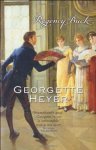
Georgette Heyer Regency BuckHowever, let me introduce the topic. That Sun article set me off on a trail which uncovered several articles discussing the public’s literary tastes, and how and why the “experts” thought they were changing. The experts were mostly librarians and booksellers. In 1929, The Sydney Morning Herald asked the large circulating libraries whether they’d seen changes from the previous year’s borrowing. Yes, said the librarians. They noted:

  • a changing of the guard in popular authors, but since none of the names – except one – are familiar to me, I won’t detail them. The one I did recognise was identified as “rapidly approaching the status of best-sellers”, Georgina Heyer! Well, I sort of recognised her, as presumably they meant Georgette Heyer. Her books would have been gaining traction around then, and I can’t find a Georgina.
  • a decline in the “sex-novel”, and also in plays. “Once upon a time every play published by Pinero and other popular dramatists sold almost as well as a novel”. How interesting.
  • increased interest in detective and mystery stories, and historical novels
  • increased interest in short story collections. Woo hoo! They write that “a very few years ago publishers hesitated to bring out volumes of short stories. That is all changed now.” Is an increased interest happening again now do you think?
  • increased sales of “standard works” (in “pocket editions”). They were “selling so amazingly well that there is almost evidence enough to show that the general public is being weaned from the frothier varieties of books”

What a fascinating insight into reading habits. I have no idea how “scientific” these observations were, but librarians are very trustworthy people, you know!

The Sunday Mail in 1932 explored changing tastes in detective fiction, arguing that “the reader of to-day wants to pit his brains against those of the detective, and so the mystery novel is assuming more and more the aspect of a mental problem”. When asked, Brisbane booksellers and librarians:

emphasised that there are “thrillers” and “thrillers,” detective stories and detective stories. The popularity of the detective thriller of the Edgar Wallace type, it was explained, was on the decline even before the death of that undoubted master, but not so the intellectual “thriller.”

They describe in some detail what makes an “intellectual thriller”.

The article also mentions increased interest in Australian books, and notes the surprising popularity of Swedish physician Axel Munthe’s The story of San Michele. It apparently “emerged from obscurity into something like the status of a best seller, all because a few people allowed themselves the pleasure of reading it ‘on chance’.” The booksellers said that bestsellers of “today are 100 per cent superior in literary merit to the bestsellers of five and six years ago”. This was the Depression era … I wonder what impact that had on reading tastes.

This idea of improved public taste was repeated in 1933 in an article in the Horsham Times which reported a statement by visiting English publisher John Lane, from Bodley Head. He said

there had been an improvement in the literary taste of the reading public throughout the world, and the demand among the great body of the public to-day was for clean healthy stories and plain dirt had little sale.

I’m not sure that “clean healthy stories” are guaranteed to be “literary”, but probably “plain dirt” isn’t? Lane suggests that “cheap lending libraries [presumably in England] were responsible for changing the literary tastes of readers in the industrial classes from the penny story magazine to volumes, and would eventually raise the literary standard of the masses”. Oh dear, this sounds a bit snooty, but I do like his belief that libraries were helping widen people’s reading tastes.

Now we jump t0 1937, with the Depression on its way out, and an article in Melbourne’s Argus titled “Novels are less popular”. It says that demand was changing, with “tastes more serious”. This came from Melbourne librarians who said that the borrowing of novels had decreased from 75% of their loans to 65%. Prahran Library chief librarian gave a reason for this:

The uncertainty of the international situation in Europe, he said, was resulting in many former readers of fiction asking for such books as Gunthe’s “Inside Europe,” and other works on economics and politics. The depression had made borrowers’ tastes more serious, and there was a growing demand for books on the trades and useful arts.

Interesting eh? Sometimes we hear that in hard times people turn to lighter fare, but apparently not always. Except, the report continues:

The [unnamed] chief librarian at a large city library said that with the return of more prosperous times many persons who had been forced to read during the depression were now finding their relaxation and amusement at the cinema. There had been a large decline in the borrowing of low grade fiction.

Hmm, there’s that “low grade fiction” again. And “forced to read during the depression” suggests that reading was not the entertainment of choice then (as that reader survey says it is in contemporary Australia)? The article quotes the librarian of the Borough of St Pancreas London as also attributing “the decline in the popularity of the novel to the appeal of wireless and cinemas”.

Anyhow, now we come to the 1947 article in Sydney’s Sun which inspired this post. Titled “Tastes in books were changing”, it looks at bookbuying in the lead up to that year’s Christmas.  It opens by stating that “book-buying boom, which began in the war years, is being maintained in the peace”. Booksellers said that:

  • War books were generally “out”, with some exceptions. However, publishers felt that war books would return just as the publication of All Quiet On the Western Front had generated renewed interest in World War 1
  • “Thrillers” were also declining, and “the sale of Westerns was negligible”
  • Australian books were popular, with most booksellers “displaying Australian books on special counters” (something we discussed recently). One firm reported that the sale of Australian books had doubled in recent years: the “First edition of Flying Doctor Calling, by Ernestine Hill (Angus and Robertson), sold out in a week. An Australian classic that keeps on selling and selling is The Fortunes of Richard Mahoney, by Henry Handel Richardson.”
  • Long historical novels were in “big demand”
  • Books about Australia and other countries were very popular. A bookseller suggested that “The quiz craze may have something to do with this thirst for knowledge among Australians”. (Love the quiz craze!)
  • European migrants were keen book buyers, buying “expensive books on politics, art, music
  • Children’s books were selling well, perhaps partly due to “the high price of toys”

The article also discussed the increasing cost of books, but said people were paying the high prices “without demur”. It also noted that “unfortunately for Australian authors the boom in Australian books” had coincided with “unprecedented publishing difficulties”, which they describe in some detail. The situation was so bad that “Some local publishers are more than a year behind in their programmes and there isn’t much likelihood of catching up for a long time to come. Dozens of accepted Australian manuscripts are awaiting publication.” Poor writers.

Through these articles, there’s an ongoing thread of concern about “literary quality”. Do we see this same earnestness about whether people are reading “quality” in book reporting today? Or, are we more tolerant of diverse reading interests?

My literary week (8), a cultural life

There’s always something going on here in the nation’s capital, besides politics that is and despite the belief in some circles that it is a soulless place! In fact, it’s so busy here – so packed full of things to do – that my reading has been pretty slow of late. However, I have been active, and thought some of my activities might interest you.

Blog mentoring – and a question for you

In my last Monday musings I mentioned that I’ll be mentoring two ACT Lit-bloggers for the rest of this year. We had our first meeting last weekend, and one of the issues we talked about – and it’s one we’ll continue to talk about – relates to what litblogging actually is. What is the difference, we want to explore, between litblogging, review and criticism? Where are the lines, what are the crossovers? We tossed a few ideas around, including the issue of informality/formality, but there’s a lot more to explore regarding content (and these concepts of review, criticism, analysis) and audience (who reads blogs, what do blog readers look for, and can this audience be widened?)

So now I’m throwing it over to my brains trust – that is, you who read this blog – because you cover a wide range of backgrounds. What say you to these questions? And how (or where) do you think litblogs fit into literary culture?

Coranderrk

I mentioned Coranderrk on this blog a couple of years ago. It was an Aboriginal Station in Victoria, established and successfully run by some remaining local indigenous people, and it operated from 1863 to 1924. I came to the story through the Bread and Cheese Club’s activity in the 1950s when they held working bees to repair the cemetery and restore the monument of leader William Barak to its rightful place in the town.

So, when I saw that the play Coranderrk, which was first performed in 2013, was going to be part of his year’s Canberra Theatre Centre season, I bought tickets, and we finally got to see it this week. It tells the story of the community’s attempt to obtain formal control over the land when local farmers started making moves to move them on! They felt the land was too valuable to be run by Aboriginal people (!), and so, as the program says,

the men and women of Coranderrk … went head-to-head with the Aboriginal Protection Board at a Victorian Parliamentary Inquiry to be allowed to continue.

The play tells this story primarily using words from sources of the time – mainly evidence and testimony from the Inquiry. The four actors – three men and one woman – each play several indigenous and non-indigenous characters to tell the story of the conflict. It is, really, like a documentary in play form (called, I believe, verbatim theatre), and it could have been very dry. Fortunately, I like documentaries. And anyhow, the writers do manage to inject the words, the story, with a sense of theatre, partly through little recurring motifs, like banter over a hat, and word plays, as well as, of course, the drama of the story itself.

It’s not a happy outcome, as you’d expect for the time, but the program says “The production aims to encourage a shared understanding of the past between Aboriginal and non-Aboriginal people.” It is just one of the many stories that are coming out now about our colonial past and that we Australians need to know if we are to advance as a “real” nation, that is, as one that knows its true history.

Coranderrk
Written by Andrea James & Giordand Nanni
Directed by Eva Grace Mullaley
Produced by Ilbijerri Theatre Company & Belvoir
Canberra Theatre Centre, 14-15 June 2017

John Waters

John Waters, NFSAOne of my several post-retirement commitments is involvement in the Friends of the National Film and Sound Archive. Like most Friends organisations we volunteer for our “parent” body, and we organise events. Recently, we ran a bus tour of the suburb of Moncrieff, whose streets are named “to honour Australia’s music history”.  We enjoyed driving around the streets, being regaled by local music expert David Kilby with biographies of and entertaining clips from such performers as Johnny O’Keeffe, Jimmy Little, Harold Blair and June Bronhill.

Then, this week, we presented an evening, to a full house, with the wonderfully generous Australian actor John Waters who willingly gave up his time, driving himself to Canberra, to talk about his career in film and, at the same time, promote the importance of preserving Australia’s audiovisual history. The NFSA is “our nation’s album” he said, and “who doesn’t like a family album”. Exactly.

There was more to my week, including my local Jane Austen group’s discussion today of the plethora of biographies about our Jane – but I think I’ll save that for another post. There’s only so much culture you can manage at a time!

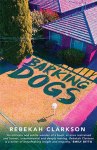
Rebekah Clarkson, Barking dogs (#BookReview)

Rebekah Clarkson, Barking dogsThe best way to describe Rebekah Clarkson’s debut book, Barking dogs, is that it’s a portrait of a community undergoing social change. This community is Mount Barker on the outskirts of Adelaide. Once a farming community, it is now, says Wikipedia, “one of the fastest growing areas in the state”, the province of developers, the aspirational and the upwardly mobile, rich pickings in other words for an observant novelist. But, did you notice that I said “debut book” not “novel”? This is because, superficially, this book presents as a collection of short stories. However …

What’s in a name? It reminded me of the recent discussion about Junot Díaz’s debut book, Drown, on the ABC’s First Tuesday Bookclub. Drown is also a collection of short stories, but panel members argued that it could be defined as a novel because “the stories are too interlinked for us not to see it as a narrative whole”. Drown, though, does have the same narrator throughout, which Clarkson’s book doesn’t. Her book is probably closer to Tim Winton’s The turning. Like Barking dogs, its stories are set in the same place, and it has some recurring characters, though, from memory, I’d say recurring characters are a stronger feature of Clarkson’s book.

The question is, of course, does any of this matter? Not really, except that calling it a novel might attract more readers – you know, those who say they don’t like short stories. And, it is always relevant to consider form, even if, in the end, the actual label is irrelevant.

The form, style and structure of Barking dogs, do, in fact, give us much to consider. There are, for example, 13 stories. Are we meant to consider the “negative” implications of the number 13 in terms of this community’s future? Why does Clarkson start the collection with a troubling story (“Here we lie”) set at a later time in the book’s chronology, and end with a story set at the earliest time (“If it wasn’t this”)? The fact that this last story, although set in the seemingly idyllic rural days, ends rather bleakly on the image of a tree “alone, stark and bare” suggests that Clarkson recognises the complexity in all communities. Again, I was reminded of Pulitzer prize-winning author Paul Beatty on the First Tuesday panel talking about how he sometimes plays around with the order of the stories in Drown, and how this changes its impact.

Regardless of the overall intention, though, the stories make great reading. Whether they are told 1st, 2nd or 3rd person, and whether the narrator is male or female, young, middling or older, or struggling financially or more well-off, Clarkson is able to get inside her characters’ heads. She captures, and explores, the feelings, values and thoughts, the confusions, uncertainties, and pretensions, of her town’s inhabitants. We can “see” it all: the struggle to pay mortgages, to maintain meaningful marriages, to raise their children (or to conceive them in the first place), to get on with their neighbours, to achieve the lives to which they aspire.

A number of motifs run through the book, including the murdered girl Sophie Barlow (whose family appears in the second story, “Something special, something rare”, but whose story is never fully told), the Wheeler family which forms the main connecting thread in the collection, and of course the barking dogs of the title. These, together with the setting, contribute to the coherence of the whole.

Some stories stood out more than others. This may say more about my particular interests, rather than the quality of the stories, but it may also be that the stories that are more connected by characters are more engaging because of the story development they entail. It’s a book that would bear multiple readings, because even skimming it for this review revealed further links and connections that I missed on my first pass.

The overall theme, that of a community going through change, is beautifully encapsulated in the story “Hold me close”, in which the recently widowed Edna, a long-term resident of the town’s now rural outskirts, struggles to understand the aspirations and lifestyle of her daughter, Andrea, who has moved back to the area. Andrea lives in a “ex-display home village” and, Edna thinks, is more interested in appearance than substance. This tension between striving for success and being, hmm, more real is played out in various ways in the other stories.

The Wheelers

But, perhaps the best way to illuminate the book is to look briefly at how the Wheeler family is woven through the book. The Wheelers are 49-year-old Malcolm, a successful management professional, his confident teacher wife, Theresa, their 11-year-old son Martin who’s been diagnosed with Asperger’s, and Jasper, their barking dog. They epitomise the new families in the area – their aspirations, their values, and their problems – and at least one of them appears, or is referred to, in seven of the stories. The first references are in passing. In “Something special, something rare”, Martin has been physically bullied by Liam Barlow, but we don’t meet him specifically, and in the following story “World peace” he is again referred to, this time by one of his classmates. We gather he’s a little different, and doesn’t fit in well with the normal schoolyard cut-and-thrust.

The next four stories (4th, 7th, 9th and 11th) in which they appear are told from their perspectives, the first two from Malcolm’s, then one from Martin’s, and finally Theresa’s. I don’t want to give too much away, but we get the picture of a fairly kind, laissez-faire husband married to a more go-ahead, shall we say, proactive, wife. In the fourth story, “Raising boys”, we also meet their barking dog who is bothering his neighbour, and in the seventh, which is, structurally, the central story, Malcolm receives some terrible news which provides the book’s emotional heart. The penultimate story, “Jasper”, is shocking. It exposes the cracks in “society today”, such as unrealistic aspirations, lack of neighbourly communication, fractured marital relationships.

Interestingly, while the stories are not presented chronologically, the Wheelers’ “story” is, giving the book a clear narrative arc. The overall order, perhaps, provides its thematic one, one that warns against rose-coloured glasses about the past.

Unfortunately, I am using an uncorrected proof copy from which quotes are forbidden (though I have “quoted” one or two phrases which I hope is okay!). However, I do want to briefly mention the writing, which maintains an effective satirical tone while also conveying a level of tenderness for the characters. There’s some lovely irony too. We know for example, that poor Graham Barlow’s vision for his business, Winners, is unlikely to be realised (“Something special, something rare”), and that Gladeview Park, where many of our characters live, does not provide the “Serene and fun-filled living” environment promised on the estate’s sign (“Jasper”).

Barking dogs offers a thoughtful, intelligent look at contemporary suburban life. It explores what a pristine, homogenous white middle-class enclave might look like. Unfortunately, it looks more like a bunch of isolated individuals than a healthy community, partly because the pressures that drive them seem to prevent real engagement with each other. It doesn’t need to be this way.aww2017 badge

Rebekah Clarkson
Barking dogs (Uncorrected bound proof)
South Melbourne: Affirm Press, 2017
240pp.
ISBN: 9781925475494

(Review copy courtesy Affirm Press)

Monday musings on Australian literature: ACT Writers Centre

Do you have a writers centre in your neck of the woods? We do in Australia, but I’ve barely written about them before. They generally provide support and/or training for writers, via online and face-to-face mechanisms, some free-of-charge but most fee-paying, and tend to be membership organisations. Over coming months, I’ll share what’s happening in different centres around Australia, but I’m starting here with the one in my city, the ACT Writers Centre.

First though, a little anomaly – to do with apostrophes! I note that the ACT Writers Centre has no apostrophe in its name, while the Australian Writers’ Centre does. Whyfor this thusness? A quick survey around the various Australian state centres revealed that most do not use the apostrophe (with the Northern Territory appearing to have a foot in both camps, depending on which page you are on!) It’s like Mothers/Mother’s/Mothers’ Day. I prefer the no-apostrophe approach. As in, what sort of (adjectival) day is it? It’s a mothers day, that is, a day for mothers. Rather than, whose (possessive) day? It’s mother’s day, a day owned by mothers. It seems that most writers centres in Australia see it the adjectival way. Either that or they don’t know their apostrophes, and that would be a worry!

Enough pedantry, let’s get on with the ACT Writers Centre. It describes itself as:

the leading organisation of writing-based culture in the ACT. Our mission is to develop writers and their work.

How do they do this? Well, by running programs, offering prizes or awards, and providing services such as manuscript assessment, editing, and mentorship. Most of these are fee-based. They also have a blog, Capital Letters.

In this post, I’m going to focus on four special programs offered, but they also offer various courses. Currently, the ACT Writers Centre runs four main programs:

HARD COPY

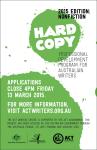
HARDCOPY 2015 flyerI’ve written about Hard Copy before, in a previous Monday Musings post. The first program was held in 2014, so this year’s will be its fourth. They describe it as “a national professional development program that helps build the capacities, aptitudes and resources emerging Australian writers need to reach their potential.”  Its aim is not specifically to achieve publication for its participants, but to help them with manuscript/project development, to arm them with an understanding of how the Australian publishing industry works, and to help them “build connections and relationships within the industry/writing community”.

This program, which is run by our local centre, receives funding from the Australia Council for the Arts, and is offered nationally, that is, not just to ACT-based writers. Also, it alternates between fiction and non-fiction writing. This year’s program, as the one run in 2015, is for non-fiction writing.

All this is pretty dry. For an insider’s perspective, do read Michelle’s posts on her blog, Adventures in Biography, on her experience of the 2015 program. She had a great experience – and I was pleased because I got to meet her while she was here! She found the program very helpful, to say the least.

Between the Lines

Hetherington and Webb, Watching the worldYou know that mantra, the one that says to be a writer you need to be a reader? Well, the ACT Writers Centre clearly believes it to be so, because this year they are offering “a facilitated book discussion group for writers with an active practice”. This sounds a bit like a reading group, but with two big differences. First, it has  a professional leader, in this case Professor Jen Webb from the University of Canberra (whose book with poet Paul Hetherington, Watching the world, I reviewed a couple of years ago). And secondly, the focus will be on “authorial technique and achievement, rather than subjective personal judgements on whether or not the book is ‘good’ or ‘bad’”.

The focus this first year will be Australasian literary novels. You can see the list on the link I’ve provided on the heading. There are 6 books, as it’s a bimonthly program: three are by men and three by women, three are by New Zealand writers including one by Maori writer Witi Ihimaera, and one is by a woman of indigenous Australian background (Melissa Lucashenko). I’d love to see their discussions written up on the Capital Letters blog!

ACT Writer-in-Residence

This is the program which, when I read about it last week, inspired today’s post. It’s a new three-year program offered by the Writers Centre in collaboration with the University of New South Wales (Canberra) and with support from the Copyright Agency Ltd. Again, you can read the details of what the program offers and expects on the link I’ve provided. Like HARD COPY it is not limited to ACT Writers. It is mainly geared to established writers, but “suitably qualified developing writers” were also encouraged to apply.

Last week the three writers were announced:

  • 2017: Isobelle Carmody, fantasy writer, particularly of the immensely popular, much translated, Obernewtyn Chronicles. (Daughter Gums was, and still is, a big fan.)
  • 2018: Jane Gleeson-White, prize-winning non-fiction writer who plans to research a novel set during World War II.
  • 2019: Angela Gardner, poet who apparently has a project on “Air” which will “include some novel public programs for Canberra – including balloon flying”.

I was initially surprised to see that all three writers have been announced now, but I guess it does enable the later writers to plan their lives, something I suspect writers often don’t get an opportunity to do!

ACT Literary Bloggers

And now comes the one close to my heart! It’s another new program, and another collaborative one, this time with the National Library of Australia. It “provides an opportunity for two emerging ACT-region writers to attend events at the National Library of Australia and document the experience for the ACT Writers Centre’s Capital Letters blog. The program, which will run from May to December, includes a mentorship with ….” yep, me, Whispering Gums! What an honour, and how interesting it’s going to be. The program is particularly aimed at writers who’d like to write about “the literary arts for the online environment”.

The two bloggers have been chosen: playwright and performance maker Emma Gibson, and blogger/podcaster and writer Angharad (Tinted Edges).

I am looking forward to working with Emma and Angharad, particularly to jointly exploring ways in which blogging can be used to further promote literary culture in the (our, any) community. You may hear more about this later in the year.