Linda Neil, All is given (#BookReview)

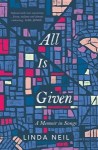
Linda Neil, All is given, coverLinda Neil’s second book, All is given, is subtitled “a memoir in songs”.  I wondered if this meant her memoir would be structured around specific songs – but that’s probably way too prosaic an idea. Certainly, it’s not what I got! I’m somewhat embarrassed to say that I didn’t know of Linda Neil, who is described in the brief author bio as “writer, songwriter and documentary-producer”, but I did enjoy getting to “know” her through this book.

The memoir starts with “Prologue: Songbook”, and immediately I had one of those glimmers of enlightenment because she opens with the end of a house concert. Now, friends of ours hold house concerts. They are such wonderful to-be-treasured occasions, which provide a beautiful way of enjoying music away from big formal concert halls or noisy popular venues. For the performer, however, there are challenges. The concert that Neil opens her memoir on finished at 11pm, and she was hungry, not to mention “spent” after nearly three hours of “singing and telling stories”. Not so, necessarily, the audience. They were energised, inspired, and wanting to talk with her in this lovely intimate venue! So, with food from her host in her hand she sits to chat with one of these people – and discovers that what the woman really wanted to do was share her own stories, which had been stimulated by the concert. Neil, as it turned out, enjoyed hearing her stories – but I learnt a lesson about house-concert etiquette!

Another issue comes up in this opening chapter which attracted my attention. She says that many people think love songs, which she was singing, are autobiographical. However, she writes,

in my experience, they may well be inspired by real people, but the form of a song means that, from this basis of fact, changes need to be made. A bass line is added perhaps. Something high is included. A man becomes a woman. A five-letter name expands to eight …

and so on. The point is, “the facts may not always be true, but the feelings certainly are”. “YES”, I wrote in the margin. And I loved her rider: “and if some events did not happen exactly the way they are described, perhaps they should have”. Haha! Love it. That is what creativity, and living, are about…

Hence, she writes in the last paragraph of this opening chapter:

So think of this collection of stories as a book of songs that contains improvisations and variations on themes of truth. If you listen closely enough you might even be able to hear the fabric of facts and fiction as they are stitched together.

What follows are delightful, non-chronological, stories of travel. This book, in fact, is as much travel memoir as a musical one, and as much about travel to the self as about the places she visits – Shanghai, Paris, Kathmandu, Kolkata, Ulaanbaatar, to name a few – though she writes engagingly about them too.

… a pilgrim of the imagination …

All is given is just a lovely read. Neil presents as a person with such an open heart and curious mind, with such a willingness to give things a go and to test her own preconceptions, that she can’t help but be interesting to read. And when you add to this, her clear, fresh prose, well, you have a book that is a winner on multiple levels. Here, for example, she’s in Paris:

Sometimes a city is the kind of place where, despite being on your own, you are never alone.  Where sitting under a statue or leaning over a balustrade of a bridge is an invitation. You have to discern very quickly, though, who might waylay you, who might waste your time and who might be, like you, a pilgrim of the imagination on a voyage through change. But if your antenna is working properly, the chance encounter with a stranger might bring you something you need at that particular moment in time, something that might not come in any other part of the world, but exactly where you sense of wonder and curiosity has led you, across oceans and skies, out of safety into the unknown.

I wanted to share all of this, but particularly that phrase “a pilgrim of the imagination on a voyage through change”.

This is what the book is about. It’s partly, of course, about the places she goes, the people she meets, the seemingly serendipitous discoveries, such as the recording studio in Kathmandu and the YWCA in Kolkata where she meets a group of people volunteering at Mother Theresa’s Missionaries of Charity, but it’s mainly about the things she learns.

She learns, for example, on her first solo trip, which paradoxically is the last one described in the book, not to travel with the Lonely Planet Guide, because “travel was best unplanned”. It’s a lesson I’m starting to learn. I can’t imagine giving up the guides altogether – not being, clearly, a complete “pilgrim of the imagination” – but I’m gradually freeing myself from the shackles of “musts” to the wonders of “let’s explore”. She experiences the “gift of stories – of listening to and receiving them, of being in the right place at the right time”. This is “the magic of travel”. She learns that she can sometimes be “prim”, when she lectures a young girl on modest dressing in India, where she was “once open-minded”, but on the other hand, that she could be “free”, in opening up to people, where once she “might have felt more cautious”. These are the surprises of travel.

She learns, too, in Mongolia that “freedom” is not the simple concept we like to think it is, that for many Mongolians the initial liberation from Russia was “a catastrophe”. Her Mongolian friend reminds her, once again she says, that:

western narratives of history aren’t the only ones, and that … there are many ways to tell the story of our collection past.

A lesson we Australians are very slowly learning now as we come to grips with different versions of our colonial past. She learns, through this and other experiences, “not to romanticise places” where the reality for the locals is very different, but also to “be happy with tiny moments”.

And so the memoir goes. I’ve focused on travel’s lessons because those reflections spoke to me. Another reviewer could very well pick up the musical motifs, her journey through sound, or perhaps explore the organic way she intersperses moments from her youth with those from travel. The point is, whatever your interest, All is given is an engaging, enjoyable read by a writer-musician who sees that being “real and true” is sometimes different from “being perfect or even good”, but who often manages to achieve both.
aww2017 badgeLinda Neil
All is given: A memoir in songs
St Lucia: UQP, 2016
238pp.
ISBN: 9780702254093

(Review copy courtesy UQP)
Monday musings on Australian literature: Reading the reader (Survey)

Late last month, the Australia Council of the Arts released the results of a survey they conducted with Macquarie University. It is, the introduction to their final summary says, “the third stage of a major study of Australia’s changing book industry, by the Australian Research Council and Macquarie University.” The project, according to the Macquarie University website aimed to investigate:

  1. Authors and their responses to changing circumstances;
  2. Book publishers and the ways in which they contribute economic, social and cultural value; and
  3. Practices of contemporary book readers.

They say they are looking into extending the research into other parts of the “Australian book industry”. Today, I’m going to focus on the readers, which is the only part in which the Australia Council was apparently involved but, having discovered the whole project, I just might delve a little more into it in future posts.

The summary document’s subtitle is “A survey of Australian reading habits”. What ho! I wish they’d asked me!

So, who did they study?

There were three parts of the research:

  • A series of focus groups: with Year 8 students at Ryde Secondary College, and with different groups at Parramatta Library (both book clubs that meet at the library and the general public)
  • An online survey of Australians aged 14 years and over undertaken by Roy Morgan Research in October 2016. The final sample of 2,944 was, they say, “nationally representative in terms of age, gender, geographic location, income and ethnicity”.
  • A seminar with masters degree students at Macquarie University.
Their research found, overall, “a strong culture of books and reading in Australia”. It appears that “although developments in digital technology have radically changed many daily habits and pastimes, reading books is one of the nation’s favourite leisure activities, ahead of browsing the internet and watching television.” How fascinating. I’m a little surprised, but pleased. They did say their sample was nationally representative, but would an online survey of just under 3,000 people really catch a representative sample of all Australians? I admit to a little scepticism (is that fair?) but still, the findings are interesting.

Overall, they found that

Australians:
  • value and enjoy reading, and would like to do more of it. Apparently we spend more TIME “browsing the internet and watching television” but are more likely to rank reading books as our favourite leisure activity over these activities. The most common reason we read for pleasure is “to relax and release stress”. This probably explains what we most like to read – see a couple of points below!
  • mix up digital forms with more traditional ways of reading. The majority of us apparently still read print, but over half of us mix this with e-reading, and 12% use audiobooks.
  • read more books than book sales suggest, which is not surprising, I would have thought, given the use of libraries, lending between friends etc (and this is what they found). When we buy books, the major chains are our main source, followed by online bookstores, and then secondhand shops with independent local bookshops a close fourth.
  • like crime/ thrillers/mysteries best! I am fascinated, really, that these “relax” people, but I know this is so (and not just from the survey). The main reason I read is not “to relax and release stress”, and “thrillers and mysteries” are not my favourite reads, so I’m out of step here. You can probably guess the most popular non-fiction category? Yes, autobiography/biography/memoir. Interestingly, the survey found that “around half (51%) of all Australians (including those who are currently non-book readers) are interested in reading the types of books that may be eligible for literary prizes such as the Man Booker and the Miles Franklin and 45% enjoy literary classics. A similar number (48%) are interested in literary fiction by Australian writers past and present.” What they say, and what they do, though, seems a little different.
  • value Australian books and the Australian book industry. I’ll just quote the first paragraph here which is that “The majority of Australians (65%) like to read fiction by Australian authors and 59% like to read non-fiction by Australians. Readers aged 50 and over are the most likely to consciously choose Australian-authored books, while younger readers tend to like Australian books without thinking about the nationality of the author. There is a strong level of interest (42%) in books and writing about Indigenous Australia.”

The report goes on to provide breakdowns of the numbers, including these points regarding interest in reading Australian writers, Australian literary fiction and indigenous writers. There tended to be some gap, in these areas, in terms of people’s interest and what they are actually reading. The report also notes that the most frequent readers – and this is no surprise – are female, over 30 years old and tertiary-educated.

You can read all the detail at the report I’ve linked to above, and that report provides a link to the more academic data provided by Macquarie University. I didn’t go there, I’m afraid. Life is a bit too busy.

Playing with the data

I did, though, have a play with the fun interactive dashboard of the data, which enables users to interrogate the data a little via various parameters. For example:
  • 10% of all readers (all genders and ages) who use online sources to find out about books, use book blogs/bloggers. But if you change the parameters to Frequent Readers who are Female and aged 30-39, then 19% use book blogs/bloggers, while only 7% of Frequent Female Readers who are 60-69 do. Funnily (!), Occasional Male readers aged 14-19 seem not to have ever heard of book blogs/bloggers, whereas their Female counterparts have! Overall, book blogs/bloggers are fourth in terms of online sources of information after online booksellers, Facebook and GoodReads. Other sources include online literary journals, Instagram, Twitter and YouTube. It’s really interesting to see the difference here between different permutations of readers.
  • Regarding physical sources, only 5% of all readers (all genders and ages) obtain information from face-to-face bookclubs, but change that to Frequent Readers who are Female, and the percentage jumps to 10%. The most popular physical source is “word of mouth”, at 60% plus for most of the possible permutations.
  • 42% of All Australians (all genders and ages) agree that “books and writing about indigenous Australians are of interest to me“, but if you change the parameters to Frequent Readers who are Female and All ages, the percentage jumps to 56%. Further refine that to Female Frequent Readers who are 60-69 and it jumps a bit more to 60%. By contrast, the percentage for Male Frequent Readers in the same age group (60-69) is just 45%.
Help Books Clker.com

(Courtesy OCAL, via clker.com)

There’s a whole lot of fun to be had exploring the factors people consider when choosing books to read – such as topic/subject/setting/style, or liking the author, or reader reviews, or the cover. There are eighteen reasons, and they can be explored by the same permutations – Frequent, Occasional or All readers; Female/Male or All genders; and age breakdowns or All ages. Interestingly, in all the permutations I checked, Reader Reviews ranked higher than Professional Reviews. Hmm … how much of that is due to the dearth of professional reviews available these days. The top reason though, that people base their choice on what to read, is “topic, subject, setting or style”.

The interesting thing, now, is to see what, if anything, is done with this research. For example, if people are interested in reading Australian writers or indigenous writers, but don’t, why is that? Is it that there’s not enough specific promotion of these books in the places most people go to? Or?

Any comments?

Six degrees of separation, FROM Shopgirl TO The natural order of things

Steve Martin, ShopgirlHere we are again at the first Saturday of the month – and you know what that means don’t you! Yep, the Six Degrees of Separation meme. As most of you know, it’s currently hosted by Kate (booksaremyfavouriteandbest). This means she has the power – though she will take requests – to nominate the book from which we create a chain of six more books, linking one from the other on whatever basis we can justify. After the excitement of having a book last month that I’d read, this month is back to situation normal – one I haven’t! It’s Steve Martin’s Shopgirl. As always, I have read all the books I select for my chain.

Steve Toltz, A fraction of the wholeThe obvious link would be Madeleine St John’s Women in black as it’s all about shopgirls, but I used it recently so have come up with a more fun link! The first thing I thought when I saw this month’s choice was that we currently seem to have many authors named Steve or Stephen in Australia. There’s Steven Carroll, the New-Zealand-born-but-now-Australian-resident Stephen Daisley, Stephen Orr, and Steve Toltz. I’m choosing Steve Toltz since he’s known as Steve (like Steve Martin) and because I’ve reviewed his book, A fraction of the whole. I think that’s a good enough reason.

Alex Miller, LovesongAnother interesting thing about Toltz’s A fraction of the whole, besides the fact that I enjoyed it, is that it won the inaugural NSW Premier’s Literary Awards People’s Choice Award in 2009. Two years later, in 2011, Alex Miller won it with his beautiful novel Lovesong (my review). So, my first link was on first names, and my second one is on an award won by both books, but my next is on style, specifically narrative technique.

Debra Adelaide, The women's pagesLovesong is a metafictional work about a novelist writing the story of other characters in the book. I enjoy novels which play with the idea of fiction, which remind us that we are reading fiction not reality, which draw attention to the art of storytelling. As Miller’s novelist Ken says, “I had her story now, but it is one thing to have a story and another to write it.” Another metafictional novel teasing us about the art of storytelling is Debra Adelaide’s The women’s pages (my review). Here is Adelaide’s novelist-character, Dove:

What, Dove wondered, had she done? Or had she done it? Maybe it had happened exactly like this and she was merely recording the facts.

Valeria Luiselli, Faces in the crowdMy next link – Mexican writer Valeria Luiselli’s tricksy Faces in the crowd (my review) – continues the metafictional theme. In this novel we see our writer-character trying to make something interesting out of her life, and her husband, looking over her shoulders, is not very happy:

Why have you banished me from the novel? What? You wrote that I’d gone to Philadelphia. Why? So something happens.

But this is just one of the layers in this complex little (but big) novella.

Mario Vargas Llosa, The feast of the goatI’ve probably done the metafiction thing enough for this round, so let’s move on to something else – translated fiction. I don’t read as much translated fiction as I’d like, but I have read some and am going to link to another translated work by another Latin American writer, Mario Vargas Llosa’s The feast of the goat (my review) If Luiselli is about exploring the meaning of, value of, boundaries of, fiction, Vargas Llosa is all about using fiction to tell a very serious story set during the end of Trujillo’s dictatorship in the Dominican Republic.

Antonio Lobo Antunes, The natural order of thingsMy final book is another translated work but that’s not the reason I’ve chosen to link it. My reason is that it’s another story which explores a political event, in this case Portugal’s Carnation Revolution. The book is António Lobo Antunes’ The natural order of things (my review). This one, however, is less overtly political than Vargas Llosa’s book, being about how people cope when the world around them is anything but “natural”.

Last month I said that next time we’d need to travel more widely than just England and Australia – and we sure have. This is also my first #6degrees meme which has more male writers than female, and an equal number of non-Australian books to Australian. What’s come over me!

Have you read Shopgirl? And whether or not you have, what would you link to? 

Ian McEwan, Nutshell (#bookreview)

Ian McEwan, NutshellLike Carmel Bird’s Family skeleton, which I reviewed recently, Ian McEwan’s Nutshell has a narrator who won’t appeal to those who don’t like devices like skeletons in cupboards or babies in wombs. However, repeating what I said in my review of Bird’s book, it all depends on the writer’s skill, and McEwan, like Bird, is a skilful writer. Consequently, when the novel opened with “So here I am, upside down in a woman. Arms patiently crossed, waiting, waiting, waiting and wondering who I’m in, what I’m in for”, I relegated my disbelief to the pillion and set off for the ride.

As you’ll have guessed from that opening quote (if you didn’t already know), our narrator is a foetus. In my experience, McEwan writes strong, attention-grabbing first chapters, and Nutshell delivers here too. Our foetus-narrator, close to being born, is forced to be party to, or at least cognisant of, a plot concocted by his mother, Trudy, and uncle, Claude, to kill his father. Ring any bells? Yes, he (and it is a “he”) is a Hamlet in the wings. This is a clever modern riff on Hamlet, exploring many of the same issues, such as revenge, action versus inaction, corruption. It’s also a commentary on what we could grandly call the modern condition – on our world which is “too complicated and dangerous for our quarrelsome natures to manage”.

SORT OF SPOILER (so miss this paragraph if you wish)

If you know your Hamlet what I say next won’t be a spoiler, and if you don’t know your Hamlet, the part I’m giving away happens slap-bang in the middle of the book, hence is not, I’d suggest, a spoiler? So, with that fair warning, here goes. Nutshell is a tight, murder-mystery. For the first half of the book, the question is “will they do it?”, while in the second half, it’s “will they get away with it?” We are privy to most of the plotting and planning because our foetus goes, of course, wherever his mother does. However, this is as much an ideas-driven book as a plot-driven one so, I’m going to move onto some of the ideas the novel teases out.

McEwan is clear about what he sees as the “rotten state” (one of the many allusions in the novel to Hamlet) the world is in. There are references to world powers out of control. Europe  is “in existential crisis, fractious and weak”, while China, “too big for friends or counsel” is “cynically probing its neighbours’ shores”. “Muslim-majority countries” are “plagued by religious puritanism” and “foe-of-convenience” America, now “barely the hope of the world” is “guilty of torture”. There’s also the nuclear threat, climate change “driving millions from their homes”, the “urinous tsunami of the burgeoning old”, and our increasing loss of liberty in the service of security. For our foetus, though,

Pessimism is too easy, even delicious, the badge and plume of intellectuals everywhere. It absolves the thinking classes of solutions. We excite ourselves with dark thoughts in plays, poems, novels, movies. And now in commentaries. Why trust this account when humanity has never been so rich, so healthy, so long-lived.

It’s an attitude I like – and is what makes Nutshell not the bleak book it could be.

How does McEwan get away with all this?

The book, though, is not without its awkwardness. Sometimes the “rants” are a little too much, providing a virtual grab-bag of the world’s ills, from the loss of the Enlightenment’s rationality to the threat of North Korea. And sometimes our foetus-narrator is a little too knowing. Most of the time, McEwan makes clear why his narrator knows what he knows, including the limits to his knowledge, but sometimes our imaginations are stretched just a little too far. This is a very-knowing, very smart, highly articulate foetus, one who is not above giving his mother a kick:

In the middle of a long, quiet night I might give my mother a sharp kick. She’ll wake, become insomniac, reach for the radio. Cruel sport, I know, but we are better informed by the morning.

It is his “one morsel of agency” (and he uses it, giving, perhaps, Hamlet a lesson!) It is through these radio talks that our foetus learns most of what he knows about the world. Overall, McEwan maintained the conceit well, and I enjoyed the foetus-narrator’s view on the world he expects soon to join. Fortunately, my disbelief stayed on the pillion!

Besides this, the book is fun to read. There are allusions galore – not only to Hamlet but to a wide range of literary works. I would have missed many but I enjoyed spotting others, such as Jane Austen’s “two inches of ivory”, Julian Barnes’ “sense of an ending” and of course Hamlet’s “rotten state” and “a piece of work”. There is probably a bit of McEwan showing off here – flexing his literary credentials – but spotting allusions gave me little fillips of pleasure! There are also many funny scenes, including several involving descriptions of the lovemaking of the adulterous schemers:

I brace myself against the uterine walls. This turbulence would shake the wings off a Boeing. My mother goads her lover, whips him on with her fairground shrieks. Wall of Death! On each occasion, on every piston stroke, I dread that he’ll break through and shaft my soft-boned skull and seed my thoughts with his essence, with the teeming cream of his banality.

The question of course has to be asked: why choose such a narrator? I’m sure there’s more than one answer to this question. I have no idea what McEwan has said so I could be way off here, but early on our narrator describes himself as “an innocent”, “a free spirit”, a “blank slate”, albeit becoming less blank by the day. Is he the perfect naive (but certainly not unreliable) narrator, able to comment, “unburdened by allegiances and obligations” on the murky world, or is McEwan suggesting there’s no such thing as innocence? Or, is his function to answer that question of whether we should bring children into the world. In the end, I think that McEwan’s message – or one of them anyhow – is that the world is worth hanging around for. It is “Beautiful. Loving. Murderous”, like Trudy, and our foetus wants to live it, hoping he will find meaning. An engaging read.

Ian McEwan
Nutshell
London: Vintage, 2016
ISBN: 9781473547131 (ePub)

(A reading group read)

Monday musings on Australian literature: Books in The Australian Women’s Weekly, 1930s-1950s

This will be a short post, tonight, mainly because I couldn’t find, in the time I had available, enough information for my original idea – which was to discuss The Australian Women’s Weekly’s support for Australian writers. This was inspired by my coming across, during last week’s research into Currawong Publishing Company, an article about a prize for writers being offered by The Weekly (as it is known, familiarly) in 1941. There were two prizes, one for a short story and one for a serial. The reason it popped up during my search was because M.L.L. Woolacott of Currawong Publishing Company was one of the people quoted as supporting the prize. S/he said:

It is gratifying to see a publication such as The Australian Women’s Weekly play a leading role in the movement towards firmly establishing literature in Australia. For this is the moment to give Australian writers every opportunity.

Before I continue to the main matter of today’s post, I’d like to share what a couple of other people said. Novelist Katharine Susannah Prichard (see my review of her The pioneers) said:

Australia has many writers who would produce fine stories and novels if only they could be assured of having their works published in Australia. This competition being launched by The Australian Women’s Weekly is going to give them that chance.

And novelist Eleanor Dark (see my review of her Juvenilia), whose book The timeless land had just been selected as book-of-the-month in the USA, said that “Literature in Australia needs encouraging, for without encouragement the growth will be slow.”

So, a lot of positive support, but I had trouble tracking down an announcement of the winners, and whether the competition was run again. The information could be there, but there’s only so much time …

However, as I was researching this, I did discover that during the 1930s to 1950s, The Weekly regularly published complete novels in an issue, often in a supplement. They were, I’d say, more like novellas or very-long-form short stories, but what a great service the magazine provided to readers – and presumably to the writers whose work was published.

Now, reader, you know what I did next: I checked out these novels and writers to see if any were recognisable. I only checked a handful – there’s only so much time, you know – but I found that mostly the names were not known to me, nor to Professor Google or AustLit. Some were, though, such as T.C. Bridges whose Messenger’s millions appeared in 1935 and C.K. Thompson whose The third man (not THE third man, of course!) also appeared in 1935. The third man Supplement is headed “complete book-length novel”. A book-length novel? I wonder what other sorts of novels there are? Anyhow, Thompson was a journalist based in the Hunter Valley of New South Wales. T.C Bridges, on the other hand, was born in England and worked primarily as a freelance writer. Although he was clearly published in Australia, AustLit says that they have no evidence that he visited Australia.

This was then popular literature, perhaps even pulp fiction, but I’m impressed that during a time when people didn’t always have a lot of disposable income they could find books in their magazine. (Of course, there were also the public libraries.)

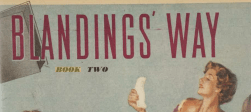
Blandings Way, Book Two, magazine headerBut now, I said this was going to be short, and I’m going to stick to that promise, so I’m concluding with a summary of “the story so far” for Book Two of Blanding’s Way, written by Eric Hodgins and published in 1952:

THE STORY SO FAR: In their Dream Home at Lansdale the Blandings had all sorts of exciting things happen. The vegetable garden produced a record crop, the fields caught fire, thirteen-year-old Joan became a prize-winning essayist, and Mr. Blandings was elected to the school board. NOW

I do love that the exciting things included producing a record crop, becoming a prize-winning essayist, and being elected to the School Board. Sounds right up my alley! Oh, in case you are interested, the “book” occupies 10 multi-column-tiny-font pages of the magazine. If you tried to print the “book” it would, according to my system, take 64 pages.

Note: The National Library of Australia has produced a discovery page for The Weekly, from which their digitised articles can be accessed directly. You can in fact, locate and read any issue published between establishment in 1933 and 1982. Now, if I had the time …

Jill Roe, Our fathers cleared the bush (#bookreview)

Jill Roe, Our fathers cleared the bushAs that old pop song goes, what kind of fool am I? I went, you see, to Macquarie University, which I chose for its then modern approach to tertiary education. It was great, but somehow, I didn’t end up in tutorials taught by Thea Astley, nor did I study Australian history in which Jill Roe was one of the University’s foundation lecturers. What was I thinking? Hindsight is a marvellous thing, eh?

Most of you will know who Thea Astley is, but non-Australians, in particular, may not know Jill Roe. She is best known for her comprehensive award-winning biography of Miles Franklin (see a review by Lisa, ANZLitLovers), but she wrote many books and was, among other things, a regular contributor to the Australian Dictionary of Biography. The book I’m reviewing here, Our fathers cleared the bush, was published last year, only months before her death early this year.

Old and new regionalism

What a fascinating read it was – for its content, which tells the story of Eyre Peninsula, a part of Australia I don’t know, and for its form and style. This latter is what I’m going to focus on mostly in this post. The book’s subtitle, “remembering Eyre Peninsula”, provides some clue to its form, which I’d describe as an amalgam of memoir/family history, regional history and historiography. Roe seems, overall, to be exploring an approach to writing the history of regions.  In her introduction she writes:

The aim is not so much to tell my own story – though I often start there – nor to fill a gap in the literature – though there is one – but rather, on the basis of personal reflections and a now quite extensive range of materials, to capture some key aspects of, and moments in, the regional experience over time.

“Extensive range of materials”. Hold that thought, because I’ll come back to it. For now, though, I’m sticking to the regional history idea. Chapter 7, one of my favourites in fact, is titled “I danced for the Queen”. In it she writes quite a bit about regionalism and regional histories. She suggests that as Australian history established itself in the 1950s and 60s, “some fine regional studies appeared” and she names a few. It was “a golden age of regional history when it seemed the national story was becoming clear”. But, she argues, that was “old regionalism”. Since the 1970s, new issues and factors have arisen. These include the understanding of “regionalism” itself; the rise of interest in local and family history which is adding “new building bricks, even new layers” to the undertaking and appreciation of regional history; the role of the environment; and that major factor, the recognition of Aboriginal history, which she says introduces a discontinuity into held narratives. She suggests that exploring Aboriginal history “seems to work best in regional frameworks”. Perhaps, but there is also need to include Aboriginal history in the overarching national story. I presume she would argue that too?

She teases out the Aboriginal history issue a bit more. She says:

On a grander scale, the history of the Kimberley in Western Australia is being transformed by research into the Aboriginal experience, much of it distressing, none of it yet settled or fully integrated into the national story. This history may be hard for some to take in, but that is because it adds new data and a challenging dimension to taken-for-granted narratives. In time, along with environmental and the other histories, Indigenous history will most likely lead to a new regional history in this country.

She then makes what could almost be a manifesto:

… my firm belief that any history in which people cannot recognise themselves – whether proudly or ruefully, in surprise or dismay – is not good history.

Beautifully said, and hard to argue with – at least these days when we don’t accept that history begins and ends with great deeds by big men (and occasionally women).

“a now quite extensive range of materials”

Now, histories can often be rather dry, but Our fathers cleared the bush has a lovely conversational tone. It almost felt like she was talking to me as I read along. We learn a lot about life on the Peninsula from the 1840s to the 1960s and beyond. We hear about farms and schools, churches and sport, transport and the country show. I laughed at her comment that when she turned her mind back to the Peninsula in 1998, she “paid no attention to sport as a source of social life and values, a mistake I mustn’t make again”. Anyhow, all these are features of country life, and many are shared through the prism of her and her family’s experience, but while we come away knowing the skeleton of her life, this is definitely not a memoir. The focus is the history.

However, as well as telling the history, she also shares her methodology and her sources. She says that “the discovery of a new source is the historian’s delight”. She mentions women’s diaries and school records; and she talks about the value and limits of census data. She uses anecdotal evidence but carefully notes the unreliability of recall. She notes there are limits to what personal memories can offer the large picture. In her family, for example, there were no sons so the daughters “did more than usual of the outdoor work.” It would be not be valid to generalise, then, she’s saying, from her family. For some readers, Roe’s historiographical discussions might get in the way of the history itself, but I enjoyed getting to know the historian’s mind.

Finally, she also points to histories that are still waiting, such as “a comprehensive account of the Aboriginal experience of the Eyre Peninsula”. Others include “the coming of service stations” to Australia or the role of Greek Orthodox churches in fishing communities. Anyone looking for a PhD topic might like to start here!

So, I’m at the end of my post and I’ve told you very little about the Eyre Peninsula. All I can say is that if you are interested in the Peninsula, or in the history of rural Australia, you should find what you’re looking for in this book (particularly given its index and extensive end-notes) but if you are interested in approaches to modern history writing, this would also be a good book to read. Roe says, early on, that her approach to history is “post-modern, in the sense that it can’t come to a definite conclusion”. That is certainly what she has presented here – a story about a region that tells us much but which also leaves many questions to be answered – because life goes on and there’s always more historical research to do.

PS For a lovely tribute to Jill Roe written just after her death, please read blogger (and historian) Yvonne’s post.

aww2017 badgeJill Roe
Our fathers cleared the bush: Remembering Eyre Peninsula
Mile End: Wakefield Press, 2016
249pp.
ISBN: 9781743054291

(Review copy courtesy Wakefield Press)

Telling Indigenous Australian stories

This weekend is particularly significant for indigenous Australians. No, let me rephrase that: it’s significant for all Australians because what happens to indigenous Australians marks who we are as a nation. And, right now, who we are is not wonderful.

Anniversaries galore

If you’re Australian, you’ll know what I’m talking about, but for everyone else, the situation is that we have two important anniversaries this weekend. Today, 26th May, is the 20th anniversary of the tabling in Parliament of the Bringing Them Home report documenting the Stolen Generations. (On 26th May the following year, the first National Sorry Day was held to keep front and centre our poor treatment of indigenous Australians, so next year will be its 20th anniversary). Then tomorrow, 27th May, is the 50th anniversary of a referendum held in Australia to change the Constitution regarding indigenous Australians. The resounding Yes vote (90% overall) ensured that indigenous Australians would from then on “be counted in reckoning the Population”. It also gave the Federal Government the power to pass legislation specifically for indigenous Australians. And, just to add to the significance, next week, on 3 June, will be the 25th anniversary of the Mabo decision which recognised native title in Australia.

These anniversaries are, naturally, causing much reflection about what has been achieved since then, and what we (and indigenous Australians in particular) would like to achieve. The truth is that achievement has been woeful. Indigenous Australians’ health, education, incarceration rates – and so on – are significantly worse than for the rest of the population. It’s outrageous – and a subject too big for me here. However, I did want to mark this time, so am going to return to an issue we’ve discussed here before – who tells indigenous Australians’ stories. I’ve chosen this approach because of a serendipitous find in the National Library (NLA) bookshop yesterday.

Jeanine Leane's Purple threads
Courtesy UQP*

You see, I’ve been wondering recently what indigenous writer, Wiradjuri-woman, Jeanine Leane is up to. I greatly enjoyed her book, Purple threads (my review), and was impressed by the forthrightness and clarity with which she discussed this issue of telling indigenous Australian stories at an NLA conference back in 2013. She spoke particularly about classics, and she said this (re-quoting from one of my posts):

Through Xavier Herbert, Patrick White, David Malouf & more recently Kate Grenville, who among others have been hailed as nation writers & what I saw and still see to some extent in Australian literature to date, is a continuous over-writing of settler foundation stories which overwrite Aboriginal experience and knowledge. Settlers are always re-settling and Australian literature really reflects this and the critics and scholars write of such works as if everyone reading it is also a settler reader.

Now, here comes the serendipitous bit. I was browsing the Library’s bookshop yesterday while waiting for a meeting and noticed a recent issue (No. 225, Summer 2016) of the lit journal, Overland. I find it hard to resist lit journals so I picked it up and, flicking through the table of contents, saw an article by Jeanine Leane titled “Other people’s stories: When is writing cultural appropriation?”. That was all the excuse I needed to buy the issue.

Settler narratives controlling indigenous stories

In some ways it goes over ground I’ve written on before, but that post discussed an article on the topic by non-indigenous writer, Margaret Merrilees. She argued that “questions of appropriation become issues of personal ethics, conscience issues”. However, Merrilees was approaching the topic more from a practising writer’s point of view, and she made some sense regarding the challenge confronting non-indigenous writers. If they leave indigenous characters out altogether they are continuing the dominant culture’s silencing of indigenous lives but if they include them they risk not getting it right.

Leane explores the issue from a broader political view. She’s concerned that the “Australian” story continues to be in the hands of “settler” writers and that their stories – including, and particularly, those involving indigenous characters, like Katharine Susannah Prichard’s Coonardoo and Patrick White’s A fringe of leaves – become “the authoritative narrative of settler colonialism”. Readers see these books as “Aboriginal stories” but they are not, she says.

She unpicks Lionel Shiriver’s controversial dismissal of concerns about “cultural appropriation” at the Brisbane Writers’ Festival last year. She argues that Shriver’s idea of writers using “empathy” to create characters who are “other” to themselves does not recognise what this “empathy” really involves. For Leane, you don’t get this “empathy” from archival research but from social and cultural immersion. She criticises Australian writers for not having “this level of exposure” and, moreover, for not “striving for it”.

Leane accepts that the books by “settler” writers – like Kate Grenville, et al – have a place in the study of Australian literature but they need to be read and studied side by side with works by indigenous Australian writers, who are now emerging and challenging settler representations. She refers to Larissa Behrendt’s analysis of White’s A fringe of leaves in her book Finding Eliza: Power and colonial storytelling (a book I’ve still to read but which Lisa, Michelle and Bill have reviewed on their blogs).

Engagement through literature

Leane ends her essay discussing what she sees is the critical issue – which is not whether non-indigenous authors should include indigenous characters in the their books or how they can do it – but the paucity of indigenous writing being taught in schools. She argues there is a link between the higher attrition of indigenous students in schools and “the lack of Aboriginal voice and representation in the curricula”. And,  further, she asks,

if, on the whole, non-Indigenous people are not reading Indigenous self-representation, how can they write about Indigenous lives and experiences? Put another way, if non-Indigenous people are still only encountering Indigenous people via the works of non-Indigenous writers/historians/filmmakers/artists, then are they really encountering us at all? How can they even think about writing about us if you don’t really know us?

Very good question – which addresses both Shriver’s ideas re “empathy” and Merrilees’ concern about including indigenous characters.

Leane quotes Canadian scholar Margery Fee who addresses the gap between indigenous and non-indigenous people. There needs to be a conversation between us, she says – and that conversation, says another Canadian, Judy Iseke-Barnes, can be had through the sharing of literature. Yes! Iseke-Barnes talks of “conversation-through-literature, of cross-cultural engagement through ‘deep and informed readings’ of Indigenous texts”. She sees this as an ongoing process. Leane argues that “this kind of engagement must precede any discussion of how to ‘write’ Indigenous people.”

She then teases out this engagement, clarifying in simple terms exactly what it means, and concludes that without sincerely trying to understand indigenous culture, it is impossible to properly represent indigenous characters. It is, instead, cultural appropriation, it’s “stealing someone else’s story, someone else’s voice”.

I like that Leane not only presents the problem here – and argues it lucidly – but she has a solution. And it’s a solution that would surely make sense to any reader – which presumably is all of you who read my blog? I’m glad I found – serendipitously – what Leane was up to!

This essay is available online, free, at the Overland site, but if you’d like to support them, you can also buy it at the link.

Monday musings on Australian literature: Currawong Publishing Company

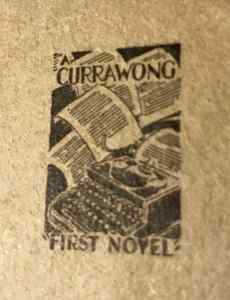
Currawong First Novel logoAs regular readers know, I’ve been involved in much clearing out of houses over the last eighteen months. I have, as a result, accumulated a small but interesting collection of older books, several of which I have already posted on. Today’s post is inspired by another such book, And all the trees are green (1944), by A.E. Minnis who’s unknown to me. However, my post is not so much on Minnis but on the book’s publisher, Currawong Publishing Company.

It captured my attention for a couple of reasons, starting with the little logo on the plain front cover which reads “Currawong First Novel”. Inside, there is a publisher’s Foreword which says that the novels in the series are all “first novels” (obviously) by “young Australian authors”. That made me sit up. I wondered how many authors whom we now know got their start with Currawong – the way many contemporary authors got their start with publishers like McPhee Gribble (such as Helen Garner and Tim Winton) and Fremantle Press (Elizabeth Jolley). Anyhow, the Foreword goes on to set out its philosophy, which is that their authors are chosen mainly for three reasons:

Each author has a story to tell, and tells it. [Haha, love that “and tells it” bit]
Each author’s style shows more than a promise of developing into a powerful literary instrument.
Each author is Australian, either by birth or adoption.

They continue to say that they invite manuscripts from authors who have not had a novel published in Australia or overseas, that “the setting of the plot of any novel submitted need not be Australian”, and, something most authors would love, that “each author whose work is accepted will be placed under contract to The Currawong Publishing Company for his or her next three literary works”.

You can see why I wanted to find out more about them. The AustLit database, which is, unfortunately, only fully accessible by subscription (which I don’t have) says this

The Currawong Publishing Company was a war-time success, active from about 1942 to 1951. Currawong issued a wide variety of fiction – including mysteries, westerns, romances, and fantasies – under the slogan ‘You can’t go wrong with a Currawong’; with a few exceptions, Currawong’s authors were Australian. Currawong also issued a series of ‘Unpopular Pamphlets’, advancing left-wing economic and socialist ideas for post-war reconstruction.

I was also able to read, before I hit the paywall, that the most referenced work relating to this entry is Kylie Tennant’s award-winning debut novel, Tiburon, albeit Currawong’s edition was a later “pocket” one.

Anyhow, Currawong sounded interesting, so I decided to research further, but they aren’t listed in my copies of The Oxford companion to Australian literature, nor The Cambridge companion to Australian literature, nor the index in the Annals of Australian literature. I could find them in Trove, of course, though mostly as the publisher of books being reviewed. That’s better than nothing!

I found, for example, a review of a novel by Ailsa Craig, If blood should stain the wattle (1947). The reviewer calls it a “fine first novel by an Australian author” and says:

Her style is impressive and she writes convincingly about country scenes with which she is familiar … It is rather a sombre story of a modern tyrant who rules the lives of his family in almost mediaeval style. You will find it an enthralling study of human relationships handled simply yet vividly.

The Courier-Times reviewer was a little less glowing, saying “There is quiet talent here but a little too much of the Daphne du Maurier technique to give it its own personality” though does admit that “the story is a good one, well-told”. Meanwhile, over at The Age, the reviewer says that the book was highly commended in the competition won by Ruth Park’s Harp in the south! Ailsa Craig, according to AustLit, was “a writer, journalist and scholar. She was also the first female London correspondent for the Sydney Morning Herald” and she won the prestigious, in Australian journalism circles, Walkely Award.

After Trove, I turned to Professor Google. I didn’t find a lot but did find, in Google books, a reference in History of the book in Australia, Vol. 3: Paper empires, edited by Craig Munro. The reference, which appears in the essay by Ian Morrison titled “Case study: Pulp fiction”, explains that Currawong was one of the leading publishers of pulp fiction – those mysteries, westerns, fantasies, etc – during the war years.

Unfortunately, in all this research, I couldn’t find much about the reason I decided to write this post, their “first novel” series, but I did find this little anecdote in one of those end-of-year articles newspapers like to write about books. The Sunwrote this in its article, “Tastes in books were changing”:

Oddity of the publishing year has been the fact that two books on taxation became bestsellers almost overnight. Earlier in the year Currawong Publishing Company issued “I Can Get It For You Tax-Free!” by E. Kellie, with an introduction by Sydney taxation expert J. A. L. Gunn. In quick time three editions of the book were sold. Currawong has now published, at 10/6, a sequel entitled “Farmers, Bushrangers, Businessmen,” by B. Hall, curiously with an introduction by J. A. L. Gunn. The title is drawn from the indiscreet remarks made about Australia in London last year by Dr. C. E. M. Joad. B. Hall’s book is as witty and as shrewdly informative about taxation affairs as E. Kellie’s book. Chapter headings range from “How to Jack Up Your Director’s Remuneration” to “Don’t Go Shop Crazy Till You Get Your Provisional Assessment.” ‘The publishers’ claim that Mr. Hall can teach Mr. Kellie a thing or two about income tax legerdemain is amply confirmed and must be causing Treasurer Chifley some concern. Taxpayers can confidently anticipate a companion book next year by Capt. Starlight with an introduction by J. A. L. Gunn. (14 December 1947)

There is a joke here – besides the fact that a book on tax went quick-smart into three editions! –  in that the books were, in fact, written by J.A.L. (John Angus Alexander) Gunn. The so-called authors, E Kellie and B. Hall, allude to bushrangers Ned Kelly and Ben Hall, hence the reviewer’s reference to the next book being by Captain Starlight! I’m not sure that all the contemporary reviewers got this. (By the way, Gunn was a highly respected accounting practitioner and was elected into the Australian Accounting Hall of Fame.)

During all this research I found a wide variety of books published by Currawong, in addition to pulp fiction – a book on Indonesia and one by A.O. Neville on Australia’s coloured minority; a book on Australian art, and one containing plays; an autobiography by tennis player Dinny Pails, and much more. They were clearly an active publisher in their time.

As for A E Minnis, I could find little about him – though I did discover that it’s a him. The only review I found starts with “Mr Minnis writes interestingly concerning the odyssey of his young hero, Dick Radford” but it then goes on to just describe the story. I wonder if Mr Minnis ever got his next two books!

Shakespeare’s Sonnets, app-style

Back in 2011 I wrote a post, a few in fact, on Touchpress‘s wonderful iPad app for TS Eliot‘s poem The wasteland. I love that app. It’s an excellent example of how interactive digital media can enhance learning about or enjoyment of literature, for a start, though Touchpress has applied its approach to a wide range of scientific and historical topics, including the solar system and Leonardo da Vinci’s Anatomy.

As you’ve probably worked out by now, Touchpress has also done one on Shakespeare’s sonnets, the whole 154 of them. It was released back in 2012 but I only bought it a year or so ago, when I decided it was time I became more familiar with this part of his oeuvre. So far I’ve only dipped into it, but have decided it’s worth posting on it now, rather than wait until I’ve finished it.

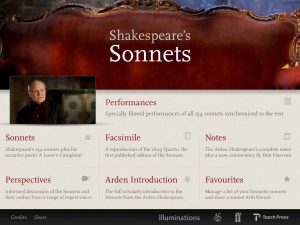
SHAKESPEARE SONNETS APP MENUSo this is an introduction rather than a proper review. The app follows a similar format to that used for Eliot, with some variations due to the work itself, and its age and particular history. It comprises the following menu items:

  • All 154 Sonnets in text form
  • Performances, by different people, such as Jemma Redgrave, David Tennant, and Stephen Fry, of each sonnet (filmed performances with the text synced to it)
  • Facsimile reproduction of the first published edition of the sonnets in 1969
  • Perspectives, that is, commentary on the sonnets, including their form, history and Shakespeare’s use of them, by various academics/Shakespearean scholars, such as Katherine Duncan-Jones, James Shapiro, Don Paterson – filmed talks, with transcript of the text.
  • Notes, that is, Arden’s detailed notes on each sonnet, including notes on individual lines.
  • Arden’s scholarly Introduction
  • Favourites, which as you’d assume allows users to save and share – yes – their favourites.

There is a Home icon so you can quickly return to the menu screen to navigate around the app. And there are also well thought through navigations. For example, on the screen containing the straight text of the sonnet are icons linking directly to the Notes, the filmed reading of the sonnet, and the Facsimile version. If you then  choose Notes, you get three tabs – Arden Notes (explanation of allusions and idioms, definitions of obsolete words, and the like), Commentary (critique) and My Notes (make your own notes).

As with all Shakespeare – given the unfamiliar-to-us language of his time – the sonnets come to life when read by people who know what they are doing.  You can read them in order, or navigate easily to particular sonnets. You can also read/hear them by performer, as when you touch a performer’s image up pops a windows listing the sonnets they perform.

Anna Baddeley, reviewing the app for The Guardian says

The Sonnets app, like its older sister The Waste Land, has the power to awaken passions (in my case, Shakespeare and poetry) you never knew you had. Reading outside and trying vainly to shield my iPad from the glare, I prayed the sun would go in so I could see what Don Paterson had to say about Sonnet 129.

Paterson’s commentary is the best thing about this app. It’s like sitting in the pub with a witty, more literary friend, who uses language such as “mind bouillabaisse” and “post-coital freak-out”. Most fascinating is his emphasis on the weirdness and borderline misogyny of the sonnets, a view echoed by the other academics interviewed for the app.

I don’t know Don Paterson, whom Wikipedia tells me is a Scottish poet, writer and musician, but Baddeley is right – in the sense that his commentaries are fresh, engaging, personal, funny and yet also meaningful. I wouldn’t go so far as to say they’re the best thing about the app, because it’s the whole that is important, but they certainly give it life.

This is not something to read in a hurry, and it is a BIG app, but how wonderful it is to have these sonnets so readily available on my iPad wherever I go.

Have you used this app, or would it interest you?

William Shakespeare
Shakespeare’s sonnets
iPad app
The Arden Shakespeare, Touch Press and Faber and Faber, 2012
1.55Gb

Monday musings on Australian literature: Sisters in Australian fiction

Sara Dowse, As the lonely blyYesterday I posted my review of Sara Dowse’s novel As the lonely fly, which centres on the lives of three sisters (well, primarily, two sisters, and the daughter of the other sister), and today, playwright Joanna Murray-Smith mentioned another book about sisters, Shirley Hazzard’s The transit of Venus, when giving her Top Shelf on Radio National’s Books and Arts Daily program. It got me thinking about novels which feature sisters – and I realised that some of our best-loved classics deal with them. Think Jane Austen’s Pride and prejudice and Louisa May Alcott’s Little women, for a start. And, I can’t resist mentioning, though it’s not a novel, that infamous play, King Lear!

So, I thought it would be fun to talk about sisters in (Australian) fiction, about novels in which the sister relationship plays a significant role in the story. I have read all the books I mention here, but most of them before I started this blog, unfortunately.

Ada Cambridge’s Sisters (1904), which I read over three decades ago, now tells the story of four well-to-do sisters at a time when marriage was seen as women’s only option. She explores – unsentimentally – what this means for the sisters, who have to decide whether to marry for money, for love or not at all. By focusing on the experience of women from one family, by setting their decisions against each other, Cambridge is able to keep her exploration of matrimony tightly focused. I like Cambridge for similar reasons that I like Austen, her clear, somewhat acerbic eye on how social conventions can limit people’s real options.

In Sara Dowse’s As the lonely fly (2017), the three sisters, Frieda, Clara and Manya, have a somewhat awkward relationship, but then they face awkward times. They represent different responses to the same problem, increasing anti-Semitism and the resultant pogroms in their homeland. All migrate, but at different times and/or to different places, and with, significantly, different goals. They have a sense of responsibility for each other, but don’t always understand each other’s decisions. Their sisterly relationship provides a natural, organic basis upon which Dowse can explore various responses and outcomes. This might sound mechanistic, but it isn’t. The sisters live and breathe too – and I cared deeply about them, particularly Clara!

Elizabeth Harrower The watch towerA different sisterly relationship occurs in Elizabeth Harrower’s The watch tower (1966) (my review). Laura and Clare are effectively abandoned by their parents when they are young. There’s seven years between them, so the relationship is driven partly by Laura feeling a sense of responsibility for her sister and also by her not having some of the opportunities afforded her younger sister. It’s a close relationship, and as Laura’s life starts to unravel, Clare tries her hardest to make Laura see what is happening, while not getting caught up in it herself. It’s a chilling study of misogyny, of power and control, but one in which the sisterly relationship provides a source of support.

Shirley Hazzard’s The transit of Venus (1980) also deals with two sisters, Carolyn (Caro) and Grace Bell, and follows them for several decades. Orphaned when young, the girls move to England where they form relationships, and marry. The story mainly follows Caro, and I’m afraid I can’t recollect a lot about how their relationship is depicted, though I seem to remember it is supportive but also reflects those frustrations between sisters who choose different courses in their lives. Joanna Murray-Smith in her Top Shelf statement talked about loving the way Hazzard tells how the sisters’ lives “intersect over a lifetime”.

Elizabeth Jolley, An accommodating spouseElizabeth Jolley’s An accommodating spouse (1999) deals with a relationship that’s a little odd, which won’t surprise you if you know Jolley. It’s about a rather eccentric professor who is married to a woman, Hazel, who happens to be a twin. The twin sister, Chloë, lives with them, and the situation works, largely because there is an accommodating spouse (though who this is and how might not be what you think). Towards the end, after a disturbing event, the Professor

is sorry that his own agitation during the party will have been a burden on Hazel and on Chloë. He comforts the thought with the real fact that Hazel and Chloë always shared misfortune, so only shared half each, of any difficulty.

This is so Elizabeth Jolley to have a character justify himself that way!

Olga Masters’ Loving daughters (1984) reminded me, when I read it back in the 1980s, of Jane Austen – not just because it has a traditional marriage plot-line but because it is set in a small community and has some of Austen’s wicked wit. I remember laughing at the image of the young curate riding around town, while he pondered which sister should he marry – the lively, fun one or the practical, nurturing one. The book, though, is more serious than this comment suggests – and deals, like Austen does, with the way social rules and expectations impinge upon lives and the decisions people make. The sisters’ relationship is affected by both their different personalities and the pressures they find themselves under.

It’s interesting – though perhaps not surprising – that these books, with the exception of Sara Dowse’s, deal in some way with marriage. These are not romances so it’s not because the authors are focusing on marriage as the goal of women’s existence. In fact, it’s pretty much the opposite, it’s that they question, in some way, society’s assumption that getting married and being a wife is the nub of women’s lives, or they tease out the implications for women of being married. I wonder if we’d find any trends in a selection of books about brothers?

Anyhow, do you have any favourite books about sisters?

(Oops, I finished this in time for a Monday post, and forgot to hit the SCHEDULE button! So, most of you anyhow have this week’s Monday Musings on Tuesday)