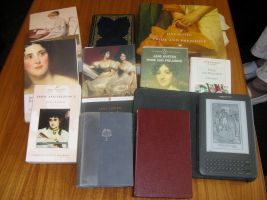
Just a few editions of Pride and Prejudice
I’m only one day back from California and it’s Six Degrees of Separation time again, but I absolutely couldn’t miss this one as our host Kate (booksaremyfavouriteandbest) nominated Jane Austen’s Pride and prejudice as the starting book. It’s a particularly special choice because last month we commemorated the 200th anniversary of Austen’s death. This meme, as you know, requires us players to create a chain of six more books, linking one from the other on whatever basis we like. I don’t think I need tell you that I’ve read Pride and prejudice, which Austen called “my darling child”, but I’ll confirm that, as always, I have also read all the books in my chain. Moreover, because of Austen’s importance to me and to this year, I’m going to try to make every book in this chain relate to her in some way …
 I’ll start with an example of the sort of book I rarely read – that is, spin-offs and sequels – and nominate Jo Baker’s Longbourn (my review). Longbourn, as the Austen fans among you will know, is the name of Elizabeth Bennet’s family home, and Baker’s novel focuses on the lives of its servants. I read this for my Jane Austen group, and while most of us found the plot rather far-fetched, as is not unusual with this “genre”, we thought Baker’s research into the lives of servants of the time made the book a worthwhile read.
 From here, I’m going to nominate a book I read long before I started blogging, but which Guy (of His Futile Preoccupations) reviewed recently, Elizabeth Jolley’s The newspaper of Claremont Street (Guy’s review). I could have linked to a Jolley I’ve reviewed here, as one of the reasons I’ve chosen Jolley is because I sometimes call her my antipodean Austen, but I want to nominate Newspaper because she’s a cleaner, in other words, essentially a servant.
 My next link is a cheeky one, Jane Austen’s Lady Susan (my review), the book which marks the transition between her juvenilia and mature novels. It’s a cheeky link because the recently widowed Lady Susan, described by another character in the book as “the most accomplished coquette in England”, is poor. She’s desperate to marry well so that she can be kept in the manner to which she had become accustomed, but as the book opens she can’t afford her own house, let alone servants! By the way, this book contains one of those quotes you often find in those “wit and wisdom” or “favourite quotes” of Jane Austen books: “where there is a disposition to dislike a motive will never be wanting”. Love it.
 I’m going to continue being cheeky, and name another juvenilia work for my next link, Jane Austen’s Love and freindship (sic) (my review). It wouldn’t be cheeky, actually, if I linked it on the juvenilia theme, but, as some of you will know, the recent film adaptation of Lady Susan (starring Kate Beckinsale) was titled (somewhat irritatingly to Austen fans), Love and friendship. What were they thinking? Anyhow, Love and freindship (yes, she spelt it with an “ei” not “ie”) is an epistolary novel written when she was 15 years old. Its humour is broad, but you can see in it the writer she was to become.
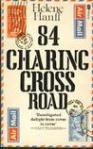 Another epistolary book that I’ve enjoyed, though it’s not a novel, is Helen Hanff’s 84 Charing Cross Road (my review). This is such a classic now that I’m sure you’ll know it but, just in case you don’t, it comprises the delightful correspondence that took place in the middle of the twentieth century between American writer and bibliophile, Helene Hanff, and Frank Doel of Marks & Co, a London secondhand and antiquarian bookshop. It’s the sort of book that booklovers, like me, adore – and I adore it even more because during the correspondence Hanff fell in love with Pride and prejudice and asked Frank to find her a copy. She wrote:
“You’ll be fascinated to learn (from me that hates novels) that I finally got round to Jane Austen and went out of my mind for Pride and Prejudice which I can’t bring myself to take back to the library till you find me a copy of my own.”
 So now, what to choose for my final book? It has to be one of Austen’s, and I’m going to make it Northanger Abbey (my review), not only because it is 200 years old this year, but because it is the one that contains her famous defence of the novel. I’ve mentioned it so many times before, but I’ll quote it again:
… there seems almost a general wish of decrying the capacity and undervaluing the labour of the novelist, and of slighting the performances which have only genius, wit, and taste to recommend them. “I am no novel–reader — I seldom look into novels — Do not imagine that I often read novels — It is really very well for a novel.” Such is the common cant. “And what are you reading, Miss — ?” “Oh! It is only a novel!” replies the young lady, while she lays down her book with affected indifference, or momentary shame. “It is only Cecilia, or Camilla, or Belinda”; or, in short, only some work in which the greatest powers of the mind are displayed, in which the most thorough knowledge of human nature, the happiest delineation of its varieties, the liveliest effusions of wit and humour, are conveyed to the world in the best–chosen language.
How better to end this post than on such a gorgeous description of the novel!
So, I think I’ve done what I set out to do and made this all about Austen, albeit we have dipped our toes briefly in Australia and the USA along the way. I hope it hasn’t been too boring …
Have you read Pride and prejudice (dare you admit you haven’t)? Whether or not you have, what would you link to?





 Whispering Gums