C.J. Dennis, The moods of Ginger Mick

Sometimes a bloke gits glimpses uv the truth
(“In Spadger’s Lane”)

I wasn’t sure, really, that I wanted to read CJ Dennis’ verse novel, The moods of Ginger Mick, which I received as a review copy from the Sydney University Press as part of their Australian Classics Library – but have surprised myself. I rather enjoyed reading it and am glad that I had this little push to do so!
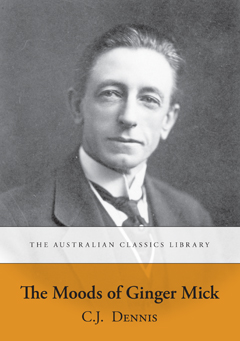
The moods of Ginger Mick
The moods of Ginger Mick cover (Courtesy: Sydney University Press)

The moods of Ginger Mick was published in 1916 just weeks before the big Conscription Referendum, according to Philip Butters who wrote the new introduction to this edition. It does not however buy into that debate. The book comprises 15 poems “written” by Dennis’ other character, The Sentimental Bloke, at whose wedding Mick was best man. The poems introduce us to Mick and his larrikin life before the Great War and then go on to chronicle his life as a soldier.

Dennis writes his poems in broad Australian slang (but there is a glossary at the end). Most are 6-line stanzas with an ababcc rhyme (the same as Wordsworth’s “Daffodils”!) but every now and then there is a different rhyme scheme which mixes it up a little. The sweet poem “The singing soldiers”, for example, has a sing-song aab(with an internal rhyme)acc, while the poignant “Sari Bair” about the eponymous battle has 4-line stanzas with a simple aabb rhyme.

I enjoyed reading the poems, not only for their evocative language but also for their subject matter. While their setting and language make them very much of a particular time and place, their concerns have some universality. They are about egalitarianism vs class difference, and about what it means to be a man (a “bloke” as it were). Mick starts off as a bit of a larrikin – one who cares not for the “toffs” and for whom the “toffs” care not! As he says in an early poem:

But I’m not keen to fight so toffs kin dine
On pickled olives …
(“War”)

What sends him to war in the end is “The call uv stoush” but, when he gets there, he starts to discover that in uniform all men are equal, that

… snobbery is down an’ out fer keeps,
It’s grit an’ reel good fellership that gits yeh friends in ‘eaps.
(“The push”)

This poem, “The push”, provides a wonderfully colourful roll call of the sorts of men who enlisted. Other poems cover the support of women at home, hopes for work when they return home now they’ve proved themselves (after all the “‘earty cheerin’ … per’aps  we might be arstin’ fer a job”) and the sense that Australia has grown up as a nation (“But we ‘av seen it’s up to us to lay our toys aside”). There is ironic humour (as in “Rabbits”) and pathos (as in “To the boys who took the count” and “The game” in which Ginger Mick finally realises that he’s found his metier). There’s also some racism that was, unfortunately, typical of the time. And of course there is patriotism, with some rather lovely descriptions of the Australian landscape. I just have to mention here some references to gums:

An’ they’re singin’, still they’re singin’, to the sound uv guns an’ drums.
As they sung one golden Springtime underneath the wavin’ gums.
(“The singing soldiers”)

An’ we’re ‘opin’ as we ‘ear ’em, that, when the next Springtime comes,
You’ll be wiv us ‘ere to listen to that bird tork in the gums
(“A letter to the front”)

As a group, the poems offer an interesting insight into Australia’s experience of the First World War, particularly given their mix of realism and romanticism that belies perhaps the recent glorification that’s developed around our ANZAC heritage. If you are interested in Australia’s cultural and literary heritage, it is well worth giving this short little book a look.

C.J. Dennis
The moods of Ginger Mick
Sydney: Sydney University Press, 2009 (orig. pub. 1916)
87pp.
ISBN: 9781920898984

(Review copy supplied by the Sydney University Press)
Andrew Croome, Document Z

Truth, according to the dictionary, can mean several things including:

  • the state of being the case, fact or actuality; and
  • a transcendent or spiritual reality.

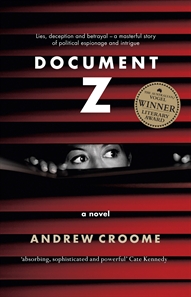
Document Z bookcover

Document Z cover image (Courtesy: Allen & Unwin)

Truth in all its variety and slipperiness is, I think, the fundamental theme of Andrew Croome’s Document Z which won the 2008 The Australian/Vogel Literary Award. This book, which chronicles the famous-in-Australia Petrov Affair about the defection of Vladimir (familiarly, Volodya) and Evdokia Petrov in 1954, began as a PhD Creative Writing thesis. Who needs a PhD in Creative Writing, though, when you have a publication offer instead?

At the end of the novel is a reference to an oral history that was conducted with Evdokia by the National Library:

This historian’s questions give her the space to betray Volodya, to admit his faults, to commit herself finally, to the truth. She doesn’t. The record is no all-important thing, and what exactly would be the point?

What indeed? After all, duplicity is what the book is about. Vladimir and Evdokia are MVD agents at the Soviet Embassy. This is their secret role, in addition to their formal embassy roles, and it puts them in conflict with the ambassador since, in effect, they work for two masters, the ambassador and the MVD headquarters in Moscow. Not an easy position to be in, particularly in a regime that thrived on suspicion.

Croome nicely structures the book, commencing with the dramatic attempt on 19 April 1954 by the Soviet authorities to return Evdokia to Russia. The book’s narrative form is multiple third person subjective, and this opening scene is viewed through Evdokia’s eyes: “Evdokia knew this crowd was for her. They were hunting her…”. She was wrong though. The crowd was with her and were “hunting” those who seemed to be taking her away. This opening chapter ends with the words, “Everything he had betrayed”. The scene is set to tell their story, and the book flips back to 1951 and their arrival in Canberra. From this point on the story is told through several eyes, particularly Evdokia’s, Vladimir/Volodya’s (who, Moscow thought, “could be well and truly trusted [my stress]”) and Dr Bialoguski’s (the man who worked for ASIO and who, through cultivating Petrov’s friendship, engineered the defection).

I enjoyed the book – partly because it was set in familiar territory, which is a bit of a rarity for we Canberrans, and partly because I was interested in the Petrov Affair. Croome seems, to the best of my knowledge, to have captured the era well. I loved the description of the Soviet Embassy wives going shopping…and he nicely evokes the polarisation of views between East and West/Communism and Capitalism that characterised the Cold War period. However, the book was a little unsatisfying too. I think it’s because Croome focusses a little too much on plot machinations for me – and yet the plot is not dramatic enough to support this. He does try to get “into” the characters but, for all his sound characterisation of the Petrovs, they are, at the end, pretty much as shadowy in terms of their “true” natures/desires/motivations as they were at the beginning. In the end, there’s not much drama in either the political or the personal story. It feels, almost, as though they were victims of circumstance – and perhaps they largely were.

And what were these circumstances? Well, they were largely the duplicitous – and fear-ridden – situation they lived and worked in. I had to laugh, early in the book, at the description of the embassy’s secret (MVD) section: “Somewhere, the roof leaked“. The book has many little ironies and paradoxes mostly playing on notions of secrets, lies, deception and betrayals, playing, that is, on a world in which truth is treated with rather careless abandon. By the end of the book we are, I think, no nearer the truth. We perhaps know some of the “facts” (albeit this is fiction!), but we do not “really” know the “spiritual reality” of these two people whose marriage seemed weak and who apparently lived a pretty sad life in exile.

I’d certainly recommend the book … it’s well written, and is a genuinely interesting portrayal of the case. But if you are looking for insights into the affair, I’m not sure you’ll find them here.

Andrew Croome
Document Z
Crow’s Nest: Allen & Unwin, 2008
350pp.
ISBN: 9781741757439

Kazuo Ishiguro, Nocturnes: Five stories of music and nightfall

Kazuo Ishiguro

Kazuo Ishiguro, 2005 (Courtesy: Mariusz Kubik CC-BY-SA 3.0)

I like Kazuo Ishiguro – and have read 5 of his 6 novels – so I was looking forward to reading Nocturnes, his first published collection of short stories. Nocturnes, as the subtitle describes, comprises five short stories, each focussing in some way on music, and on a day’s end.

The five stories – a couple of them with overlapping characters – are unmistakably Ishiguro. All have first person narrators, and in all cases the narrator is either unreliable or in some other way not completely across what is going on. This is the Ishiguro stamp … as is the overall tone of things not being quite right, of potential not being quite achieved, of people still looking for an elusive something but not necessarily knowing quite what that is.

When reviewing a short story collection I don’t necessarily feel the need to list each story but with there being so few in this case, I think I will, so here they are:

  • “Crooner”: an aging crooner, with the narrator as his accompanist, serenades his young wife from a gondola at a time when their marriage is breaking down
  • “Come rain or come shine”: a nearly 50-year old ESL teacher visits old university friends, only to find that their relationship is under stress
  • “Malvern Hills”: a not-yet-successful young rock guitarist visits his sister and brother-in-law in the country, and meets some Swiss tourists who are also musicians and whose marriage is a little rocky. (Hmm… see a theme developing here?)
  • “Nocturne”: another not-very-successful musician (this time a saxophonist) finds himself in the same hotel as the (now ex-)wife from the first story, while they are both recuperating from plastic surgery
  • “Cellists”: a cellist with potential is mentored by another cellist who is not quite what she seems

While there is a similarity in the tone of these stories, there are also differences. “Come rain or come shine” and “Nocturne”, for example, are a little reminiscent of When we were orphans in the sense that Ishiguro slowly (even in a short story!) but surely leads his characters (and we readers alongside) into increasingly bizarre, if not almost surreal, behaviours. Moreso than the other stories, these two have a comic, albeit tinged with pathos, edge.

The technique Ishiguro uses to present his notions of failing or missed potential is one common to most of his writing: he explores and exposes the gap between appearance and reality. This gap is given literal expression in “Nocturne” where two would-be stars are both bandaged for most of the story as a result of their plastic surgery, but it is there in all the stories: from the first story’s Tony and Libby Gardner who are separating for the most “superficial” of reasons to the last story’s self-described virtuoso cellist. It is found in Ray Charles’ version of the title song in “Come rain or come shine” “where the words themselves were happy, but the interpretation was pure heartbreak”. This gap is also conveyed through the prevaricative words commonly used by Ishiguro’s narrators, such as “I guess”, “perhaps”, “maybe” and “probably”:

I guess it showed in our music (“Crooner”)

Perhaps it was simply the effect of receiving a clear set of instructions (“Come rain or come shine”)

Maybe they were just tired. For all I know, they might have … All the same, it seemed to me (“Malvern Hills”)

… that probably means … and Maybe it was plain spinelessness. Or maybe I’d taken on board … (“Nocturne”)

Maybe there was a tiny bit if jealousy there … and … well, maybe there’s something in that (“Cellists”)

Ishiguro’s hallmarks of misconceptions and misconstructions, assumptions and self-deceptions are all evident here…sometimes in the narrator, sometimes in the other characters, sometimes in both.

The stories stand alone but, somewhat like Tim Winton‘s The turning, there’s a feeling that these stories go together, not just because of the recurring characters in two of them, and the apparent similarity of setting in the first and last stories, but also because of the recurring musical motif and the consistency in theme. If I were a musical expert rather than dilettante I might have tried to relate the five stories to some sort of musical structure but, fortunately for you, I am just the dilettante! That said there are some neat little links between the first and last stories which round them off nicely, just like a well-conceived piece of music.

There are no twists in the tail or crashing codas in these stories. This may disappoint some readers but, for me, they are deliciously conceived quiet, subtle stories that cleverly draw you into their characters’ lives while at the same time leaving you with the impression that you should keep your distance lest you too suffer from their malaise and disappointments.

Kazuo Ishiguro
Nocturnes: Five stories of music and nightfall
London: Faber and Faber, 2009
221pp.
ISBN: 9780571244997

William Trevor, The woman of the house

[WARNING: SPOILERS, if you think it matters]

According to Wikipedia,William Trevor’s characters “are usually marginalised members of society: children, old people, single middle-aged men and women, or the unhappily married.” This is certainly the case with Trevor’s short story, The woman of the house, which was published last year in The New Yorker. All four characters in the story are marginalised, two are middle-aged to old, and two are young, but all live on the edge of society struggling to survive in one way or another. In fact it is said of the two young men that:

Survival as they were was their immediate purpose, their hope that there might somewhere be a life that was more than they yet knew.

Pretty grim stuff. The plot is simple. Two young men of “stateless” origin  are employed to paint the house of an old disabled man whose carer/companion is his nearing 50-year-old cousin, Martina. By the end of the story the old man has disappeared from view … we have a pretty good idea of what has happened to him and it ain’t pretty.

The story is perfectly set up. The two strange men who appear to know little about painting – and who we are told are somewhat like “gypsies” – have clearly been shown where the money of the house is kept. The woman, Martina, is (to be euphemistic) taken advantage of by the local butcher and in return receives some special meats. Aha, we think, here is a case of two con-men facing some easy pickings…but, this would clearly be too cliched for Trevor. They don’t steal the money and she is not so down-trodden as it seems. Trevor makes no judgement – just tells it like it is when life is hard and people make pragmatic decisions in order to survive.

And that’s all I’m going to say about this tight little story…except of course that it has inspired me more than ever to read a Trevor novel.

Arnold Zable, Sea of many returns

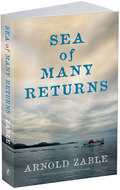
He leaps through centuries, tears apart myths, and reassembles them in his own way.

Sea of Many Returns cover

Cover image courtesy Text Publishing

These words that are said of one of the characters in Arnold Zable’s Sea of many returns could just as easily be said of Zable himself – not only of this book, but of his earlier ones such as Cafe Sheherazade. Zable loves telling stories, stories that weave between each other in an attempt to understand the impact of dislocation and exile on the human psyche – well, on his characters’ psyches but it is not hard to universalise this.

Sea of many returns is, essentially, a dual point-of-view novel:

  • the first person narrator, Xanthe, who was born in Melbourne to an Ithacan father and who tells her story; and
  • the third person story of Mentor, her paternal (also Ithacan) grandfather whose journals she is translating.

The story roams, backwards and forwards, from 1895 to present time as Xanthe and Mentor tell of the lives of their family members in Greece and Australia…about all their leavings and returnings, for work or adventure, or more terribly for war or, simply, to find a better life:

The stories I have heard, and am yet to hear, are echoes of one refrain: Is there somewhere on earth where I can find peace and prosper? Once the question is posed, the agony begins, the eternal dilemma: to stay or leave? To retreat behind fortifications, or cast our fate to the winds? (Xanthe, p. 203)

Underpinning this dilemma is the yearning for Ithaca – which translates, really, to the yearning for place, for home. Towards the end of the novel Mentor discusses the notion of “nostalgia” or “the pain of longing for the return”. Put this together with “the Ithacan phobia, the fear that I may never return” and the result is a melancholic – but not depressing – tone, since it is mostly accompanied by, if not always strength of mind, a resilience of spirit.

Not surprisingly, it’s the men who travel, at least in the earlier times of the book. As Xanthe’s aunt says, resignedly, “Let your men roam distant lands. Let them do what they must. What choice do we have? Bend your back to the mountain. Sow and reap”. And so, while Xanthe talks to some of the women in her Greek family, it is the men whose stories she seeks as she tries to understand her father, the angry Manoli, and her grandfather, Mentor. However, the book’s final section, titled “Epilogue: The resident tiller of the soil”, focuses on 90-something year old Irini who, quite paradoxically Xanthe realises, has not left Ithaca since her arrival there 90 years before and yet “is both voyager and teller, Odysseus and Homer”. This is perhaps a little elliptical but it has a certain resonance nonetheless! And Andreas does mutter in the previous section, “To know one place is to know all places”.

While the novel takes on a mythic overtone, it is “history” which provides its backbone and puts flesh on its characters: there are, for example, the way-too-many wars (to which many men go and from which some return), the 1916 anti-Greek riots in Kalgoorlie, the 1953 earthquakes in Ithaca, and the building in Melbourne of Cafe Australia and the Capitol by the Chicago architects, Walter Burley and Marion Mahoney Griffin. This last one seems a bit odd in terms of the overall thrust of the book but is interesting to one who lives in the city they planned!

I have only touched on a little of what this novel contains – there are the references to the Homeric quest and the story of Odysseus, there is the drunk but wise Niko, there is the beauty of the language in its rhythms and descriptions, and there is music – but if I go on, I might, like its storytellers, never stop. As Andreas says to Xanthe near the end

I have told you one version of the story and tomorrow I may tell it with a different slant. Each word I utter is true and false at the same time …

Paradoxical? Yes! But that is the essence of this lyrical and mesmerising but also rather mystifying – or, is that mythifying – book!

Arnold Zable
Sea of many returns
Melbourne: Text Publishing, 2008
307pp.
ISBN: 9781921351532

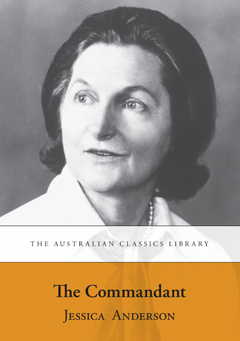
Jessica Anderson, The commandant

Jessica Anderson, The commandant Book cover

Cover image for The commandant (Courtesy: Sydney University Press)

When I first read about Sydney University Press’s Australian Classics Library, the book I really wanted to read waThe commandant by Jessica Anderson. It’s her only historical novel, but its subject matter doesn’t stray much from what she told Jennifer Ellison in an interview many years ago, “I was very much, and always have been, preoccupied with people who are strangers in their society” and “I am interested in families… They are interesting – you know, the tangle” (Rooms of their own). This is a clever and thoughtful novel by yet another much overlooked Australian woman writer.

[WARNING: SPOILERS, if you don’t know the history on which this is based]

The plot is pretty simple. It is set in Queensland’s penal settlement of Moreton Bay in 1830. It draws from the real story of the commandant there, Patrick Logan, who was noted for his harsh methods and who was murdered while out on an expedition. In the novel, Logan’s family is joined by his wife’s young sister (“the stranger”), Frances, who, on her way up to the settlement via Sydney, has been introduced to “radical” ideas critical of Logan’s regime. The scene is therefore set for potential conflict either between Patrick and Frances, or within Frances herself, or both.  In the end, it is a bit of both as Patrick finds his practices questioned and Frances confronts the realities of living in a penal settlement.

Except for Frances’s boat trip up to Moreton Bay with some of the settlement’s residents, the novel is set entirely in Moreton Bay. The characters include Logan’s household (family and servants), his wife Letty’s two women friends, officers of the settlement including two medical officers and the man sent to replace Logan, and of course some prisoners. There are also some characters in Sydney – Frances’ would-be beau and the sisters of a newspaper editor jailed for his criticism of the regime and against whom Logan is bringing libel action. The characters are well-drawn, with the significant ones nicely complex. You get a good feel for life in the settlement.

I would love to write about many of the characters as there are some wonderfully meaty ones, but I’ll just focus on Frances, the only character, really, who changes during the course of the novel. At the beginning, she “was seventeen; she was not stupid, but was often absurd”. She is also sympathetic to the idea of reform, which she says she developed through seeing servant life and poverty first-hand in Ireland and which puts her at odds with many in the settlement. She has a lovely ability to question herself, to see her failings, and it is this which enables her to learn from her several painful experiences. By the end, she is wiser in the ways of the world and has learnt to live with “incurable knowledge”, but has not lost her commitment to the cause of humanity.

Much of the story is told in dialogue – in fact, it wouldn’t be hard to turn it into a play/screenplay. Anderson handles this dialogue well, nicely differentiating the characters, from Letty’s lisp to officer Collison’s uneducated speech patterns. Letty’s lisp is an ironic touch – it lulls us into thinking she is one of those superficial flirtatious women but we soon discover that she is more complex than just a pretty little wife. Characters are nuanced by their reactions to each other  as well as by what they say, rather than by a lot of specific authorial comment, though there is that too.

There is also description, including some particularly beautiful ones of the bush during the search expedition for Logan, such as:

…a few clumps of trees, their rough bark the colour of iron, and their foliage a dun green, stood with the junction of trunk and root shrouded (my emphasis) by tall pale grass; and although at his left the river marked out a fissure of brighter greens, none among them were the sappy (again my emphasis) greens of England and Ireland or the dense fleshy greens of the coast … Among and behind this scrub stood big trees with foliage in similar colours, and with trunks of grey, or silvery grey, or of mauve shading to grey or rust, or of the beautiful colour of pink clay. It was as if everything here inclined not to the sun’s bright spectrum, but to those of the mineral earth and the ghostly daytime moon.

This is not an entirely benign landscape she is decribing – but neither does it hang heavily on her tale: her main focus after all is people. Here is an evocative description of Letty:

She fragmented the worry with her laugh, and waved it away with her hands, but it always seemed to reassemble, out there in the air, and float back to resettle on her.

One of the things that intrigued me most about the novel as I was reading it was the narrative form. It is a pretty straight chronology, but with many small flashbacks that help illuminate the characters. Most interesting though are a couple of slight but meaningful foreshadowings which, before the novel’s end, give us a sense of the sisters’ futures. This makes us realise that the novel is not really about them…it is about humanity, about how we treat each other – and, about that special word, mercy. You will have to read it for yourselves to know what I mean.

Jessica Anderson
The commandant
Sydney: Sydney University Press, 2009
326pp.
ISBN: 9781920898946

(Review copy supplied by the Sydney University Press)

Markus Zusak, The book thief

In one moment, there was great kindness and great cruelty, and I saw it as the perfect story of our humans are. (Zusak on the Random House website)

Zusak could hardly have chosen, for The book thief, a better setting to explore the best and worst of humanity than Germany during the Holocaust. The book reminds me a little of Ursula Hegi’s Stones from the river which also deals with a small German town during the war and the hiding of Jews, though Hegi’s book has a much wider canvas, covering a few decades.

The novel, which is narrated by Death, tells the story of a young girl Liesel (the book thief) who is left with a foster family in a small German town in the lead up to and during World War II. Liesel is treated well by her foster parents, Hans and Rosa Hubermann, and makes friends with people in the neighbourhood including Rudy Steiner, a boy her own age. Not long into the novel, the Hubermann household is also joined by Max, a 24 year old Jewish man whom they hide. From here we follow the family and the neighbourhood as they live through the war. The characters – and there are many of them – are well drawn.

It’s a clever, memorable book. The use of Death as a narrator and its structure, which seems both old world (the chapter titles ‘featuring….’) and post-modern (the inclusion of the illustrated stories, the little bold-type assertions like ‘A small threat from Viktor Chemmel to Rudy Steiner’, ‘He survived like this’), give it a fresh tone which impel the reader on. This tone has a veneer of whimsy while at the same time being deadly serious.

There is a bit of foreshadowing but it’s handled well. It tells us our narrator is omnipotent and warns us that bad things are going to happen (and we know they will anyhow). I don’t usually mind foreshadowing – and agree with Death who says:

Of course, I’m being rude. I’m spoiling the ending, not only of the entire book, but of this particular piece of it. I have given you two events in advance, because I don’t have much interest in building mystery. Mystery bores me. It chores me.

The star of the book for me is its language. It’s superficially simplistic but is really quite sophisticated. There are some wonderful images – ‘pimples were gathered in peer groups on his face’; ‘they were going to Dachau to concentrate’; ‘rumour of sunshine’; ‘the sky began to charcoal towards light’ – but these are not overdone.

Zusak effectively handles the fact that the characters are German and would be speaking German through the occasional use of German words and phrases. And he lightly translates most of this German for us,  such as ‘”Keine Ahnung’, Rudy said, clinging to the ladder. He had no idea.'” Again, there isn’t too much of this but just enough.

The repetition of the curses – “Saumensch”, “Saukerl”, “Jesus Mary and Joseph” – give it a light touch, as do things like the “Keine Ahnung … He had no idea” above and the gruesome humour of “they were going to Dachau to concentrate”. Again, none of this is overdone. Not too funny, but definite touches of humour. There are those who say you can’t “do” humour and the Holocaust, but I don’t agree: this book is a perfect example of why I don’t.

There is also poetry to the language – with this poetry coming as much through the rhythm, as through imagery:

In the morning he would return to the basement.
A voiceless human.
The Jewish rat, back to his hole.

[and]

She didn’t need an answer.
Everything was good.
But it was awful, too.

[and]

Why him?
Why Hans Huberman and not Alex Steiner.
He had a point.

[and]

Their drivers were Hitlers, and Hubermanns, and Maxes, killers, Dillers and Steiners.

And then there is the frequency of ‘3s’. For example:

  • The Hubermanns lived at 33 Himmel Street (and 33 was the age Jesus Christ was when he died – relevant?);
  • the common curse was ‘Jesus, Mary and Joseph’;
  • a lot of the rhythms (such as the examples above) come in threes.
  • it is third time unlucky for Hans Hubermann
  • “The Word Shaker” written by Max story starts with “three important details about his life”.

The threes just keep coming. Three is a pretty magical number: the trinity; mind, body and spirit; past, present and future. The concept of “three” is found in most religions and represents, at its simplest, unity.

The novel seems to have two main themes. One is the power of words – to help and to hinder. I loved this, describing Leisel’s surviving the bombing: “the words WHO had saved her life”. The personification of words here, at the end of the novel, is really effective. Words sustain her through most of the book, but there was a point when she nearly gave up on them, as when she tears up a book in the mayor’s house after having seen Max in the Dachau march:

Soon there was nothing but scraps of words littered between her legs and all around her. The words. Why did they have to exist? Without them, there wouldn’t be any of this. Without words, the Führer was nothing. There would be no limping prisoners, no need for consolation or worldly tricks to make us feel better.

What good were the words.

BUT the other theme is the one that ends the book: what it means to be human. Death says:

I wanted to explain that I am constantly overestimating and underestimating the human race – that rarely do I ever estimate it. I wanted to ask her how the same thing could be so ugly and so glorious, its words so damning and brilliant … tell her the only truth I truly know … I am haunted by humans.

In other words, Zusak, in this book, encapsulates humanity – its best and its worst – and does it through using ordinary people living in/coping with extraordinary times. His message is simply that humans are capable of wondrous things and of heinous things. No astonishing truth really – we all know it – but he shows how closely these can co-exist and how fine the line often is.

Markus Zusak
The book thief
Sydney: Picador, 2005
584pp.
ISBN:033036426X

Prime Minister’s Literary Awards, 2009

Nam Le’s The boat has won the fiction category in the Prime Minister’s Literary Awards. Much deserved too I say! Interestingly, the non-fiction prize was shared by two books: Evelyn Juers’ House of exile, and Marilyn Lake and Henry Reynolds’ Drawing the global colour line. Lisa, at ANZLitLovers, recently wrote about Juers’ book – you can read what she says here.

The Boat – Recap

Back in February I reported on my bookgroup’s discussion of The boat on our group blog, but that was before I started writing here. I won’t repeat here what I said there – as you can read it yourselves. I will note though that one of its stories was included in Mandy Sayer’s recent anthology, The Australian long story. That has to say something! If you haven’t read it yet, think about it now. Nam Le is a new voice on the scene and I certainly hope he isn’t a flash in the pan.

A.B. Paterson, The Man from Snowy River and other verses

Cover for The man from Snowy River and other verses (Courtesy: Sydney University Press)

Is there an Australian out there who doesn’t like Banjo Paterson? Who can’t sing “Waltzing Matilda”, or quote a line or two from “The Man from Snowy River” or “Clancy of the Overflow”? While some of the 12 titles chosen for publication by Sydney University Press in its first set of Australian Classics Library might be surprising, the selection of A.B. Paterson’s The man from Snowy River and other verses should not be. Indeed, Peter Kirkpatrick writes in his introduction to this edition that “You’re about the read the most famous book of Australian poetry ever published”. As well as having been published in entirety many times over the more than 100 years since it first hit the streets in 1895, its poems have also appeared in collected works editions and too numerous to count anthologies. This then is not really the sort of book a reviewer “criticises” in the traditional sense of the word.

Perry Middlemiss, at the appropriately named  Matilda, recently reprinted an 1895 Brisbane Courier review of the first edition. This review makes it clear that many of the poems were already well-known and quoted “all over Australia”. And nothing, I’d say, has changed in the intervening century or so! Why is this? In Derek Parker’s  new biography, Banjo Paterson: the man who wrote Waltzing Matilda, Paterson is quoted as saying:

Poetry is older than civilisation … and it will make men laugh or weep or fight better than any acting or speech-making. Of course, this only applies to real poetry, and not to the verse that most of us write. There is a great difference between poetry and verse, and when a man speaks of real poetry, he should always take his hat off.

So Banjo, it seems, didn’t make great claims for art…I’m not so sure about that.

Paterson was 31 when this collection was published. Many of the poems had been published in The Bulletin, whose editor, according to Peter Kirkpatrick, wanted his readers in the lead up to Federation in 1901 “to imagine the kind of nation Australia might become”. Paterson was an important tool in his vision-making armoury. This provides an interesting hook from which to view the poems. What is the Australia and what are the values that Paterson espouses?

Paterson was born in the country but at the time of writing these poems was a city solicitor. Many of the poems, though, romanticise the country over the city, such as “the foetid air and gritty of the dusty, dirty city” versus “the vision splendid of the sunlit plains extended” (“Clancy of the Overflow”). And many, in a similar vein, champion the underdog – the working man versus the toff or boss. It’s not always simple black and white though. If you only knew Paterson from his well-known poems like “The Man from Snowy River”, “Clancy of the Overflow” and even “The Geebung Polo Club” you would be forgiven for thinking his view of the bush and bushmen was romantic. This is not completely so, though. Paterson in fact chronicles human behaviour in all its diversity. Alongside the hardworking drovers and shearers (albeit some with a touch of cunning) like “Saltbush Bill” and the characters in “A Bushman’s Song” and “The Droving Days”, there are the easily duped “Man from Ironbark”, the rogue Ryan who is helped to escape the law by his loyal girl in “Conroy’s Gap”, and the cheating horse-owners whose attempt to sell off a poorly performing horse comes back to bite them in “Our New Horse”. Having read William Lane’s The workingman’s paradise I was tickled to see a reference to shearers and unions in “A Bushman’s Song”: “‘We shear non union here,’ says he. ‘I call it scab’, says I”.

Many of the poems are humorous: there are characters whose gullibility lets them down as in “Johnson’s Antidote” and others who fail in their attempts at trickery (often to do with horse-racing). Paterson lauds ingenuity, but not when it is deceitful. There are also the nostalgic poems yearning for the romance of the simpler past (before money and business got in the way), such as “On Kiley’s Run”. And then, of course, are the tragic ones, speaking directly of the hardships of life. The saddest has to be one of my childhood favourites, “Lost” (“Though far and wide they sought him, they found not where he fell;/For the ranges held him precious, and guarded their treasure well”). Another is “Only a Jockey” about a 14-year-old jockey who dies in a training accident (“What did he get from our famed Christianity?”).

While all the poems are rhyming, Paterson uses a great variety of rhythms and rhyming schemes to match the tone of his “verse” – from the heroic, romantic and elegaic to comic. There’s also intertextuality (such as Clancy appearing in “The Man from Snowy River”) and a good deal of irony. I like the self-conscious story-telling in poems like “Conroy’s Gap”:

And that’s the story. You want to know
If Ryan came back to his Kate Carew;
Of course he should have, as stories go,
But the worst of it is, this story is true:
And in real life it’s a certain rule,
Whatever poets and authors say
Of high-toned robbers and all their school,
These horsethief fellows aren’t built that way.

Not all the poems work equally well – some are a little awkward and clumsy – but, taken as a whole, recognising the spirit in which they were written, they present an intriguing insight into late 19th century Australia and values, and make entertaining reading as well. Whether you call it poetry or verse, I take my hat off to Banjo!

A.B. Paterson
The Man from Snowy River and other verses
Sydney: Sydney University Press, 2009 (orig. pub. 1895)
128pp.
ISBN:9781920899035

(Review copy supplied by Sydney University Press)

Tessa Hadley, Friendly fire

TessaHadleyMacmillan

Tessa Hadley (Courtesy: Macmillan Books, via their “noncommercial” terms of use)

“Friendly fire”, a short story by the English writer Tessa Hadley, is a simple story of two middle-aged women cleaners in an industrial warehouse, Pam who owns the cleaning business and her friend Shelley who is helping her out for the day. The story focuses on Shelley and nothing much really happens – it’s more about what goes through Shelley’s mind as she cleans the factory floor and its toilets.

The first thing that strikes about the story is the language: the stars are “like flecks of broken glass” and “she let the cold creep into her as if she were made of stone”. Very quickly we get the sense that Shelley is not the happiest person on the planet. Hadley also uses double negatives – “they didn’t make a bad team” and “it wasn’t that she wasn’t proud” – further conveying Shelley’s less than joyous feelings about life.

So, what happens? Shelley and Pam go to the warehouse, clean (one upstairs and one downstairs) and then leave for home. While she is cleaning, Shelley thinks about her son Anthony who is a soldier in Aghanistan, and we realise that it is her fear for his safety that occupies her mind day and night, that colours her emotions. The title of the story comes from her worry that her son might have been involved in a friendly-fire incident. Her husband tells her: “Why d’you have to make up trouble … as if there wasn’t enough already?” In between, she thinks about the ups and downs of her marriage, her daughter’s teen pregnancy, her menopausal loss of libido. Life certainly seems rather circumscribed these days for Shelley. Even her husband’s playful phone messages – about funny place names like the Fishmonger called “A Plaice to Go” – fail to lighten her spirits. Perhaps she’d like to be in a different place?

At the end of the day, they return to the car and “the sky was a blue so pale that it was almost no colour”. Muted like her sense of her life! So, what is it about? Primarily, it is about the worries of a mother for her son engaged in an arena of war. It’s not dramatic, but it’s a nicely observed story that conveys the wider implications of our engagement in war, and how women – the mothers – bear much of that.