Willa Cather, The sentimentality of William Tavener

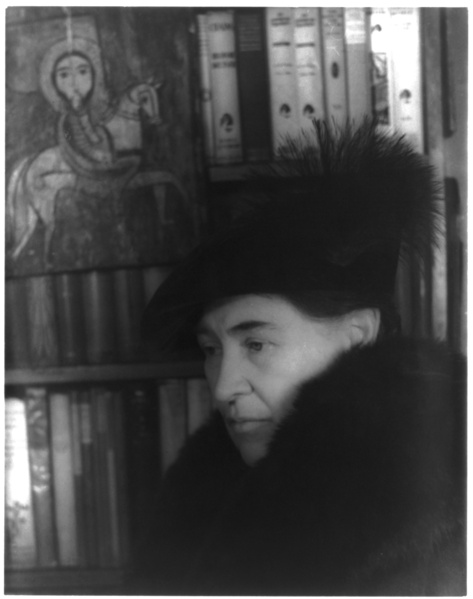
Willa Cather

Willa Cather, 1936 (Photo: Carl Van Vechten; Public domain, via Wikipedia)

Last week’s Library of America story was Willa Cather’s “The sentimentality of William Tavener” (1900). I can’t resist blogging about this one because it’s by the wonderful Willa, to whom I was introduced when I first lived in the US in the early 1980s. I have read only three of her novels (My Antonia, The professor’s house, and Death comes for the archbishop) but loved her from the beginning: for her robust, somewhat terse and yet not unsubtle style, and for writing so evocatively about the nation I was living in and keen to learn about.

The Library of America’s introduction says that this story is one of her earliest pieces and that it “combines recollections from her childhood years in Virginia, where she was born, with the atmosphere of her family’s later home in Nebraska”. It also introduces us, the Library continues, to “the strong-willed pioneers who would be so prevalent in her later, more famous fiction”.

“The sentimentality of William Tavener” might be an early piece but it demonstrates well her ability to tightly evoke character and mood. Its plot is flimsy: it takes place in one evening and concerns Hester Tavener’s plan to get her husband to allow their sons go to the circus. He, it appears, is hard and demanding of the boys; she, their ally in obtaining some of the pleasures of life (“No debtor ever haggled with his usurer more doggedly that did Hester with her husband on behalf of her sons”). In less than 6 pages, Cather provides a powerful picture of this couple – of their individual (equally strong in their own ways) personalities and the somewhat distant relationship between them. In the first paragraph is this:

The only reason her husband did not consult her about his business was that she did not wait to be consulted.

And yet, he, the William of the title, is not a pushover – but he does things his way:

Silence, indeed, was William’s gravity and strength.

On the night of the story though, he breaks his silence and the astonishing effect, the ending teases us, is that it just may augur a new balance of power in the family. We see the possibility of this coming as the evening wears on and the barrier between the couple starts to break down through the sharing of memories, but it is heralded by a sudden change in style from concrete, matter-of-fact almost staccato reportage to a descriptive interlude:

The little locust trees that grew by the fence were white with blossoms. Their heavy odor floated in to her on the night wind and recalled a night long ago, when the first whip-poor-Will of the Spring was heard …

There is irony in the title: William is not presented as a sentimental man and yet, we find, a little sentimentality can work wonders.

The story introduces us to the Willa Cather to come – to her direct, matter-of-fact style; to her strong characters who often survive by the force of their own will in a world that is hard (or they perceive as hard); to her exploration of relationships and the challenges of maintaining them (particularly in the long haul); and to her evocative, careful use of landscape and nature. If you enjoy this story, and have not read any other Cather … then do move on to her novels.

POSTSCRIPT: For an excellent analysis of Willa Cather’s writing, see AS Byatt’s article in The Guardian. It takes a writer to know a writer!
Ruth Park, Swords and crowns and rings

Note to self: never again “read” an audiobook over a long period, such as, say, 5 months! This is how I read Ruth Park‘s engrossing 1977 Miles Franklin award-winning novel, Swords and crowns and rings. It was not hard to keep up with the plot as it’s pretty straightforward – and powerful. It is hard, though, over such a time to keep up with and remember all the nuances in her writing and expression and the way they affect character development and thematic strands. For a thoughtful review of the book by someone who read it more sensibly, please see my friend Lisa’s, of ANZLitLovers, here.

I am not an experienced “reader” of audiobooks and I have to say that I found what seemed to me to be the over-dramatisation of the story rather trying in the first few CDs. I gradually got used to it, however, and by the end I was happy with Rubinstein’s reading, but it did take me a while to settle into it.

New-Zealand born Ruth Park is a wonderful chronicler of Australian life. Her novel, The harp in the south, set in working class Sydney in the 1940s is, to my mind at least, an Australian classic – but it is just one of her extensive and well-regarded body of work. Her autobiographies are also well-worth reading, not only for the light they throw on her life and on that of her husband, author D’Arcy Niland, but also on that of the Australian literary establishment of the mid-twentieth century.

Anyhow, back to the novel. Swords and crowns and rings tells the story of two young people born in an Australian country town before World War 1 – pretty Cushie Moy (born to a comfortable family with the stereotypical socially ambitious mother who has married down) and the dwarf, Jackie Hanna (whose background is well and truly working class). Not surprisingly, Cushie’s parents frown on the friendship which develops between the two. This is not an innovative story but, rather, good historical fiction with evocative writing and sensitive character development. Consequently, as you would expect, the two are separated just as they realise their love for each other and the book then chronicles their respective lives – Cushie with various relations in Sydney and Jackie in a number of country locations before he too reaches Sydney. Much of the book takes place during the early 1930s Depression. Park gorgeously evokes the hardships – physical, economic and emotional – experienced by people like Jackie and his step-dad “the Nun” as they struggle to support themselves. All this is underpinned by Park’s thorough knowledge of the social and political history of the time: we learn about labour organisations and the rise of socialism, of that irascible politician “Big Fella” Jack Lang, and of the building of the Sydney Harbour Bridge.

The resolution is predictable – it is, after all, a book of its genre – but it is not over-sentimentalised and is not achieved before the characters, Jackie in particular, have matured to the point that we can trust that he not only deserves what will come but that he will continue to work and mature for the betterment of himself and those he loves. It is truly a powerful book about human nature, as well as about the place and time in which it is set.

Ruth Park
Swords and crowns and rings (Audio CD)
Read by Deidre Rubenstein
Bolinda Audio, 2007
18 hours on 15 compact discs
ISBN: 9781741636628

Helen Simonson, Major Pettigrew’s last stand

If you like warm-hearted novels with a positive ending you may like this. If you like such novels with a touch of social commentary you will probably like this. If you like books like The Guernsey Literary and Potato Peel Pie Society and Miss Garnet’s angel, then this is definitely for you. But if you like a little more meat in your sandwich, a little more fodder for the brain, then you may like to look elsewhere for your next read.

Major Pettigrew’s last stand concerns one widowed Major Pettigrew and the little, very English village in which he lives. He meets Mrs Ali, the English-born-of-Pakistani background owner of the local shop, and the result is a story of racism, classism and materialism as these two find they have much in common but are confronted by bigotry and cultural expectations (from both sides) that set to derail them. I won’t go into details. There are some interesting characters including the Lord of the manor, some businessmen and a self-centred ambitious son, but most are a little too stereotyped for serious analysis. Some valid contemporary issues regarding English village life are raised, particularly regarding the increasing cultural diversity in the population, and the aristocracy and its role in villages, but the plot becomes a little melodramatic and predictable for my preference.

There are however some nice observations in the book:

…as I get older, I find myself insisting on my right to be philosophically sloppy. It’s so hard to maintain that rigour of youth, isn’t it?

I have no patience with all this analysing of writers’ politics … let them analyse the prose.

Good point. I often – as I’m sure many of us do – wonder how much we should take into consideration the politics of the creator. Is it OK to like TS Eliot? Should we listen to Wagner?

Life does often get in the way of one’s reading…

Ain’t that the truth?

Simonson is British born but wrote this in the USA where she now resides. There are quite a few “digs” at America. The Major, with whom we are supposed to sympathise, if not identify, is critical of American “self-absorption” though he discovers that his potential American daughter-in-law has more substance than he thought. The book, does, in fact  explore the way we stereotype each other in ways that can prevent “true” relationship developing. As the Major recognises at one point, he

knew he was a fool. Yet at that moment, he could not find a way to be a different man.

The novel has some genuinely funny scenes and is lightly satirical in that way that the English tend to do well… And so, while it is not my preferred type of reading, it is nicely written and will provide good reading for those who want a bit of grit without the grimness that often accompanies stories of racial conflict and politics. I know a few people to whom I will happily recommend it.

Helen Simonson
Major Pettigrew’s last stand
New York: Random House, 2010
361pp
ISBN: 9781400068937

(Unpublished proof copy, lent)

Alexander McCall Smith, Tea time for the traditionally built

Alexander McCall Smith said at the literary event I attended recently that if he achieves nothing else in his life he is glad he introduced the concept “traditionally built” because it has brought such comfort to many women (particularly, he says with a twinkle in his eye, in America!).

Tea time for the traditionally built is the tenth book in the No. 1 Ladies Detective Agency series – which is not a bad achievement for an idea that started out as a short story! The eleventh in the series, The Double Comfort Safari Club, is now out (in Australia at least) and McCall Smith has no plans yet to finish the series. When you’re on a good thing …

I am not, as I said in my recent post on McCall Smith, normally a reader of series, but I have made an exception for this series and forgive it the things that would normally make me steer clear of books like this, such as simple language and repetition of theme, because, well, because it is gentle and generous. Generosity is, in fact, an important quality for McCall Smith. At the talk I attended he said that he rarely based his characters on real people because that would be “an abuse of authorial role”! Tell Truman Capote that! When he does draw on real people, he said, it is to paint that person in a positive light. One such example is Mma Potokwani, matron of the Orphanage that features in the Detective Agency series, who is clearly a woman he admires.

Anyhow, onto Tea time. It’s a gentle read – with the plot this time focusing on a football team that is suddenly losing every game after having been consistently successful. The owner, Mr Molofololo (great name eh?), suspects a traitor in the ranks and Mma Ramotswe is, of course, called on to investigate. Suffice it to say that she does and the outcome isn’t quite what Mr M suspected.

I’ll say just one more thing about these books and that is that McCall Smith does create “rounded” characters…even the admirable ones have their flaws and this, I think, gives his books a little depth that can engage, even though the language and style do not offer the challenge than I prefer in my reading. Reading one a year is a nice thing to do – and keeps me in touch with a writer who knows the world has problems but who likes to think that people can be good, and that there is hope yet!

Alexander McCall Smith
Tea time for the traditionally built
London: Abacus, 2009
266pp
ISBN: 9780349119977

Edith Maude Eaton, Mrs Spring Fragrance

This week’s Library of America short story offering is “Mrs Spring Fragrance” by Chinese American author Edith Maude Eaton (1865-1914) who wrote under the pen name of Sui Sin Far. She had an American father and a Chinese mother and, according to the notes which accompany the story, was apparently the first person of Chinese descent to write in the US about Chinese-American life.

“Mrs Spring Fragrance” was published in a collection in 1912. Its concerns are not new to us, reading it nearly a century later and familiar with literature about the challenges of living cross-culturally, but at the time it was apparently rather exotic. The subject of the story is marriage, and the conflict between traditional Chinese arranged marriage and westernised marriage in which young people choose their marriage partner. The main characters are a happily married Chinese couple who live in America, the Spring Fragrances. Their marriage was arranged but as we are told early in the story, both are quite “Americanised”. Mrs Spring Fragrance, we learn, is sympathetic to the plight of their young neighbour who has been promised in marriage but who wants to marry her chosen love.

The plot turns on that old conceit of eavesdropping – of things heard out of context which threaten to derail the “real” situation. (Interestingly, there is a book published by Cambridge University Press titled Eavesdropping in the novel from Austen to Proust, which explores the concept of eavesdropping in nineteenth century English and French novels.) Anyhow, back to the Spring Fragrances. In this story, the eavesdropping is complicated by cultural confusion and the result is … Well, I’m not going to give it away as you can read it yourself using the link above.

I will say, though, that what is eavesdropped is Tennyson’s statement:

‘Tis better to have loved and lost,
Than never to have loved at all.

Surely, says Mr Spring Fragrance, expressing a Chinese perspective despite his “Americanisation”:

Is it not better to have what you do not love than to love what you do not have?

It is a straightforward story, but told nicely and with a light touch. She shows how difficult it is to truly “change” cultures: through such comments as those above and Mrs Spring Fragrance’s unconscious error when she refers to the “loved and lost” poem as the “beautiful American poem written by a noble American named Tennyson”! You have to laugh – but not cruelly, as these are appealing characters, earnest in their desire to do the right thing.

This is not a must-read story, unless you are interested in the history of Chinese-American literature, but it is an enjoyable one nonetheless.

Martin Boyd, A difficult young man

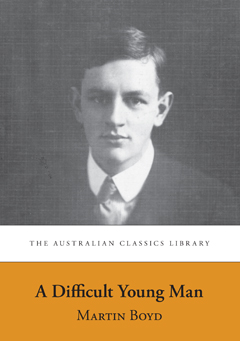
Martin Boyd's A difficult young man
Difficult but handsome (Courtesy: Sydney University Press)

I’m not sure what I was expecting, but I certainly wasn’t expecting the delightful sly wit I found in Martin Boyd’s A difficult young man, which, I understand, is the second book in the “Langton Quartet”. This novel though can clearly stand on its own – otherwise, why would Sydney University Press publish it alone as part of its Australian Classics Library? Is it the best written of the four? The most readable? The one most commonly studied (which goes back to the original question anyhow)? Or was it simple a case of eeny-meeny-miny-moe? (Even “eeny meeny miny moe” has a Wikipedia article – how great is that?) Whatever  the reason, my appetite has been whetted, and the first book, A cardboard crown, will now be promoted in my TBR pile.

Anyhow, back to the serious stuff. I know it was written in a completely different place and oh, nearly a sesquicentenary later, but there’s more than a whisper of Jane Austen about Boyd’s book. Superficially, this book and Austen’s works are very different: this is not a romance – but then neither is that Jane Austen’s focus either; its main characters are male rather than female; it has an autobiographical thread which none of Austen’s novels do; and it uses first person rather than Austen’s omniscient third person narrator. The similarities are, rather, in language (their wit and irony) and form (both write what can be described as social satire). I may be the first person to have put these two authors in the same sentence, but, well, that’s the fun of being a blogger: you can say it as you see it! And what I see is that both writers make me chuckle with their observations on human nature.

So what is the plot? The story is narrated by Guy Langton (a veiled Martin), who is the fourth son of Steven and Laura Langton. He focuses on the late adolescence-early adulthood of the eldest living son, Dominic (inspired by – but not – Merric), the “difficult young man” of the title, who, as the story progresses, manages to fail in, or otherwise mess up, pretty well everything he does. Through the course of the book the family moves from Australia (Melbourne and environs) to the family seat in England and back to Australia again. The book chronicles a number of domestic crises, at the root of which is usually Dominic who somehow undermines “the various attempts to fit him into some place in the world”.  In many ways though, the book is just as much about Guy who, through the process of narration, works to find a balance between “the unaltered impression” of “my childish mind” and “the glaze of adult knowledge”. This is a clever book which reads like, but is not, an autobiography.

It’s an engaging story – not so much for its rather episodic plot as for its array of wonderful and mostly eccentric characters, from the social-climbing arriviste Aunt Baba (who thinks anyone who does “a kindness from which they received no benefit” is silly) to the gentle, wise but somewhat ingenuous father, Steven. My favourite aspect of the book though is its style. I usually enjoy self-conscious narrators, and Guy is definitely that. He regularly addresses the reader directly, reminding us that he can use “the mask of a character in the story” and advising us of which “glaze” he is applying at the time. In this way he lets us know which parts might be more suspect than others in terms of the “facts”, which he recognises as being different from the “truth”:

..but the reader must take certain wild statements as intended for fun, though they contain an element of truth too subtle to be confined within the limits of accurate definition. One can make exact statements of fact, but not of truth, which is why the scientist is forever inferior to the artist.

And this brings us to another concern of the novel – the importance of the imagination. In many ways the book is a hymn to the creative life, a statement of the Boyds’ belief that a life lived without imagination is probably a life not worth living. It also makes a plea for humane values, for peace not war, for gentle not brutal discipline of children, for education that is not conformist. The book is set in the years leading up to World War 1 and the point is made that life before the war – the “secure civilisation” – was to change irrevocably after.

In addition to irony, Boyd uses a wide range of literary techniques rather effectively, such as foreshadowing (which teases us while at the same time directing our understanding), analogies, contradiction, and allusions (particularly to art and literature). All of these imbue the book with a reflectiveness that undermines a focus on plot.

There are so many strands to this novel – its style, diverse subject matter, and characterisation – that would be fun to explore, but that would leave nothing for the rest of you to talk about, so I will finish with a statement made by the narrator towards the end of the novel:

This is really what I am seeking for throughout this novel, the Memlinc in the cellar, the beautiful portrait of the human face, lost in the dissolution of our family and our religion.

I am doubtless romanticising the Bynghams [maternal ancestors], but there is an element of truth in what I write, which is all I ever claim. Also everyone romanticises what interests him.

As he does so often in the novel, he says one thing here and then undermines it immediately after. But it works, and it works because life is messy and contradictory and yet out of this mess and contradiction comes a vision of something that is real and enduring – and that is the transcendence of family, and the importance of imagination.

Martin Boyd
A difficult young man
Sydney: Sydney University Press, 2009 (orig. pub. 1955)
223pp.
ISBN: 9781920898960

(Review copy supplied by Sydney University Press. This is the last of 12 books that my friend Lisa (aka ANZLitLovers) and I received to review. We believe more will be published in this series: if these 12 are anything to go by we are in for a real treat – and the cause of Australian literature can only profit from that.)

Geoff Page, The scarring

Geoff Page (born 1940) is a Canberra-based poet who has been active in the Australian poetry scene for many decades now. He was also, for nearly three decades, an English teacher. Page has published several volumes of poetry and at least three verse novels, of which The scarring is his first.

The scarring, which I read a few years ago but have been wanting to review here, is, I have to say, one of the most gut-wrenching works I have read. Page has set it in the landscape – rural northern New South Wales – of his childhood and says it was inspired by rumours he heard as a child (but it is not a “true” story). The story spans around seven decades from the 1910s to the 1980s, and chronicles the lives of a couple from their youth and courtship through to old age. As the blurb on the back cover says, “their separation through war sows the seeds of their eventual destruction”.

One of the things I love about the book is the way Page weaves so much of the social and political history of twentieth century Australia through the lives of this couple – war, the Great Depression, the boom of the 1950s, city versus country life and values, and of course gender inequity and the old double standard! The scene is set from the first line:

Breed em tough, the old man says.

Little do we know what lies beneath this seemingly innocuous opening – and I’m not about to give it away to you now. Let’s just say that Page deftly weaves the breeding motif through his tale of a young couple running a cattle property.

Here is an example of how history is told alongside life on the farm:

the new white stiffness of the sheets
where Sally will be his forever

‘Forever’ moves on two years more.
The set of skills they share between them
shoves them sideways from the news:
Sudetenland, then through to Munich,
Kristallnacht and into Prague.
It rattles in through bakelite
and once or twice on Cinesound
showing at the flicks in town,
that lifted arm and square moustache
relishing a massed salute.

And so the story moves on to its more or less inevitable – given the events that occur – conclusion. This is not flowery poetry. Page tends more to a spare style that is well suited to his setting and subject.  The poetry’s insistent rhythm draws you on, and Page’s use of repetition slowly but subtly builds up the tension. This is a novel that you’ll want to read in one sitting.

Page is, I think, a little too unsung … but then, isn’t that the case with most poets?

Geoff Page
The scarring
Alexandria: Hale & Iremonger, 1999
111pp.
ISBN: 0868066826

Don DeLillo, Midnight in Dostoevsky

Do reading synchronicities affect our comprehension? Well of course they do, since everything we do affects our comprehension to some degree doesn’t it? Anyhow, I have just read Don DeLillo’s short story, “Midnight in Dostoevsky” (you can read it here), and, as I read it, I couldn’t help bringing to mind Salman Rushdie’s The enchantress of Florence. Whether that’s valid or not is, I suppose, up to others to decide.

The plot concerns two college boys who spar, who indeed become disconcerted if they concur:

This was not supposed to happen – it unsettled us, it made the world flat – and we walked for a time in chagrined silence. Even in matters of pure physical reality, we depended on a friction between our basic faculties of sensation, his and mine, and we understood that the rest of the afternoon would be spent in the marking of differences.

At the beginning of the story the two boys see a man, and they start sparring about him. It starts with what sort of coat he is wearing but, over time, moves into less apparent things such as where he’s from. Interspersed with this are other scenes, including a few from their Logic class. Are you starting to get the connection with Rushdie? It’s the imagination-reality nexus I’m thinking about…the point where imagination and reality meet and merge.

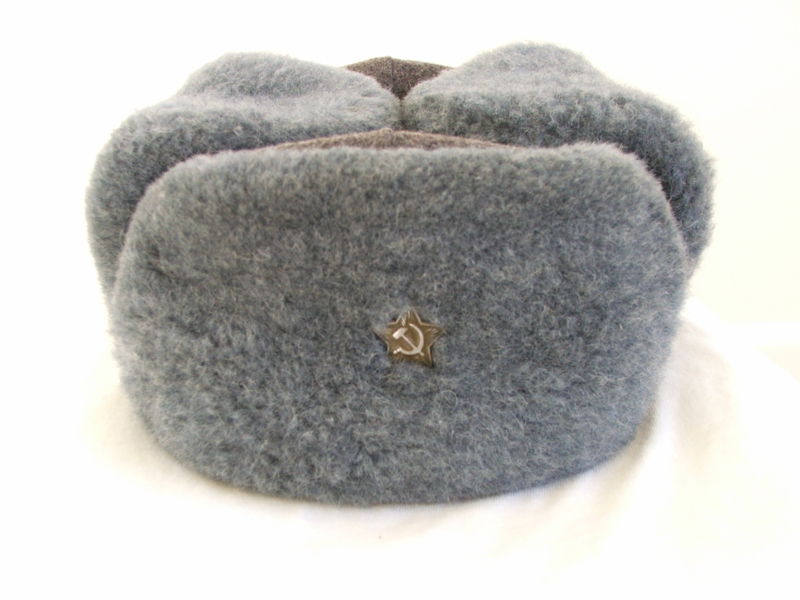
Russian Ushanka Hat

Russian Ushanka Hat (Courtesy: Eugene Zelenko, via Wikipedia, under CC-BY-SA-3.0)

It’s a gorgeously ironic tale, with the boys attending a very dry Logic class (in the evocatively named Cellblock) taught by the rather inscrutable Ilgauskas “who was instructing us in the principles of pure reason … he challenged our reason for being, what we thought, how we lived, the truth or falsity of what we believed to be true or false”. This class nicely counterpoints the flights of fancy the boys engage in when they are alone:

“Think of the hat he’d be wearing if he was wearing a hat,” I said.

“He’s not wearing a hat.”

“But if he was wearing a hat, what kind of hat?”

As I said, this is a story about imagination versus reality… The boys’ fascination with the man continues, as their imaginings become more and more intense (but never moves into actual fantasy the way Rushdie does in his novel).

“Feel the air. I say minus nine Celsius.”

“We’re not Celsius.” [narrator]

“But he is, where he’s from, that’s Celsius.”

That did make me laugh – fiction becoming, in a sense, reality for a while!

We then discover that Ilgauskas reads Dostoevsky (“day and night”) and so our narrator starts to read Dostoevsky too, finding it “magical” that the book which he leaves open at a page in the library is there the next day, open at the same page. In a great leap, he decides that the man is Russian, and that Ilgauskas is his son. His friend Todd says, “Does he have to be Russian to read Dostoevsky?”. Our narrator answers:

“That’s not the point. The point is that it all fits together. It’s a formulation, it’s artful, it’s structured.”

Wow, is this DeLillo’s fiction manifesto? I love it and I love the way this fiction manifesto also works for reason and logic, even though Ilgauskas says that “we  invented logic to beat back our creatural selves”. Creatural? A lovely bit of wordplay: one dictionary provides several meanings including “a living being” and “an imaginary or fantastical being”; another dictionary says “anything created” and “an animate or living being”. Now, that word packs a punch in this story!

The story continues, with the inevitable desire to check the reality of their fiction…but I won’t give any more away. Suffice it to say that this is one delightful and very intelligent story, well worth the read.

(Oh, and as for reading synchronicities? It’s quite possible that had I not just read the Rushdie, I might have come at the story from quite a different angle, such as looking at the relationship between the two boys – but I’ll never know now!)

Hilary Mantel, Wolf Hall

An interesting question to ponder when thinking about Hilary Mantel’s Wolf Hall is the significance of the title. While the place Wolf Hall, the family seat of the Seymour family, does get a few mentions it does not really function as a location. Wolves, however, are one of the subtle motifs running through the novel. As its protagonist remembers late in the book:

…homo homini lupus, man is wolf to man.

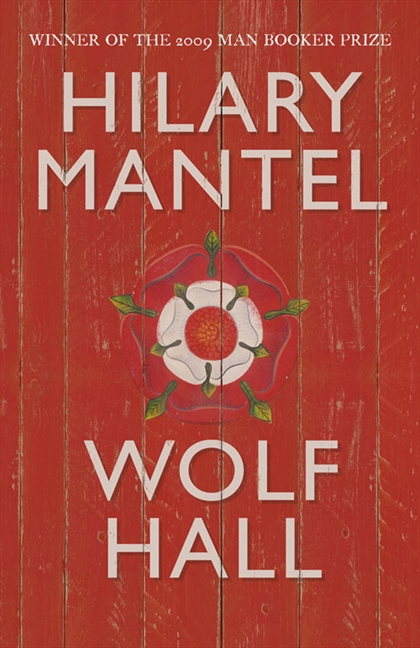
Hilary Mantel, Wolf Hall

Cover image (Courtesy HarperCollins Publishers)

And, after reading the novel, it would be hard to refute this notion! Wolf Hall is set in England between 1500 and 1535, with most of the action taking place between 1527 and 1535. It deals primarily with the lead up to and first years of Henry VIII’s marriage to Anne Boleyn, but as seen through the eyes of Thomas Cromwell. Its plot centres on the machinations involved in dissolving Henry’s marriage to Katherine (Catherine) of Aragon, who had failed to produce a male heir, so he could legally marry Anne Boleyn; its real subject matter, though, is far wider than that. Its time period – the early years of the English Reformation – and its plot mean that it deals with the major issues of the time, including England’s separation from Rome, the translation of the Bible into English and the relaxing of rules regarding access to the Bible, the Act of Supremacy, and succession to the throne. Running through this are the jostlings for power, the skullduggery, and the betrayals (and suprising acts of loyalty) that are the hallmarks of the Tudor Court. Man was indeed wolf to man then (and I sometimes wonder how much has changed?).

This is an exquisite – though large! – novel. It won the 2009 Booker Prize: I can’t compare it with the others because I haven’t read them, but I did enjoy this immensely. In my recent review of The enchantress of Florence – and what fascinating synchronicity to read these two in sequence – I said that the one word I would use to describe it was “paradoxical”. The word I would use for Wolf Hall is “subtle”. It is subtle in so many ways – in its narrative style, its humour, its irony, its symbolism, its descriptions, its juxtapositions. Nothing here is heavy-handed or overdone.

But first, its narrative style. I was forewarned about Mantel’s use of “he” in this novel and perhaps this helped, because I rarely found it difficult or confusing. In fact, I rather liked the style. It’s a bit like a first-person novel told in third person – third person subjective (limited) point of view, I guess – and so the use of “he” reminds us that it is HIS perspective we are getting. Everything we know we know through him, through his thoughts and through his interactions with others. I found this approach intriguing – it gave immediacy and distance at the same time. And this brings me to the man himself.

Thomas Cromwell, for those who don’t know their English history, rose from very humble beginnings to being Henry’s trusted chief minister. He did this by dint of his character and the timely beneficial patronage of Cardinal Wolsey. He became street-smart in his youth but he also educated himself in the culture (literature and art) of the times. He could speak Latin, Italian and French. He was an accountant and lawyer.  He knew about trade. He was no slouch in the kitchen either. He was, indeed, a jack-of-all-trades. Here is a description early in the book (1527):

Thomas Cromwell is now a little over forty years old. He is a man of strong build, not tall. Various expressions are available to his face, and one is readable: an expression of stifled amusement … It is said he knows by heart the entire New Testamant in Latin … He is at home in courtroom or waterfront, bishop’s palace or inn yard. He can draft a contract, train a falcom, draw a map, stop a street fight, furnish a house and fix a jury…

A man, that is, not to be trifled with – and yet he is a man who develops a large and loving household full of loyal children, relatives and “wards”. Some of the loveliest sections of the book are set in his home, Austin Friars. He is also loyal – sticking by Wolsey, for example, in his decline – and firm, hard even, but not cruel.

However, I don’t want this review to be as long as the book and so shall move on. I loved Mantel’s descriptions – they are always short but highly evocative. Here is the Duke of Norfolk:

The duke is now approaching sixty years old but concedes nothing to the calendar. Flint-faced and keen-eyed, he is lean as a gnawed bone and cold as an axe-head;  his joints seem knitted together of supple chain links, and indeed he rattles a little as he moves, for his clothes conceal relics…

And here is another telling description (after charges against Wolsey have been written):

It is a wan morning, low unbroken cloud; the light filtering sparely through the glass, is the colour of tarnished pewter. How brightly coloured the king is, like the king in a new pack of cards: how small his flat blue eye.

Delicious aren’t they?

The novel ends at an intriguing point – but I won’t give that away here except to say that it does not conclude with the end of Cromwell’s life. That, we believe, is the subject of a sequel.

I would love to keep writing about the characters, the language, the way Mantel puts it all together – such as the way she drops hints then explores them later – but that could become boring. Better for you to read the book (if you haven’t already). Instead, I will end with what is probably the book’s overarching theme – that of “how the world works”, and that is through machinations behind the scenes:

The fate of peoples is made like this, two men in small rooms. Forget the coronations, the conclaves of cardinals, the pomp and processions. This is how the world changes: a counter pushed across a table, a pen stroke that alters the force of a phrase, a woman’s sigh as she passes and leaves on the air a trail of orange flower or rosewater…

It was ever thus, eh?

Hilary Mantel
Wolf Hall
London: Fourth Estate, 2009
653pp.
ISBN: 9870007292417

POSTSCRIPT: Steven, at A Momentary Taste of Being, posted a link to this fascinating article by Hilary Mantel on Thomas Cromwell. It is well worth a read.

Salman Rushdie, The enchantress of Florence

The enchantress of Florence by Salman Rushdie

Cover image, used by permission of The Random House Group Ltd

Where to begin? Salman Rushdie’s latest novel, The enchantress of Florence is one of those books-writ-large: its canvas is broad, its structure a little complex and it has a large character set. In other words, you need your wits about you as you read this one.

This is only my third Rushdie. Like most keen readers I read and enjoyed Midnight’s children, with its inspired exploration of the partition of India. I also loved his cross-over children’s book Haroun and the sea of stories. It is a true laugh-out-loud book. In fact, as I started this book I had a flashback to Haroun, not so much because of the subject matter but the light rather satirical if not downright comedic tone. It is very funny at times, particularly in the beginning.

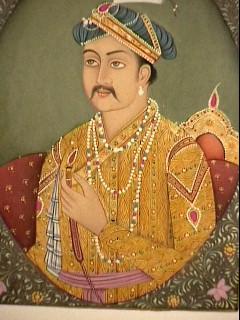
Akbar the Great

Akbar the Great (Courtesy: Wikipedia, Presumed public domain)

The novel is set in the 16th century and revolves around the visit of a young Italian, the so-called “Mogor dell’Amore” (Mughul of Love), to the Mughal emperor Akbar‘s court and his claim that he is a long lost relative of Akbar, born of an exiled Indian princess (Qara Köz) and a Florentine. The story moves between continents, with “Mogor’s” story about his origins in Medici Florence being told alongside that of Akbar’s court. The book is populated with a large number of historical figures – and at the end of it is an 8-page (my edition) bibliography of books and web-sites Rushdie used to research his story. They include social, political and cultural histories as well as fictional works such as Italo Calvino’s Italian folktales. One could wonder, at times, whether it’s a little over-researched, but perhaps that would be churlish.

The next question to ask is, What sort of novel is it? Is it historical fiction? Well yes. Is it a picaresque novel? Yes, a bit. Is it a romance? That too, a bit. Is it a comedy? Certainly. Is it a fable? Could be! What it is, under all this of course, is postmodern.

If I had to use one word to describe this book it would probably be paradoxical. On the second page of the story, the bullock cart driver who brings the stranger (our “Mogor”) to town, describes his passenger in these terms:

If he had a fault, it was that of ostentation, of seeking to be not only himself but a performance of himself as well, and, the driver thought, everyone around here is a little bit that way too, so maybe this man is not so foreign to us after all.

And thus the scene is set for a rather rollicking tale about people who either aren’t all – or don’t seem all – quite real, who play games with each other, who are perhaps more alike (“not so foreign”) than they are different, and who manipulate, fight, love and hate each other as they struggle to find (or understand or establish) their place in the world. In fact, at the end of the first chapter the sort of paradoxical story we are embarking on is made clear:

The visionary, revelatory dream-poetry of the quotidian had not yet been crushed by blinkered prosy fact.

In other words, as you read this book, keep your wits about you! And that is, I admit, what I found a little hard to do as stories, people, and ideas were thrown at me…and then taken back and thrown at me a different way. As I read books I tend to jot notes on the blank page/s you usually find at the end. My notes on this one are all over the place: Love, Power, Names and their mutability, Truth, Religion and Faith, Imagination and Reality, Stories, Nature of men and women, East versus West, and so on. The question now is, Do any of these tie together or form a coherent thought upon which to hang the book? I think there is, and it is to do with ideas surrounding imagination and reality. In Chapter 3, for example, we learn of Akbar’s love for Jodha, the woman he has conjured up for himself:

She was an imaginary wife, dreamed up by Akbar in the way that lonely children dream up imaginary friends…and the emperor was of the opinion that it was the real queens who were the phantoms and the nonexistent beloved who was real.

Their love is called “the love story of the age”, and the chapter talks about the border between “what was fanciful and what was real”. Love, and its power, is one of the driving forces of the novel, and, without giving anything away, the ending more or less unites the two ideas: the power of love, and the conjunction of imagination and reality.

But, truth be told, I’m having trouble writing about this book…and I think this is because, for me at least, it started off with a flourish but got bogged down, particularly when we moved from India to Florence. That said, it picked up again near the end. Here is Akbar in the last chapter:

Again, at once, he was mired in contradictions. He did not wish to be divine but he believed in the justice of his power, his absolute power, and, given that belief, this strange idea of the goodness of disobedience that had somehow slipped into his head was nothing less than seditious. He had power over men’s lives by right of conquest … But what, then … of this stranger idea. That discord, difference, disobedience, disagreement, irreverence, iconoclasm, impudence, even insolence might be the wellsprings of good. These thoughts were not fit for a king.

The word I used earlier in this review to describe this book was paradoxical and this is because almost every “truth” presented within its pages is met by an equal but opposite “truth”. And perhaps that is the biggest truth of all!

Salman Rushdie
The enchantress of Florence
London: Vintage, 2009
355pp.
ISBN: 9780099421924