Monday musings on Australian literature: Et toi, France!

With a certain event happening in Paris, and other parts of France at the moment, I thought it would be fun to briefly explore, some literary connections between Australia and France. I say “some” because there’s no way I could know, let alone list, all the ways in which our countries have connected over the years through literature. My aim, instead, as I often do in Monday Musings, is to introduce the topic with some ideas and let you all do the rest.

Settler Australia’s connection with France starts right back at the time of the arrival of the British in 1788, when French explorer Jean François de Galaup, comte de Lapérouse, and his expedition, met Captain Phillip’s First Fleet in Botany Bay in January 1788. After spending a few weeks in the settlement, the French left, and, as Wikipedia reports, “neither he nor any members of his expedition were seen again by Europeans”. In early 1801, another French explorer, Nicholas Baudin, led an expedition to map the coast of New Holland, as Australia was called back then, not leaving until July 1803. During this time they met Matthew Flinders’ expedition which was also charting the coast. Baudin stopped in Mauritius en route home, and died there of tuberculosis.

These were just the start of many links between France and Australia over time. Some have been negative (often military in origin, like nuclear testing and a certain submarine cancellation) and some positive (mostly cultural, like the work of Alliance Française and an interesting organisation called ISFAR, or Institute for the Study of French-Australian Relations), but overall there are strong and continuing connections. After all, who can resist some French pastries with their coffee?

Now, though, my main point, literature …

Australian novels set in France

Australians being the travellers they are, it’s not surprising that our novelists sometimes set their stories in places other than Australia, like, say, France, albeit their reasons vary as greatly as their novels. War is one reason characters find themselves in France, and work is another, while for others it is travel, or study, or following lovers. Many of the novels I list here are not fully set in France, but all spend some time there – and they are almost all from this century.

  • Diana Blackwood’s Chaconne (2017, my review): starting in Cold War Paris, about a young Australian who goes to Paris for love only to find it’s not what she expected.
  • Michelle de Kretser’s The life to come (2017, my review): a big novel about contemporary social issues including emigration and personal challenges, one of its five parts is set in Paris.
  • Alan Gould’s The lake woman (2009, my review): a “romance” involving an Australian airman who parachutes into a lake in France just before D-Day.
  • Marion Halligan’s The golden dress (1988, read before blogging): multigenerational novel set in Newcastle, Paris and Sydney.
  • Marion Halligan’s Valley of Grace (2009, my review): set wholly in contemporary Paris, and about fertility, babies and children.
  • Anita Heiss’ Paris dreaming (2011, my review): one of Heiss’ “choc lit” books about professional First Nations’ women, this one about a young art curator mounting an Indigenous Australian art exhibition in Paris.
  • Mark Henshaw’s The snow kimono (2014, my review): a mystery set mainly in mid-late 20th century Paris and Japan about two men, their fractured lives, lies and memory.
  • Katherine Johnson’s Paris savages (2019): historical fiction based on the true story of three Badtjala people from Queensland’s Fraser Island, who, in 1882, were taken to European cities, including Paris, as ethnographic curiosities. 
  • Mary Rose MacColl, In falling snow (2013): historical fiction about an elderly woman in 1970s Australia reflecting on her life as a nurse in France during WW1.
  • David Malouf’s Fly away Peter (1982, read before blogging): about three very different Australians, and the impact on them of their experience of WW1 in France.
  • Alex Miller’s Lovesong (2009, my review): the love story of Sabiha and John who met in Paris, told to a writer in Melbourne, who ponders the art and responsibilities of storytelling.

There are also Australian short story collections which contain stories, sometimes just one, set in or referencing France, including Emma Ashmere’s Dreams they forgot, Irma Gold’s Two steps forward, Paddy O’Reilly’s Peripheral visions, and Tara June Winch’s After the carnage.

Australian novels written or published in France

Too many Australian novels have been translated into French over the years, so here I’m sharing some different examples of connections that can happen.
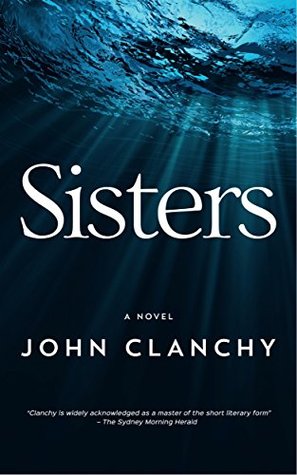
John Clanchy, Sisters

Writers’ retreats are loved by many writers for the opportunity they provide for dedicated, uninterrupted writing time, but not many Australian writers get to do so in France. This however is what John Clanchy did in 2008. His novel Sisters (2017, my review) was originally drafted at the La Muse writers retreat in southern France, and was later published by the retreat. The retreat is open to all sorts of creators, besides writers.
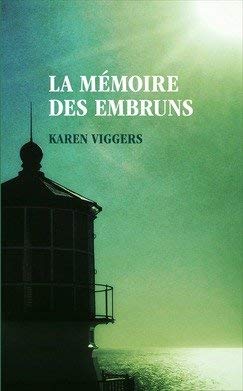
When it comes to translation, a highly successful contemporary Australian writer is Karen Viggers (see my posts). She is a bestselling author in France, with her novel The lightkeeper’s wife having also been awarded the Les Petits Mots de Libraires literary prize. Her latest novel (her fifth) is being translated. On why she is so popular in France, she says that they love her “big landscapes”. Most of her novels have strong environmental themes and are set in gorgeous Australian landscapes. (She has a French page on her website.)
Book cover

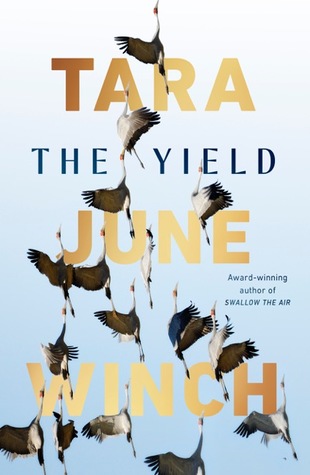
Then, in a different again example of Australia-France literary connections, there is Wiradjuri author Tara June Winch who moved to a French country town when, as a young woman in her 20s, she found herself caught up in the Andrew Bolt “It’s so hip to be black” discrimination case. She withdrew from the legal action taken by several First Nations Australian identities, and disappeared from view for some years, during which, living on her French farm, she wrote her award-winning novel The yield (2020, my review). As far as I know, she is still based in France.
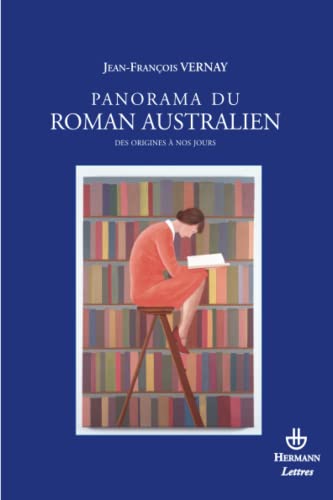
Different again, but still relevant, is Noumea-born Jean-François Vernay, whose somewhat quirky book about Australian novels, Panorama du roman Australien, was published in France in 2009. (It was later revised and expanded, and published in Australia as A brief take on the Australian novel, on my TBR).

Finally, there is our lovely French blogger, Emma (bookaroundthecorner) who includes Australian books in her reading diet, giving our often strange idioms her very best shot.

Now, you know what to do – share your love of bookish France.
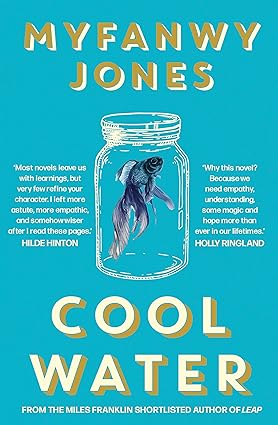
Myfanwy Jones, Cool water (#BookReview)

When I was a little girl, I was allowed to watch a limited amount of television, and what I loved – yes, you can laugh at me – were the singing cowboys, like Roy Rogers and Gene Autry. We are talking the 60s and I was constrained by what was on at the times I was allowed to watch, but still, I gave my heart and soul to these cool dudes. At least, they were to me. All this is a long way around to say I love that Myfyanwy Jones’ third novel, Cool water, features one of my favourite songs from that era, the titular “Cool water”, but I’ll return to that later.

Cool water is a strong, but thoughtful novel about fathers and sons, about what makes a good man, and, particularly, about family and what we inherit (whether we like it or not). I have read a few novels since blogging that explore manhood and fatherhood, including books by Christos Tsiolkas and Steve Toltz. This is another, and I found it absorbing. Set in tiny Tinaroo in Yidindji Country on the Atherton Tablelands of Queensland, Cool water is structured around two storylines, one, set in contemporary times, and the other set over 1955 and 1956 during the building of Tinaroo dam. Threading through these two time-frames are three men, Frank, his father Joe, and grandfather Victor.

“Life was an extreme sport” (Frank)

The novel opens with a Prologue, featuring Victor, the town butcher, appearing supremely confident at a town event. But immediately there is something a bit askew in the way he is described. Not only is he “imposing”, but he’s “horribly handsome”. We are introduced to many of the characters who will appear in the story to come, but the Prologue closes at “the end of the hall, where fatherly embrace has become stranglehold: Joe, white-faced now, wide-eyed and wheezing, as Victor Herbert uses the crook of his arm to apply an unrelenting pressure …”

From here, we jump to the present and Victor’s grandson Frank. His father, Joe, has died in the last year, and he, his wife Paula and daughter Lily have returned to Tinaroo for Lily’s wedding. But all is not well. Joe casts such a shadow over Frank that his relationship with Paula is suffering. They are drawing apart. The novel is told third person, but in the contemporary story, it is all from Frank’s perspective, whereas in the earlier story we switch between Victor, young Joe, and a woman named Evelyn who, unhappy in her marriage, catches the philandering Victor’s eye. Jones handles the storylines well, but it is Frank’s voice which carries the novel as he struggles to make sense of his complicated father and be the man, husband and father he wants to be:

… he feared all the men in his family were cursed. And that however hard he tried to be good, he would not be able to escape his shadow.

By contrast, Joe is the murkiest character. We see him as a young boy, caught in an adult drama between Victor and Evelyn that he doesn’t understand. A sensitive boy, he has promise as a human being, but is the youngest and least tough of Victor’s three sons and bears more than his share of Victor’s brutality. Unlike Victor and Frank whom we know as adults, we only know adult Joe through Frank’s eyes. This can feel frustrating because a strong sense of intergenerational trauma underpins the novel but the Joe Frank describes doesn’t match the child we’ve met. However, through seeing how his father treated him, and hearing Frank’s (and his sister’s) recollections, we gradually fill in the gaps to see a man who didn’t fully shake his father’s brutal volatility. As the story progresses, we realise that Joe’s dreams of a different life to that mapped out by his butcher father had not been realised. His death seems to Frank, “a measured suicide” through “deliberate self-neglect”. He is the saddest character in the story.

All this is told against the backdrop of the dam and its lake – first the building of the dam, and later as a drought-stricken recreational facility. This three-generation story could have been set anywhere, so why choose this? I had some ideas, but wanted to see if Jones had been interviewed about it, and I found she had, at Good Reading Magazine. Jones says that her novels “always seem to start with place”, and so it was a visit to Tinaroo Dam which inspired this novel. She says that, “in 2017, Tinaroo Dam was at 25 per cent capacity and full of blue-green algae; pieces of the old, submerged town of Kulara had begun to surface – an eerie manifestation of the ever-present past”. 

And there you can see the inspiration. The dam is a powerful place, with a complicated history worth exploring but it also works as a useful metaphor for the “ever-present past” (and thus perfect for Jones’ exploration of intergenerational trauma). Dams and lakes, too, are intrinsically paradoxical, with dam-building representing violence and a desire to control, and lakes offering opportunities for beauty, peace and recreation. Jones uses this to full effect, including well-placed references to colonialism and First Nations dispossession, starting with subtle humour in the Prologue, where we are told that a visiting magician had “come a long way by ship (that said, so had most of the crowd, one way or another). In such ways can writers both truth-tell and decolonise our literature, without telling stories that are not their own.

As for the song, “Cool water”, lines from it appear a few times in the novel, always associated with Victor and always conveying some sense of menace, but also just a little perhaps of a lost soul, a war-damaged man who has lost his way. (In case you are interested, here is the version of “Cool water“, by Frankie Laine, that was popular in 1955 when the novel is set, but there are many versions out there which convey different senses of its meaning.)

Ultimately, Cool water is a hopeful novel, one that recognises and conveys unapologetically the very real damage that can happen in families, but that also sees, as Frank hopes early on, that “a different ending was always possible”. A sensitive novel that leaves much unanswered. I like that.

Myfanwy Jones
Cool water
Sydney: Hachette Australia, 2024
296pp.
ISBN: 9780733650024

(Review copy courtesy Hachette Australia)

Monday musings on Australian literature: Forgotten writers 6, Constance Clyde

“Forgotten” is a subjective thing, as I suggested with my fifth post in this series on Lillian Pyke whose reputation as a children’s writer has survived in niche circles at least. My next subject, Constance Clyde, like Lillian Pyke, has entries in both AustLit and Wikipedia suggesting some notability, but I had not heard of her before.

Like my last three Forgotten Writers, Clyde was the subject of one of my posts on the Australian Women Writers (AWW) blog this year. Once again, I am not including here the piece written by Clyde that I published there, but it’s a little different from the more romantic stories I’ve published. Titled, “The paying back”, it references a failed romance but its subject is the relationship between a mother and her unmarried daughter … check it out at AWW.

Constance Clyde

Constance Clyde (1872-1951), born Constance Jane McAdam, is another writer who wrote under a few names, but Constance Clyde seems to be the name by which she was best known, as well as the name she mostly wrote under. However, for the record, AustLit says that she also wrote under Clyde Wright, Pen, C.C. and C. Clyde. Christopher Dawson, writing in the Inside Boggo Road Gaol blog, describes her as the “author of a novel, contributor to high-class English reviews, sometime social editress of a Christchurch (N.Z.) newspaper, and in 1906 one of Emmeline Pankhurst’s Suffragettes”. He sums her up, in his 2023 article, as “a formidably independent woman”.

Clyde was born, the 11th child in her family, on 25 Jul 1872 in Glasgow, Scotland, and died in Brisbane, Queensland, on 30 Aug 1951. The “Clyde”, both Dawson and I suspect, comes from Glasgow’s Clyde River. She moved to Dunedin, New Zealand, with her family when she was 7, and was schooled there. According to Australian writer and journalist Zora Cross (writing as Bernice May), Constance Clyde’s first poem, called “Blighted Hopes,” was published in the Otago Witness when she was twelve, and she won second prize in a story competition for adults when she was still at school.

She arrived in Sydney in 1898, where she continued her career in literature and journalism, contributing to Australian and English newspapers, including the Sydney Bulletin. Cross says that Clyde was one of the first women to contribute to the Bulletin regularly, and that it was the Bulletin that gave her “the idea that one can and should write from the soul”. She also says that “Possessed of a rippling sense of humor, a pen as strong and vigorous as a man’s at times, it is because she does write with her soul that this writer has so many admirers.” Cross, adds later that Clyde

thoroughly mastered the tense, compressed drama the pink-covered weekly [The Bulletin] favored, and her work earned the admiration of the reader and the envy of the aspiring writer of the day.

Meanwhile, Dawson says New Zealand academic Kirstine Moffatt describes Clyde’s subject matter as encompassing “social, feminist and literary questions”. Wikipedia says that, in an essay entitled “The Literary Woman”, Clyde urged women to continue “to make brilliant discoveries in the realm of the emotions”.

In 1903, Clyde went to London to pursue a literary career, and her only novel, A pagan’s love, was published there in 1905. Anti-Puritan, it apparently explored ideas about women’s dependence, which included the heroine considering an extra-marital relationship with a man. Cross writes that while in London, Clyde met leading writers like HG Wells and Bernard Shaw.

In 1907, she was imprisoned in Holloway Prison as one of the suffragettes who ’caused a disturbance’ in the House of Commons. She wrote about this experience – which I found in Hobart’s The Mercury (June 24 1907) – from how she went about ensuring that she was arrested through to her release after thirteen days incarceration. It’s worth reading, not only for its firsthand experience but for its insight into who she was, but I’ll just share this little reference to Australia and Australian literature. She says one visitor was not allowed to give her a rose, but another was

permitted to leave a book. It is Tom Collins’s “Such is Life,” and she had previously reviewed it as a volume “suitable for reading in a desert, island, or gaol.” I find its acid philosophy, flavoured by eucalyptus, thoroughly refreshing!

Some time later, she returned to New Zealand, and in 1925 co-authored a travel book with journalist Alan Mulgan. In 1928, while living in Auckland, she was described by Sydney’s Smith’s Weekly as “one of the most brilliant and versatile of Australasian women journalists”. The article explains that:

In order to understand officialdom, Miss Clyde in recent years accepted appointments in New Zealand institutions, being on the staff of a backward school, sub-matron of a women’s gaol, and attendant at a mental asylum of 1500 inmates. She is strongly opposed to the new N.Z. Child Welfare Act, which she contends gives the official too much power over family life. Her great desire is to have proper Montessori teachers in New Zealand for such backward children as do come into the hands of the State.

In 1931, she was ejected from the New Zealand Parliament for protesting against the 1925 Child Welfare Act. She was a true activist, in other words.

Sometime after this, in the early 1930s, she returned to Australia, to Brisbane, where she was again imprisoned in 1935, this time for refusing to pay a fine for fortune-telling using tea-leaves. Dawson reports that, when in court for this offence, she said, “I thought that I could do some good in this depression by sympathy, kindness and advice, and especially by telling people that there is nothing wrong with this world except the monetary system.” As Dawson added, “even reading tea leaves could become a political platform” for Constance Clyde. Somehow, in between all this she wrote prolifically, with AustLit listing over 130 works by her, most of them short stories, the latest dated 1938.

Sadly, as Dawson chronicles, her life ended quietly, petering out “in the mundane concerns of suburbia after such an ambitious foray into the bohemian literary circles of turn-of-the-century Sydney and London”. There was no obituary. Forgotten already it seems!

Sources

  • Bernice May (aka Zora Cross), “Constance Clyde“, Constance Clyde”, The Australian woman’s mirror, 3 July 1928 (Accessed: 22 July 2024[
  • Christopher Dawson, Constance Clyde of Dutton Park: Author and Suffragette, 16 May 2023 [Accessed 22 June 2024]
  • Christopher Dawson, “A Suffragette Recalls Boggo Road Gaol“, Inside Boggo Road blog, 17 June 2018 [Accessed: 22 June 2024]
  • Constance Clyde, Wikipedia (citing several sources) [Accesed; 21 June 2024]
  • Constance McAdam, AustLit (sourced from A. G. Stephens, ed., Australian Autobiographies, vol.2) [Accessed 21 June 2024]

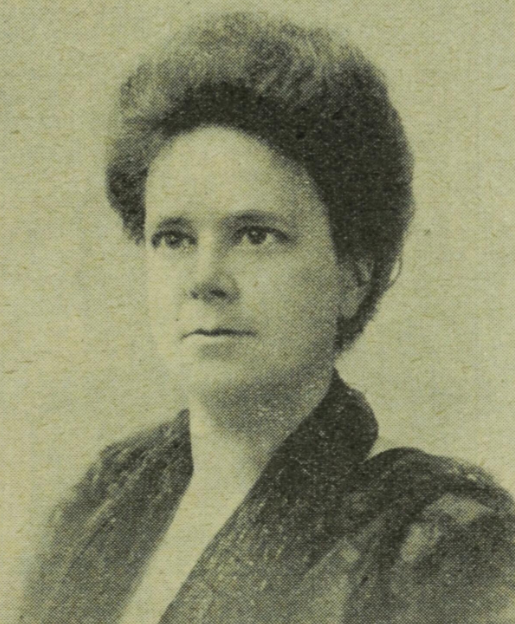
Image: Constance Clyde in her suffragette days, circa 1914, from Australian Women’s Mirror 1928. Public Domain from Wikipedia.

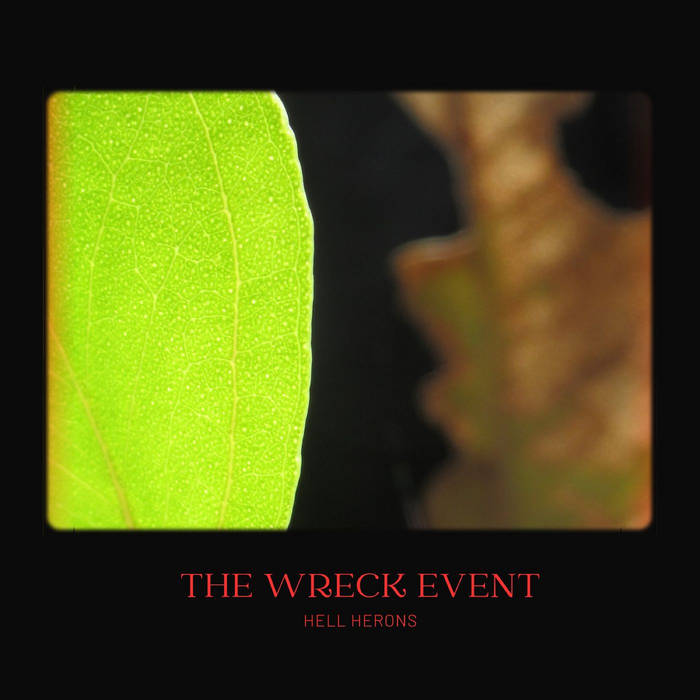
Hell Herons, The Wreck Event

In late June I attended the 2024 ACT Literary Awards which were held in the Canberra Contemporary Art Space. In my post on those awards, I shared the MCs’ acknowledgement of CCAS’s ongoing sponsorship. They made the point that this space is an appropriate venue because there are links between all artists, including the fact that many have interdisciplinary practices. At the end of that week, on 29 June, a work was launched that epitomises that idea.

The work is called The Wreck Event, and it is a spoken-word-and-music album, produced by the Hell Herons. While I had gradually become aware of it through my various social media channels, it was an email from one of the creators, Nigel Featherstone, which filled me in on the details. The Hell Herrons are, he said, a “new ACT-based (mostly!) spoken-word/music collective”.

This collective comprises four inspiring creators:

  • Melinda Smith (ACT): won the 2014 Prime Minister’s Prize for poetry with her collection, Drag down to unlock or place an emergency call (still on my TBR); author of multiple poetry collections
  • CJ Bowerbird (ACT): won the 2012 Australian Poetry Slam, in addition to performances at literary, poetry and folk festivals in Australia and internationally
  • Stuart Barnes (QLD): won the 2015 Thomas Shapcott Poetry Prize, was shortlisted for the Montreal International Poetry Prize, among several prizes and commendations for his poetry including his most recent shortlisting for Like to the lark published by Upswell.
  • Nigel Featherstone (regional NSW, neighbouring the ACT): shortlisted for the Queensland Literary Award, and ACT Artist of the Year 2022; author of several novellas/novels, many of which I have loved. (See my posts.)

I described them as inspiring, not only because of the impressive body of work they have all produced over years of commitment to their practice, but because of their willingness to take risks and push boundaries, including this latest project.

Nigel wrote that over the last two and a half years, the Hell Herons worked “more or less in secret, combining spoken-word poetry with original music”, their aim being “to play, experiment, and test the limits of what’s possible with the way recorded spoken-word interplays with music, specifically the electronic kind”. For Nigel, this project has been “one of the most exciting, surprising and exhilarating projects” he’s ever worked on. It’s the first for which he has been responsible for all the music. (The closest he has come before was being librettist for The weight of light, which I reviewed back in 2018.)

All four wrote and performed the words, while Nigel wrote, performed and recorded all the music. Then, with funding from artsACT, the final 16-song album was mixed and mastered by Kimmo Vennonen of kv productions. Kimmo re-recorded all the vocals and added elements of noise manipulation to round out the sound.

More about Hell Herons’ story and detailed artist bios can be found at their website. But, I’m not sure that the site explains their strange name, Hell Herons. Apparently, it comes from the nickname for a dinosaur whose fossilised remains were found on the Isle of Wight some years go. The scientific name given to it, Ceratosuchops inferodios, translates to “horned crocodile-faced hell heron”. Project-supervisor Neil Gostling of the University of Southampton is quoted in the The Guardian as saying “This is a really exciting piece of news for the dinosaur world as these are some of the most charismatic and enigmatic predators.” I don’t think our four Aussie Hell Herons see themselves as predators, but they can lay claim to being both “charismatic and enigmatic”.

The Wreck Event is available on 40 music-streaming platforms, including Spotify, Apple Music, and Deezer. It can also be download through Bandcamp. Singles from the album are planned, with “Nocturnal” featuring Melinda Smith, already released. This will be followed soon by “Bitumen Stitches” featuring CJ Bowerbird, then “Off-World Ghazal” with Stuart Barnes, and Nigel’s “The Literaries” later in the year. It is categorised in AppleMusic as Electronica.

My thoughts

Some of you, I know, are like me and enjoy poetry but don’t always find the time to put in the effort it often needs to truly appreciate. I have enjoyed poetry since I was a child, but it hit me recently that it was introduced to me orally, via my parents reading it to me. And that, I think, is the best way to experience and understand poetry – read it out loud, or hear it spoken. In this blog, I have talked about spoken poetry before, including posts on an interactive app for TS Eliot’s The wasteland, with its compelling spoken performance by Fiona Shaw.

Now, I am speaking about spoken poetry again, this time set to music. I can imagine what an exciting, fun, demanding, uplifting – and yes probably also challenging – time the Hell Herons had putting this work together, but the end result is something beautiful and mesmerising. Interestingly, the tracks list and liner notes do not identify which poet is responsible for which. Because it’s a collective? If you know them you can work it out.

There is a trajectory, or arc, to the order of the pieces, starting with a wake-up poem, “Wake into you”, which commences,

Here it comes:
the first breath
of a new day

And ending with the beautiful and almost elegiac, “Be this your peace”, which closes on us going to bed,

A nap on the couch in the afternoon, another 
the next day if you need, nine 
novels piled high beside your bed,
light out before dark comes on,
dreams that lift you up, silence. 
when the moon lies beside you

Be this your peace. 

These have both narrative and symbolic value to the whole. Between them are poems that express things in the poet’s lives or of concern to them, some personal (like “Nocturnal”, and “True shelter, for Robyn”), some political (like “Off-World Ghazal, for Judith Wright”), and some of course both (like “Little Gods”). As this was a project which started during the pandemic, its impact is felt, indirectly, but also directly in poems like “Lockdown Week 9 (show me)”. Nature, which was probably more dear to us than ever during the pandemic, features strongly, but especially in poems like “Paperdaisies”.

The whole album is worth listening to, but of course, some poems and performances stand out. I can’t name them all, and anyhow, for each of us it will be different. Poetry, and music, are personal. I will close on one that I found both powerful, and interesting, “Off-World Ghazal, for Judith Wright”. This poem was inspired by Judith Wright who, at the end of her career, wrote a series of poems in an Arabic/Persian form called Ghazal. Ghazals, says Wikipedia, “often deal with topics of spiritual and romantic love and may be understood as a poetic expression of both the pain of loss or separation from the beloved and the beauty of love in spite of that pain”. They have a strict form, and must not exceed 15 rhyming couplets. Wikipedia also says that some argue that, traditionally, the poem is “addressed to a beloved by the narrator”. Stuart Barnes’ ghazal seems to encompass this, with the beloved being the “World”. It is cheeky, angry and sad all at once about what is happening to the World, and the separation or loss which feels imminent. The distorted voice, and Nigel’s insistent music, further enhance the poem’s power.

Do check out The Wreck Event on your preferred music streaming service. It’s an inspired project, and I’d love to hear what you think.

Brigitta Olubas and Susan Wyndham in conversation with Julieanne Lamond

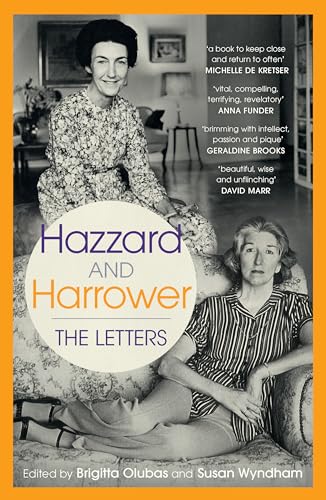
This week’s Meet-the-Author conversation with Brigitta Olubas and Susan Wyndham about their book Hazzard and Harrower: The letters was high priority for me – not only because Hazzard and Harrower are wonderful writers, but because Olubas and Wyndham are themselves significant players in Australia’s literary community.

For those who don’t know them, Shirley Hazzard (1931-2016) and Elizabeth Harrower (1928-2020) were both Australian-born writers, but Hazzard spent most of her life overseas, primarily in New York and Capri. She wrote four novels, of which I’ve read her last two (before blogging), The transit of Venus and The great fire (which won the Miles Franklin Award in 2004). Elizabeth Harrower’s trajectory was more complicated. Aside from living in London from 1951 to 1959, she lived most of her life in Sydney. She published four novels between 1957 and 1966 (of which I’ve read two), withdrew her fifth from publication in 1971, and then pretty much disappeared from view until Text Publishing reprinted her works in the 2010s. Text also convinced her to let them publish that withdrawn novel (In certain circles), and they published a collection of her short stories. I’ve read both of these. (My Elizabeth Harrower posts.)

Brigitta Olubas, an academic and Hazzard’s official biographer, instigated the project to edit the letters, and asked journalist and literary editor Susan Wyndham to collaborate with her. Wyndham had, during her career, interviewed both Hazzard and Harrower. For the project, Olubas focused on Hazzard’s letters and Wyndham Harrower’s. It was a big task that included negotiating how to reduce 400,000 words of letters to the final 120,000. During the conversation, Olubas joked that, at one stage, Harrower had five letters in a row, providing some insight into the challenge it had been to choose letters that would make a coherent whole. Julieanne Lamond, who conducted the conversation, is a literary critic and academic in Australian literature at the Australian National University.

The letters begin in 1966 and continue for four decades, though the two writers didn’t meet physically until 1972, and after that only a few more times.

The conversation

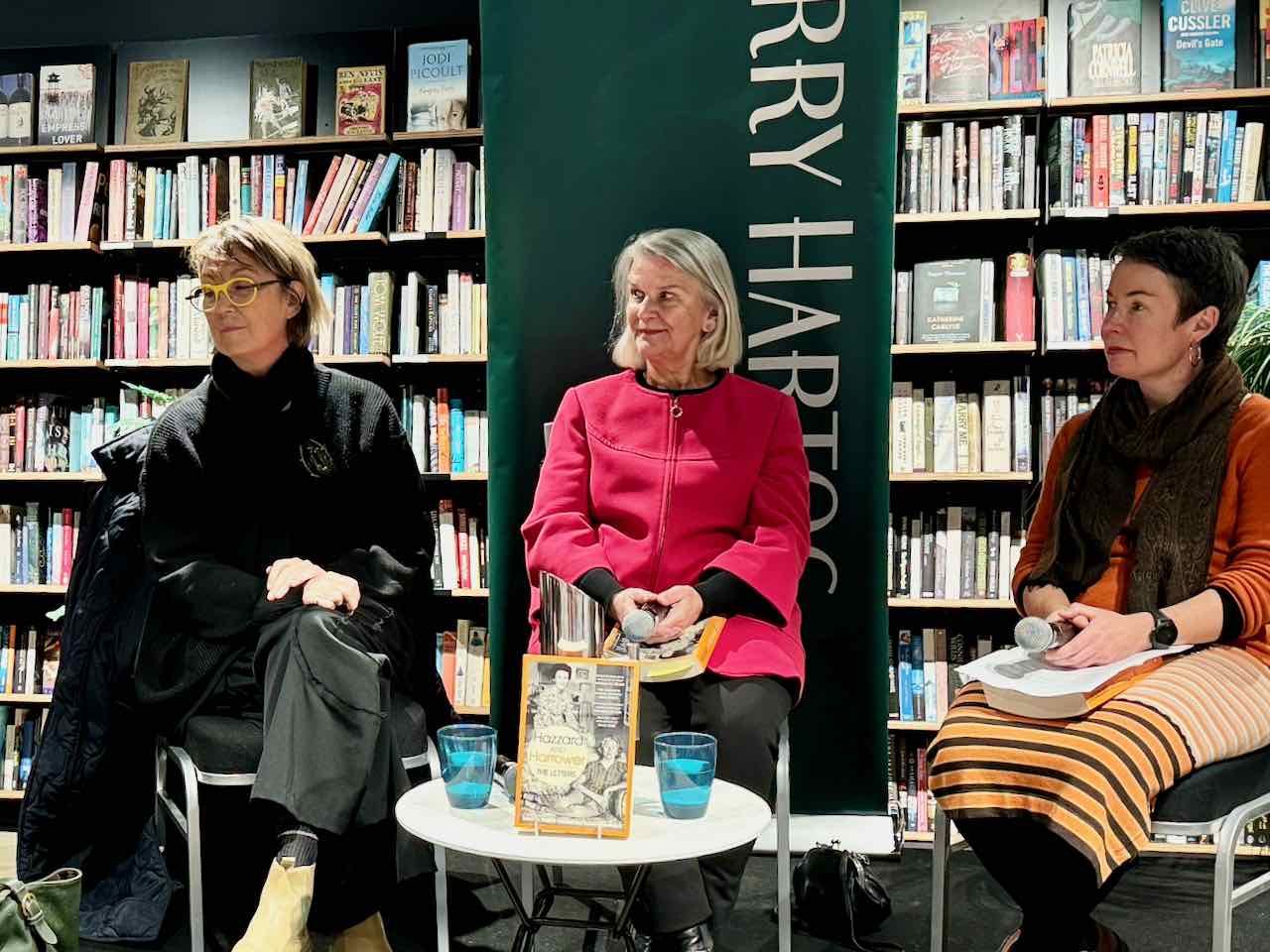
From left: Brigitta Olubas, Susan Wyndham, Julieanne Lamond

MC Colin Steele did the usual acknowledgement of country and introductions, before passing the session over to Julieanne, who started by asking Susan and Brigitta to describe the relationship between the two writers. I am going to use first names from hereon. Last names sound just too formal for warm-hearted events like these.

On their relationship: Susan explained that the two writers were introduced to each other by Shirley’s Sydney-based mother Kit, and that their friendship was formed on the page. Although Elizabeth’s friendship with Kit was kind and caring, family problems and Kit’s mental fragility meant that Elizabeth was thrust into an intimacy she wasn’t necessarily expecting. However, although Kit and her needs occupied part of their correspondence, the two women also wrote about their own lives, what they read, the political landscape, and challenges they confronted in writing (including writer’s block). Their correspondence, suggested Brigitta, may have been more important to Shirley, who said that Elizabeth reflected “something eternal in my consciousness”. She also mentioned the brief falling out they had after Elizabeth visited Shirley and her husband in Italy.

For her part, Elizabeth would tell her friends that she didn’t have much time for Shirley Hazzard, and yet her final letters to Shirley express a keen desire (or concern) to hear from her. Susan suggested that Elizabeth’s attitude could be related to the fact that as Shirley became famous, she became grand in her manner, which Elizabeth didn’t like.

Later, Julieanne asked why would someone, like Elizabeth, take on responsibility for someone else’s mother. Susan explained that Elizabeth liked Kit; they had fun together. Also, her own mother had died (aged only 61) soon after Elizabeth had become friendly with Kit. Elizabeth felt some guilt about her own mother, so was perhaps making up for that. Caring for Kit also enabled her to procrastinate her writing! Julieanne suggested the situation created a complicated sibling-like relationship between Shirley and Elizabeth. Brigitta agreed, adding that Shirley had a sister living in Sydney with whom she had a poor relationship, and would call on Elizabeth to do things that one would normally ask of a sister.

On their careers: Elizabeth had a more difficult career. She wrote a lot in London but it became more difficult after she returned to Australia (due to her own mother’s health). Elizabeth moved in Sydney’s literary circles, including Patrick White, Kylie Tennant and Christina Stead. She had good reviews, but didn’t make a lot of money from her novels. The watchtower – described as a “great act of compression and atmosphere” – was particularly well reviewed.

Shirley also had a late career with big gaps, but is now being rediscovered by younger writers. Both, Brigitta said, were writing “outside their time”, making them difficult to market. They wrote what they wanted to write, what they were good at.

Patrick White, who admired Elizabeth’s writing and kept urging her to write, apparently said that “she’s living a novel rather than writing one”! She was a diligent writer early on but needed a day job to pay her way. She was working at Macmillan publishing while writing her fourth novel, The watchtower (1966). She obtained a grant for her next novel, but that was the one she withdrew. Did she write better when she was pressured for time, as she had been with The watchtower?

By contrast, Shirley was lucky, as she was published by The New Yorker, which provided an income you could live on. She also had a much older, well-off husband, Francis Steegmuller. They worked as jobbing writers, honing their craft. Life wasn’t easy though. She was receiving “monstrous letters” from mother, and her husband started developing dementia.

Meanwhile, Elizabeth had her own challenges. Her mother died in 1970 but, besides Shirley’s mother Kit, she took on helping others, like Kylie Tenant. She got “sucked” into Kylie’s complicated life. She was sympathetic to others. She had a “laser vision into other people’s psyches” which was good for her writing, but it impacted her life.

Both writers, too, were sociable, and claimed they had no time to work. All this affected their careers.

On their correspondence: Both writers put a lot of effort into crafting their letters, which shows in the way their letters reveal their insight into character, dark humour, sense of place, and moral compass.

Brigitta answered in the affirmative Julieanne’s question about whether the two were thinking about posterity as they wrote their letters. Infuriatingly, Shirley didn’t keep her manuscripts – she seemed invested in herself as a “perfect first-time writer” – but she kept her letters and diaries. Elizabeth, on the other hand, threw out many letters, including those she wrote to her mother, but she did keep an “organised set of letters”. Susan believes she wanted posterity to find her. This may be why she was discreet in her letters, often not naming people she wrote about. Susan did some sleuthing to unearth some of this information.

Brigitta added that they had no false modesty. They were aware of their value as writers.

On their political views. Both Shirley and Elizabeth had strong political commitments. Shirley worked for the UN for 10 years. She was bound up in the moral seriousness of the project, and likened her own views to those of Milton – his liberal attitudes, and his commitment to becoming involved in political ideas. Later, Shirley became obsessed with Watergate. In 1977, her article “Letter from Australia” (paywalled) was published in The New Yorker. I think it’s here that Shirley writes about Nixon and Republicans, saying something like “each one in his awfulness makes the next one possible”. Hmmm…

As for Elizabeth, she grew up in Newcastle, through wartime. She saw poverty, and she witnessed the Aldermaston anti-nuclear protests in England. She was galvanised by Whitlam and his reform project. She was staying with Christina Stead at University House in Canberra when the Dismissal occurred, and was at Parliament House when Whitlam appeared on the steps. Susan read from Elizabeth’s letter to Shirley on 17 November 1975, but I’ll excerpt her excerpt. Elizabeth describes Stead answering the phone and being told that Malcolm Fraser was now Prime Minister, then writes:

… Horror. Horror and stupefaction. People very nearly fell down in the street with amazement and dismay. Manning Clark (our most splendid historian) said he was literally sick … Everyone was outraged. Our votes meant nothing. Moderate reform is not allowed to take place here. The new leaders came out on the balcony and laughed like Nazis …

We weren’t surprised when Susan said that later, Paul Keating became her new hero.

Despite this, Elizabeth wrote that she wished she hadn’t become so involved in politics.

Q & A

There was a brief Q&A. By this time I was struggling to keep up with my notes, but here are some of the points discussed:

  • Brigitta and Susan talked about their own, relatively new, literary friendship which has been forged through this project.
  • Regarding gaps in the letters – and things not discussed – they don’t know why. Were they discussed when they met, or over the phone, or?
  • Regarding the brief falling out between Shirley and Elizabeth, this happened in 1984 during a visit Elizabeth made to Capri. She hadn’t wanted to go but had relented after much urging from Shirley. Elizabeth didn’t behave well. Brigitta and Susan speculated on why. Perhaps she didn’t want to let Shirley feel grand (as she was inclined to do), or perhaps, being worried about spending money, Elizabeth didn’t want to feel obliged. An audience member wondered whether the awkwardness came from theirs being primarily an epistolary friendship. Perhaps, was the answer. Speech seemed to be a second language for Shirley. She could be more truthful in writing. She was also, they commented wryly, better at monologues than conversation. Writing gave them both time to consider their thoughts. (I relate to that!)
  • There was also discussion of the history being lost because people aren’t writing letters like this any more. Julieanne commented on the value of letters like these in which time and care have been taken to express thoughts. There is a sort of romance, too, it was suggested, in the time and distance correspondence like this involves.

Brigitta shared some words from a short letter Elizabeth wrote to Shirley on 13 June 2005 concerning a visit Shirley was making to Australia:

You say you hope to be recognizable, and I look much more worn than I feel, but we’ll know each other.

“But we’ll know each other”. Lovely – and what fascinating women.

Vote of thanks

Beejay Silcox, literary critic and Artistic Director of the Canberra Writers Festival, gave the vote of thanks. As eloquent as ever, she was enthusiastic in her acknowledgement of what Brigitta and Susan have achieved and of the conversation we had just experienced. I think I got the gist of her remarks. Describing herself as “a pathological shredder of the past”, she admired these “life-ravenous”, ferocious, flawed and gorgeous women whom we discover through their letters. She described the book as protecting the comradeship of writing, and as a “great and mighty gift” to readers. Our culture tends to praise newness, she said, and bright, shiny things are lovely, but they are not the whole story. Yes! (This is why my reading group aims to include at least one classic/significantly older book in our reading schedule each year. Not only do “good” older works make great reading but they add perspective and depth to all our reading.)

Another very enjoyable, and well-organised, meet-the-author event.

ANU/The Canberra Times Meet the Author
MC: Colin Steele
Harry Hartog Bookshop, Australian National University
16 July 2024

Monday musings on Australian literature: First Nations Australian short story collections

NAIDOC Week 2024 National Logo

NAIDOC Week 2024 finished yesterday, but, as I often do, I am bookending the week with Monday Musings posts. Last week, I posted on First Nations Australian Stella listees. This week I’d like to highlight some recent (meaning 21st century) short story collections. In my admittedly limited experience, First Nations people can be wonderful storytellers. Lest this sound like a stereotype or generalisation, see Tara June Winch’s quote below!

As I shared last week, NAIDOC Week’s theme this year was Keep the Fire Burning! Blak, Loud and Proud. It encompasses a number of ideas but one, the website says, relates to forging “a future where the stories, traditions, and achievements of Aboriginal and Torres Strait Islander communities are cherished and celebrated, enriching the fabric of the nation with the oldest living culture in the world.” Short stories make a perfect contribution to this goal, and contemporary First Nations writing is richly served in this form. My aim here is to share a selection in order to provide a resource for anyone interested in reading more First Nations stories.

“we are a culture that has survived by storytelling” (Tara June Winch)*

The first First Nations stories I read were the “myths and legends” which comprised a significant component of the first works of First Nations literature to find its way into the mainstream. Not all of these, I admit, were written by First Nations people, though some were, such as those published in the 1970s and 80s by Dick Roughsey. Some others claimed (and I hope this was honest) to have shared the stories with the agreement of the relevant owners of those stories. I then jump a few decades to journals like The Griffith Review which has, from its start, included writings – fiction and nonfiction – by First Nations writers. Indeed, they write on their website that

One of the things that makes Australia truly unique is being home to the oldest continuous civilisation. What this really means is undervalued and little understood in this country. It is part of the reason Griffith Review has featured Indigenous writing in every edition.

So, we find articles, poetry and fiction by Tony Birch, Melissa Lucashenko, Ellen van Neerven, Alexis Wright, and others. One of the first First Nations short stories I reviewed on my blog was one by Melissa Lucashenko from The Griffith Review.

Selected short story collections and anthologies

  • Tony Birch, Common people (UQP, 2017) (Lisa’s review)
  • Tony Birch, Dark as last night (UQP, 2021)
  • Tony Birch, Father’s day (Hunter Publications, 2009)
  • Tony Birch, The promise (UQP, 2014)
  • John Morrissey, Firelight stories (Text Publishing, 2023)
  • Mykaela Saunders (ed), This all come back now: An anthology of First Nations speculative fiction (UQP, 2022)
  • Adam Thompson, Born into this (UQP, 2021) (my review)
  • Ellen van Neerven (ed.), Flock: First Nations stories then and now (UQP, 2021) (on my TBR)
  • Ellen van Neerven, Heat and light (UQP, 2014) (my review)
  • Archie Weller, The window seat (UQP, 2009)
  • Tara June Winch, After the carnage (UQP, 2016)

As with the Stella listees, UQP leads the pack here too, with such a strong commitment not only to First Nations writing but to that dreaded form, the short story! And, many of these collections have been listed for (or won) some of Australia’s top literary awards. The stories cover all genres – contemporary fiction, speculative, dystopian, historical fiction, satire, ghost stories, and so on.

I would like to add here a title from Fremantle Press, though its ambit is a little wider. Published in 2022 and edited by Ellen van Neerven and Rafeif Ismail, it is Unlimited futures: Speculative, visionary Blak+Black fiction, and it comprises “speculative, visionary fiction from 21 emerging and established First Nations writers and Black writers” (Fremantle website). I’ve reviewed a few pieces from it, including Ambelin Kwaymullina’s Fifteen days on Mars (my review).

I didn’t plan for this to be a treatise, but a taster – or, is it, tempter? I will close on another quote that speaks to me …

We are your original storytellers. Our culture has survived through story and we are the civilisation with songlines etched in the land you inhabit. (Tara June Winch)*

* Tara June Winch, “Decolonising the shelf”, Griffith Review 66 (Nov 2019)

Click here for my previous NAIDOC Week-related Monday Musings.

Have you read any First Nations short stories – Australian or otherwise? And if so, care to recommend any?

ALS Gold Medal for 2024 announced

It is some time since I wrote about the ALS Gold Medal. This is not because I don’t think it’s interesting or worthwhile, but because there are so many awards, and I just don’t have the time to write up announcements for every award made each year. So, I pick and choose a bit, and this year’s ALS Gold Medal winner is – well, you’ll see … but first, a quick recap on the award.

As I wrote in my first post on the medal, it was established in 1928 by the Australian Literary Society (ALS) – hence its name – but this society was incorporated in 1982 into the Association for the Study of Australian Literature (ASAL), and it is this organisation that now makes the award. The Gold Medal is awarded to “an outstanding literary work in the preceding calendar year”. Note that it is for a “literary work”, which means it can be fiction, poetry, memoir, biography, and so on.  It is Australia’s longest-standing literary award, but there is no money attached to it, just a gold medal. This is a shame for the writers, but it is nonetheless an award that is well worth having.

The shortlist for this year’s award was:

  • Jordie Albiston, Frank (documentary poetry)
  • Stuart Barnes, Like to the lark (poetry)
  • Katherine Brabon, Body friend (novel)
  • J. M. Coetzee, The Pole and other stories (short story collection)
  • Omar Sakr, Non-essential work (poetry)
  • Sara M. Saleh, The flirtation of girls/Ghazal el-Banat (poetry)
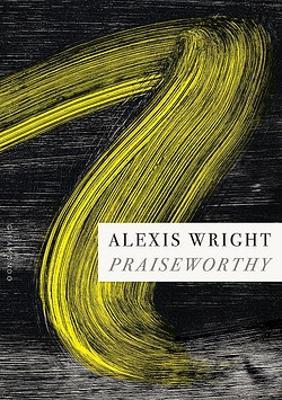
  • Alexis Wright, Praiseworthy (novel)

And the winner, announced on July 8, is

Alexis Wright’s Praiseworthy 

How apposite for Wright’s win to be announced in NAIDOC Week. This is the third time that Wright has won the medal. Books+Publishing, announcing this award, says that over the life of the award only two other writers have won it three times, and they are Patrick White and David Malouf. Those of you who read my Monday Musings post this week may remember that I observed that Alexis Wright and Melissa Lucashenko are the only writers who have won the Stella Prize three times. This woman, this First Nations writer, really is something, and I need to catch up my reading of her.

For the record, Praiseworthy has, so far, won the ALS Gold Medal (2024), the Stella Prize (2024), the Queensland Literary Award for fiction (2023), and the James Tait Black Memorial Prize (2023). It has also been shortlisted for the Miles Franklin Literary Award (2024).

This year’s judges for the medal were Elizabeth McMahon (academic and literary critic), Ali Alizadeh (literary writer and theorist), and Ann Vickery (poet and feminist scholar). According to Books+Publishing, the judges described Praiseworthy as “a novel for and of our time… hilarious, furious, poetical and painful”.

(BTW I haven’t read any of this year’s shortlist, but I have read two of last year’s including the winner, Debra Dank’s We come with this place).

Monday musings on Australian literature: First Nations Australian Stella listees

NAIDOC Week 2024 National Logo

Yesterday was the start of NAIDOC Week 2024. As has been my practice since 2013, I’m devoting this week’s Monday Musings to the cause.

NAIDOC Week’s theme this year is Keep the Fire Burning! Blak, Loud and Proud. Without specifically stating it, this theme responds, I’m sure, to the devastating loss of the Voice referendum last year. As the website says, it “celebrates the unyielding spirit of our communities and invites all to stand in solidarity, amplifying the voices that have long been silenced”. They say more, but I’ll just share two other points. One is that “the fire represents the enduring strength and vitality of Indigenous cultures, passed down through generations despite the challenges faced”, and the other is that

Through our collective efforts, we can forge a future where the stories, traditions, and achievements of Aboriginal and Torres Strait Islander communities are cherished and celebrated, enriching the fabric of the nation with the oldest living culture in the world.

For this year’s NAIDOC Week Monday Musings, I thought I’d pick up the point about cherishing and celebrating the stories of Aboriginal and Torres Strait Islander communities. This is simplistic, I know, but one way in which stories are celebrated is through awards – particularly through being short- or long-listed, or winning them. One award which has actively sought to embrace diversity in its foundational purpose is the Stella. Yes, that diversity is limited to “women and non-binary writers”. Nonetheless, the achievements have been significant in encouraging and raising the profile of many writers who may not have been seen otherwise.

So, with 17 years of the prize now in the bag and in the spirit of celebrating their achievement, I am listing all those works by First Nations writers which have featured in the Stellas over that time. This might also give them another little time in the air.

The Stella listees

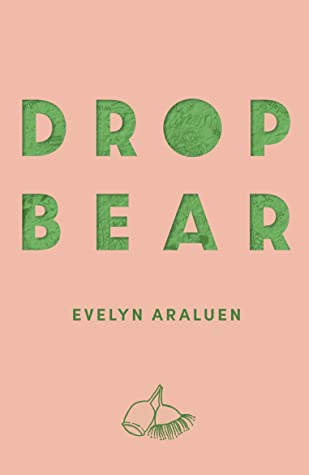
  • Evelyn Araluen, Dropbear (Poetry and prose, UQP) : Winner 2022 (my review)
  • Claire G. Coleman, Terra nullius (Fiction, Hachette Australia) : Shortlisted 2018 (my review)
  • Dylan Coleman, Mazin Grace (Fiction, UQP) : Longlisted 2013 (Lisa’s review)
  • Debra Dank, We come with this place (Nonfiction, Echo) : Shortlisted 2023 (my review)
  • Ali Cobby Eckermann, She is the earth (Poetry/Verse novel, Magabala Books) : Longlisted 2024  (on my TBR, kimbofo’s review)
  • Gay’wu Group of Women, Songspirals (Nonfiction, Allen & Unwin) : Longlisted 2020 (Denise’s review)
  • Anita Heiss, Bila Yarrudhanggalangdhuray (Fiction, Simon & Schuster) : Longlisted 2022 (my review)
  • Ngaire Jarro & Jackie Huggins, Jack of Hearts: QX11594 (Nonfiction, Magabala Books) : Longlisted 2023 (kimbofo’s review)
  • Melissa Lucashenko, Edenglassie (Fiction, UQP) : Longlisted 2024 (on my TBR, Brona’s review)
  • Melissa Lucashenko, Mullumbimby (Fiction, UQP) : Longlisted 2014 (Lisa’s review)
  • Melissa Lucashenko, Too much lip (Fiction, UQP) : Shortlisted 2019 (my review)
  • SJ Norman, Permafrost (Fiction, UQP) : Longlisted 2022
  • Elfie Shiosaki, Homecoming (Poetry, Magabala Books) : Longlisted 2022 (Lisa’s review)
  • Nardi Simpson, Song of the crocodile (Fiction, Hachette) : Longlisted 2021 (my review)
  • Ellen van Neerven, Heat and light (Fiction/short stories: UQP) : Shortlisted 2015 (my review)
  • Chelsea Watego, Another day in the colony (Nonfiction, UQP) : Longlisted 2022 (on my TBR, Bill’s review)
  • Tara June Winch, The yield (Fiction, Penguin Random House) : Shortlisted 2020 (my review)
  • Alexis Wright, Praiseworthy (Fiction, Giramondo Publishing) : Shortlisted 2024 (Bill’s second post with a link to his first)
  • Alexis Wright, The swan book (Fiction, Giramondo Publishing) : Shortlisted 2014 (on my TBR, Bill’s review)
  • Alexis Wright, Tracker (Nonfiction, Giramondo Publishing) : Winner 2018  (Bill’s review)

Some comments. There are 20 listed books (if I’ve got them all) out of 204. Of these there have been two winners – Alexis Wright’s Tracker and Evelyn Araluen’s Dropbear – seven shortlists, and 11 longlists. Alexis Wright and Melissa Lucashenko are the most listed authors – out of all authors – through the history of the prize to date. The listed books include novels, poetry and nonfiction.

Certain publishers appear frequently, particularly UQP which has an excellent – and long record – for supporting and publishing First Nations Writers. Eight of the listed books come from them. First Nations publisher, Magabala, has three, and Giramondo which publishes Alexis Wright also has three. Hachette has published two, with Simon & Schuster (which is behind the new First Nations imprint Bundyi I wrote about last week), Allen & Unwin, Penguin Random House and Echo, each having one. It’s healthy to see a spread, but it’s also great to see serious support being reflected here.

You will also see that almost every book has been reviewed by a litblogger. Some have been reviewed more than once, but I’ve just chosen one to share here. I hope that my posting this list will remind us all of some good books out there, and whet our appetites to check out First Nations writing.

Click here for my previous NAIDOC Week-related Monday Musings.

Six degrees of separation, FROM Kairos TO …

Another month, another Six Degrees. This is the only meme I do as a regular thing, and sometimes I wonder why I do it. It is fun to think about how to link books, so it’s always exciting to see what book Kate has chosen next. But, is it more than fun? Does it result in our choosing to read books we hadn’t considered before? Is its main value in keeping us connected? Are there other benefits or impacts? Any thoughts?

While you ponder that, I’ll just get on with it … if you don’t know how the #SixDegrees meme works, please check host Kate’s blog – booksaremyfavouriteandbest.

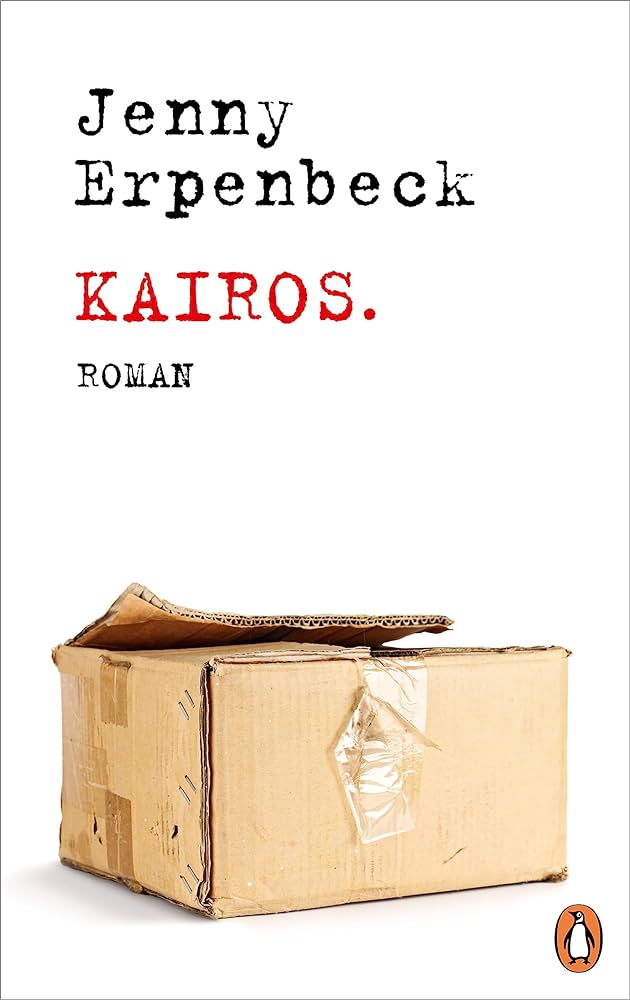
The first rule is that Kate sets our starting book. For this month she set the 2024 winner of the International Booker Prize, Jenny Erpenbeck’s Kairos (translated by Michael Hofmann). It is described at GoodReads as “a complicated love story set amidst swirling, cataclysmic events as the GDR collapses and an old world evaporates”. I’d like to read this one but suffice it to say I haven’t, to date.

WG Sebald, Austerlitz

I considered choosing another book set in or about the GDR, but I ended up choosing another translated German writer, without specific relevance to the GDR. My link is W.G. Sebald’s Austerlitz (my review), translated by Anthea Bell. If you know Sebald, you will know that this is no ordinary novel, but very broadly its central, titular character is a man who, traumatised by being a kindertransport refugee from Czechoslovakia in 1939, tries to recover his memory and his life some 50 years later.

Rabih Alameddine, An unnecessary woman

My next link is to a book in which the protagonist translates Austerlitz, among other books, because translating great books is her hobby, her passion. The book is Rabih Alameddine’s An unnecessary woman (my review). My reading group read this novel, and we did a straw poll on which of the books the protgonist writes about we’d most like to read. There were several, but Austerlitz was the winner. An unnecessary woman is a beautiful book about readers and reading.

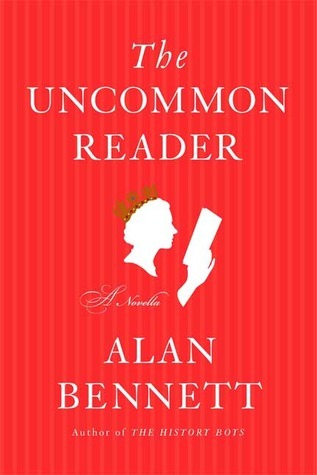
A very different reader is Alan Bennett’s in his novel The uncommon reader (my review). The reader is Queen Elizabeth II, and in his story she discovers reading through a mobile library that visits the palace grounds. In my post, I wrote that Bennett cheekily suggests what the impact might be on her family, staff and the politicians around her when reading becomes not only something she wants to do all the time (instead of her work) but also results in her starting to think and question. A whimsical but not unserious book about readers and reading.

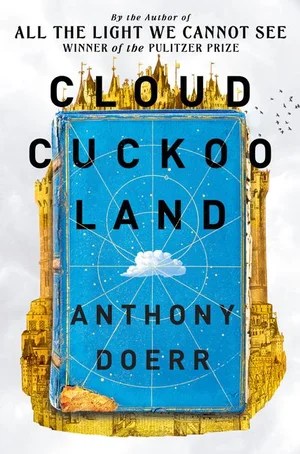
It’s no accident that Alan Bennett’s Queen discovers books through a library. Bennett is surely making a statement there too. A book which the librarians in my reading group loved for its love and promotion of libraries is Anthony Doerr’s Cloud Cuckoo Land (my review). Among other things, this novel is about the role played by librarians in fostering knowledge and reading. Doerr’s Dedication is “For the librarians then, now, and in the years to come”.

I cannot resist staying with the libraries and librarian theme. A character in Doerr’s book speaks of how endangered books are, “They die in fires or floods or in the mouths of worms or at the whims of tyrants. If they are not safeguarded, they go out of the world.” Librarians and readers safeguard books, and this is exactly what is happening in the first story in Rebecca Campbell’s dystopian book, Arboreality (my review). A librarian and university researcher are fighting desperately against time to save books which are being destroyed by climate-change induced floods and fires.

Book cover

Besides its interest in books, Arboreality is – obviously – about trees. It features many trees, but one species provides a linking thread between the stories, the Golden Arbutus. A very different tree but an equally significant one in terms of the book is the greengage tree in Shokoofeh Azar’s The enlightenment of the greengage tree (my review), translated by Adrien Kijek (pseudonym). It is on top of this tree that the character Roza attains enlightenment. Coincidentally, in this Iran-set politically-driven novel, a library is burnt.

This chain has taken us around the world – but, unusually for me, not to Australia – and through time, from centuries past and into the future. Also unusually for me, four of my six writers are male. Finally, I’d like to draw your attention to a neat circle – my closing book, like the book that starts this month’s meme, is translated.

Now, the usual: have you read Kairos and, regardless, what would you link to?

Delicious descriptions: Charlotte Wood on silence and solitude

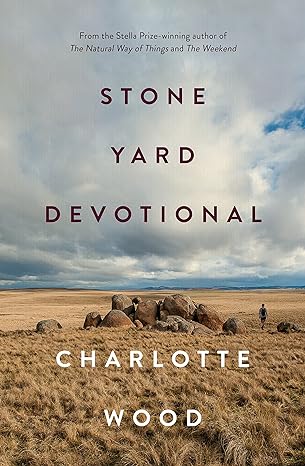
It’s some time since I wrote a Delicious Descriptions post, but I want to explore Charlotte Wood’s novel Stone Yard devotional (my review) just a little more. Although I finished it over a week ago, I keep thinking about its evocation of quiet lives in retreat – and what Wood might be saying.

I am, admittedly, a woman of “a certain age”, but, nonetheless, I am surprised to find that where once I loved filling my life with noise and action, I am now enjoying quiet. By noise and action, I don’t mean energetic activity – I’ve never minded being sedentary – but I mean I have never actively chosen quietness. Recently, however, this has changed. Now when Mr Gums and I drive long distances, for example, we often drive in silence – no music, no audiobooks, podcasts or radio programs, just silence. And, I like it.

It is this silence that Wood’s unnamed narrator in Stone Yard devotional seeks, and Wood writes about it in a way that not only makes it meaningful in terms of why we might seek it, but that is calming to read.

It starts the afternoon our narrator arrives at the abbey. “The silence is so thick,” she writes, “it makes me feel wealthy”. What an idea that is, “the silence is so thick it makes me feel wealthy”. A couple of paragraphs later, she explains that the abbey’s welcome booklet says they “accept that guests might want total solitude”. “Noise is discouraged”, and guests “are free to decline joining others for eating or worship”. She “cannot think of a greater act of kindness than to offer such privacy to a stranger”.

A couple of pages after this, and despite not being required to join in, our narrator decides to go to Lauds in the little church, and finds herself wondering how they get anything done with all this toddling into church every couple of hours. But then she realises that this “is the work. This is the doing”. She finds herself “drenched in a weird tranquility” and she wonders whether this has come from

being somewhere so quiet; a place entirely dedicated to silence. In the contemporary world, this kind of stillness feels radical, illicit.

Such silence, however, while appealing in theory, is not as simple as it sounds. She talks about the Lectio Divina, which Wikipedia describes as a traditional monastic practice comprising “four separate steps: read; meditate; pray; contemplate”. This is a step too far for our narrator at this point in her journey, and she finds herself arguing internally with what she is seeing, but

Despite this, the process is strangely beautiful. Sister Bonaventure says getting caught on a word is the point, and if you remain troubled or confused by it, you just ‘hand it over to God’. This is so antithetical to everything I have believed (knowledge is power, question everything, take responsibility) that it feels almost wicked. The astonishing – suspect – simplicity of just . . . handing it over.

The narrator is an atheist and the novel is not about religion per se, so she comprehends this concept more broadly in the sense of letting the things that bother you just sit, instead of endlessly turning them over.

This brings me to the idea I shared in my post on the novel, that of

waiting. An incomplete, unhurried emergence of understanding, sitting with questions that are sometimes never answered.

Thoughts about stillness, silence, solitude, and contemplation, freedom and peace, form the backbone of this novel, but they are tested by the visitations or “visitants”. They are also specifically tested by the idea of an active life. Sister Helen Parry distances herself from the abbey’s inhabitants, getting on with her activist work via “internet video calls … calling for action on this or that”. She brings, says the narrator, “everything we so painstakingly left behind”. Local farmer Richard Gittens’ wife, Annette, views life at the abbey as “sick … unnatural”.

And yet … (indeed, Elie Wiesel’s “and yet” is the narrator’s favourite phrase) … the end, when it comes, seems to suggest that there is a place for all. And that, maybe, there is no either-or, but what is right for us at different points in time. A gift of a book for anyone interested in thinking about how to live in our noisy, troubled and troubling world.

Charlotte Wood, Stone Yard devotional, Crows Nest, Allen & Unwin, 2024