Monday musings on Australian literature: What value literary awards?

If you are an Australian reader, you have probably heard that the new Premier of Queensland, Campbell Newman, has abolished the Queensland Premier’s Literary Awards. This was a shock as it had not been flagged during the election. His reason? To save some $250,000, as part of the Liberal National Party’s promised cost-cutting drive!

It was a wry moment for me when I heard the news, because only a few days before the announcement, I had pondered in my post about Adelaide Festival Awards for Literature whether, with the Festival becoming an annual event, South Australia would finally have an annual literary award, like most other Australian states.

Queensland’s literary awards program has been running since 1999 and is (hmm, was) one of the most comprehensive literary awards programs in Australia. It offers (offered) prizes in fourteen or fifteen categories, which included unpublished manuscripts, non-fiction, poetry, short stories, unpublished indigenous writers and fiction. Many of our significant writers have benefited from these awards, including Helen Garner, Alexis Wright, Tim Winton, Thea Astley, Nam Le, David Malouf, Judith Beveridge, Peter Carey, and Les Murray.

Australians will know that many of these award winners are not Queenslanders and their winning books were not necessarily about Queensland. Does this matter? All (I think) of Australia’s state-based awards are not state-limited in their criteria. I think that’s a good thing, though I can see arguments for limiting them to their states just as we have awards for women, for young writers, for indigenous writers, for unpublished works. What I don’t think is a good thing is to do away with awards. Awards for creative endeavours are always fraught. There are no objective standards to judge artistic creations by. But, this doesn’t mean they don’t have value – for the winners, for the short- and longlisted authors, and for the industry as a whole.

There are supporters of the decision. One is blogger Mark Fletcher who argues that these awards are “vanity projects” for Premiers and that “there are more significant funding opportunities for the arts in Queensland than the award: the end of the award does not mean the end of arts funding in Queensland”. Opponents, on the other hand, fear that this is the thin end of the wedge and that more cuts to arts funding are coming. Time will tell …

The topic has already been discussed on Australian blogs. Here are just a very few:

  • Angela Meyer of LiteraryMinded talks of the value of the prize to writers, publishers and booksellers
  • crikey.com calls it a sad announcement
  • Jeff Sparrow in Overland argues that this may be the harbinger of more cuts as more conservative governments gain power in Australia. He suggests that “There’s an urgent need for a new defence of literature, arguments that are neither philistine populism nor patronizing elitism but instead make the case why writing should matter to ordinary people. It’s something we’ve traditionally been very bad at. We need to get much better, very quickly.”
  • Lisa Hills of ANZLitLovers advises that the awards will be made with or without prize money and provides the link for submissions.
  • skepticlawyer describes plans by authors Matthew Condon and Krissy Kneen to continue the awards, probably using the law of trusts – and provides a link to their Facebook page for the awards.

I think that’s enough. You get the drift I’m sure. But, I wonder, what do you think about Literary Awards. Are they worth defending? What do awards mean to you, as a reader?
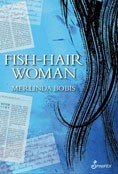
Merlinda Bobis, Fish-hair woman (Review)

Merlinda Bobis Fish-hair woman

Courtesy: Spinifex Press

How do you classify a book like Fish-hair woman by Filipino-Australian writer, Merlinda Bobis? Darned if I know, but I’ll have a go. It’s part war story, murder mystery, political thriller, romance, and historical epic. It draws on the magical realist tradition of writers like Isabel Allende, but overarching all this, it is a book about stories – about the stories we cleave to ourselves and the stories we tell others, the stories that convey the truth and the ones that hide it, the stories that change with time and those that never change.

But enough preamble, let’s get to the action. The book is set in the Philippines, with the core story taking place in a village called Iraya in 1987. It is a time of civil unrest: government soldiers fight communist insurgents (the historical New People’s Army), with privately-controlled armies added to the mix. The villagers are caught in the middle, struggling to survive under

violence dressed as salvation. What hopeful word, the sibilants a gentle hush: salvacion. The soldiers and the rebels spoke of this same cause, even as they remained in opposite camps and our village festered in between.

The central characters are Estrella, the fish-hair woman who uses her 12-metres-long hair like a net to retrieve the dead from the river (“trawl another victim of our senseless war”); her older “sister”, Pilar, who joins the communist insurgents; and Tony, the Australian journalist whom both had loved. These relationships are complicated by the fact that Estrella, whose mother died at the birth, is the illegitimate daughter of the most powerful man in the village, Mayor Kiko Estraderos (aka Doctor Alvarado), the man who runs the private army.

While the main action occurs in 1987, the time-frame moves between 1977, 1987 and 1997, with the story being mostly told from the perspective of 1997. By this time Pilar and Tony are among the dead or disappeared and Tony’s 19-year-old son Luke has been lured to the Philippines, on the pretext that his father is alive, by Kiko who wishes to “sanitise history and facilitate his return to politics”.

It’s a multi-layered story of political unrest, complicated village loyalties, and familial and romantic love. It is told in first person and third person, with changing points of view.  Sometimes we see through Estrella’s eyes, sometimes Luke’s, sometimes an omnipotent narrator’s or another character’s, and occasionally through newspaper clippings. Woven through it are recurring images and smells – the sweet lemongrass tainted by the corpse-laden river, the fireflies that light the dead so they can be found, and Estrella’s long hair that magically grows each time she senses violence and pain.

Australian Women Writers Challenge 2012 Badge

Australian Women Writers Challenge (Design: Book’dout – Shelleyrae)

This is one of those books that requires you to go with the flow. Its structure mimics the way we layer stories, the way we weave history and myth, stories and memories, so that at any one time we may or may not know where we are or who we are. Estrella, the fish-hair woman, and Stella, Doctor Kiko’s daughter, for example, are different facets of the same person, each with different stories.

There are simpler characters, too. One is Pay Inyo, the village gravedigger. He reminded me a little of the grandfather in Lianke’s Dream of Ding Village. He’s the peaceful man, the wise one who urges a humane path, who says it’s about perspective, “about how and from where you look … how far … and what you will to see”. But even he is unsure about the story:

But who is the hero in this story? Pay Inyo is not sure anymore, nor is he sure about what the story is in the first place. There are too many stories weaving into each other, only to unweave themselves at each telling, so that each story can claim prominence. Stories are such jealous things. The past and the present, ay, what wayward strands.

There were times, as I read, when I thought that Bobis may have created a few too many “wayward strands”. Some stories may not have been critical to tell, but her voice is so compelling and the language so expressive that I didn’t really begrudge her these, because by then I was well and truly along for the ride.

This is a novel set during war and yet it is not really about war. It is about people, “those whom we love and hate”, about how we use and manipulate stories to “save” or ” kill”, and, as Pay Inyo would like us to see, about collective grieving, collective responsibility:

This is the wake of the world: each of us standing around a pool that we have collected for centuries. We are looking in with our little pails … We try to find only what is ours. We wring our hands. Ay, how to go home with only my undiluted pail of grief? To wash my rice with or my babies, to drink? But the water is my dead kin, an enemy, a beloved, a stranger, a friend, someone who loved me or broke my heart. How to tell them apart? How to cleave water from water?

For all the sadness and brutality in this book, it has a big heart. And its message is clear. We are all in this together. How much better if we see it sooner rather than later.

Merlinda Bobis
Fish-hair woman
North Melbourne: Spinifex Press, 2011
303pp
ISBN: 1876756977

(Review copy supplied by Spinifex Press)

Vale Jerome

In living there is always
the terror
of being stung

of something
coming for you
on the unavoidable wave

(from “Bluebottles” by Dorothy Porter in her collection The bee hut)

I have not posted since last week’s Monday musings, and there will be no Monday musings this week, but I will resume in a day or so. In the meantime, my heart is just a little too sore for reading and reviewing.

Last week, the 26 year-old son of good friends died, just over three years after being diagnosed with cancer. It goes without saying that he was too young. He had so much to give and so much to live for.

I have bothered and worried about whether to write this post. After all this is not my story – I am just one of the bit-players on the side – but in the end I decided that for we who like to write, writing is cathartic, and so here I am. But I am not going to tell the story. It is for those closer to tell. I simply wish to say that no matter how much you prepare for a death like this, it is still devastating when it comes.

I will leave you with Jerome’s own words written in January this year in his raw, honest, beautiful blog:

What is wrong with this world. How is it that so few spend their lives doing things they love and so many do [what] they hate for something they do not need. I want to shout to the masses but [s]o few would listen. I would not have listened.

This is it. Do it now. You will not be here again.

And with Dorothy Porter, because … well, you’ll see why:

talking
and climbing
with this
glimmering
young man
who was talking to me
about death
how
a good dose of death
if you truly drink it
is a gift

a gift
a fresh cold
slap
a fresh dark
creek
you’ll never sleep-walk
through your life
again

(from “The snow line”, also in The bee hut)

Thank you Jerome for sharing your pain, ideas and hard-earned wisdom so generously and openly over the last year. I am proud to have known you.

Monday musings on Australian literature: Famous Australian literary couples

Illustration derived from page scans of an ori...

The Bloke and Doreen go to a play, The Songs of a Sentimental Bloke, 2nd ed. 1917 (Presumed Public Domain: Wikipedia)

We all know Romeo and Juliet, Elizabeth and Darcy, and Cathy and Heathcliff. They are ingrained into the consciousness of readers of English literature. But we Aussies have some couples of our own and I thought it might be fun to introduce you to just a few. They are interesting, not only because they are great characters, but because they also represent of different aspects of Australian culture.

The Bloke and Doreen

Most Australians have at least heard of CJ Dennis‘ verse novel The songs of the Sentimental Bloke (1915) and might have studied an excerpt or two at school, like I did. It has been adapted for film and television, and been made into a musical and a ballet. It tells the story of a larrikin and Doreen, the young woman he falls head-over-heels for. The challenge for contemporary readers is that it’s written in the working class vernacular of its time. However, if you “listen” to the words, it doesn’t take long to pick it up and to become engaged by the Bloke and his attempts to win Doreen’s hand. Doreen is no easy pick-up, and to win her, he must fix up his act (such as give up drinking) and become a respectable man:

Fer ‘er sweet sake I’ve gone and chucked it clean:
The pubs an’ schools an’ all that leery game.
Fer when a bloke ‘as come to know Doreen,
It ain’t the same.
There’s ‘igher things, she sez, fer blokes to do.
An’ I am ‘arf believin’ that it’s true.
(from “Doreen”)

The songs of a sentimental bloke is, what we’d call today, romantic comedy so it all works out fine in the end. The Bloke develops and matures, wins his woman, and leads a productive and settled life as a happily married man.

Voss and Laura

By contrast, Voss and Laura’s story is a tragic romance. They are the creation of Patrick White in his novel, Voss (1957), which he based loosely on the German-born Australian explorer Ludwig Leichhardt who tried to cross Australia in the mid-19th century. Voss has been made into an opera, but so far attempts to adapt it to film have not come to fruition (something I expect to write more about later).

Voss meets Laura in the opening scene of the novel at the Sydney home of her uncle and Voss’s patron, but they spend very little time in each other’s physical presence because, for the majority of the novel, Voss is away on his ill-fated expedition. (I did say it was tragic.) Most of their relationship occurs via letters and telepathic communication. Theirs is a passion fed by a meeting of minds and spirit.

Voss thought how he would talk eventually with Laura Trevelyan, how they had never spoken together using the truly humble words that convey innermost reality: bread, for instance, or water. Obsessed by the struggle between their two souls, they had threatened each other with the flashing weapons of abstract reasoning, while overlooking the common need for substance. But now we shall understand each other, he said, glancing about. […] Human relationships are vast as deserts: they demand all daring, she seemed to suggest.

It’s a grandly conceived – and quintessentially Australian – epic in the way it confronts the outback, something that remains a somewhat odd, but very real, part of the Australian character. We are highly urbanised and yet the outback still plays a significant role in our consciousness. It’s there, just behind our cities, beautiful but threatening at the same time. Confronting this vastness is still seen, by many Australians, as an antidote to the the superficiality of city life – and Voss (with Laura, by his side in abstract) confronted it big-time.

Oscar and Lucinda

Oscar and Lucinda are the main characters in Peter Carey‘s novel of the same name. Published in 1988, it, like Voss, is set in 19th century Australia, but unlike Voss it has been successfully adapted to film. Oscar, the rebel son of a strict religious father, and Lucinda, an heiress who buys a glass factory, meet on board ship and are attracted to each other through their love of gambling and taking risks. Like Voss and Laura, they are outsiders and their story ends tragically …  but while Voss and Laura’s story is spare and intense, Oscar and Lucinda’s is wild and over-the-top. They construct a glass church which hydrophobic Oscar, in a grand gesture of love, sails a few hundred miles up river through uncharted country to Bellingen, providing an unforgettable image for anyone who has read the book. What makes this Australian is not only its description of white settlers confronting the bush and its particular exploration of religiosity in the colony, but in the way Carey uses the idea of gambling to weave the story because, Australia is (whether we like it or not) a big gambling nation.

Unfortunately, though, I can’t find my copy, so no quotes from this one for you.

Do you have favourite literary couples, Australian or otherwise? I’d love to hear of literary couples who have resonated with you.

Adelaide Festival Awards for Literature, 2012

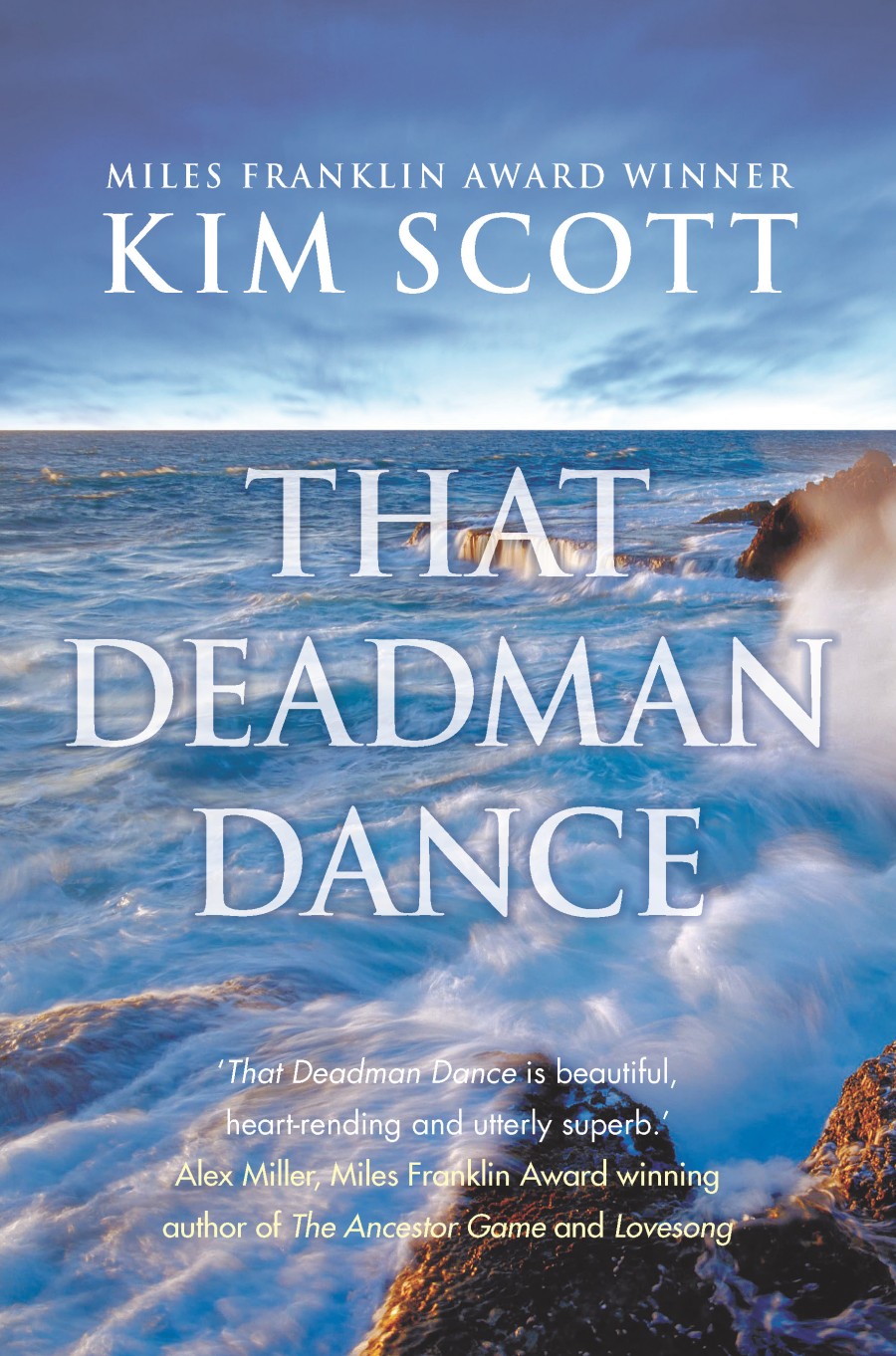
Kim Scott That Deadman Dance

Kim Scott's That Deadman Dance (Image courtesy Picador Australia)

The Adelaide Festival Awards for Literature are biennial awards, coinciding, funnily enough, with the holding of the biennial Adelaide Festival. I understand, however, that from 2012 the festival will be an annual event. Presumably this means the literary awards will also be awarded annually from now on. If that’s the plan, South Australia will finally have an annual literary award, like most other Australian states.

Anyhow, this year’s winners, which were announced earlier this month, are:

  • Premier’s and Fiction award ($15,000) award: Kim Scott‘s That deadman dance (My review)
  • Nonfiction award: Mark McKenna’s An eye for eternity: The life of Manning Clark
  • John Bray Poetry Award: Les Murray’s Taller when prone
  • Barbara Hanrahan Fellowship: Nicki Bloom for The sun and other stars
  • Wakefield Press Unpublished Manuscript Award: Margret Merrilees’ The First Week

There are a few other prizes including for Children’s and Young Adult books, but these are the ones of main interest to me and so they’re the ones I’m giving you!

It’s great to see Kim Scott garnering another two awards for That deadman dance. It has now won:

It was shortlisted for several other Australian literary awards in 2011 and has also been longlisted for the 2012 International IMPAC Dublin Literary Award. I do hope it is starting to make inroads into overseas markets.

Izzeldin Abuelaish, I shall not hate (Review)

Revenge is a concept that I just don’t get. No, let me put that another way. I understand the emotions that give rise to the desire for revenge – though I’ve never, admittedly, been tested myself, not like, say, Izzeldin Abuelaish. What I don’t understand is the belief that revenge is the answer, that it will make something (whatever that thing is) better. I’ve never seen it do so. In fact, what it seems to do is make things worse. And so, I admire Abuelaish’s stance in his book, I shall not hate, because if anyone has been tested, he has.

Dr. Abuelaish & Rabbi David

Dr. Abuelaish & Rabbi David, Oct 2009 (Photo credit: achituv, using CC-BY-SA 2.0)

For those of you who don’t know his story, Abuelaish was born in the Jabalia Refugee Camp in the Gaza Strip in 1955. Through hard work and persistence, the encouragement of several teachers, and the support of his mother, he became a doctor, eventually specialising in gynaecology and obstetrics, and becoming an infertility expert. This, though, is not what the book is about. It’s about his ability to rise above horrific personal tragedy – the killing of three of his daughters by Israeli Defence Force (IDF) shells in January 2009 during a 23 day attack on Gaza* – and his decision:

I had two options to choose from: I could take the path of darkness or the path of light.

He chose the path of light, because, as he writes:

I believe in co-existence, not endless cycles of revenge and retribution. And possibly the hidden truth about Gaza can only sink in when it is conveyed by someone who does not hate.

Though making this choice – towards light – was clearly a conscious act, we readers aren’t surprised because we’ve seen him making this same choice throughout the book despite, as he says, being “tested by brutal circumstances the whole of my life, as have many people in Gaza”.

The book chronicles his life from birth to the tragedy – and then his response. He tells about his family’s leaving their farm (which was subsequently taken over by Ariel Sharon!) to join the refugees in Jabalia, and their lives in the camp. He describes the struggle to survive – under grinding poverty that’s rather reminiscent of Frank McCourt’s in Angela’s ashes. He understands how poverty and long-standing oppression lead to acts of violence. As a young boy, he saw education could provide a way out but writes of how without the encouragement of teachers he could well have given up in order to work to help support his parents and siblings. And, he describes his early experiences with Israelis, including working on an Israeli farm during a school vacation, and their joint recognition that they had more similarities than differences.

More alike than different. That’s one of the threads of his story. Another is his belief – and this, again, is a belief he has chosen – that good can come of bad. That’s how he has survived and will, presumably, always survive the setbacks that confront him. One of the lessons of the book is, I think, this one of choice – it is within us all to choose light over dark, hope over desperation. A cynical reader could see Abuelaish as naive except, and this is a big except, he has walked the talk. Not only did he experience the violent (I can’t begin to describe what he saw in his daughter’s bedroom minutes after the attack) deaths of his daughters but throughout his life he has faced immense obstacles to get where he’s got and to maintain his generous positive philosophy. Just reading his descriptions of getting in and out of Gaza – such as he did on a regular basis to work in an Israeli hospital – has made me decide that I will never again complain about being held up a few minutes at an airport for a random security check!

This is not literary fiction, but the story is so compelling it rises above the plain prose. If I had any criticism it would be that it gets a little repetitive at times – but then, I get the sense that life is pretty repetitive in Gaza! He tells his story chronologically, with the odd out-of-sequence digression to make a point. And, there is the rare use of medical imagery to convey an idea. He describes hate as a chronic disease and says:

I am a physician, and as a consequence I see things most clearly in medical terms. I am arguing that we need an immunisation program, one that injects people with respect, dignity, and equality, one that inoculates them against hatred.

It might sound like most of the book is just about talk, but Abuelaish is about more than that. He recognises that action is needed. This action can be as simple as bringing people together so they can share their experiences, find commonalities and learn to trust again. Trust in the Middle East is, he says, “gasping for air”. But, the point I really like is his argument that empowering women, changing their status and role, is a critical part of the solution. Girls need to be properly educated and women’s values need to be better “represented through leadership at all levels of society”. The impediments to achieving this are both financial and cultural, and he has established a foundation titled Daughters for Life to work towards this aim. “Investing in women and girls”, he writes, “is a way out of poverty and conflict”.

When the going gets tough, the tough get going … and Abuelaish is one tough, in the best senses of the word, guy. This is a book I won’t be forgetting in a hurry.

Izzeldin Abuelaish
I will not hate: A Gaza doctor’s journey on the road to peace and human dignity
London: Bloomsbury, 2010
237pp.
ISBN: 9781408814147

* This is not a spoiler. If you don’t come to the book already knowing the basic story, you will know it from the back page and from the foreword and opening chapters.

Monday musings on Australian literature: Louisa Atkinson, and indigenous Australians

Louisa Atkinson (1834-1872)

Louisa Atkinson (1834-1872) (Courtesy: Artist unknown, via Wikipedia)

Time for another Monday Musings highlighting an Australian literary pioneer, this time Louisa Atkinson. I came across Atkinson a few years ago when I was researching Australian women writers for Wikipedia. She’s one of those women who achieved much in her field but who, I believe, is little known. She was a journalist, novelist and naturalist. She was born in 1834, in the Southern Highlands of New South Wales, just a couple of hours’ drive from where I live.

There’s a good general biography of her online at the Australian Dictionary of Biography, but here is the gist:

  • She collected and painted plant specimens for well-known scientists of the time including Ferdinand von Mueller, and she is commemorated in the Atkinsonia genus as well as several plant species.
  • She was a rebel when it came to clothing. While, as is typical of her time, she was highly religious, she shocked the good women of her rural neighbourhood by wearing trousers for her naturalist ramblings and pony-riding.
  • She was a well-regarded botanical artist. Twentieth century Australian artist Margaret Preston described her drawings as having “unexpected elegance and extreme accuracy”.
  • She was the first Australian woman to have a long-running series of articles in a major newspaper. This was her natural history series, A Voice from the Country, which ran for 10 years from 1860.
  • AND she is credited as being the first Australian-born woman to publish a novel in Australia. It was titled Gertrude, the emigrant girl: A tale of colonial life (1857). This and her second novel, Cowanda: A veteran’s grant (1859), are available as etexts from the University of Sydney’s excellent SETIS project (to which I’ve linked the titles). Gertrude tells the story of a young immigrant girl hired to be a housekeeper in a country house by Mrs Doherty who, to give a sense of Atkinson’s style, is described in the first chapter as “a small woman, with a brown careworn countenance; the index of generous emotions, strong passions, and acute griefs, which had worn her straight features into sharp outlines, and given a restless keenness to her small dark eyes”.

I have only dipped into Atkinson’s novel, Gertrude, to get a sense of her writing so I won’t write any further on that. What is interesting to explore a little is her experience of indigenous Australians. Elizabeth Lawson in her book on Atkinson, The natural art of Louisa Atkinson, wrote that her father created a model farm, but

Oldbury’s promise was clouded by its exploitation of the convict system and by its dispossession of the local Gandangara people, a dispossession the family at least recognised. And just above the house on a natural terrace of the mountain rose a great Aboriginal grave-mound with carved funeral trees which Louisa was later to sketch. This mound and its increasing desolation stood in silent rebuke of Oldbury’s enterprise, of its new English place-names and all they signified.

Nonetheless, Lawson writes that Atkinson befriended, and retained life-long friendships with Aboriginal people both at Oldbury and in the Shoalhaven area where she spent some time. That she had sympathy for them is clear from one of her columns for A Voice from the Country (22 Sept 1863) in which she wrote:

These unhappy races have become rather a tradition, than a reality, already in many districts …

She describes their lives, their homes, their hunting with a naturalist’s, and sympathetic, eye:

On one occasion, when the remnants of three different friendly tribes had assembled for a grand corroboree or dance, I made plan of the encampment; each tribe was slightly apart trom the other, divided by a sort of street. Thus, the inviters (?) were clustered in the centre, having, I think, seventeen camps; the Picton tribe on the right hand, five camps, and the Shoalhaven on the left, comprising ten or eleven gunyahs, consecutively forming a village.

She also writes:

The men were severe to their wives, striking and even killing them – when under the influence of anger, but I believe these cases were far less frequent when they had not lost virtues and acquired vices from the so-called Christian people who invaded them.

Interesting, and sensitive, observation. She talks of the problem of drinking:

Intemperance is one of the vices so sadly prevalent among them, they know what its fatal results are, lament them, but have not courage to resist. How frequent is the paragraph in the country paper of an aborigine’s death from this cause, how many have sunk unrecorded. A great sin lies on us as a people, for much has been done to injure, and little to benefit the poor original possessors of our farms and runs.

And thus she confirms that thinking about indigenous Australians with a humane and clear-eye did not pop up suddenly in the mid to late 20th century!

Louisa Atkinson tragically died not long after (but not due to) the birth of her first child, when she was only 38. What a lot she achieved in a rather short life – and what an interesting person she would have been to know.

Virginia Woolf, The mark on the wall (Review)

Back in November I wrote a post titled Nettie Palmer on short stories which resulted in Stefanie (of So Many Books) recommending one of her favourite short stories, Virginia Woolf‘s “The mark on the wall”. I told her I’d read it and, finally, I have.

This is the sort of story I like. It doesn’t have a strong plot but is the meditation of a lively, creative mind. This meditation is inspired by a mark on the wall which leads the first person narrator to wonder what the mark is, and what it might signify. She doesn’t want to get up to investigate, preferring to let her mind wander, as it will, on the possibilities:

How readily our thoughts swarm upon a new object, lifting it a little way, as ants carry a blade of straw to feverishly, and then leave it …

The story does progress, albeit in an organic, stream-of-consciousness way, rather than according to any clear logic. She wonders if the mark is a hole, then thinks it could be a stain, or even, perhaps, something more three-dimensional like a nail head that has broken through the paint. At the end, we do discover what the mark is, but that’s not the point of the story. The point is what she thinks about as she considers the mark …

And the things she thinks about are wide-ranging as we have come to expect in stream-of-consciousness, a technique of which Woolf was one of the early pioneers. The thing about stream-of-consciousness is not only that it tends to roam over a wide range of ideas and topics, but that these ideas and topics are very loosely connected. Sometimes the thread between them is barely visible, usually because the connection is idiosyncratic to the thought processes of the narrator.

This is the case with “The mark on the wall”. The first paragraph uses strong imagery – based around the colours of red and black – which encouraged me to expect something more dramatic than what did, in fact, follow. In the third paragraph she exclaims:

Oh! dear me, the mystery of life. The inaccuracy of thought! The ignorance of humanity!  To show how very little control of our possessions we have — what an accidental affair this living is after all our civilisation …

Nothing, though, is accidental in Woolf’s story, no matter how much the stream-of-consciousness form may lull us into thinking it is. This is the story of a woman concerned about the meaning or import of reality. She ponders the shallowness of “things” (including, even, knowledge). In the second paragraph she suggests the mark may have been made by a nail holding up a miniature that would have been

a fraud of course, for the people who had this house before us would have chosen pictures in this way — an old picture for an old room.

She writes of how we like to construct positive images of ourselves but how fragile this is, of how superficial reality is. Interestingly, while the story flits from idea to idea, there’s one motif (besides the mark) that recurs, Whitaker’s Table of Precedency. Whitaker’s exemplifies “the masculine point of view which governs our lives”. She uses it to represent the faith we have in rules, and the way we let rules and reality prevent our seeing the “sudden gleams of light”.

There’s a funny sequence in which she imagines a Colonel pontificating with other men on the history of objects like ancient arrowheads. The  Colonel, she imagines, might suffer a stroke and his last thought would be, not his wife and family, but the arrowhead which, she suggests in her stream-of-consciousness way,

is now in the case at the local museum, together with the foot of a Chinese murderess, a handful of Elizabethan nails, a great many Tudor pipes, a piece of Roman pottery, and the wine-glass that Nelson drank out of — proving I really don’t know what.

That made me, a librarian-archivist, laugh!

And so, what is it about? Well, the mark seems to represent the unwelcome intrusion of reality into her life – it gets in the way of her thinking (of her desire “to catch hold of the first idea that passes”) while also, paradoxically, offering inspiration to her thoughts. An intriguing story. And, like Stefanie did to me, I recommend it to you.

Virginia Woolf
“The mark on the wall”
Originally published: 1919
Available online at The Internet Archive 

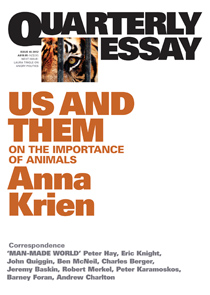
Anna Krien, Us and them: On the importance of animals (Review)

Krien Us and them

Quarterly essay cover (Courtesy: Black Inc)

I’ll admit it right up front, I am not a vegetarian or a vegan. I like to eat meat. I wear leather shoes. I like to think, though, that the source of these products has had a comfortable life and a quick, stress-free death. But I’m kidding myself, I know. And Anna Krien’s essay, Us and them, about the relationship between humans and animals, doesn’t reassure me.

In roughly 25,000 words, Krien, whose Into the woods I reviewed a couple of years ago, explores the complex relationship we humans have with our living, breathing co-inhabitants on this earth of ours. She exposes the underbelly of this relationship but resists simplistically declaiming the abuses and proclaiming that there is an easy solution. We all know there isn’t. As she says in the first section:

I’m not weighing up whether our treatment of animals is just, because it isn’t. That age-old debate is a farce – deep down we all know it.

The real question is, just how much of this injustice are we prepared to live with.

To try to answer this question she confronts the tension that exists in our relationship with “them” which is, as she puts it, the tension between seeing them as “beings” versus “objects”. She asks:

How to ensure that the butcher, the scientist, the farmer recognise that the creature in their care is a being, even as all the while they [and, I would say, by extension we] continue to use it as an object?

This is a well-structured essay. After an introductory section in which she sets the scene and poses her question, Krien explores the issues thematically, through the sorts of “encounters we have with animals”: Killing; Testing; Hunting,

These are, obviously, the encounters which are the most problematic. She spends little time on our positive and generally more mutually beneficial* encounters, such as in their roles as pets, guide dogs, and companion animals. That’s fair enough, given the serious questions she wanted to confront, but it’s a bit of a shame, nonetheless.

I like Krien’s writing. It’s well-researched, informative, and presents unpleasant facts with a light touch. She’s neither didactic nor conclusive but rather writes as one going on a journey with us. And she asks hard questions, such as these ones in the killing section:

  • Should Australia remain in the live animal trade and by so doing help other countries improve their animal welfare practices?
  • What does it say about our priorities when we have a World Society for the Protection of Animals but not one to protect women?
  • How do we explain the fact that more Australians empathised with the cows (being sent to Indonesia) than with people (such as those Indonesians for whom the cattle trade  means work and food, let alone the asylum-seekers plying the same seas as the cows)?

She explores the complexities of testing and here again disabused me of my head-in-the-sand hopes. I was surprised to read that the number of animals being used in research and teaching is increasing not decreasing. And again, the difficult questions. Is some testing acceptable, necessary even, and others not? And if so, on what basis do we decide? Why is there a disjunction between what scientists do in animal testing and believe is ethical, and what laypeople think?

Australian Women Writers Challenge 2012 Badge

Australian Women Writers Challenge (Design: Book'dout - Shelleyrae)

In her section on hunting, the focus is not so much on recreational hunting but on the hunting of animal pests – some native, such as dingoes, and some feral. She talks about apex predators, and the environmental impact of removing them. When the top predator goes, the ecological balance is severely disturbed. The loss of dingoes, for example, can be directly related to the extinction of small mammals. One solution to protecting farm animals that doesn’t involve killing dingoes is to use guardian animals like maremmas and alpacas. Hmm, methinks, introduced species aren’t always a good option – think camels, think cane toads – but so far so good it seems.

Late in the essay, Anna Krien writes that many scientists describe our current geological era as the Anthropocene, recognising the significant (negative) impact human activities are having on the earth. She follows this with biologist Edward O. Wilson‘s suggestion that what comes next will be “the Age of Loneliness” typified by “a planet with us and not much else”. I don’t want to think about what that would be like. There’s no easy answer to all this but, as Krien says, we must “acknowledge the questions” and continue the discussion. To do anything else is to deny that not only are animals are “important” in themselves but, to put it selfishly, they are important in multitudinous ways to us.

Anna Krien
“Us and them: On the importance of animals”
in Quarterly Essay, No. 45
Collingwood: Black Inc, March 2012
125pp.
ISBN: 9781863955607

(Review copy supplied by Black Inc.)

* Though I’m aware I’m making a human-centric assumption here!

Monday musings on Australian literature: Women writers and politics in the 1930s

I have written before about the fact that there’s been two periods in Australian literature when women writers seem to have flourished. One was around the 1920s to 1930s and the other around the 1970s to 1980s. Today I want to write a little about this first period because, from the perspective of 80 plus years later, it was an exciting period for women writers – that wasn’t sustained.

Australian academic Maryanne Dever says that “women represented a significant section of the writing community” in the interwar years and that this concentration “could be said to be one of the major distinguishing features of the then Australian literary landscape”.* Women were significant in the reviewing community, held office in major literary societies, judged literary competitions and edited anthologies. Many were also active politically. So, who were these women? I’m going to list just a few here.

Marjorie Barnard (1897-1987) and Flora Eldershaw (1897-1956)

Barnard and Eldershaw were major players in the Australian literary scene. They met at university and in 1929 won the Bulletin literary prize with their collaborative novel A house is built. Like all their collaborative works, they tackled in this book social issues, including gender stereotyping. Both held strong viewpoints regarding social justice and both were active in the Fellowship of Australian Writers, with Eldershaw becoming its first woman president in 1935. In their late thirties they shared a flat together and held what can best be described as “salons” at which a range of literary and political issues were explored with many of the intellectual luminaries of the time. Eldershaw was, not unusually for writers of the period, pro-Soviet. And she negotiated hard for writers to be supported, particularly in their old age.

Katharine Susannah Prichard (1883-1969)

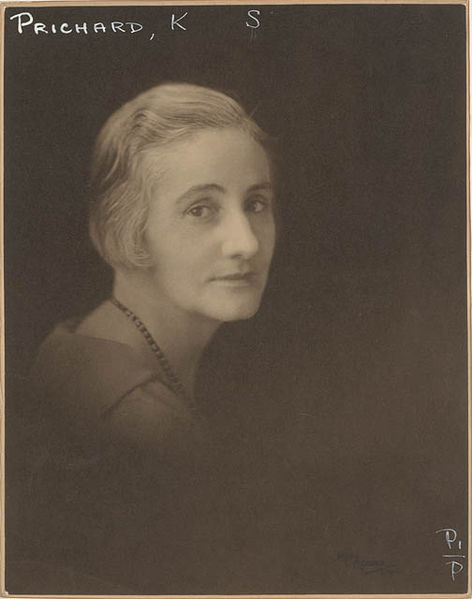
Katharine Susannah Prichard

Prichard, 1927/8 (Courtesy: State Library of NSW, via Wikimedia Commons)

Prichard, whose book The pioneers I’ve reviewed here, shared the 1929 Bulletin prize with M. Barnard Eldershaw, for her book Coonardoo (which I have also read, but many years ago). Coonardoo is one of the first Australian books to deal with a relationship between a white and an indigenous Australian. Prichard was a founding member of the Communist Party of Australia. Her novels documented people’s struggles, in work and relationships with each other. Her son, Ric Throssell, became an Australian diplomat and writer.

Miles Franklin (1879-1954)

Franklin’s career started long before the period I’m writing about here – My brilliant career was published in 1901 – but she was still active during this period and in fact won a prize in 1936 for her novel All that swagger**. I can’t resist sharing this excerpt which describes the hero, Danny, chopping down gum trees:

Guarding the illusive land were throngs of giants–the stateliest trees on the globe. Delacy was like an ant in the aisles of box trees and towering river gums, but he attacked them as an army, grunting with effort, sweat dripping from him. His slight form grew as wiry as steel; his hands were corneous and scarred with the work of felling and grubbing. (All that swagger, Ch. 3)

A contemporary reviewer described it as “probably the finest Australian novel ever written”. It deals with an Irish immigrant and his family’s history in Australia over 100 years, up to 1933. The Bulletin ‘s reviewer suggests that the hero, Danny, “seems certain to take a lasting place in Australian literary tradition.” The reviewer, I think, got that wrong, but Miles Franklin herself has achieved this through the eponymous prize she bequested. What is less well-known is that Franklin was politically active much of her life, and in fact spent around 9 years working for the National Women’s Trade Union League in Chicago from 1906 to 1915. On her return to Australia she worked hard to promote Australian literature, supporting, for example, the creation of fellowships for writers.

Other writers

Other politically active writers at the time included Jean Devanny, who was a Communist and who used her writing to promote her ideology; Eleanor Dark, who was active in the Labor left; and Nettie Palmer, who actively mentored younger writers like Marjorie Barnard and Flora Eldershaw and who, with her husband Vance, was anti-Fascist and a proponent of egalitarianism.

Literary histories about the period rarely mention any of these writers in isolation, which tells us something about the richness of the literary life of the time and of their collaborative approach to promoting not only Australian literature but also the values they thought should underpin Australian life. I never tire of reading about them, but I still have a way to go before I can feel well-read in their writings.

*From my research for Wikipedia. The citation is: Dever, Maryanne (1994) “Conventional women of ability: M. Barnard Eldershaw and the question of women’s cultural authority” in Dever, Maryanne (ed) Wildflowers and Witches: Women and Culture in Australia 1910-1945, St Lucia, University of Queensland Press, pp. 133–146

** Accessible online at Project Gutenberg Australia

DISCLAIMER: I have read works by most of these writers, but mostly long ago. I hope, in future months and years, to (re)read their works, and review them here.