Sorry folks, but I have been slack. Meanjin took a little while to post the final round but I’ve taken even longer to report back to you. February was not a good reading and blogging month for me as my Past Whisperings link shows. I am, however, back now and ready to post the winner which, you may remember, was to be chosen from Thea Astley‘s “Hunting the wild pineapple” and Tom Cho’s “Today on Dr Phil”. I have (now, anyhow) read them both.
And what a pair of stories they are … it’s fitting in many ways that it came down to these two because they are probably the most “out there” of the stories in the tournament. Both take you on wild rides where one minute you feel firmly planted in reality and next you’re not quite sure. They seem grounded in reality but what’s going on stretches your imagination almost to breaking point. Cho’s “Today on Dr Phil” exposes our modern culture’s propensity for public confession, for seeking our five minutes of fame, while Astley explores the violence lurking just below the surface of many human relationships.
For the final round, Meanjin used three judges all of whom are published authors themselves:
Ryan O’Neill, the Scottish born Australian writer of The weight of a human heart, wrote that Cho “expertly controls the story until the fitting, chaotic climax, while at the same time posing serious questions about identity and self”. But, he gives it to Astley’s story for “the spikiness of its style, the oddness of its characters, and the vividness of its setting”.
Susan Johnson, author of several novels including Life in seven mistakes which I’ve reviewed, writes of Astley’s “wonderful, theatrical, imaginative flourish”. However, using a horse race metaphor, she gives it to Cho, not only because he manages to make some “brilliant cultural and ethnic allusions” but because “he’s alive, and straining, and needs to get home to eat”.
So, one vote each now. Who will win?
Chris Flynn, author of A tiger in Eden which I’ve also reviewed, has the casting vote – and what a vote it is. I love it because, while appreciating Tom Cho’s wonderful, clever story, he gives it to Thea Astley – and I can’t argue with his reason:
… this is Thea Astley we’re talking about here. If Cho had been up against any of the more realist writers we’ve seen in the competition, some of which he’s already taken out, it would be game over man, game over … But … Astley was the progenitor, the chain-smoking, wise-cracking, jazz-loving four times Miles Franklin-winning champion of linguistic manipulation whose style got on Helen Garner’s nerves and who pushed the envelope of Australian literature when no-one else had the cojones to do so. My vote goes to Thea Astley, as without her, I don’t know where we’d be today.
I love that Flynn recognises and takes into account Astley’s contribution to Australian literature. I hope Cho isn’t disappointed because he was beaten by a real grand dame. He has nothing to be ashamed of – and I will continue to read his short stories in Look who’s morphing. It’s a great collection.
And so the winner of the latest Meanjin Tournament of Books is Thea Astley’s “Hunting the wild pineapple”.
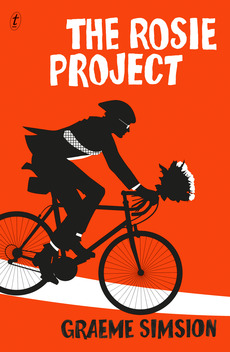
While I go to films fairly regularly, I rarely think of adapting books to film when I am reading. However, I was only a few pages into Graeme Simsion’s The Rosie project when it occurred to me that it was perfect film material. The feeling got stronger – and then around a third of the way through the novel I decided to look at the publicity sheet Text Publishing sent with the book. I usually read these sheets after reading the book. Guess what? The Rosie project started as a screenplay and has won a Writers’ Guild Award for Best Romantic Comedy.
This brings me to the other thing that crossed my mind as I read it: how to categorise it. I’ve now read two books in a row that are a little outside my usual fare. Like the previous one, Anita Heiss’s Paris dreaming, The Rosie project is a romance, but it’s not chicklit and I’m not sure it fits the romance genre as a whole either. You see, the protagonist – as the cover may have told you – is a man, one Professor Don Tillman. As I understand it, romance novels tends to involve a female protagonist and the trials and tribulations she meets en route to true love. Movies have a genre called “romcom” but I’m not sure that term is used for novels. It is, however, the most appropriate description for this novel – because it’s a romance and it’s funny.
Now, I’d better give you a brief outline of the plot. It opens with Don Tillman, a genetics professor, about to give a public lecture on Asperger Syndrome as a favour for his friend Gene (ha!), a psychology professor. In the second paragraph, you start to suspect that Don himself has Asperger’s:
The timing was extremely annoying. The preparation could be time-shared with lunch consumption, but on the designated evening I had scheduled ninety-four minutes to clean my bathroom.
Ninety-FOUR minutes!? The novel continues in this vein with Don admitting to being socially inept, to being routine-driven and focused on efficiency over all else, and so on. He knows all this about himself, but never in the novel is he named as having Asperger Syndrome so I won’t either. However, this description of him provides a good introduction to the novel’s basic premise. Don, nearing 40, wants a wife but, not surprisingly given the way he approaches the world, he hasn’t had much success. He starts the Wife Project and creates a 16-page questionnaire designed to help him eliminate unlikely candidates before he wastes time on getting to know them. In comes 30-year-old Rosie, whom he thinks Gene has sent to him as a candidate. But Rosie, he quickly realises, would fail his questionnaire on the first page. She smokes, works in a bar (and so, he presumes, would fall below the required IQ), is not punctual, dresses unconventionally – you get the picture. Yet, there’s something about Rosie … so, pretty soon, Don offers to help her find who her father is, and thus begins the Father Project, which rather puts on hold the Wife Project.
From here, the novel runs pretty much to a romcom formula. The light tone tells you that it is likely to turn out the way you expect but despite this, the novel engages. This is because, although the plot is formulaic, the characters aren’t. Don is an unlikely hero. He’s aware of his difference and, as the novel progresses, starts to think about whether he can change himself to become more acceptable to people. It’s, dare I say it, poignant – but it’s not saccharine. Don and Rosie are too themselves for that. The novel also has some truly laugh-out-loud scenes. Comedy which involves ridiculing difference can be uncomfortable but again the tone saves it – it’s light and it’s warm. We like Don and our laughter is not so much at his behaviour as at the absurdity of the situations he sometimes finds himself in. I loved, for example, his description of his special treatment by airlines:
As we drank champagne in the lounge, I explained that I had earned special privileges by being particularly vigilant and observant of rules and procedures on previous flights, and by making a substantial number of helpful suggestions regarding check-in procedures, flight scheduling, pilot training and ways in which security systems might be subverted. I was no longer expected to offer advice, having contributed ‘enough for a lifetime of flying’.
I enjoyed the book. It is a warm, but not stuffily earnest, book about accepting and celebrating difference, about negotiating relationships that accommodate different ways of being. It would make a great film.
I was inspired to write this post last year when commenter Wendy Borchers mentionedCatchfire Press and described it as being associated with the University of Newcastle. I’d never heard of it. It is a community-based press primarily run by volunteers, but their covers, they say, are chosen by competition between senior design students at the University of Newcastle. The link is perhaps a little tenuous though there may be other connections not mentioned on their website. Whatever, they look like a delightful press with a wonderful heart doing something good for a local community, and they reminded me to look at the role university presses play in Australian publishing.
So, let’s look at some of the university presses which are out there promoting and publishing Australian literature – and I’m going to focus mainly on fiction. There’s probably a lot going on that I’m not aware of, but there are a few publishers who for me really stand out, and the grandma of them all is …
Way back in the 1980s when I rediscovered Australian writers, and particularly Australian women writers, it was UQP that brought some of the best to me, like the wonderful Olga Masters who died way too early. Their imprint is recognisable and when I see it I know to expect quality. But then, they’re Queenslanders and so am I! UQP has apparently been going since 1948. They started as a traditional academic press but moved into more general publishing of fiction, poetry, indigenous writing and children’s literature. They published the early works of writers like David Malouf, Peter Carey and Kate Grenville and are now moving into digital publishing. Check out the authors page of their website and you can’t help but be impressed at their contribution to the Australian literary landscape.
Now, jump three decades and we come to the next university press to make an impression on me, and that is …
This was the first publisher to send me books to review. It was a new thing for me, and Lisa of ANZ Litlovers, and it was new for them. That was in late 2009 and what they sent us was their first lot of books in their Australian Classics Library, some of which they had already captured and published via their SETIS digital program. They introduced me to writers like Price Warung, encouraged me to read CJ Dennis, and gave me another Jessica Anderson to read. Their focus is still, I think, more traditionally academic, but I love and appreciate their commitment to some lesser known Australian classics.
And then, in just the last week or so I heard, via Twitter from bloggers Marilyn and Yvonne, of
Australian National University
And its ANU E Press which is publishing, electronically and free of charge, books in its ANU Lives Series in Biography. You have to buy the print versions but the online versions are free. These aren’t fiction – being biography – but are of interest to me with titles like Maori and Aboriginal women in the public eye and Transnational ties. I need to keep an eye on them.
That’s three but I’m sure other Aussies can point to more … and I hope they do because universities are well placed to offer different spins on publishing as these three examples do. It looks to me as through each is operating under different economic imperatives but achieving something important in our local publishing scene.
And here I will close, well aware that it is now nearly Wednesday … My excuse is that I am currently on the other side of Australia and my personal time clock is out of whack! Or something like that ….
Oh, and I will add more links when I am back in my more comfy computing domain …
Paris Dreaming (used by permission of The Random House Group Ltd)
Late last year I wrote a post about the inaugural Canberra Readers’ Festival. One of the speakers was indigenous Australian author, academic and activist, Anita Heiss. I wrote then that I bought one of her books. It was her fourth (I think) chick lit novel, Paris dreaming. This might surprise regular readers here, as chick lit is not really my sort of thing, however …
There are reasons why I was happy to read this book. First was that my reading group chose it as part of our focus on books featuring Canberra for our city’s centenary year. Yes, I know, it’s called Paris dreaming, but the heroine starts in Canberra and Canberra is mentioned (not always positively I must say) throughout the book. The other reason is the more significant one, though, and that is Heiss’s reason for writing the book. I said in the first paragraph that she is an activist and her chick lit books, surprising though it may sound, are part of her activism. In fact, I think pretty much everything Heiss does has an activist element. In her address at the Canberra Readers’ Festival she described herself, an educated indigenous Australian, as in the top 1% of the bottom 2.5% of Australia. She feels, she said, a responsibility to put her people on the “Australian identity radar”.
Does this book do it, and if so how? Well, one of her points is that 30% or more of indigenous Australians are urban and this book, as its genre suggests, is about young urban indigenous women. Anita Heiss manages I think (though I’m not the target demographic so can’t be sure) to present characters that both young indigenous and non-indigenous women can relate to. Our heroine Libby and her friends are upwardly mobile young professionals. They care about their work; they love fashion, drink and food (this is chick lit remember!); and they wonder how to marry (ha!) their career goals and romance.
Indigenous art vase, Government House, Canberra
So what’s the plot (besides the obvious chick lit formula which this book certainly follows)? At the start of the novel 30-year-old Libby, manager of the education program at the National Aboriginal Gallery, is on a man-fast. She’s been bitten one too many times and has sworn off men, much to the dismay of her tiddas (her “sisters”). She is, though, keen to develop her career and wants a new challenge – all part of the chick lit formula – and so pitches a proposal to her boss that she mount an exhibition of indigenous Australian art at the Musee du Quai Branly in Paris. Of course, her boss approves and off she goes to Paris where, following the formula, she falls for hunky, sexy Mr Wrong while Mr Right watches on, spurned (and spurned and spurned). But, of course, I don’t need to tell you how it comes out in the end do I? This is not subversive chick lit because that would not serve Heiss’s purpose …
Did I enjoy it? Yes, but not so much as a piece of literature because my reading interests lie elsewhere, but as a work written by a savvy writer with a political purpose. This purpose is not simply to show that young, urban, professional indigenous Australians exist but, as she also said in her address, to create the sort of world she’d like to live in, a world where indigenous Australians are an accepted and respected part of Australian society, not problems and not invisible. She is therefore unashamed about promoting indigenous Australian creators. She names many of them – artists, writers, filmmakers – and discusses some of their work, educating her readers as she goes. Most of the people, works and places she mentions are real but there’s an aspirational element too. The National Aboriginal Gallery does not exist but she presents it as a significant player in the Canberra cultural institution scene. Good for her!
I’ll probably not read another of Heiss’s choc lit (as she, tongue in cheek, calls it) books, but I’m glad to have read this one – and I’ll certainly look out for works by her in other genres (including her memoir Am I black enough for you?). Heiss is a woman to watch.
Anita Heiss Paris dreaming
Sydney: Bantam, 2011
313pp.
ISBN: 9781741668933
Miles Franklin, c. 1940s (Presumed Public Domain, via Wikipedia)
I have mentioned the new Stella Prize before but, for those of you who may not be across this new award on the Australian literary scene, here is a brief recap. It is named for Miles Franklin – her full name was Stella Maria Sarah Miles Franklin – and is “for the best work of literature (fiction and non-fiction) published in 2012 (for this inaugural one) by an Australian woman”. The prize of $50,000 will go to one author.
The award was created by a group of 11 women, including the writer Sophie Cunningham, in response to what many of us felt was an abysmal under-representation of women writers in Australia’s major literary awards and other literary activity (such as reviewing and being reviewed). The Stella Prize people want to turn this around and, as they say on their website, to:
raise the profile of women’s writing
encourage a future generation of women writers
bring readers to the work of Australian women.
The judging panel is a varied lot and should, I think, do an interesting job:
Kate Grenville: best-selling and award-winning Australian novelist. (Surely she doesn’t need any further introduction?)
Claudia Karvan: actor, producer and television scriptwriter
Rafael Epstein: television and radio journalist who has won the prestigious Walkley Award twice
Fiona Stager: bookshop owner and past president of the Australian Booksellers Association.
And, in fact, I think they have if the longlist – quite different to most literary prize longlists I’ve seen before – is any guide:
Romy Ash, Floundering: a debut novel on contemporary themes
Dylan Coleman, Mazin Grace: an historical novel about mission life, by a Kokatha-Greek writer
Courtney Collins, The burial: a debut historical crime novel which has apparently already been optioned for film. It reimagines the life of Australia’s ‘lady bushranger’, Jessie Hickman
Robin de Crespigny, The people smuggler: described as “a non-fiction thriller and a moral maze” and I think I’ll leave it at that!
Michelle de Kretser, Questions of travel: the fourth novel by an award-winning Sri Lankan born writer. I’ve read two of her previous novels and am keen to read this one.
Amy Espeseth, Sufficient grace: novel by a Wisconsin born writer. It won an unpublished manuscript award back in 2009.
Lisa Jacobson, The sunlit zone: a verse novel which writer and reviewer Adrian Hyland describes as combining “the narrative drive of the novel with the perfect pitch of true poetry”
Cate Kennedy, Like a house on fire: a collection of short stories by one of Australia’s best short story writers. I’ve only read a couple of hers but need to find time to read more.
Margo Lanagan, Sea hearts: a fantasy or speculative-fiction novel about selkies and the like that also appeals to non-genre readers (I believe). Her prose is said to be beautiful.
Patti Miller, The mind of a thief: a memoir exploring issues around native title.
Stephanie Radok, An opening: subtitled “twelve love stories about art” this one sounds hard to classify but fascinating to read. I think the judges called it “mixed genre”.
Carrie Tiffany, Mateship with birds: the second novel by the author of the truly splendiferous Everyman’s rules for scientific living. This is waiting patiently in my TBR.
What a fascinating list eh? It contains few of the usual suspects – even among our somewhat maligned women writing fraternity, we do have some “usual suspects” – but some great sounding works. By longlisting such a diverse collection the judges are surely sending out a message about the depth and breadth of women’s writing in contemporary Australia. Some of the books have been reviewed by participants in the Australian Women Writers challenge. Paula Grunseit has provided a brief survey of these reviews at the challenge site. If you go there you can enter a book giveaway at the same time!
The shortlist for the 2013 Stella Prize will be announced on Wednesday 20 March. and the inaugural Stella Prize will be awarded in Melbourne on the evening of Tuesday 16 April. I’ll keep you informed.
I was going to start this post with that well-known quote by Sophocles – or was it Plato – complaining about the young people of today, but a little bit of research turned up the fact that that quote is somewhat spurious. It was probably inspired by Plato’s Republic in which he presents a dialogue with Sophocles about the ideal education, advocating a “stricter system” to ensure young people “grow up into well-conducted and virtuous citizens”. It was not a tirade on “the youth of today”. That permutation was the work of variously identified twentieth century writers/speakers.
So, instead, I’ll dive straight into Thea Astley‘s essay, “The monstrous accent on youth”. It was written in 1968 and reproduced in last year’s Meanjin anthology which contains a selection of essays organised by decade, starting with the 1940s. I plan to dip into the anthology over the year as there are essays by writers like Patrick White and David Malouf, poems by Judith Wright, and so on. A treasure for dipping into.
I was, I suppose, surprised by the Thea Astley essay, though in retrospect I probably shouldn’t have been. She was never one to go lightly and she sure doesn’t here in criticising the youth of the 1960s. She talks of discussing moral dilemmas in a “middle-class girls’ high school” and being horrified by her students’ callous responses to her questions about conscription during the Vietnam War:
Girls, like female spiders, want to have their men and eat them, too. I was appalled by the selfishness of their reactions and wondered if this were merely a by-product of thinking in a Liberal Party voting area.
She suggests that the generation of the 1960s were frank and (by implication “progressive”) about sex and drugs but had a “hard conservative core”. She then talks of discussions at Macquarie University and says attitudes were more liberal there, “particularly noticeable in the nuns”. (I went to Macquarie University in the 1970s and had many nuns and seminarians in my tutorials. She’s right. They were usually thoughtful tutorial participants.) But, she’s discouraged by the narrowness of the reading. Her students hadn’t read, she said, “Compton Burnett, Cheever, Edmund Wilson, Nabokov, Gordimer …”. Hmm, must say that, with the exception of Nabokov, I hadn’t read those writers then either – in fact, I didn’t even hear of Gordimer until the 1980s – and yet I called myself a reader.
She ponders the reading issue, wondering if that generation spent more time drinking than reading, and worries that “their livers are in more danger than their morals”! I found this fascinating given the current concerns about drinking and the young …
Anyhow, I started to be concerned that the essay was simply going to be a rant against the young and, while it is that to a degree, her main concern is more to do with social change, I think. She writes:
The permissiveness of our generation to the younger has created the monstrous over-rated importance of youth. Oldies – pregnant, sick, reeling – can tremble vertical upon trains and buses while thick-thighed youngsters cling to their seats.
“Thick-thighed”. That sounds like Astley. But, back to the argument. Here in this paragraph near the end of the essay is her main point: “life is so easy for the young and, because of this, so difficult”. She is, in other words, not completely critical of the young. She sees their behaviour in a wider social context, as something that’s partly of her generation’s own making. Perhaps she would have approved of Plato’s “stricter system”?
Thea Astley
“The monstrous accent on youth” (1968)
in Meanjin Anthology
Melbourne University, 2012
(Kindle ed.)
How many Halls of Fame are there specifically for writers? I’m not sure I’ve come across many, but last year I became aware of the Western Australian Premier’s Book Awards Hall of Fame when Tim Winton was inducted into it. The hall of fame is hosted on the State Library of Western Australia website. I’m not sure what the criteria are – I haven’t been able to find out anything about it, not even when each writer was inducted, besides a page for the actual “hall” and some press announcements of inductees. These announcements variously describe it as a hall of “acclaimed Western Australian writers” or “of notable and prolifc WA writers”.
Some of the inductees have been dead for some time suggesting that writers don’t (or didn’t) have to be alive to be inducted into it. There are currently 16 writers in the hall. Is that what you say, “in the hall”? They include:
Mary Durack …
who’s best known for her novels Kings in grass castles about her pioneering family and their role in the Kimberley region of northern Western Australia. I have reviewed a biography of her, True north, by Brenda Niall, and her poem “Lament for the drowned country”. The hall of fame describes her as “one of our great literary figures”. Most of her novels were not, I think, great literature but her contribution to Western Australian and Australian literary life through her writing (novels, non-fiction, short stories, poetry and journal/newspaper articles) and her support of other writers makes her a worthy recipient of the accolade.
Nene Gare …
who is best known for her novel, The fringe dwellers, which I read many years before I started this blog. The novel was made into a film of the same name by Bruce Beresford. She probably doesn’t have the national standing or recognition that the other writers I’ve listed here did and do but The fringe dwellers, like Thomas Keneally’s The chant of Jimmie Blacksmith, is an example of a novel confronting indigenous issues by a non-indigenous Australian writer. An obituary for her husband, who was the last commissioner for Native Welfare, says that “In 1965, Gare rewrote the manual for Native Welfare officers. His premise for his section on children was: ‘Under all normal circumstances children are best reared by their parents’.” This is a view that was still not well accepted at the time, as the Stolen Generations report made clear.
Elizabeth Jolley …
who, those of you who read this blog regularly, know is one of my favourite writers. I have written about her many times, including reviewing the first of her set of three autobiographical novels, My father’s moon, and her slim memoir-like work, Diary of a weekend farmer. The hall writes that she is (was, now) “acclaimed as one of Australia’s leading writers. She has received an Order of Australia , honorary doctorates from Western Australia Institute of Technology (now Curtin University) and Macquarie University, and the ASAL Gold Medal for her contribution to Australian Literature.” I will be writing more about her in years to come!
Katharine Susannah Prichard …
who is one of our political women writers. Prichard was a member of the Communist Party of Australia. I have reviewed her novel The pioneers,which reflects many of her social concerns. The hall describes her as “communist, feminist, social reformer and pacifist”. She wrote novels, plays, short stories and poetry.
Randolph Stow …
who is the other writer I’ve listed whom I haven’t reviewed on this blog. I have had his novel, The merry-go-round in the sea, on my TBR for a long time. One day! Lisa, at ANZ LitLovers has reviewed (and loved) it. He wrote several novels which have become Australian classics including To the islands and the children’s novel Midnite.
Shaun Tan …
would be the youngest of the list. I have only reviewed a small work of his, Eric, which comes from his collection, Tales from outer suburbia. He is an author and illustrator of books for children and adults. He is happy to collaborate with creators from all fields and is not precious about his works being adapted, supporting for example the Australian Chamber Orchestra’s presentation of his The red tree. His short film The lost thing won an Academy Award in 2011 for Best Animated Short Film. The experience of being “other” is one of his major themes.
Tim Winton …
who is one of only two writers to have won the Miles Franklin Award four times. (The other was, in case you’ve forgotten, Thea Astley!) I have read most of Winton’s oeuvre, but have only reviewed one here, Breath. Even if you’re not Australian, chances are you’ve heard of Winton. His most popular book, Cloudstreet, regularly wins polls as Australia’s best or most loved book. He writes for adults and children, and like many of the writers here, writes in multiple forms. He is passionate about the environment and works actively for it – as well as writing, fishing and surfing.
Are you aware of other specifically designated literary Halls of Fame?
David Foster Wallace got me in with the first few words of his essay “Twenty-four word notes”. They are:
Utilize A noxious puff word.
Oh yes! “Utilise” (as we down under spell it) is one of my pet peeves. Why use “utilise” when “use” is a perfectly good word? I regularly mutter. Wallace is a little more direct:
Since it does nothing that good old use doesn’t do, its extra letters and syllables don’t make a writer seem smarter; rather, using utilize makes you seem either like a pompous twit or like someone so insecure that she’ll use pointlessly big words in an attempt to look sophisticated.
I wouldn’t quite have put it that way myself, but have quoted him so you can see the strength of Wallace’s feelings on the matter of words and usage. (By the way, did you notice the use of “she” here?)
Before I continue, though, I should say that I’m not sure that I’d call “Twenty-four word notes” an essay since it is exactly what it says it is, that is, it’s a set of musings and arguments about twenty-four rather ad hoc words. They do not seem to be presented in any particular order and there’s not really a coherent argument, but for those of us interested in language they are great fun to read … even if he touches the odd nerve or you don’t agree with his perspective. I was interested to discover in the Copyright Acknowledgements at the end of the book that this essay/article was originally published in the Oxford American Writer’s Thesaurus (in 2004, 2008 and 2012).
I enjoyed the piece for a number of reasons. Firstly, there are the pet peeves, of which “utilize” is just one. Another is “that”. There are two issues, as he says, with “that”. One is the “that” versus “which” issue, but I won’t go into that (ha) now. It’s the other “that” issue which (or, is it that!) intrigues me. You see, I had been given to understand by some Americans, that “that” can be used for people as in, say, “Wallace is the writer that wrote Infinite Jest“. Over here, down under, we learnt that “who” and “whom” are for people, and “that” and “which” are for things. Wallace agrees and in fact calls misuse of “that” for “who” or “whom” as a class marker! Hmm … that’s a bit strong … but, class marker or not, I know that I always cringe (internally anyhow) when I hear “that” used for people.
My other pet peeve that Wallace addresses is, hallelujah, “loan”. Wallace says, and I quote, because once again I’d only be muttering under my breath:
If you use loan as a verb in anything other than ultra-informal speech, you’re marking yourself as ignorant or careless.
But now here’s the thing. I have felt for a decade or more now that this loan-the-noun/lend-the-verb distinction is a losing battle. Language is, after all, a living thing. It changes. It has to, and, really, we want it to. This makes writing anything prescriptive like Wallace has done here a risky thing. Wallace doesn’t specifically address this issue of change but he does imply it. For example, immediately after the above statement about “loan”, he continues
As of 2004, the verb to lend never comes off as fussy or pretentious, merely as correct.
“As of 2004”. There’s his recognition, subtle though it is, that there are limits to prescription. I’m glad he makes that concession.
While there are other words about which he is similarly scathing regarding their misuse, not all words have been chosen for this reason. For example, there’s the word “pulchritude”* which he describes as an ugly word that is the complete opposite of its meaning. “Pulchritudinous” is even worse he says! I have to agree. He then goes on in this particular word note to list other words that are the opposite of what they denote, such as “big”, “diminutive” and “monosyllabic”. It is this sort of thing that makes language such fun, isn’t it?
Another word he discusses is one of my daughter’s favourites, “myriad”. I was anxious about reading this one for fear that he would be scathing about it too, but fortunately not. Rather he writes of the right and wrong ways to use it … and I’m pretty confident my word-loving, writing daughter gets it right.
Almost every word he discusses provided me with some entertainment or education – yes, I did learn “stuff” too – but I’m going to finish here on the last word he writes about. It’s “hairy” and his discussion of it is relevant to the book the article was written for – a thesaurus. This note – which in fact occupies some three pages – is about the huge number of descriptors for “various kinds of hair and hairiness” in the English language. I had heard of a few of them – such as “hirsute”, “glabrous” and “flocculent” – but others were a revelation. For example, the “cirrus” we use for clouds comes from the Latin for “curl” or “fringe” and gives rise to words like “cirrose”. And what about “hispidulous”? He describes this as a “puffed up form of hispid” and recommends avoiding it. I think I will. Then there’s “pilimiction”, which refers to an affliction we’d all like to avoid I reckon …
It is difficult to write on words and usage without being somewhat prescriptive, and Wallace isn’t afraid to be that. It is possible, I think, to write about words and usage without offending your readers, but this is not an example of that! Nonetheless, taken in the right spirit, it’s an interesting read and one which offers some good advice on writing. I enjoyed it.
David Foster Wallace
“Twenty-four word notes”
in Both flesh and not
Melbourne: Hamish Hamilton, 2009
ISBN: 9781926428185
*Wordpress’s spell-checker didn’t like this word either. Can you blame it?
Today’s Monday Musings is the second in a series of posts I plan to write this year about Canberra writers to commemorate our centenary. The first post covered Canberra’s women poets. Like that post, all the poets mentioned below appear in The invisible thread, Canberra’s centenary anthology that I’ve mentioned before.
The American poet Ezra Pound apparently once said “I haven’t known anyone worth a damn who wasn’t irascible”. Well, we have, I believe, a few Aussie poets who would live up to that description, and AD Hope, one of Australia’s most significant poets, would be one of them. He is famous, for example, for describing Patrick White’s novel The tree of man as “illiterate verbal sludge”, which, not surprisingly, offended Patrick White who was, I must admit, also known for being irascible. All this, of course, has little to do with Hope’s poetry except that, like White, he was highly critical of Australia. Reviewers have variously described his poetry as “sardonic”, satiric” and “sharp-edged”. One of my favourite poems of his, “Country Places“, makes fun of Australian place names and was included in Jamie Grant’s 100 Australian poems you need to know. Being of a certain age, I also like the following lines from “Spaetlese” in his collection A late picking:
Old men should be adventurous. On the whole
I think that’s what old age is really for:
Tolstoy at Astapavo finds his soul;
Ulysses hefts his oar.
But, the poem in The invisible thread, “Meditation on a bone“, is a different thing altogether. Inspired by an inscribed bone from about AD1050, it is about passion, rage and age, ending with:
Canberra is a small city, and was even more so a few decades ago. Consequently, poets like AD Hope, David Campbell and Rosemary Dobson knew each other pretty well. In fact, I mentioned David Campbell in my Capital Women Poets post because he and Dobson were good friends and, among other things, translated Russian poetry together. Like Hope, who was born in a country town about 100kms south of Canberra, Campbell was born in an even smaller country town a similar distance by road due east of here. But, unlike the highly academic Hope, Campbell was a war hero, a skilled sportsman, and a keen fisherman, among other things. His humorous poem, “The Australian Dream”, which gently mocks Australia’s fascination with royalty around the time of the 1954 Royal Tour, is included in Grant’s abovementioned anthology.
The poem included in The invisible thread, “Mothers and daughters“, is short and sharp but complex too. Its subject is mothers and daughters, but its themes are youth and age, competition between women, anxiety about sexuality, and there’s a little revenge sting in the tail because the first line of this taut 8-line poem introduces the male gaze as well:
Geoff Page is particularly special to me – not that he would know it – because he taught my son English at Narrabundah College and he was also the first author to attend my reading group’s discussion of his work. We did two of his verse novels, The scarring (my review) and Freehold, and Geoff was wonderfully generous in sharing his thoughts with us. The scarring is one of the most shattering works I’ve read in a long time. Geoff is, in fact, well-known in Canberra, in certain circles at least, because he has, for many many years, supported Australian poetry and jazz through his monthly Poetry at the Gods and Jazz at the Gods events, of which I have attended a few over the years. He also holds a popular Dead Poet’s dinner every winter and is a regular reviewer of poetry for ABC Radio National.
Page is also represented in the Jamie Grant anthology by one of his best-known poems, “Smalltown Memorials“, about the plethora of World War 1 war memorials in country towns. His poem in The invisible thread is “My Mother’s God“, a rather wry but affectionate look at the beliefs of his protestant mother’s generation:
…
His second book, my mother says,
is often now too well received;
the first is where the centre is,
tooth for claw and eye for tooth
whoever tried the other cheek
Well, Christ maybe,
but that’s another story
…
Oh, and he too was born in a country town, Grafton, some long distance north of Canberra.
Alan Gould is another poet I’ve reviewed here – but for him it was his novel, The lakewoman – and he also agreed to attend my reading group’s discussion of that book. I haven’t, I must say, read much of his poetry – and, unlike the first three poets, he was born in a city. London, to be exact! His poem in Jamie Grant’s book – yes, he’s there too – is called “Pliers“.
“The roof tilers“, Gould’s poem in The invisible thread, immediately brought to mind a delightful short film that I fell in love with, oh over 30 years ago now, called The Log Driver’s Waltz. Made by the National Film Board of Canada in 1979, and sung by the gorgeous Kate and Anna McGarrigle, it delighted me with its whimsy but also because it’s an ode to the grace (and courage) that can be found in the working man. Of course, I had to check You Tube and there it was. Have a look …
Thanks Alan Gould for a beautiful poem and for letting me wander down memory lane!
Both are slender; one is already high.
You watch as he steps on his wire legs,
from batten to batten, pauses, steps,
My last poet – unlike the previous four – is younger than I and, while he hasn’t attended my reading group, I have seen him perform live. He is a poet and rapper from Queanbeyan – sometimes unkindly called “struggle town” – which is the New South Wales town that borders Canberra. Our cities are, as a result, bound closely together, even if sometimes those binds fray a little. Musa is, for an oldie like me, exciting and refreshing. He performs at poetry slams (and can be found on You Tube) and his subject matter often deals with social justice issues to do with multiculturalism, youth opportunity, and similar. His poem in The invisible thread is, of the poems I’ve quoted here, the most grounded in our region. It’s called simply, “Queanbeyan”, and describes his love-hate relationship with a city that contains some of the worst of urban life – “alcos”, “used syringes”, bullies, and people playing pokies – but that’s also “a place where you can still see the stars”. I plan to keep an eye on Omar Musa in coming years.
Who are your favourite male poets?
Note: if a poem is hyperlinked, it is to a copy of that poem on the web.
Mexican writer Valeria Luiselli’s Faces in the crowd was, as regular readers here might remember, one of my two Bah Humbook virtual gifts from Stu of Winston’s Dad. I ordered it on Christmas Day for my Kindle – after all, it was a Christmas present – and have now read it. Wow, what a read, but how to write about it?
Perhaps I’ll start by quoting something near the end of the novel:
There are people who are capable of recounting their lives as a sequence of events that lead to a destiny. If you give them a pen they write you a horribly boring novel in which each line is there for an ultimate reason: everything links up, there are no loose ends.
This is not such a novel. Things don’t link up, there are loose ends, and it’s both chronological and not. It is in fact a metafictional work. It has the old story-within-a story-within-a-story structure, the self-consciousness about fiction versus reality, all of which could be a bit old hat, except it isn’t. The first person narrator is a somewhat frustrated novelist in Mexico City. She has two children – the boy and the baby – and a husband. To make her novel, an autobiographical one, interesting, she has her husband leave her. (Wish fulfilment? we wonder.) Reading over her shoulder, he says:
Why have you banished me from the novel? What? You wrote that I’d gone to Philadelphia. Why? So something happens.
This fictional husband sometimes takes up the story, telling of his life in Philadelphia and of missing his children. Our narrator reminds us that “it’s only a novel, none of it exists” and says she is writing “A horizontal novel, told vertically”, and then “A vertical novel told horizontally”, and still later “Or a horizontal novel, told vertically. A horizontal vertigo”. Word play, you see! I can imagine the fun the translator had with this – and from what I can tell, she seems to have made a good fist of it because there’s a lot of humour here, humour that is linguistic, verbal, and that requires you to keep your wits about you.
Meanwhile, interspersed with telling the story of her current life in Mexico City and the “fictional” life of her husband in Philadelphia, she tells of her past when she worked in New York City “as a reader and translator in a small publishing house dedicated to rescuing ‘foreign gems'”. There are a few “digs” at Americans in the book and one follows this statement, when she continues, “Noone bought them, though, because in such an insular culture translation is viewed with suspicion!” I can see why Stu, with his love of translated literature, related to this work! This story, the one about her time in NYC, is full of unusual but colourful characters flitting into and out of each other’s lives, houses and beds, all told through little, sometimes interconnecting, vignettes which mostly serve to illustrate the contrariness of existence.
There’s Moby, for example, who “forged and sold rare books that he himself produced on a homemade printing press”. “My husband reads some of this”, our narrator writes, “and asks who Moby is. Nobody I say. Moby is a character.” Is he? Your guess is as good as mine. Suffice it to say that Luiselli plays these games with us from beginning to end, all the while challenging us to consider what is fiction, what is real. Is any of it real, she seems to be asking? She writes, “Writing this is coarse. But reality is even more so.” There are ghosts, blindness, and shadows; people and objects suddenly slip from being substantial to being insubstantial. And gradually our narrator, herself, seems to merge with the obscure Mexican poet, Gilberto Owen, about whom she is writing, while running into (or does she?) other poetic luminaries like Federico Garcia Lorca, William Carlos Williams and Ezra Pound.
There’s a fantastical element to the story, but it’s not the same as Gabriel Garcia Marquez‘s magical realism. It’s more slippery, if that makes any sense at all. While Gabriel Garcia Marquez expects us to comprehend “the magical” as part of it all, Luiselli seems to be saying the opposite, suggesting that perhaps “nothing is”.
This all might sound rather depressing, but it’s not. It is in fact a fun read. And while the novel is, I think, about the challenge of living an artistic life in which the things of the real world threaten to overwhelm the imagination, the final word is positive – albeit ironically so. You’ll have to read it yourself though to find out what that is.
Valeria Luiselli Faces in the crowd
Translated by Christina MacSweeney
London: Granta Books, 2012
ISBN: 9781847085580 (Kindle ed.)


 Whispering Gums