I don’t make a practice of discussing politics in my blog, though regular readers are sure to have picked up my pro-social-justice values (which is why I love writers like, say, Thea Astley). My reason for being politics-lite here is that politics is a divisive game, and my aim here is to be inclusive. However, I do want to write briefly today about a very specific political issue likely to affect Australian, and in fact international, researchers. I’m talking about the significant cuts being made to Australia’s major national cultural institutions like the National Library of Australia, the National Museum of Australia and the National Film and Sound Archive.
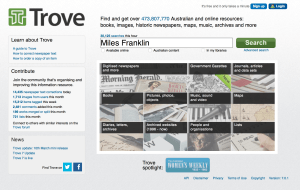 Those of you who read my Monday Musings series will know that one of the resources I use regularly – particularly for the more historical posts – is the National Library of Australia’s Trove service. Trove provides access to a wide variety of collections from libraries, museums, archives and other research institutions around Australia. It combines traditional book catalogue information with digital content, including digitised Australian newspapers dating back to the early 1800s.
Search on a name or topic – like say, Miles Franklin – and if you don’t filter the search in advance, it will return resources in any form for which material is held, including books, photos, newspapers, diaries, music, maps, websites, government gazette announcements. And it’s free – well, the search is, and around a third of the content is freely available. According to Mike Jones and Deb Verhoeven in The Conversation, Trove contained, at the end of February,
information on over 374,419,217* books, articles, images, historic newspapers, maps, music, archives, datasets and more, expressing the extraordinarily rich history of Australian culture.
Trove can be used by anyone, anywhere – academics, authors, local and family historians, and so on. A recent Sydney Morning Herald article looked at the Twitter hashtag #fundtrove, and quoted some of the tweets, such as this from author Kaz Cooke
Without Trove I couldn’t be writing this novel about the imagined lives of real 19th Century Australian vaudevillians#fundtrove.
Academics similarly tweeted the importance of Trove to their research projects. One, Evan Smith, wrote he couldn’t have done his research project on “public order policing in the ACT” without it, and historian Alicia Cerreto posted that “@TroveAustralia changed the ways that we historians can tell the stories of Australia. It is a critical resource”. At a time when interest in history appears to be booming – just look at all the history-focused TV shows and non-fiction books proliferating at present – reducing this service seems like madness.
In 2011, Trove was awarded the Excellence in eGovernment and the Service Delivery Category awards at the Australian Government’s ICT Awards. It has also been recognised internationally as a leader “in facilitating public access to documentary heritage”. The Canberra Times recently reported that
Australian Research Council laureate fellow and professor of history at Griffith University, Mark Finnane, said Trove brought Australia “great credit” internationally and no other service compared.
“It’s really a world-leading innovation, in the way it ties collections together,” he said. “[We] can’t afford to be without this tool.”
As a free-discovery-cum-content-aggregation service, Trove, says The Conversation (cited above), simplifies the work of researchers by reducing the time they need to spend tracking down relevant information. It improves their efficiency in other words. It’s all the more ironic, then, that it’s the current Federal government’s decision to apply their so-called “efficiency dividend” to cultural institutions which threatens Trove’s continuation. How silly is that!
PS: For more on the #fundtrove campaign, check out discontents.com.au. Blogger Tim Sherratt lists what we can do, and is updating his post as more information appears.
* Trove itself claimed on 14 March to have over 474,674,488 resources. On this link, you can also see a list of all the organisations whose resources are included in the service.







 Whispering Gums