Jane Austen on history and historians

Jane Austen, we know from her letters, was a keen reader. She read novels, sermons, plays and poetry, magazines and, of course, histories. Did you know, though, that she also wrote a history? This is her juvenilia piece, The history of England from the reign of Henry the 4th to the death of Charles the 1st (online text), illustrated by her older sister Cassandra and completed in November 1791, the month before Jane turned 16.

It’s not, however, like any history you’ve read before, except perhaps Sellar and Yeatman’s 1066 and all that. Published in 1930, this book, Wikipedia tells us, is “a parody of the style of history teaching in English schools at the time”. Well, interestingly, scholars argue that Austen’s History is a parody of the histories being taught in the schools of her time, in particular, Oliver Goldsmith’s History of England from the Earliest Times to the Death of George II (1771). The parody starts on her title page where she tells us “N.B. There will be very few Dates in this History”. She also identifies the author of her history as “a partial, prejudiced, & ignorant Historian”, satirising Goldsmith’s claims to be objective. “It is hoped the reader admits my impartiality” he wrote in his Preface, but many readers, including our Jane, would not admit this at all given some of his pronouncements!

Mary Queen of Scots, by Cassandra Austen, believed to be modelled on Jane

Mary Queen of Scots, by Cassandra Austen, believed to be modelled on Jane

And so, as you’d expect in a parody, Austen is unashamedly subjective in her History, usually promoting the opposite to the prevailing view of her times. She is, for example, partial to the Stuarts, and particularly to Mary Queen of Scots, and is critical of Elizabeth I, “that disgrace to humanity, that pest of society”. She continues:

It was the peculiar misfortune of this Woman to have bad Ministers —— Since wicked as she herself was, she could not have committed such extensive Mischeif, had not those vile & abandoned Men connived at, & encouraged her in her Crimes. I know that it has by many people been asserted & beleived that Lord Burleigh, Sir Francis Walsingham, & the rest of those who filled the cheif Offices of State were deserving, experienced, & able Ministers. But oh! how blinded such Writers & such Readers must be to true Merit …

If you know anything about Austen scholarship, you won’t be surprised to hear that her History has been the subject of intense theorising, with various perspectives being explored, in addition the parody/satire angle. Other perspectives include that it

  • explores ideas about historiography, and the blurring of fact and fiction; and/or
  • reflects Jane and her sister Cassandra’s maternal line’s Jacobite/Stuart sympathies (which were not shared by the men of the family) or, conversely, it reflects their anti-mother attitudes; and/or
  • supports a feminist reading of her work; and/or
  • conveys Austen’s irreverence towards authority.

My aim is not to discuss these here, though, because I want to refer briefly to Northanger Abbey, the first version of which was written around 1798–99 (that is, only a few years after the History). It is famous for its defence of the novel, but it also contains references to other sorts of reading including, yes, history. I want to share some of these, which make interesting reading in the light of her History. The references come from heroine Catherine Morland’s conversation with Henry Tilney and his sister Eleanor.

When you read Austen, you need to know whether Austen approves of the characters who are speaking, as this affects how we are meant to read the character’s pronouncements. Now, in Northanger Abbey, Catherine is our heroine, but she is also young and a little naive. As the novel progresses, she is “taught” by the somewhat older and wiser, Henry Tilney, but he can also be a little pompous. So, I think we can read the following comments with some respect for Catherine’s position, as well as for Henry’s.

“That is, I can read poetry and plays, and things of that sort, and do not dislike travels. But history, real solemn history, I cannot be interested in. Can you?” [Catherine]

No, not necessarily, Austen is perhaps suggesting:

“… I read it a little as a duty, but it tells me nothing that does not either vex or weary me. The quarrels of popes and kings, with wars or pestilences, in every page; the men all so good for nothing, and hardly any women at all—it is very tiresome: and yet I often think it odd that it should be so dull, for a great deal of it must be invention. The speeches that are put into the heroes’ mouths, their thoughts and designs—the chief of all this must be invention, and invention is what delights me in other books.” [Catherine]

We hear you Catherine! And we think back to Austen’s History where, surely with tongue in cheek, she refers her readers to “inventive” writers for authority, such as Shakespeare (“whereupon, the King made a long speech, for which I must refer the Reader to Shakespear’s Plays” or “he afterwards married the King’s daughter Catherine, a very agreeable Woman by Shakespear’s account”) and Sheridan:

Sir Walter Raleigh flourished in this & the preceding reign, & is by many people held in great veneration & respect — But as he was an enemy of the noble Essex, I have nothing to say in praise of him, & must refer all those who may wish to be acquainted with the particulars of his Life, to Mr Sheridan’s play of the Critic, where they will find many interesting Anecdotes …

Cheeky Jane!

And so the discussion continues, with the reasonable Eleanor Tilney stating that she likes history but is happy if historians, such as Austen’s revered David Hume, embellish speeches to make them readable.

“Historians, you think,” said Miss Tilney, “are not happy in their flights of fancy. They display imagination without raising interest. I am fond of history—and am very well contented to take the false with the true. In the principal facts they have sources of intelligence in former histories and records, which may be as much depended on, I conclude, as anything that does not actually pass under one’s own observation; and as for the little embellishments you speak of, they are embellishments, and I like them as such. If a speech be well drawn up, I read it with pleasure, by whomsoever it may be made—and probably with much greater, if the production of Mr. Hume or Mr. Robertson, than if the genuine words of Caractacus, Agricola, or Alfred the Great.”

Ah Eleanor, I hear you. The scene concludes with Catherine making some concessions while suggesting that she used to think all historians did was to write “great volumes … for the torment of little boys and girls”, and Henry Tilney teasing her about this idea of historians aiming to “torment” rather than “instruct”.

Reading or studying history appears in other novels too, particularly in Mansfield Park, where, for example, Austen tells us Fanny, her heroine, had to “read the daily portion of history” but where she also says of Fanny and her sister, Susan, that “their conversations, however, were not always on subjects so high as history or morals”.

I’ve barely touched the surface of Austen’s discussions of history and what we might make of them, but I hope at least that I’ve shown why students (and lovers) of Austen never run out of ideas to think (and argue) about!

Monday musings on Australian literature: Blak and Bright

I should have written about the Blak and Bright last Monday, as the Festival was held last weekend, but unfortunately I only heard about it – my inattention, I’m sure – a few days ago, via an ABC RN program (which you can listen to online). However, although the actual Festival is now over, I think it’s still a worthwhile topic – and, anyhow, most of you who read my blog wouldn’t have been able to attend, given it was held in Melbourne.

So, what is (was) Blak and Bright? From the website, link above, it is described as the debut event of the Victorian Indigenous Literary Festival. Their “about” page lists sponsors and supporters, and says:

We believe Indigenous writing is relevant and exciting to literature lovers and readers everywhere.

What a simple, straightforward “mission statement”! Unfortunately, there is no program online. However, there is a list of artists, and from that you can locate the sessions they were involved in. Via this method, I found a fascinating variety. Here are a few:

  • 6 Plays in 60 Minutes: six short play readings from Australia’s longest running Indigenous theatre company, Ilbijerri.
  • Blak Book Club: an opportunity to discuss two Indigenous books, Gayle Kennedy’s Me, Antman & Fleabag and Tony Birch’s Ghost River.
  • Borrow a Rare (Living) Book: opportunity for attendees to have one-on-one sessions with Indigenous storytellers/Elders (Aunty Di Kerr, Uncle Larry Walsh, Aunty Kerry Reed-Gilbert and Aunty Judith ‘Jacko’ Jackson).
  • Cross Continental Conversations: explored the international Indigenous writing scene, by discussing the experiences of a contingent of Aboriginal writers who travelled to the Native American literary organisation, Woodcraft Circle, and the Literary Commons exchange in India. Participants were Lee Francis IV, Bruce Pascoe and Ali Cobby Eckermann.
  • Fresh Blak Writers: Maurial Spearim (playwriting), Hannah Donnelly (speculative fiction), and Elijah Louttit (screenwriting) talking about how they got started with their writing.
  • Ellen van Neerven, Heat and light, book coverPublishing and Editing Blak: about the challenges faced by Blak writers working with white editors and publishers, and the challenges faced by Blak editors and publishers. Posed the question: Is there a need to make Aboriginal language or depiction of culture easy for a white readership? It involved Rachel Bin Salleh, Ellen van Neerven (whom I’ve reviewed) and Sandra Phillips.
  • Sistas are Doing It: Tammy Anderson, Anita Heiss, and Kate Howarth share how to “build and sustain a career as a Blak writer”.
  • Yung, Blak and Bold: involved young writers presenting new ways of presenting the world. “Listen”, the program advised, “as we bust stereotypes and discuss how words in new contexts can activate change”. Featured Benson Saulo, Amelia Telford and Nayuka Gorrie. (All new to me, but that’s the point I guess!)

It looks wonderfully varied, catering for all sorts of interests. It involved several writers I don’t know; and some, like Bruce Pascoe, Ally Cobby Eckerman, Gayle Kennedy, who are on my radar to read. Sessions were supported (sponsored I presume) by some wonderful literary “players” like the Small Press Network and the Stella Prize. I would be interested to see an assessment of how it went, recognising that these sorts of events can take a few years to build.

There is a blog on the site. I’m not sure if it will continue post-festival, but in addition to posts about events, it has a series on the topic “Why I read Blak?”:

  • Associate Professor at the Graduate School of Language and Culture at Osaka University, Sei Kosugi: on the global reach of Australia’s Indigenous storytellers, naming a couple of the writers she teaches and why.
  • Writer and crossword-maker, David Astle: on “an important lesson he’s learnt from reading Blak”.
  • Writer Drusilla Modjeska: on the various ways reading Blak has enriched her reading and writing life. She looks more widely, starting with African writer China Achebe’s Things fall apart (which I will be reading and reviewing in a few months – at last!)
  • Our very own Auslit blogger Lisa Hill: on the value to her of reading books by Indigenous Australians. She writes that “I feel as if I am being invited to get to know my country better. I’m being welcomed in to share in an ancient story”.

Finally, in the RN program I heard (link in the opening paragraph), Anita Heiss spoke on why people should read Blak. She has fleshed it out on her blog. It not only gives excellent reasons – such as “we write human rights” and “we write the search for self” – but it provides a useful but by no means complete list of works and authors well worth checking out.

Delicious descriptions: Gerald Murnane’s landscape and imagination

A couple of years ago I reviewed Gerald Murnane’s The plains. I found it a mesmerising book, but a challenging one to fully get my head around, to grasp and hang onto what I’d grasped. Then a couple of days ago, I reviewed his memoir, Something for the pain: A memoir of the turf. It was quite a revelation – and among those revelations were some ideas that seemed to flesh out The plains, though he doesn’t specifically address those ideas to the novel in his memoir.

The main revelation relates to his feelings about landscape. Murnane hates the sea and doesn’t much like mountains either. What he loves are plains. In chapter 6 he refers to his “lifelong dislike of travel”, initially developed when he was still a boy. He also, as a boy

settled on what would be my ideal landscapes for the rest of my life: the green and mostly level countryside of south-western Victoria.

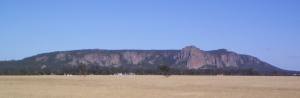
Mount Grapples

Mount Arapiles, Western Victoria (released on Wikipedia to Public Domain, without conditions)

Plains, in other words. In chapter 15, he talks about a horse owner P.S. Grimwade. (An aside. In this, as elsewhere in the book, he focuses on what he “imagines” Grimwade to be like, stating that he suspects he wanted “to keep in mind the ideal man rather than have in sight the actual man”! “Perhaps”, he writes, “I wanted to think of him as someone for whom racing was better imagined than experienced – someone such as myself”.) Anyhow, he goes on:

I would have envisaged P.S. Grimwade as owning an extensive property in what I consider the centre of the universe, in the quadrilateral bounded by Ballarat, Ararat, Hamilton, and Camperdown in the Western District of Victoria, which is a landscape of plains and low hills and vast skies. I’ve never felt comfortable when surrounded by steep hills, and I’ve always tried to keep away from mountains.

In fact, Grimwade, he discovered, lived in a different part of Victoria, one he’d never visited – but, it’s telling I think that he places this horse owner, who fascinates him, in a place comfortable to him. He writes that he’s entitled to his imagination about Grimwade:

In the unlikely event that this book should be read by some or another descendant of a man named P.S. Grimwade, and that the descendant should wish to tell me that my account of the man is untrue, inaccurate, preposterous, whatever, I urge that descendant not to waste energy, time, or ink on the matter. Nothing will keep me from revering my saint as he was revealed to me.

Are you getting the picture of this memoir? It’s the imagination that’s important …

Then we get to chapter 22, “Sir Flash and the Borderers”, the chapter that gave me a big ah-so moment. Early in the chapter, he writes again of his ideal landscape:

… the ocean itself repelled me, and I’ve kept well away from it all of my adult life. During my brief holidays on my grandfather’s farm in the 1940s, I was more interested in another sort of ocean. Whenever I stood on a tall cliff above some or other bay, I got inspiration not from the blue-green Southern Ocean reaching away towards the South Pole but from the yellow-brown ocean of land reading towards places I had seen only from a distance, if at all: the plains of the Western District to the north and the north-east of Warrnambool or, away to the north-west, a mostly level landscape …

This discussion introduces a story about a group of horse-owners and horse races in what he calls the Border District. It’s here that I was reminded of The plains, because of the way he imbues the Border Country – and the Borderers who live there – with a sense of “otherness”. These people and their horses came from a real part of Australia, obviously, but it’s a part that was unknown to him when he came across them, so he unfolded a map and “set not only my eyes but my imagination also roaming”. He gives it and its people the aforementioned names, and he awards the people – imagines, in other words – certain characteristics, including “the usual amount of shrewdness and sagacity attributed to people living far from the capital cities”. I won’t tell you all that he ascribes to them – it makes for wonderful reading – but here’s the final bit that brought The plains to my mind:

I would not have my Borderers thought of as wholly devoted to gain, however. They numbered among them many a man who wore his hair bunched above his ears and on his neck and who stood out on a racetrack on account of his elegant dress and proud bearing. Such a man owned a vast cattle or sheep property and lived in a mansion with a veranda on three sides and groves of deciduous trees all around. His mansion included a library and a study. The walls of the study were covered with photographs of the finishes of races won by his own horses. The walls of the library were covered, of course, with books …

This imagination, this creation of a place that seems both in and separate from the Australia we know, a place populated with people who have dreams and an artistic sensibility, is very reminiscent to me of The plains. Rightly or wrongly – but I hope the former – I now feel I understand Murnane a little more, his aspirations, how his imagination works and the absolutely fundamental role it plays in his life.

Many years later, Murnane moved to live in this very landscape – in Goroke where I believe he lives now – and discovered the people aren’t quite as he imagined. But that’s another story.

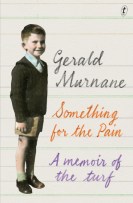
Gerald Murnane: Something for the pain: A memoir of the turf (Review)

Gerald Murnane, Something for the painWhen I heard Australian author Gerald Murnane had written a memoir, and even more when I heard its title, Something for the pain: A memoir of the turf, I knew I had to read it. I am not a horse racing tragic, by any stretch, but how could I resist such an intriguing sounding memoir from one of Australia’s most erudite, though too little read, contemporary authors? With such a title, the book sounded unlikely to be a typical chronological story of his life – and this suspicion was indeed borne out in the reading.

Something for the pain is a dry book – but I don’t mean dry in terms of boring. I mean dry in terms of containing a wicked, wry sense of humour. Murnane is deadpan straight, and yet he knows exactly what he is doing, what he is telling us about himself, as he discusses this horse or that, this trainer or that owner, these colours or that racecourse. I enjoyed The plains which I reviewed a few years ago, but this is something else altogether. Where that novel was somewhat obscure and challenging to nut out, reading this memoir is like listening to Murnane talking. You could almost think he is ingenuous, but …

Bernborough, c. 1945 (Presumed Public Domain, via Wikipedia)

Okay, so what do I mean by all this? Let’s see if I can explain it. The book is, in a very real sense, exactly what Murnane says it is. In other words, it is about horse racing and Murnane’s love of it. It has twenty-seven chapters, and pretty well every one is titled with a specific reference to the turf – usually a horse or a racing personality. The novel’s second chapter, titled “The Drunk in the Dance Hall”, refers to an actual dance hall drunk who gave his father a great racing tip, while the following chapter, “A Bernborough finish”, includes the name of a particular horse (Bernborough, of course). But, while the chapter titles refer to horse racing, and while every chapter tells us something (quite a bit in fact) about horse racing, or, more accurately, about Murnane’s experience of and feelings about horse racing, the chapters also convey information about him. I found it absolutely delicious to read.

“The Drunk in the Dance Hall” starts, for example, with “I could never learn to dance”. We learn a little about his experience of dancing and something also of early to mid-twentieth century dance hall culture  – as well as the story of the aforementioned racing tip and its result. Even more interesting, though, is the next chapter about Bernborough. It starts with:

I was never one for hanging pictures or sticking up posters or postcards. I’ve always preferred to be surrounded by bare, plain surfaces and to have my desk facing a wall rather than a window.

However, in 1982, he tells us, when he was lecturing at a college of advanced education, he found a display board above his desk. Uncharacteristically – for him – he decided to stick up some pictures. There was space, he explains, for thirty to forty postcard-sized pictures, but he stuck up just three, neatly grouped together, surrounded by much bare space:

The first two were portraits: one of Emily Brontë and the other of Marcel Proust. The third was actually two linked scenes, the first showing a field of horses nearing the straight, and the second showing the winner of the race and his nearest rivals as they reached the winning post.

You can just see it, can’t you, the surprise of his colleagues and students when confronted by this. He continues, a couple more pages in:

During those years, I sometimes sensed that some or other visitor to my room was puzzled by the odd little group of images huddled together on the otherwise bare wall. To the few who enquired I was pleased to explain that the young woman from Victorian England, the eccentric Frenchman, and the bay stallion from Queensland were equally prominent figures in my private mythology and continued to enrich my life equally.

I mean, honestly, how can you not love that! He says no more, however, on this, following it instead with the story of Bernborough and how the term “Bernborough finish” was born. He concludes on his orchestrating his own Bernborogh performance. The next chapter (no. 4) whizzes back to the 1940s, Murnane being born in 1939, and some childhood memories – which of course include racing stories.

And so, in this lurching backwards-forwards way, Murnane tells us much about the history of Australian horse racing – about owners and trainers, and betting, and specific horses – which I found interesting in an arcane sort of way. Along the way, though, we also learn a lot about him, things that provide much insight into his work and what drives him. We discover his love of maps but hatred of travel, his favourite landscape, his love of names and colours, his preference for the spiritual over the material, his enjoyment of beer and his meticulous creation of personal archives, his discomfort with any sort of pretension or self-consciousness, and last, but by no means least, his vivid imagination. We discover his cheeky sense of humour. The way chapters are framed or introduced versus the content that follows is a good example. Take Chapter 10 in which he discusses psychoanalysis, religion and betting systems. It might just be my warped sense of humour, but the juxtaposition of these made me laugh. And we do learn some facts about his life – his various jobs, his parents and his uncle Louis, and his wife. What he doesn’t do is discuss his writing in any depth, though he frequently mentions his (autobiographical) first novel, Tamarisk Row, which makes many references to racing, and he does occasionally talk a little about his views on writing.

I’m going to leave it here, not because I have nothing more to say, but because I want to pick up one or two issues – relating to his writing – separately in a Delicious Descriptions. So, I will end with one little anecdote. Around halfway through the book, he discusses his search for his own racing colours and design. He has settled, he informs us, on some combination of brown and lilac but just cannot decide on a design. He writes:

I described the task as serious, and I do take it seriously. I’ve devoted myself to horse racing as others sorts of person devote themselves to religious or political or cultural enterprises, although I hope I can still make a joke at my own expense. I read once that certain musical compositions (by Bach? by Beethoven? I forget) sounded like the efforts of the human soul to explain itself to God. If ever I find my perfect combination of brown and lilac, I’ll feel as though I’ve thus explained myself. But I seem destined to never find my perfect set of colours. Is this because I’ve deluded myself for most of my life? Are racing colours not so eloquent as I’ve always believed? Or, is my soul too much of a mess for explanation?

Not likely, I’d say. Murnane is one very intelligent man – and his memoir is well worth reading. Don’t be put off by the stated subject matter. The turf does infuse it all, fascinatingly so, but it’s the mind behind it that shines through.

Lisa at ANZLitLovers also reviewed this book recently.

Gerald Murane
Something for the pain: A memoir of the turf
Melbourne: Text Publishing, 2015
251pp.
ISBN: 9781925240375

(Review copy courtesy Text Publishing)

Monday musings on Australian literature: Spotlight on Robert Dessaix

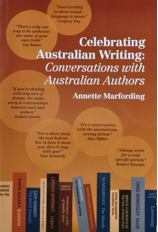
Courtesy: Annette Marfording

Courtesy: Annette Marfording

Last year, I published a guest post by Annette Marfording, who was, for many years, the Program Director of the Bellingen Readers and Writers Festival. At the time of this post, she had just self-published her book, Celebrating Australian Writing: Conversations with Australian Authors, containing a selection of interviews she’d conducted over many years with a wide range of Australian writers. Rather than review it, I’ve decided to use it for an occasional series within Monday Musings. I won’t be quoting large slabs of the text, or giving away all the content of the interviews. Besides the fact that that would break her copyright, I’d like to see people buy the book because not only is it a good read but Marfording is generously donating the profits (see the end of the post). My plan is to use Marfording’s interviews to springboard brief discussions about some writers who interest me. OK?

I won’t necessarily discuss my selected authors in the same order as Marfording’s book, but I am starting with the first author, Robert Dessaix. I haven’t reviewed Dessaix here because I haven’t completed any of his books since I started blogging. However, I have read his first book, the critically acclaimed memoir A mother’s disgrace (1994). I’ve also dipped into other books, including his collection of essays and articles As I was saying (2012), and I have enjoyed his thoughtful, engaging contributions on language to ABC RN’s old Lingua Franca program. He also presented, for many years until 1995, ABC’s Books and Writing program. Language and literature, as you’ve probably gathered, are his passion

So, who is Robert Dessaix? Wikipedia describes him as a novelist, essayist and journalist, but it would probably be more correct to call him an essayist, memoirist, journalist and novelist, because novels – of which he’s written two – form the smallest part of his output. He reminds me, in this regard, of writers like Drusilla Modjeska and Helen Garner (though Garner does have a good number of novels under her belt as well as other writing.) Anyhow, for a better bio than that provided by Wikipedia, it’s worth checking out his own website. He was born in Sydney, adopted as a young child, and was married, but now lives with a male partner. Much of this story is told in A mother’s disgrace. Here is an example of his writing from that book:

There’s something deeply comforting, after all, about the promise of a linear narrative: birth, school, university, marriage, family, career, onwards, upwards … the autumnal years a bit misty, perhaps, the phut as the fuse runs out, best not thought about too graphically but on the whole not a bad way to live out a sequence of years. The trouble is that, once you’ve set out on that alluringly straight track, it’s hard to swerve off it or come to a standstill. It’s hard to live what I’d call swoopingly.

I have tried to swoop and veer. I didn’t have the wit to veer away from marriage, I had to be sent packing. But I did curve away from teaching Russian literature to university students into working at the Stables Theatre in Kings Cross and then in radio, I did swerve sharply away from Canberra to experiment with being a Sydneysider again, I did deviate (after a messy start) from the heterosexual straight and narrow to try more fulfilling, multifaceted ways of loving …

But now, to Marfording’s interview. Marfording clearly researches her subjects and asks questions specifically relevant to each of her interviewees, rather than rely on a standard set of questions. She talked to him about some of his specific writings of course, and a bit about his writing practice. She also talked with him about travel, which features in much of his writing. He has some interesting things to say about what he looks for in travel, and how that has changed over time. What he now looks for, he tells Marfording, is conversation. It’s also one of the topics in As I was saying. He writes:

‘The grand business of our lives,’ the novelist Henry Fielding said, ‘the foundation of everything, either useful or pleasant’ is conversation. It’s quite a claim. His contemporary Samuel Johnson was hardly less emphatic: ‘There is in this world,’ he said, ‘no real delight (excepting those of sensuality) but the exchange of ideas in conversation.’ They were eighteenth century English gentlemen, so their enthusiasm is not surprising: the eighteenth century was the heyday of conversation in England …

He goes on to discuss those with opposing views. The Hebrews, he suggests, cared little for conversation, neither did Jean-Jacques Rousseau who saw it as “frivolous”, and Presbyterianism, he writes, “has never been good for animated intercourse”. He concludes by analysing the art of conversation then and now – but that’s a discussion for another day, because …

The part of the interview that particularly interested me stemmed from his contribution to the Little Books on Big Themes series (from which I’ve reviewed Dorothy Porter’s On passion). Dessaix chose his topic – On humbug! I enjoyed this section of the interview because it got into discussing truth and facts. He shares two of his epigraphs. For A mother’s disgrace, he used a line from Jeanette Winterson, “I’m telling you stories, trust me”, and for Arabesques, it was “When I invent things, it is to make the truth clearer”. He explains:

I try to distinguish between fact and truth […] things can be broadly speaking true without being absolutely factual, if you know what I mean.

Yes, I do, Robert! Marfording then questions him about his review of Helen Garner’s The spare room, a raw novel based on her experience with a friend who had terminal cancer. Dessaix, and he wasn’t the only one, said that it shouldn’t be described as fiction because it’s based on fact. Yet, Marfording questions, putting him on the spot, Dessaix’s own novel Night letters is also based on his life. Dessaix’s answer is that his was “partly fictionalised” and that he “changed the order”, implying that Garner hadn’t. Indeed he suggests that she simply publishes her notebooks and that “she should come out and admit what she does”. Hmm … all this said, the  interview does conclude with Dessaix talking about his favourite books and writers:

I do actually love Helen Garner’s writing; I love Michelle de Kretser’s writing, The Hamilton case and The lost dog; I was very taken with Thea Astley at the time, I mean I haven’t read her for years, but I just read book after book of Thea Astley’s …

His very favourite books, though, are the 19th century Russians.

Dessaix is an interesting, erudite – dare I suggest, Renaissance – man who’s well worth reading. Thanks to Marfording for an excellent interview.

Annette Marfording
Celebrating Australian Writing: Conversations with Australian Authors
Self published, 2015
273pp.
ISBN: 9781329142473

Note: All profits from the sale go to the Indigenous Literacy Foundation. You can purchase the book from its distributor, lulu.com.


Annie Dillard, The Maytrees (Review)

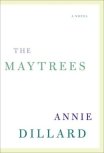
Annie Dillard, The MaytreesI am not, as I wrote in my recent post on Emma Ayres’ memoir Cadence, a big “reader” of audiobooks. In fact, until Cadence, I hadn’t listened to one for a few years. However, we do have a few here that we had given Mr Gums’ mother as her sight started to fail and which we retrieved after she died back in 2011. I bought them for her, so am rather keen to see what I think of my choices!

Now, I’ve never read Dillard, though of course I’ve heard of her. The Maytrees, published in 2007, is her second novel, her first being the Pulitzer prize-winning novel Pilgrim at Tinker Creek published over thirty years earlier in 1974. Fascinating … but I’m not surprised. The Maytrees is such a quiet, deeply thoughtful book, it could only have grown out of years of living and contemplation. It reads like a lifelong meditation on the meaning of life at its very foundation – on how and why we love, on how we should live our lives.

WARNING: POTENTIAL SPOILERS

Provincetown, 1983

Provincetown, 1983

There is very little plot, though there is a storyline which tracks the relationship, through various ups and downs, of Toby Maytree (called Maytree in the book) and Lou, the woman he marries. This story is imbued with the place they live, Provincetown, Cape Cod, a place I visited in the 1980s. I loved reliving my experience through Dillard’s gorgeous evocation of it. Anyhow, the time spans from Maytree’s childhood in the late 1920s and 1930s through several decades to, I guess, the 1990s or so. Paradoxically, while the place is woven closely into the story – you get to know, intimately, the dunes, the tides, the beach shack, and even the bed that is moved, as needs change, up and down the floors of their home to bring the outdoors in – the story is absolutely universal. It’s the quintessential boy-meets-girl story but one that doesn’t end at “happily ever after”. It takes us through the long years of their marriage, the birth of their child, a devastating betrayal, a huge-hearted forgiveness, and their deaths. The book shifts around a bit in chronology, making you work a bit, but you usually know where you are.

While the main themes of the book relate to love and life’s meaning, many other ideas come through. There’s a lot of discussion of reading and literature. We are told early in the novel that “He read for facts, she for transport”. When she, Lou, finds love, here is her reaction:

Love so sprang at her, she honestly thought no one had ever looked into it. Where was it in literature? Someone would have written something. She must not have recognized it. Time to read everything again.

Later in the book when love is lost and recovered, she wonders again about love and life’s meaning. There might be a point to life, she wonders, and there might be an answer in books. She feels, however, that she had only moved a millimetre on these questions in her lifetime. She reflects on how life with Maytree had felt complete – until she’d had her baby, Petie, after which she couldn’t imagine life without him. But, inevitably, he too moved on, and in time had his own child presenting him to her as if she didn’t know the experience or feeling!

In other words, it’s a wise, knowing book, a book which sees how people think and behave. Here is Lou, newly alone:

She ignored whatever did not interest her. With those blows she opened her days like a piñata. A hundred freedoms fell on her. She hitched free years to her lifespan like a kite tail. Everyone envied her the time she had, not noticing that they had equal time.

I loved that little kick – “not noticing they had equal time”. How often do we see the other grass as greener, not seeing our own!

There’s also sly – or perhaps not so sly – commentary on American politics. Dillard describes Hoover, in 1947, warning Americans about artists, and asks “Did America have a culture besides making money?” There’s reference to a “Strictly for profit hospital”, and, at another point, when Maytree ponders the idea of shooting himself to save getting too old, we are reminded that “this was America”. These scattered political jibes provide interesting intrusions into what is mostly a philosophical novel.

The language is quietly beautiful. As I was listening to it, I could only really capture phrases to share, such as “he rummaged her spare comments”, or a description of one of Maytree’s earlier girlfriends as “a great handful of a girl out west”, or a description of the sea as a “monster with a lace hem”. Little motifs run through the book. Lou’s various red items of clothing like a scarf or a dress and Maytree’s red-speckled notebooks, for example, provide colour and continuity, and hint too at the passion of their love.

Maytree and Lou are drawn at depth. We move inside both their heads at different times. At the time of Maytree’s betrayal – which I must say is the point in the book that is hardest to grasp – gentle, but strong and resourceful Lou decides that “if this was not shaping up to be Maytree’s finest hour it might as well be hers”. The other main characters populating their Provincetown world include Deary, Reevadare Weaver, Cornelius Blue and Jane Cairo, all of whom add depth and diversity to the close community Dillard depicts.

I must say though that I found it quite a difficult book to listen to. In some ways it was too slow – we read faster than we can listen, I’ve been told. As the reader, David Rasche, read pages and pages of admittedly beautiful description and contemplation, I felt held back. I wanted to read it at my pace, faster. And yet, it was also too fast, because at times I wanted to stop and mull over the words and ideas.

I could go on, but without having the book itself to bring it all together the way I’d like, I’ll just close here and say that I found it a thoroughly satisfying book. It is warm, non-judgemental, generous and wise. And if that sounds like it’s also sentimental and corny, you’d be wrong. One day I’ll read more Dillard.

Annie Dillard
The Maytrees (audio)
(read by David Rasche)
Harper Audio, 2007
5.5 hours on 5 CDs

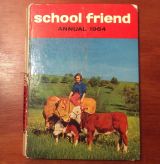
School friend annual 1964

The things you find when you start to declutter! School friend annual 1964 is a blast from my very distant past. Yes, I know, some of you weren’t born then, but I can’t resist sharing the sort of books produced for young girls in the olden days! I loved receiving annuals and anthologies, books in my favourite series or by my favourite authors. The more books I received, the more successful I rated my Christmas. Anyhow, it’s fascinating to look at this over 50 years after it was published.

School Friend AnnualSchool friend annual was an English publication which was also distributed in New Zealand, South Africa, and the Federation of Rhodesia and Nyasaland. Loyal countries of the British Commonwealth, in other words. As far as I can tell it started publication in 1927 and lasted until 1982 by which time I believe it was all comic/picture strip. One article I read suggested that the 1960s are the most collectible!

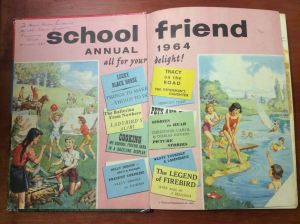
I’m going to discuss the main contents of my 1964 volume by rough category, so we can look at the reading matter deemed suitable for the young girl and teen of the early to mid 1960s. It’s a time when the Beatles were starting to make their presence felt, when the Civil Rights Movement in America was well under way, but when the second wave of women’s liberation hadn’t really started:

School Friend Annual 1964Stories (Prose or verse)

  • Lucky Black Horse, by Cecil Danby: young girls and horses, then, and still now!
  • The Ballerina from Nowhere: this would have been one of my favourite stories (told in verse in fact) as I adored ballet and loved ballet books and ballet stories. No horses for me. It was ballet all the way. The ballerina illustrated is very nicely developed, which was something for skinny-rake me (at the time) to aim for.
  • A Christmas Carol, from the famous story by Charles Dickens: an excerpt.
  • The loneliest girl in town, by Christine Landon: about the new girl in town who wants to join the dashing looking scooter club. This is a teen story, with such writing as ‘”Haven’t you ever realised why Gloria can’t stand you, Mandy?” she asked merrily, “It’s because you’re heaps pretty than she is. She was scared you’d be a rival.”‘ I don’t suppose writers of contemporary children’s books have their protagonists talking “merrily”, do they?
  • The legend of the fire-bird, illustrated by Mollie Higgins.
  • The girl who went back to 1066, by Evelyn Day: a time travel story.
  • Tropical Magic: A cruise in the sun – the story of a hair stylist at sea, by Janet McKibben: about an Island Chief in the Indian Ocean wanting his daughters’ hair to be dressed western style!
  • The midnight feast, by Gwen Perrott: besides the ballet stories, my other favourite stories were school stories – and if they had a midnight feast, all the better
  • Ladybird’s alibi, by Frances Cowen: a detective story involving teens staying with relations: “Uncle George and Aunt Mary are dears, and almost make up for our not being about to spend our holidays with Father and Mother in Ceylon”. Love the language – “dears” – and the social history here, with the parents in Ceylon, another part of the British Commonwealth.
  • The Fisherman’s Daughter, by Percy Clarke: an historical adventure story about a missing father, a strange lady in black and a foreign lugger.
  • Mysterious neighbours, by Hilary Bailey: a contemporary neighbourhood story.
  • All because of Cora, by Frances Lindsay: about a girl in a school choir who wants to be a singer, and her jealous rival.

Stories (Comic form)

  • Dilly Dreem – she’s a scream and Mitzi and Fritzi: short comics, interspersed through the annual.
  • Tracy on the road: a longer story about teenage fashion models. It’s all about a race to be first at a fashion show, but when their competitors run someone off the road, they stop to help. “Luckily”, we are told, “the girls had changed into casual clothes”.
  • The Sparrows of Angel Street: about a street decoration competition
  • My school friend Sara in A dazzling display: I suspect “My school friend Sara” is a series that ran through several annuals.
  • The tomboy next door: what it says – and it would have appealed to me.
  • Camera-mad Carol: about a school girl who wins a camera.

Crafts and cooking

  • Present surprise: add a touch of tinsel: ideas for wrapping presents and Christmas decorations to make.
  • Enticing with icing: how to pretty up a cake with lots of icing – “with a bit of care, imagination and a pound of icing sugar you an turn quite ordinary fare into delicious treats to surprise your guests”. I wonder how many pre-teens, as I was, had guests they cooked for?!
  • Craft articles: two with Practical Prue, make a Pepper ‘n Salt Stand out of raffia, and how turn a dull tray into a “gay” one, plus another article on how to weave yourself a lampshade.

Fashion advice

  • Pretty up a plain dress in six gay ways: oh the changes in language we have experienced! Anyhow, this illustrated article, as they all are, shows how you can sew on lace, add a scarf or a belt, or a frill.
  • A style for your shape: illustrated article on choosing a hairstyle to suit your face shape. After all “let’s face it, it’s your hair that tops off your final appearance”. Haha!
  • Sally Brook’s Variety Act: for example, when buying a coat “don’t have a big collar … they seem to swamp young people”. And “Buying beads isn’t wise, if you have little money to spend on jewellery. Fashions change too quickly. If you want a necklace that you can wear on and on, and which always looks nice, save up for a single row of artificial pearls”. Or, for the same reason, avoid the long chains and medallions, in lieu of “a small chain with a locket or tiny pendant. Our Grandmas wore them, and they’re still being worn today.” (I’m afraid I didn’t take Sally’s advice when I got to the age a few years later – I bought the “in” chunky medallions and long chains! I still have some!)

General interest

  • Pets and their people: a celebrity story containing photos of celebrities like photogpraher Cecil Beaton, actor Hayley Mills and singer Adam Faith.
  • The seven ages of a ballerina: a story in pictures about learning ballet from beginning to being a starring ballerina, “her triumphant/dream-come-true/Reward for practising”.

So, plenty of illustrations, a few comics, a variety of stories covering a range of interests, plus the specific inclusion of horses, ballerinas, craft ideas and, most importantly, fashion advice. What more could a young girl want over the school holidays?

School friend annual 1964
London: Fleetway Publications, 1963
126pp.

Stella Prize 2016 Longlist

The announcement of the Stella Prize Longlist is a red-letter day for the Australian Women Writers Challenge … and also for me of course. So, today, I share the list with you. The shortlist will be announced on March 10.

The judges look good to me: writer Emily Maguire, memoirist/essayist Alice Pung, author/academic Brenda Walker, literary critic/author Geordie Williamson, and bookseller/founder of the Indigenous Literacy Foundation Suzy Wilson.

Alice Robinson, Anchor Point

Anyhow, here is the longlist:

  • The women’s pages by Debra Adelaide (Pan Macmillan) (I’ll be reading this soon)
  • The other side of the world by Stephanie Bishop (Hachette)
  • Panthers and the Museum of Fire by Jen Craig (Spineless Wonders)
  • Six bedrooms by Tegan Bennett Daylight (Random House)
  • Hope Farm by Peggy Frew (Scribe)
  • A few days in the country: And other stories by Elizabeth Harrower (Text) (on my TBR, and now higher in my priority list)
  • A guide to Berlin by Gail Jones (Random House)
  • The world without us by Mireille Juchau (Bloomsbury)
  • A short history of Richard Kline by Amanda Lohrey (Black Inc)
  • Anchor point by Alice Robinson (Affirm Press) (my review)
  • The natural way of things by Charlotte Wood (Allen & Unwin)
  • Small acts of disappearance: Essays on hunger by Fiona Wright (Giramondo)

As is usual for the Stella, the list include novels, short story collections (a few in fact) and non-fiction … And as is usual, I have most on my radar. I have read the first three Stella Prize winners: Carrie Tiffany’s Mateship with birds, Clare Wright’s The forgotten rebels of Eureka and Emily Bittos’s The strays. All have been excellent reads, which augurs well for my enjoyment of this year – although as we have been hearing lately past practice is no predictor of the future!

I’m sorry that this is a basic post … I am holidaying for a few days in a gorgeous Aussie country town, and am without my normal computing facilities. The iPad us not conducive to long post writing. Phew, do I hear you say?

Monday musings on Australian literature: National Libraries Day (UK)

Caroline of Book Word blog has written a wonderful post about National Libraries Day in the UK, which took place just this last weekend, on Saturday, 6th February. Caroline provides three witnesses to argue for the value of libraries:

  • Peter Balaba, Head Librarian, Nakaseke Community Library, Uganda, who talks about the outreach programs they provide in a book-poor region.
  • novelist Zadie Smith who tried, but failed, to save Kensal Rise Library in London and who notes the government’s shameful behaviour, saying that “it’s always difficult to explain to people with money what it’s like to have very little”.
  • novelist Ali Smith who last year published Public library and other stories, which is so titled not because there’s a story titled “Public library” (there isn’t) but because interspersed through it are “comments from other bookish people about the importance of libraries”. Love this.

ALIA Library Lovers Day 2016 GraphicYou’re probably wondering why I’m telling this story in my Monday musings on Australian literature post series. Well, firstly it’s because I thought it was a great initiative and wondered whether we have anything like this here in Australia.  I found that we do have something similar: ALIA (Australian Library and Information Association)’s nomination of Valentine’s Day as ALIA Library Lovers Day. They suggest a bunch of activities that libraries can use to promote library love (including using the social media hashtag #librarylove) and they have merchandise for sale. There’s a 2015 wrap up page which suggests that only a few assorted libraries around Australia took up the idea but those which did seemed to have got into the swing of it. What I didn’t find on their site is any sort of overall statement about the day – its genesis and history, its goals, its long term plans. Clearly it is about encouraging people to use their libraries, but is there a stronger, more coordinated political agenda?

I searched a little more and found an online article on a site called Infotoday. The article, written in 2011 it seems, says this:

As with many great ideas, the genesis of LLD is lost in time, but here in NSW we launched our first LLD in 2006, claiming Feb. 14 for library lovers and renaming it in honor of their passion. To celebrate, public libraries across NSW gave away more than 50,000 “love libraries” wristbands in green, blue, and orange and invited their clients to wear their hearts on their wrists. In 2007, the campaign went national under the auspices of the Australian Library and Information Association (ALIA) and Public Libraries Australia (PLA) as their first combined advocacy event. (Today Australia, tomorrow the world!)

So it sounds like it’s been going for around 10 years now. The article describes some of the activities that have happened over the years, and concludes that LLD has been

an enduring and unqualified success story for NSW public libraries. Staff members love to get involved by dressing in red and pink, decorating their libraries, baking, and choosing and reviewing books. And the community members welcome the opportunity to thank library staff, enjoy a chocolate or two, and share their love of books and reading.

Again, it doesn’t say how they define or measure success of the program, but it sounds pretty localised and low key (not to mention rather female oriented. Aren’t there any male librarians? Not that men can’t enjoy baking or dressing in red and pink, but …!) Still, I’m glad there’s something promotional happening.

My other reason for writing this post is that it gives me an opportunity to share a couple of quotes from Steve Toltz’s Quicksand, which I reviewed last week. Here’s our anti-hero looking for a book:

The salesgirl at the third bookstore I tried suggested the local branch of the public library. I know what you’re thinking bailiffs: What is this, 1996? I raced through the streets as if through a time tunnel, to the bland underwhelming brick building behind the train station. My heart sank when I came across an island desk with twenty computer terminals, leather couches and espresso machines, but upon asking the librarian directed me to the appropriate shelf. It was there …

Not very positive really, but the second reference is worse:

After half an hour drive, the van halted and the door opened onto an abandoned-looking prison courtyard reminiscent of a library on Sunday.

Hmm … I guess it’s a good thing that Toltz notices libraries enough to satirise them, but if his is a common attitude it’s a worry.

Are you aware of a library promotion “day” in your neck of the woods? And, if so, do you take part?

George G. Foster, The eating-houses (Review)

Some of you will know that Mr Gums and I love to eat out. So, when I saw a Library of America (LOA) Story of the Week titled “The eating-houses” by one George G Foster appear in my in-box at the end of last year, I knew I had to read it. I just had to find the time to slip it in. I eventually did, and here I am.

The first thing to say about it is that those of us who thought our era of conspicuous dining-out was a new thing are wrong. Foster writes in the opening paragraph of his article that:

We once undertook to count these establishments in the lower part of the City, but got surfeited on the smell of fried grease before we got half through the first street, and were obliged to go home in a cab. We believe, however, that there can’t be less than a hundred of them within half a mile radius of the Exchange. They are too important a “slice” [see publication details below to understand this reference] of New York to be overlooked …

This reminded me of my return last year to the little suburban shopping centre of my teen years – Wahroonga, in Sydney. I looked across the street, from where I was standing, to the local supermarket on the corner and ran my eyes down from it to the other corner. Just a short distance. And it was wall-to-wall cafes with nary another business in between. That was just that little side of that street. There were a couple of cafes on my side, and around both corners, and across the other street as well. Amazeballs as the young would say! Clearly Mr Gums and I are not alone in our predilection for eating out.

Anyhow, back to Foster. You might have gathered from my excerpt that he was not much in favour of these establishments, and you’d be right. He satirises them, and their denizens, pretty mercilessly. He clearly thinks home-cooked meals are  better – “the fare is generally bad enough — not nearly equal to that which the cook at Home above Bleecker* saves for the beggars”. He ridicules their lack of style and taste:

It is really wonderful how men of refined tastes and pampered habits, who at home are as fastidious as luxury and a delicate appetite can make them, find it in their hearts—or stomachs either—to gorge such disgusting masses of stringy meat and tepid vegetables, and to go about their business again under the fond delusion that they have dined.

He categorises the three main styles of eating-houses – satirically referencing the great Swedish botanist and taxonomist Linnæus – and satirises the diners. He describes a journalist ordering “rosegoose”: “when goose leaps suddenly in front of a poet of the Press, who ordered it probably through a commendable preference for a brother of the quill”.

At the cheap Sweenyorum “sixpenny eating-house” style of place, you only get a spoken menu which, he says, “does away with lying in print, to which bills of fare as well as newspapers are too much addicted”. Still, beware here, he advises, of added extras, or your sixpenny cut will suddenly be “seven shillin'”! Just order “a small plate of roast beef mixed, (this means mashed turnips and potatoes in equal quantities)”, add some bread perhaps, and a glass of free water. Then you will “pay one shilling for the whole, and go about your business like a refreshed and sensible man”.

He briefly mentions the cake and coffee shops which are open all night, and therefore frequented by journalists, firemen, and the like. He reserves special praise for the latter:

They are generally far more moderate than politicians and less noisy than gentlemen. At the first tingle of the fire-bell they leap like crouching greyhounds, and are in an instant darting through the street towards their respective engine-houses—whence they emerge dragging their ponderous machines behind them, ready to work like Titans all night and all day, exposing themselves to every peril of life and limb, and performing incredible feats of daring strength, to save the property of people who know nothing about them, care nothing for them, and perhaps will scarcely take the trouble to thank them.

Oh dear – I do hope their “plate of biscuits with a lump of butter in the belly for three cents, and a cup of coffee for as much more” provided them with enough sustenance! And did you note the reference to politicians?

His final paragraph is reserved for the “expensive and aristocratic restaurant of which Delmonico’s is the only complete specimen in the United States”. I was rather intrigued by this because he argues that, at a place like this, you will get

a dinner which is not merely a quantity of food deposited in the stomach, but is in every sense and to all the senses a great work of art.

“A great work of art” is how many of our top chefs like to see their food today. Paying large sums for food like this seems, in one sense, insensitive. And yet, does art have to last forever, or can it be enjoyed in the moment before we move on? I’m still pondering this.

The interesting thing is, as LOA’s notes tell us, that Foster’s “preference for high-society haunts like Delmonico’s ultimately caused his downfall”. He was imprisoned for forging cheques, and spent 9 months in prison the year before he died. His obituary in the New York Times described him as

a remarkable example of the worthlessness of a brilliant talent unguided by a moral purpose, or a decent regard for the proprieties of civilized society.

Do consider reading this article. It’s short and entertaining – and is a fascinating piece of 19th century social history.

George G. Foster
“The eating-houses”
First published: In New York in slices, by an Experience Carver, 1849.
Available: Online at the Library of America

* A residential area of New York.