Unfortunately – for me, anyhow – this will be my last post on the Festival, as that cold I hoped (unrealistically) to hold at bay would not be held. Consequently, for both my benefit and that of others, I decided to keep my snivelling self at home on Day 3. I’m very disappointed however, as I was very keen to attend a few events, including one titled Re-imagining Christina Stead. It was a rare session on a “classic” Australian writer and I’d love to have supported it (though hopefully, it didn’t need supporting!) And of course, I wanted to hear what the three panelists had to say.
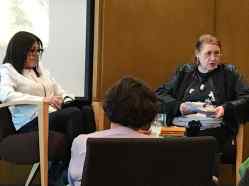
Griffith Review: the Millennials strike back: Yolande Norris, Cameron Muir, Anna Snoekstra, Frances Flanagan, and Michael Newton

Griffith Review 56
Having last year attended a lively session on the plight of the millennials, I was interested to see another session this year on them – and decided, as a baby-boomer, that I could face another beating! Seriously, though, as a parent of millennials, I am interested in their view of the world, and this session, drawing as it did from the excellent Griffith Review, seemed worth attending.
Convenor Cameron Muir introduced the session by saying that the Griffith Review editor, Julianne Shultz, conceived Millennials strike back edition in lead-up to last year’s Federal election. She wanted not to engage in the generation blame game but simply to give millennials (those born from around 1981 to around 2000) a voice. The issue, like all Griffth Reviews, contains a mix of essays, fiction, poetry and memoir pieces. The panelists all had pieces in the issue:
- Frances Flanagan (Essay) “A consensus for care”
- Michael Newton (Essay) “Unpaid opportunities”
- Yolande Norris (Memoir) “Navigating life in art” (in the online edition only)
- Anna Snoekstra (Short story) “The view from up here”
Muir then noted that a major theme in the panelists’ pieces (and perhaps in the edition as a whole?) is work, and he asked them to comment. Norris, who contributed a memoir to the edition, talked about the challenge of managing her identity as a mother and as a worker, which is an issue, in fact, that many of us baby-boomers also grappled with. It wasn’t easy then, and it still isn’t now – unfortunately. She wondered what you do when you’ve achieved the “template for life”, house and child/ren.
Newton, whose piece was an essay, talked about the broader structural issues concerning how work is changing. Insecurity (precarity) in work, he said, results in pressure and can engender anxiety, which can breed depression. Millennials in this situation worry about whether to look for another job, whether they can earn a living wage. Why, he asked, are the real structural problems being hidden under arguments about smashed avo and kidadulthood? These arguments dismiss policy concerns of Millennials.
Snoekstra, whose piece is a short story, said that she calls herself a writer in social situations, but in fact she also works as a nanny. She talked about her generation’s concern with buying a house: do they buy a house meaning they can’t go on holidays, have to take a job they don’t like, or do they decide they won’t follow that path?
Flanagan, who like Newton contributed an essay, focused more on the longterm, but also looked back into history, drawing on Hannah Arendt’s division of human activity into three categories: labour, work and action. She suggested this might provide a model for how we view work. She wanted, she said, to meditate on how modern capitalism conceals the action of power. There has been insecure work in past, she said, but there were ways to resolve those, including the introduction of award wages. Today, though, she argues, work precarity is individualised and private. (There are no labour lines, today, for example, just people “waiting for a text message that will signal the prospect of work or its absence.”) Society is no longer offering careers but fragmented work. She then moved onto discussing the kind of work we value – and this is where the title of her essay “A consensus for care” makes sense.
She talked about the cyclical nature of work, writing in her essay:
While our current age is not alone in taking the maintenance of our physical and social spaces for granted, we have certainly given it a twenty-first-century neoliberal spin. Many early childhood educators earn so little that they cannot afford to buy a house or have children of their own, despite significant post-secondary qualifications. Aged carers are paid so poorly they risk poverty. People with jobs in the world of work and action who take time away to care for elderly parents or young children are punished for their ‘choice’, not just once through foregone income but twice as a result of a grotesque superannuation system that magnifies wage gaps in retirement. Through neoliberal goggles, labour is not recognised as the essential foundation for civilisation but rather a cost burden on the public purse that should rightly be turned into a profit-making opportunity. Treasurer Scott Morrison, speaking at the ACOSS National Conference in 2016, said, ‘What I am basically saying is that welfare must become a good deal for investors –for private investors. We have to make it a good deal, for the returns to be there.’
(What can you say to that!) Arendt, she said, would not apply the idea of “returns” to this sort of activity, but to “work” that produces – well – products. Flanagan suggests that we need to look at the kind of society and care we want. She pointed to Norway’s collectivist view of responsibility, and argued that we should put care and education at the heart of our society. We need to look at values, rather than costs, and look back for values to the mid-twentieth century and earlier rather than to the last 30 or 40 years. In other words, rather than to the time during which I spent my working life. Oh, how I remember the dispiriting slide into measuring and costing things which cannot and/or should not be costed. Things like, for example, the cultural collections in our museums, archives and libraries. We saw it happening but felt powerless to change it.
And so the discussion continued, teasing out issues regarding mental health (captured chillingly, said Flanagan, in Snoekstra’s story), the separation of public and private life (in that Millennials seem very public, sharing all, but their worries are private), the need to develop support networks for work, the prevalence of toxic attitudes online particularly from disgruntled men.
On this issue of disgruntled men, Newton commented in the past men assumed they would find a partner without too much effort, but that this is not the same for the current generation of young men which can build resentment. He also noted that the hollowing out of work in manufacturing, caused largely by automation, leaves men having to consider care work. However, they don’t value this “feminised work” so, he said, the whole idea of “work” needs to be rethought.
Muir concluded by asking them what they would say to the next generation:
- Norris said this was tricky because projections are impossible, but developing and maintaining connections is important.
- Flanagan said that she would argue that technology is just a tool, and that there are still questions about power. She suggested people should learn from mentors and mentor in turn.
- Newton started, laughingly, by saying he recently had to explain the significance of Princess Di to his younger work colleagues. Seriously, though, he’d want to say that work is not an end in itself, but that they should look at values.
- Snoekstra said that she was thinking of writing YA books, and was advised to write short books, with action at beginning, due to shortened attention spans, but then discovered that 12-14 year old girls are reading Nancy Drew!
Q&A
Could unions help? For baby-boomers they facilitated collective bargaining, and gave a sense of empowerment. Flanagan said that Australia has the worst anti-trade union laws in the democratic world. She works for United Voice, a large trade union, and said they need to use social networks to deal with mass desegregation of workforce.
Is the Universal Base Income a workable solution? It was agreed that carers should be remunerated, and the small surveys done to date does not show that it reduces the desire to find other work.
What are the implications of the drive to project yourself, that if it’s not on Facebook, it didn’t happen, that “it’s not ok to be not ok”. Norris felt that there is some pushback to this now, that people are becoming willing to show cracks. Flanagan said that for us to mature we need to create a caring society.
The commentary about housing focuses on Sydney and Melbourne but what about growing regional areas where housing can be cheaper. Is a trend happening? Our panelists generally thought there was, although some of the “trendy” places are quickly becoming expensive or built out. And, Australia is probably likely to remain a largely urbanised, centralised nation.
And there ended, somewhat over time, an excellent session that did not generation blame but that attempted instead to identify the issues and find solutions.











 Whispering Gums