Rudyard Kipling, An interview with Mark Twain

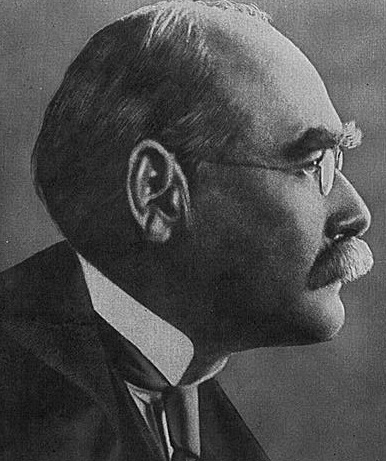
Rudyard Kipling

Kipling, somewhat older than 23! (Presumed Public Domain, via Wikipedia)

How could I resist reading this offering from the Library of America, featuring as it does two giants of the late nineteenth and early twentieth centuries? Both are writers I know well in a superficial way: I’ve really read only a little of their works. This essay, I thought, presented an interesting opportunity to get to know them from a different perspective.

“An interview with Mark Twain” was published in 1890, the year after Kipling, then 23 years old and on his overseas tour to Europe and the USA, interviewed the great man. Twain was 54, and staying in Elmira, NY, at the time. We know from the opening lines that Kipling idolises Twain:

You are a contemptible lot, over yonder. Some of you are Commissioners, and some Lieutenant-Governors, and some have the V.C., and a few are privileged to walk about the Mall arm in arm with the Viceroy; but I have seen Mark Twain … Understand clearly that I do not despise you, indeed I don’t. I am only very sorry for you, from the Viceroy downward …

Clearly this is going to be a positively reported interview! The essay starts though, rather humorously, with the challenges Kipling faced in locating Clemens (as he was known) but, one-third of the way into the essay, we finally meet Twain who, despite his grey hair (that “was an accident of the most trivial”) looked “quite young”.

Kipling’s next comment rather continues his hero-worship – and reflects the way many of we readers think when we think of our favourite writers:

Reading his books, I had striven to get an idea of his personality, and all my preconceived notions were wrong and beneath the reality. Blessed is the man who finds no disillusion when he is brought face to face with a revered writer.

You might think, from all this, that the rest of the interview will be rather hagiographic, with Kipling hanging on Twain’s every words. But, while there is an element of that, Kipling is delightfully self-conscious and there is a lovely sense of like minds engaging. Kipling reports on a conversation that ranges over a number of issues, including copyright, about which Twain has strong feelings, believing that a writer (and his heirs) should maintain control over “the work of his brains” (Kipling’s words) in much the same way as you might own “real estate” (Twain’s analogy). If you search the Internet, you will find a number of references to Mark Twain and copyright. As an (ex) librarian/archivist, I have a complicated relationship with copyright. I believe in abiding by it, I believe that creators need recompense for their work and that copyright is one way they can ensure that, but I also like people to be able to access the works they wish. According to my Internet research, Twain did not seek perpetual copyright, but enough to protect/provide for his immediate heirs. That sounds fair enough to me. And, it sounded fair enough to Kipling, though he was a little tongue-in-cheek in reporting that he saw Twain’s point, because he follows it up with “When the old lion roars, the young whelps growl. I growled assentingly”.

[If you are interested in copyright in the USA, check this timeline prepared by the Association of Research Libraries.]

Anyhow, they move on to discuss Twain’s books, and the possibility of a sequel to Tom Sawyer. Twain, teasingly, suggests that he hasn’t decided, that he could “make him rise to great honour and go to Congress” or he could “hang him”! This was too much for Kipling who says “I lost my reverence completely” arguing that Sawyer “was real”. Ah, fiction and reality I thought! This essay is speaking to me again.

Twain replies that Sawyer “is real … he’s all the boys that I have known or recollect” but then goes on to say that:

Suppose we took the next four and twenty years of Tom Sawyer’s life, and gave a little joggle to the circumstances that controlled him. He would, logically, according to the joggle, turn out a rip of an angel.

He calls this Kismet, and asks whether Kipling agrees. Kipling does to a degree, but suggests that Sawyer isn’t Twain’s property any more, “he belongs to us”. Hmmm…I’m not sure that this is the aspect of “reality” in fiction that interests me, but the discussion (which is not reported further) is interesting, if only because it reflects topics that engaged these two writers.

They they go on to discuss “truth and the like in literature” but the discussion focuses more on autobiography and Twain’s view that no matter how much an autobiographer may lie about him/herself, the “truth” will out. Ain’t that the truth! All of us writing blogs give ourselves away, regardless, I think, of how we may try to “present” ourselves… But, I think I’ll move on from this possibly murky mire!

And then, in a fascinating little discussion of novel-reading comes this point which may interest we bloggers. It’s about assessing novels. Twain says:

You see … every man has his private opinion about a book. But that is my private opinion. If I had lived in the beginning of things, I should have looked around the township to see what popular opinion thought of the murder of Abel before I openly condemned Cain. I should have had my private opinion, of course, but I shouldn’t have expressed it until I had felt the way.

Is he saying what I think he’s saying? A little later in the essay, and on a slightly different topic, Kipling says “and I am still wondering if he meant what he said”! Knowing a little of Twain, I must admit I’m wondering what was “true” in his comments, and what wasn’t … so much of his “truth” is behind rather than in his words.

Twain goes on to talk about fiction and fact, implying that he prefers the latter, that he doesn’t “care for fiction”. He then gives this advice which I love:

“Get your facts first, and” – the voice dies away to an almost inaudible drone – “then you can distort ’em as much as you please”.

I can’t think of a better point upon which to close this post … but, by way of conclusion, I found at The Huffington Post this comment made by Twain, many years later, about the meeting:

I believed that he knew more than any person I had met before, and I knew that he knew that I knew less than any person he had met before–though he did not say it, and I was not expecting that he would. . . . He was a stranger to me and to all the world, and remained so for twelve months, then he became suddenly known, and universally known.

Alan Bennett, The lady in the van

It is a truism that truth is stranger than fiction, and Alan Bennett’s The lady in the van is one work that proves it. It is strange – and wonderful – that a woman could have lived the way the eponymous lady did for as long as she did, and it is equally strange – and wonderful – that Bennett allowed her to do so in his front yard for as long as he did.

This piece was first published in the London Review of Books in 1989, but I only happened across it this year, twice! First was in the form of a BBC-4 audio CD given to my mother-in-law for Christmas by my brother. She was both mystified and entranced by it and insisted I hear it. Second was, soon after, in a review by kimbofo at Reading Matters. It became clear that this was meant to be my year for The lady in the van! And so, a couple of weeks ago I finally heard the CD, and today I finished the book. Like many before me, I was charmed.

The lady in the van is a simple tale about an eccentric old lady (though she’s only in her late 50s when the story starts in 1969) who lives in a van which Bennett eventually allows her to park in his front yard. That was in March 1974 and it continued until her death in 1989. Fifteen years! It reminded me a little of the Maylses Brothers‘ documentary film, Grey Gardens, which documents the lives of Edith Bouvier Beale and her daughter, also Edith Bouvier Beale, Jackie Kennedy’s aunt and cousin. Due to lack of funds they lived for years in dilapidation and squalor. But, while Bennett’s lady, Miss Shepherd, also lived in squalor, it’s the feisty eccentricity in all these women that associate them in my mind. They are all women who, despite their rather desperate circumstances (for whatever reason), refused to be ground down by it, who maintained some sense of pride and self in the face of a life most of us could not comprehend.

Anyhow, back to Bennett. The story is told primarily through diary excerpts, with a brief introduction, and a postscript added in 1994. In the beginning, there was Miss Shepherd (the name she gives but not her real name) and she was parked in the street in Alan Bennett’s neighbourhood. The first diary entry starts in October 1969, nearly 5 years before she moves into his front yard. Bennett explains how it is that she managed to live in her van on the neighbourhood streets for so long:

What made the social set-up funny was the disparity between the style in which the new arrivals found themselves able to live and their progressive opinions: guilt, put simply, which today’s gentrifiers are said famously not to feel … There was a gap between our social position and our social obligations. It was in this gap that Miss Shepherd (in her van) was able to live.

The whole thing does, I have to say, sound particularly English – the tolerance that enabled her to live that way for so long, and the polite and reserved rather than familiar “relationship” she and Bennett maintained over the years. Throughout the twenty years that the story covers, we learn a fair amount about Miss Shepherd despite her pretty effective attempts to keep herself to herself. We learn that she is committed to the Catholic Church (had in fact tried to be a nun) and politically conservative, and that she occupies herself selling pencils and writing letters and pamphlets. We also learn some things about Bennett, that he is kind (keeping an eye on her throughout, while respecting her privacy) but also that he likes a quiet life:

I was never under any illusion that the impulse [to let her in and stay] was purely charitable … But I wanted a quiet life as much as, and possibly more than, she did.

Bennett gives us a vivid picture of Miss S, through her bizarre sense of dress (including a skirt made of dusters) and her little speech mannerisms, such as her frequent use of the word “possibly”. One of Miss S’s problems is hygiene and toileting, and by the end she is incontinent. Throughout the story, Bennett refers to the smell (stench, actually) of her van. One day he mentions the smell to her, and she responds:

Well, what can you expect when they’re [construction workers] raining bricks down on me all day? And then I think there’s a mouse. So that would make a cheesy smell, possibly.

This is a woman with pride, despite the destitute situation she finds herself in. She is also resilient and sly, and contrives to pretty well always get what she wants. Bennett tells the story with humour but not patronisingly – and this is because it’s a humour that contains admiration for her resourcefulness, for someone who “even when she is poorly … knows exactly what she is about”. How could he do otherwise with a woman who announces to him: “I was a born tragedian … or a comedian possibly”. He clearly struggles with how much he should intervene and how much he wants to intervene. It’s a pretty invidious position to be in really – how far can you (should you, do you) extend charity?

All this said, there is something uncomfortable about it all, as there is about Grey Gardens, and this is the voyeurism involved. Both are truly fascinating stories – but a fascination tinged with horror. Are we plundering their lives for our own entertainment, or are we learning something about the resilience of the human spirit? It’s a fine line: I think Bennett, like the Maysles, has managed to draw it in the right place, and this is because of the humility and real affection with which they have presented these women. Bennett ends up, in the postscript

wondering at the bold life she has had and how it contrasts with my own timid way of going on – living, as Camus said, slightly the opposite of expressing. And I see how the location of Miss Shepherd’s van in front but to the side of where I write is the location of most of the stuff I write about; that too is to the side, and never what faces me.

Bennett, Alan
The lady in the van
London: Profile Books, 1999
92pp.
ISBN: 9781861971227

Bennett, Alan
The lady in the van (audio)
BBC Audiobooks, 2009
85 mins running time

Dorothy Porter, The bee hut

The bee hut, by Dorothy Porter

Cover image (Courtesy: Black Inc)

The most powerful presence
is absence
(from “Egypt”)

The above lines open Australian poet Dorothy Porter‘s The bee hut, a collection of poems mostly writen in the last five years of her life. The lines are prophetic … and they appropriately open a collection which deals very much, though not exclusively, with the tension between life and death. The poems are, in turn, angry, resigned, beautiful, humorous even, and philosophical. Some draw on Christian and other mythology, some allude to other poets, and some are simply founded in the unembellished here-and-now. And, despite the fact that we and she know that death is coming sooner rather than later, they are life-affirming.

The collection is divided into eight groups:

  • Head of Astarte
  • The enchanted ass
  • Poems: January – August 2004
  • Smelling tigers
  • Jerusalem
  • Africa
  • The freak songs
  • Lucky

The title poem, “The Bee Hut”, is in the “Poems: January – August 2004” group:

But do I love the lesson
of my thralldom
to the sweet dark things
that can do me harm?

In her brief introduction to the collection, novelist Andrea Goldsmith, Porter’s partner, writes that:

The bee hut became a metaphor for these last years of her life … She marvelled at the bees, as she had always marvelled at life, but she was also aware of the danger amid the sweetness and beauty.

Danger in life, the darkness that is found alongside beauty, is the defining paradox of the collection: “In living there is always/the terror/of being stung” (from “Bluebottles”). Not all poems explore this idea but many do.

There is some sort of thematic underpinning to the poem groupings, and there is a strong autobiographical flavour. The “Africa” section, for example, clearly relates to travels in Africa; “Poems: January – August 2004” were written about her time undergoing chemotherapy for the breast cancer that was to kill her; while “The Freak Songs” are “a song cycle written for performance with the music of Jonathan Mills“. These last are older poems, and therefore predate her diagnosis, but are an apt inclusion. They are wild and defiant: “I bite the apple/I lick the fire/I kiss the sweet sweet snake” (from “The Fruits of Original Sin”). But even here there’s recognition that death, in the end, has the upper hand: “You live your life/as if there’s a secure cage/for the clipped wings/you’re planning” (from “The Bluebird of Death”).

Even more than with a short story collection, it is impossible to discuss every poem in a collection – and, to be honest, I would find it hard to do so since while  some spoke to me easily and some I could grasp with a little thought, there are others that elude me, mostly because their allusions are not familiar to me. I am not, for example, an expert on French poets like Rimbaud, Verlaine, Baudelaire, so when she invokes them I can guess at their meaning but am not totally sure I “got” it. Consequently, I’m just mentioning a few of the poems which particularly appealed to me.

Her poem “Blackberries” in “The enchanted ass” deals with the imperative to write poetry and the urgency to get it down, to locate and express the idea:

and your pen slashes ahead
like a pain-hungry prince
hacking through
the bramble’s dragon teeth
to the heart’s most longed for
comatose, but ardently ready
princess.

Most of the poems are like this – strong, vivid and comprised of short active lines. There are quite a few recurrent images – blood, birds, incense. All very concrete and yet all highly evocative as well. I think that’s what I like about most of the poems – they work well on a visceral as well as a philosophical level. You feel them as well as hear them.

Also in “The enchanted ass” are “Three Sonnets”. The first refers to Byron, the second to Woolf and the third to Blake. In the Woolf one, she writes:

Life is so dangerous,
but this morning you can take
the wave
right to the sparkling shore

You can bear knowing
the street will one day dump you.
(from “What a plunge!”)

One day she finally is dumped … and yet, even then, just two-and-a-half weeks before her death she can write:

Something in me
despite everything
can’t believe my luck.
(from “View from 417”)

There are poems here that are a little obscure to me – that I will need to read again with Google at my side to check the allusions – and there are no amazingly new revelations about life and death, but their passion and vigour engaged me from the get-go! I’m glad I’ve finally been introduced to Dorothy Porter.

Dorothy Porter
The beet hut
Melbourne: Black Inc, 2009
146pp.
ISBN: 9781863954464

Richard Appleton, Appo: Recollections of a member of the Sydney Push

Richard Appleton, Appo

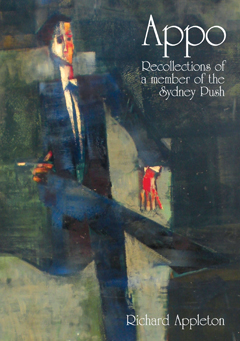
Appo book cover (Courtesy: Sydney University Press)

I wanted to start my review of Richard Appleton’s memoir, Appo: Recollections of a member of the Sydney Push, with a mention of its evocative cover, but I now see that my friend Lisa, at ANZLitLovers, has already done this, so I’ll start more boringly with definitions instead! According to Wikipedia, the Sydney Push was a left-wing intellectual group that operated in Sydney from the late 1940s to the early 1970s. On the back of the book, the Push is described as “our most original Bohemia”. What Appleton (1932-2005) describes in his memoir though is something rather less romantic, rather more earthy, than these descriptions connote. In fact, it seems that drinking and sex were about as important as protest and debate.

At the beginning of the book, Appleton lists what he sees as the strands of Sydney Libertarianism which defined the Push:

  • sexual liberty (as “a necessary precondition for political liberty”)
  • permanent protest (which Push member and academic Jim Baker describes as “the permanent struggle to keep alive libertarian values and interests”)
  • pluralism (which he describes as “the recognition of different and frequently conflicting interests, both within and between societies”)

I’m sure readers here know what Libertarianism is but, to make it simple, here is the neat definition from Wikipedia: “term for political theories that advocate the maximisation of individual liberty in thought and actionand the minimisation or abolition of the state.” This equates with Wikipedia’s description of the Push as being defined by “rejection of conventional morality and authoritarianism”.

At first glance the title raises the expectation that the book is about the Push but, when you look at the title carefully, what it actually says is that it is “the recollections” of  “a member of the Push”. That means, really, that it’s about him! And it is. There is a lot of Push in it, because clearly the Push and the relationships he formed within it, frame his life, but it is not a thorough history of the Push. He talks as much about his membership of the Communist Party of Australia and of the Australian Labor Party (ALP), his various forays into work in rural Australia, his poetry, and his work as an editor/encyclopaedist, as he does about the Push. And that’s fair enough, given the title!

Like most memoirs, it’s a pretty straightforward read. The style is chatty, with light attempts at humour that sometimes work, but  can sometimes be a little smart-alecky (“A new cycle of Push deaths had by then begun, and I had no wish to conform to that mortifying fashion”). He is (mostly) honest about his failings, which is something I like in a memoir. Structure-wise, the book is largely chronological, with the odd thematic tangent but he signposts these for us, such as this at the end of chapter 18: “While I was involved in politics I still had of course a professional and a private life. Both are dealt with, in that order, in the following chapters”.

It’s a frustrating book at times – partly because to preserve people’s privacy he is selective about what he does and doesn’t cover, and partly because there are many anecdotes (often drinking stories) in the book which seem to add little to our understanding of the Push or of him. Or perhaps that’s the point – and they do! Because the Push, as he describes it and I have no reason to argue with him, seems to be a very slippery beast. Also, presumably in the same attempt to maintain privacy, he drops hints that he doesn’t follow up. For example he refers a few times to his obsessive compulsive disorder, implying he was diagnosed late, but he never does really explain this. I found that a little mystifying, but perhaps it is this very “condition” which informs the way the book plays out.

All this aside, I did enjoy the book. It is at its most lively when he describes his several forays into rural Australia for work. His aim was to work and save money so he could return to Sydney and support his Push life of writing (poetry) and drinking. He worked hard at a wide range of jobs – destroying rabbit burrows and then catching rabbits was one such job – but for one reason or another, none of these jobs resulted in the benefits he desired. They made for some good stories though – and they provide insight into the times. I also enjoyed hearing about his life as an active member of the ALP (particularly the machinations of the factions that underpin that party) and about his experiences as an editor/encyclopaedist. He worked on The Australian Encyclopaedia, and was editor-in-chief of two editions. I would like to have heard more on this – it would, I’m sure, make a book in its own right. I also enjoyed the references to people in the Push, some of whom, just a generation older than I, have crossed my path (some in person, some by hearsay, and some through their writings). It’s interesting seeing them in (their often formative) context. The most well-known, to me anyhow, members include feminist/author Germaine Greer, author/commentator Clive James, artist John Olsen, writer Frank Moorhouse, poets Les Murray and Harry Hooton, and film producer Margaret (née Elliott) Fink.

Since Lisa started with the cover, I’ll end with it. It comprises a portrait of the author by David Perry (an Australian avant-garde filmmaker). It is shadowy, with just a few telling details; it teases us with the possibility of a bigger story. One could almost say the same of the book. It is what it is, a set of recollections, and as such provides a readable entrée to the world of the Push, but it is not, and does not pretend to be, the main course.

Richard Appleton
Appo: Recollections of a member of the Sydney Push
University of Sydney: Darlington Press, 2009
300pp.
ISBN: 9781921364099

(Review copy supplied by the Sydney University Press)

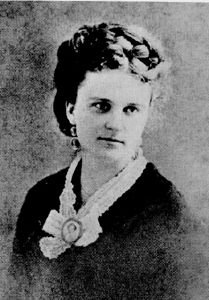
Kate Chopin, A respectable woman

Kate Chopin

Kate Chopin: What a lovely face (Public domain, via Wikipedia)

Besides Jane Austen’s works, there are only a few novels that I have read more than once. One of these is Kate Chopin’s The awakening. I was trying to think of an adjective to describe it or my feelings upon reading it, but couldn’t think of anything that wasn’t clichéd. The best way to convey my response is, in fact, the way I have – and that is to say that I’ve read it more than once!

Kate Chopin’s short story, “A respectable woman” (1894), is this week’s Library of America (LOA) offering – and you can read it here. I haven’t read and blogged all of the LOA stories that have lobbed in since I subscribed, but I have done so rather more than I originally expected. This is because they have confronted me with:

  • Authors I’ve never heard of, but who, by LOA’s brief introduction, have intrigued me;
  • Authors I’ve heard of but haven’t yet read, and so have taken the opportunity to be introduced; and
  • Authors I’ve read before and loved (or at least liked a lot!).

As you’ve already realised, Kate Chopin falls into this last category. I was stunned by Chopin when I first read her back in the early 1980s – and this was because I hadn’t before read a 19th century novel that was quite so honest about women’s experience. Thank you Virago!

Written in 1894, 5 years before The awakening was published, “A respectable woman” made me laugh. That’s not quite what I expected when I started it. After all, it is by the author of The awakening! “A respectable woman” has a simple plot. Mrs Baroda (we never learn her first name, she being the woman of the title!) and her husband have just come to the end of the of a busy entertaining period, and she is looking forward to “a period of broken unrest, and undisturbed tête-a-tête with her husband”, but it’s not to be. Her husband, Gaston, has invited his friend Gouvernail to stay…

This is a very short story – just 4 pages – but Chopin is well capable, through some well chosen words, of leading us along. The title for a start sets us up with a number of impressions and expectations that tease us as the story progresses. Will she, won’t she, is the question that follows us. The introductory description of Gouvernail subtly tells us as much about her (and her life with her husband) as about him:

He had been her husband’s college friend; was now a journalist, and in no way a “man about town”, which were, perhaps, some of the reasons she had never met him.

Clearly they are a well-to-do couple moving in other circles. They have a good though not perhaps a passionate relationship: “her husband – who was also her friend”. The story is 3rd person, and told from her point of view – and it explores her reactions to this rather taciturn, self-possessed man who, towards the end, admits that all he now seeks is “a little whiff of genuine life”. What she is learning about herself though is something different:

She wanted to draw close to him and whisper against his cheek – she did not care what – as she might have done if she had not been a respectable woman.

This story is not as iconoclastic as The awakening, but it moves in that direction with Chopin exploring the inner workings of women and their hearts in an honest and sympathetic way. The story plays ironically on the notion of respectability and what that means for women. As for whether she does or doesn’t, well, that’s for you to find out. My lips are sealed.

Jack London, War

What do I know about Jack London? Not much really, except that he wrote adventure stories like Call of the wild and White fang, and, intriguingly, a study of London slums, People of the abyss. So, when this week’s Library of America story was “War” (1911) by Jack London, I decided to read it. You can read it too, here.

“War” is an adventure story, of sorts. It is also, obviously, a war story. The plot is a simple one: a young man of 24 or so is out on a scouting mission:

…his task was to find what he feared to find. He must go on, and on, until somewhere, some time, he encountered another man, or other men, from the other side, scouting, as he was scouting, to make a report, of having come in touch.

I like the way London universalises his story by using no names. There are only two characters that count: “the young man with the quick black eyes”, our protagonist, and “the man with the ginger beard” , whom he meets along the way. It’s a short, short story and is told in two parts. In the first we are introduced to the young man and learn that

He was no coward, but his courage was only that of the average civilised man, and he was looking to live, not die.

In this part he comes across “the man with the ginger beard”. In part two, still on his scouting mission, he comes across what appears to be “a deserted farmhouse” where, after being tempted (not biblically, but the allusion is biblical nonetheless) by apples, he has his second encounter with “the man with the ginger beard”. I am being purposefully vague here as I do not want to give away what is a quick and worthwhile read.

The story is sparely told. The language is simple and evocative, with minimal use of adjectives, giving a sense of a world pared to the elementals:

It was high noon of a breathless day of heat.

and

Twice he essayed to start, and twice he paused. He was appalled by his own loneliness.

and

Another day, hot and breathless.

and

Again outside, he led the horse around the barn and invaded [my emphasis] the orchard.

This is a story about the irony and inhumanity of war. It is not a new story really but, due primarily to the tight way in which London engages our imagination and builds to the climax, it is shocking nonetheless. Clearly there’s more to Jack London than I thought!

Sawako Ariyoshi, The doctor’s wife

The doctor’s wife is the third Ariyoshi novel that I’ve read. The other two – The River Ki and The twilight years – I read well over a decade ago. According to Wikipedia The doctor’s wife is considered her best novel. All, though, are fascinating reads providing an insight into a culture which is so different from my own but in which, at the same time, people experience similar desires, pressures and emotions.

The twilight years is set in 1970s Japan and beautifully captures the cultural changes that were occurring around the time as Japan was (and still probably is) moving from  feudal/traditional parent child relationships to our more modern independent ways, with women caught in the middle. The River Ki chronicles three generations of women from the late 19th to mid 20th century, exploring changing attitudes and expectations of women. You are probably getting a picture here and you’d be right: Ariyoshi’s overriding theme concerns the role of women in Japanese society, both historically and in modern times. (Ariyoshi died in 1984.)

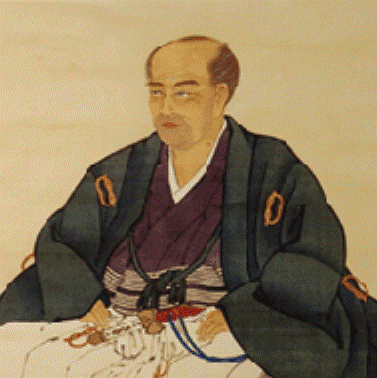
Hanaoka Seishu

Hanaoka Seishu (Public domain, via Wikipedia)

The doctor’s wife is an historical novel, spanning 70 years from around 1760 to 1830 and based on the life of famous Japanese doctor Hanaoka Seishu. A quick plot summary. The doctor’s wife is Kae, a young woman from a wealthy family, who is lured to become Seishu’s bride by his ambitious mother Otsugi, herself a woman married from a wealthy into a poorer family. The novel then chronicles Kae’s life in this extended family household as Seishu develops his medical skill and training until, near the end, he performs the world’s first surgery under anaesthetic (1804, breast cancer)*. While Seishu’s development as a doctor frames the novel, the real plot concerns the relationship between Kae and Otsugi.

The novel is told in third person, mostly the more objective omniscient voice, but occasionally we feel we are specifically in the heads of Kae or Otsugi. According to my edition’s introduction, Ariyoshi had access to Seishu’s personal records, diaries and books. However, being a man of his time and a doctor focused on his research, he did not, I assume, document much of his family life. The story, then, of the women is largely fictional. Mostly through dialogue, with description as needed, Ariyoshi describes how the loving supportive role Otsugi initially presented towards her daughter-in-law changes when her son (who had been married to Kae in absentia some three years before) returns home from his medical studies in Kyoto. Overnight, the relationship, to Kae’s shock and distress, changes into a competitive one – a competition that has serious consequences as they vie to be guinea pigs for his experiments in anaesthesia. Both women are presented as flawed, but as it is Kae who opens the novel and is the more powerless, it is with her that we are most keen to identify and empathise.

Why has Ariyoshi chosen to tell this story of conflict and competition within an historically based story of a great man? Does the historical “truth” add credibility to her exploration of familial power discrepancies? I’m not sure it’s necessary, but perhaps it helps … It is a very human tale – the grand gestures made by the women to support his research are small in the scheme of things though the impact on them, particularly on Kae, is immense. Ariyoshi realistically explores the nuances of their relationship through the normal day-to-day patterns of life (weaving, cooking, house management, childbirth) suggesting that this sort of conflict doesn’t have to be but that it often (traditionally, even) is. In fact, we readers are lulled into seeing it as the norm – the lot of women – until we are shocked out of that frame of mind near the end by Seishu’s unmarried sister who says (in broken speech because she is ill):

I think this sort of tension among females . . . is . . . to the advantage . . . of . . . every male.

She continues to explain her particular perspective on women’s secondary lot, and pronounces that:

as long as there are men and women side by side on this earth, I wouldn’t want to be reborn a woman into such a world.

Clearly, given the story Ariyoshi has told, she rather agrees  – or, at least, agrees for such societies as she depicts here in which women’s lot is not only an inferior one but which work to discourage them from cooperating and supporting each other. The novel may be set in Japan, but the fundamental truths, unfortunately, are not so confined.

What I have described here is the main story, but there’s more here that can be discussed, including the development (or history) of medicine in the east and west, the experimentation on animals and humans, and Japanese social life and customs in the Tokugawa period.

It’s a short but engrossing read. It falters a little I think right at the end when the historical facts are presented so prosaically that they threaten to overwhelm its novelistic achievements, but the last line fuses the two so beautifully that you forgive this.  The doctor’s wife is a fascinating and keenly observed novel that deserves to be read.

*Ironically, in 1811, novelist Fanny Burney underwent a horrific mastectomy without anaesthesia because it was unknown in the west!

Sawako Ariyoshi
The doctor’s wife
(trans. by Wakako Hironaka and Ann Silla Kostant)
Tokyo: Kodansha International, 1966 (orig ed), 1978 (trans)
174pp.
ISBN: 0870114654

Kevin Barry, Fjord of Killary

Sick and Indigent Roomkeepers' Society, London

A propos of nothing really, except it's Irish and makes me laugh ruefully like Barry's story

I hadn’t heard of Kevin Barry when his short story published in The New Yorker this month, “Fjord of Killary“, was brought to my attention. Kevin Barry is an Irish writer, born in Limerick in 1969, and this makes him 40 (or 41 this year). The first person narrator of the story is the same age, which rather suggests an autobiographical element, but … that’s for Barry to say! On turning 40, he (the narrator that is, a poet and a self-confessed “hopeless romantic”) did the sea-change thing, that is, he bought a pub on the west coast of Ireland and left his city life behind:

I had made – despite it all – a mild success of myself in life. But on turning forty, the previous year, I had sensed exhaustion rising up in me, like rot. Before forty, you think that exhaustion is something like a long-lasting hang-over. But at forty you learn all about it. Even your passions exhaust you. I found that to be alone with the work all day was increasingly difficult. And the city had become a jag on my nerves – there was too much young flesh around.

This is, it turns out, a mid-life crisis story. It takes place one night, in his pub. There is a storm raging outside and the waters from the fjord threatened to flood the pub … as indeed they do to the point that our narrator, with his customers and staff, retreat to the upper floor. Despite the reference to the cannibalistic black-backed gull eating its mate, this is not a gothic tale (of “the night was dark and stormy” ilk), or one of those tragic Irish sea stories. Rather it is a somewhat comic, somewhat satirical tale, about a publican whose sea-change doesn’t quite seem to be working.

The satire is conveyed in language which is both mock-heroic and melodramatic: the skies are “disgracefully gray “, the locals are prone to “magnificent mood swings”, and the downpour is “hysterical”. Our narrator self-deprecatingly equates himself with the many poets who have tried to escape to the countryside, the, as he describes it, “hypochondriacal epiphany-seeker”. He even manages a sly dig at the English occupation – yet another disaster the pub has had to withstand! There is straight-tending-to-the-absurd humour too. If you have ever spent a few hours in an Irish pub on a rainy, rainy day, as Mr Gums and I did in Avoca three decades ago (can it really be so?), Barry’s description of the drinkers and their ability to keep talking regardless of what’s going on around them or who is listening will ring true! As our narrator says of his customers:

They were all nut jobs. This is what it comes down to. This is the thing you learn about habitual country drinkers. They suffer all manner of delusions, paranoia and warped fantasies…

And he doesn’t? The joke in many ways is on him, because while these people are getting on with their odd, messy, unique lives, he is floundering.

This is a wonderfully Irish story in its wry and sly but also rather absurd take on life.  As for the ending? Well, I won’t give that away, except to say that, with my little blue pen, I wrote against the last line, “Love it!”. Read it here, and see what you think.

Sarah Waters, The little stranger

The little stranger, by Sarah Waters

The little stranger (Book cover courtesy: Virago Press)

I’m not quite sure I know where to start with this one –  the ghost story that isn’t. Or is it? The little stranger is my second Sarah Waters’ novel. I found The night watch riveting, and I did see and enjoy (but not read) her very Dickensian Fingersmith.

Like The night watch, The little stranger was shortlisted for The Man Booker Prize. It’s an easy read, and rather a page-turner, but by the end I have to say that I felt a little unsure about what I’d read. In one of those interesting bits of reading synchronicity, I recently read Helen Simonson’s Major Pettigrew’s last stand. It is very different to this one, and is set a few decades later, but they both deal with the loss of “old families” and the breaking up of their estates. Waters, though, is the far superior writer.

So, what is the plot of The little stranger? Its first person narrator, Dr Faraday, was born to the working class but, through family sacrifice, has pulled himself up into the professional middle class. After a brief flashback to a childhood memory of Hundreds Hall, where his mother had worked as a housemaid, he proceeds to chronicle the relationship he develops with the Hall’s family when he is in his late 30s and practising in the nearby town as a GP. The family comprises the mother, Mrs Ayres, and her adult children, Caroline and Roderick. The book is set soon after World War 2, and the story he tells occurs over the period of about a year, but is told from the vantage point of some three years later.

Waters is best in her vivid description of the house, its inhabitants and its increasing dilapidation. I’m tempted to read the house as a metaphor for the society it represents – for the days of elegance and upstairs-downstairs that are now on the way out.  And, extending this idea, “the little stranger” (or “dark germ”) that seems hell-bent on bringing about the house’s destruction could then be seen as a metaphor for the rapid modernisation that was occurring in post-war England and that was pushing the old families to the brink of economic and, thereby, social ruin. After all, servant Mrs Bazeley reassures the young servant girl Betty that “it” is not interested in them.

To support this way of looking at the novel, here is Dr Faraday early-ish in the novel:

But Hundreds Hall had been made and maintained, I thought, by the very people they were laughing at now. After two hundred years, those people had begun to withdraw their labour, their belief in the house; and the house was collapsing, like a pyramid of cards. Meanwhile, here the family sat, still playing gaily at gentry life, with chipped stucco on their walls, and their Turkish carpets worn to the weave…

And here is Dr Seeley (to whom he later goes for advice):

The Ayreses’ problem … is that they can’t or won’t adapt … Class-wise they’ve had their chips. Nerve-wise, perhaps they’ve run their course.

Quotes like these support a social change interpretation. And yet, perhaps it is more psychological? Dr Seeley suggests that part of one’s psychology, one’s dream-self , can break loose and become some sort of “psychic force”:

The subliminal mind has many dark, unhappy corners, after all. Imagine something loosening itself from one of those corners. Let’s call it a – a germ. And let’s say conditions prove right for that germ to develop – to grow … What would this little stranger grow into? A sort of shadow-self, perhaps a Caliban, a Mr Hyde. A creature motivated by all the nasty impulses and hungers the conscious mind had hoped to keep hidden away: things like envy, and malice and frustration…

Somewhat supporting this interpretation is Caroline’s report of her mother as saying:

the house knows all our weaknesses, and is testing them one by one.

And so what do you think? Psychological/psychic or social? Or perhaps bit of both? That is, the arrogant upper class family out of touch and unable to adapt (social) releasing all its weaknesses (psychic). I’m not sure that Waters makes the case clearly enough – partly I think due to the ambiguity posed by the narrator.

Her characterisation is in fact coherent and convincing, except for the narrator. How are we to read him? Is he genuine – does he really care for the family? Does he genuinely care for the house and its history? Or, is he a social climber who wants his way into the house any way he can. I must say I couldn’t fully work him out. Is he reliable? The tone is quite reminiscent of that in Ishiguro’s wonderful Remains of the day. Like Ishiguro’s butler, Dr Faraday tells the story from some time after the events, and he peppers his account with such words as “recall”, “I think I noticed”, “must have”, words that suggest that all may not be as he sees it. And in some ways it isn’t, but there is no intriguing twist, neither is there a traditional resolution. As I read I wondered whether he was stringing me along, whether he was the cause of the malevolence. He did after all chip away a decorative acorn from the house on his youthful visit:

I was  like a man, I suppose, wanting a lock of hair from the head of a girl he had suddenly and blindingly become enamoured of.

If he was the malevolence, there is no evidence to suggest it is anything other than unconscious. And further, if he was, it certainly makes the whole class divide story more complex – and, more interesting.

Regardless, though, of how the end comes about, of “who” (one? many? none?) is responsible, it is pretty clear that the winners – if there can be such things in the messy game of life – are the old underclass. Hundreds was, in Dr Seeley’s view, “defeated by history, destroyed by its own failure to keep pace with a rapidly changing world”. It is not surprising, I suppose, that by the end the narrator is both “baffled and longing”.  Social change never has been easy!

Sarah Waters
The little stranger
London: Virago, 2009
450pp.
ISBN: 9781844086023

Jorge Amado, Gabriela, clove and cinnamon

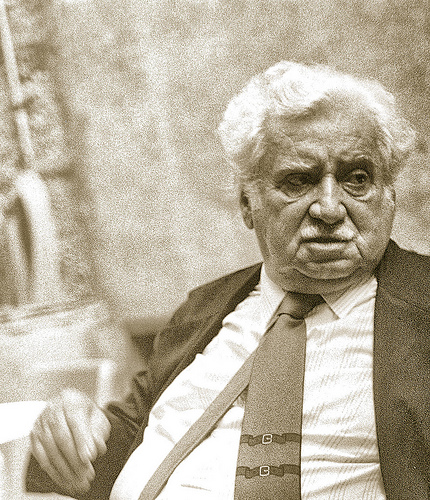
Jorge Amado

Jorge Amado, 1985 (Courtesy: Xan Carballa, via flickr, using CC-BY-NC-2.0)

How could you resist reading a book with a title like this? I don’t manage to read all the books scheduled for the various bookgroups I belong to, but when this one came up I decided it was a must – because it was by a non-Anglo writer and one I hadn’t read before, and because of its gorgeously evocative title. I wasn’t disappointed. This is fun and rather easy to read, but that doesn’t mean it’s simple.

Jorge Amado is a Brazilian writer, and Gabriela, clove and cinnamon (1958) is set in Ilhéus, a coastal city where he spent his childhood. The novel takes place in 1925 – during a time of great social change:

New streets had been opened, automobiles brought in, mansions built, roads constructed, newspapers published, clubs organised – Ilhéus was transformed. But the ways men think and feel evolve more slowly. Thus it has always been in every society. (p. 2)

The basic plot concerns Nacib (the Arab) and his love for Gabriela (the simple, but sensuous, mulatto girl he hires as his cook). But the book’s subject matter is far wider, dealing with politics and society at a time when “old ways” were being challenged by “new ways”. The “old ways” are typified by macho violence, by the notion, really, that “might is right”. Violence is used by the old leaders (mostly the “colonels”) to attain and maintain political power – and to maintain possession of women. It was accepted practice, for example, for a man to kill an adulterous wife and her lover. In fact, the novel starts with such a murder and then a little later we hear of another man being reviled for not doing so, even though his way of handling it had a delicious come-uppance about it. Ilhéus is, we are told, changing but not yet civilised; it still clings to its old and violent customs; it is

so feudal still despite its much publicised and undeniable progress.

While men hold the power, the novel is structured around women. There are four chapters, each commencing with a poem about a woman:

  • The languor of Ofenísia (who would rather die a virgin if she can’t have the Emperor)
  • The loneliness of Gloria (the mistress of a wealthy man, who has everything but what she wants)
  • The secret of Malvina (the young student who will not be controlled by a man)
  • The moonlight of Gabriela (the free spirit who should not be changed)

The first, Ofenísia, does not really appear as an active character in the book (though we are told that her “importance must not be judged by the brevity of her appearance”). The other three though manage to achieve what they want…and in doing so they epitomise the conflict between the “old ways” and the “new”, between maintaining the “status quo” (with its attendant double standard) and accepting change.

The book is peopled with a wonderful array of characters. I found it hard at the start to keep track of all the characters – particularly the many Colonels – but eventually I did, and realised that they fall into two main camps: those tied to the “old ways” and those supporting change. Colonel Ramiro Bastos is the leader of the former, and new arrival Mundinho Falcâo is a proponent of new ways of doing things, such as through negotiation. This conflict is represented literally and symbolically by the sandbar. It prevents the town being used as a port for the new cacao industry and Falcâo promises to dredge it. The scene is set for a big showdown as the various citizens of the town align themselves with one side or another, but the resolution is not as simple and dramatic as we expect. And this is partly what makes this a novel well worth reading. Change is presented as generally good, but it is not “simply” or even always so. Amado conveys this subtly. The characters are complex and through their very realistic interactions and sometimes contradictory behaviours we see that old versus new is not a simple dichotomy. Gabriela, for example, cannot be changed to fit Nacib’s image of a wealthy man’s wife: she is a free spirit who doesn’t quite represent the old or the new. She just is. And symbolically, the sandbar will not stay dredged and will need regular clearing. It is not a simple answer to continued progress for Ilhéus. Nonethess, by the end, some level of civilisation is achieved. At the trial of the husband who’d murdered his adulterous wife and her lover at the beginning of the book, the lawyer Dr Ezequiel Prado is reported as saying:

Ilhéus was no longer a land of bandits, a paradise of assassins; his theme was civilization and progress.

It is interesting to think that this book was published around the same time as Patrick White’s Tree of man (1955) and Voss (1957). Amado and White are both described as modernists, but how different they are. White is psychologically intense, while Amado here is full of humour, colour and movement, reflecting the messiness of society. Modernism, though, is a forgiving church as Lisa (ANZLitLovers) shows in her post on the subject.

There is so much to write about this book. Its humour and satire, the complex characterisation, the clever way the double murder introduced at the beginning is woven as a motif through the book, and the breadth of its subject-matter are just a few of the the topics that could be explored in depth.

I’ll leave those for others though and come back to a favourite aspect for me which is its thorough analysis of the way the desire for progress clashes with the status quo. I’ll end with statements made by two of the town’s old guard. First, the Colonel who sees that change is coming:

That’s right Colonel. Everything you’ve said is right as far as it goes. But it’s right by the conditions and needs of an earlier time. We spend our lives working hard, and we don’t realise that time is going by and that things are changing…

Then, the Colonel who doesn’t see it:

What does Ilhéus want beyond what we’re giving it? What more is there to do? To tell the truth I don’t see these new needs.

It was ever thus eh?

Jorge Amado
Gabriela, clove and cinnamon
(trans. by James L. Taylor and William L. Grossman)
New York: Vintage International, 1958 (1992)
426pp.
ISBN: 9780307276650